Mo, 5.10.2026 | Original article from: Appl. Food Res. 2026, 102021, Volume 6, Issue 1
ICP-MS/MS profiling of 13 elements with machine learning enables reliable wine origin classification, with random forest achieving over 90% accuracy.Analysis of wines elemental composition using ICP-MS/MS and artificial intelligence for classification from different origins
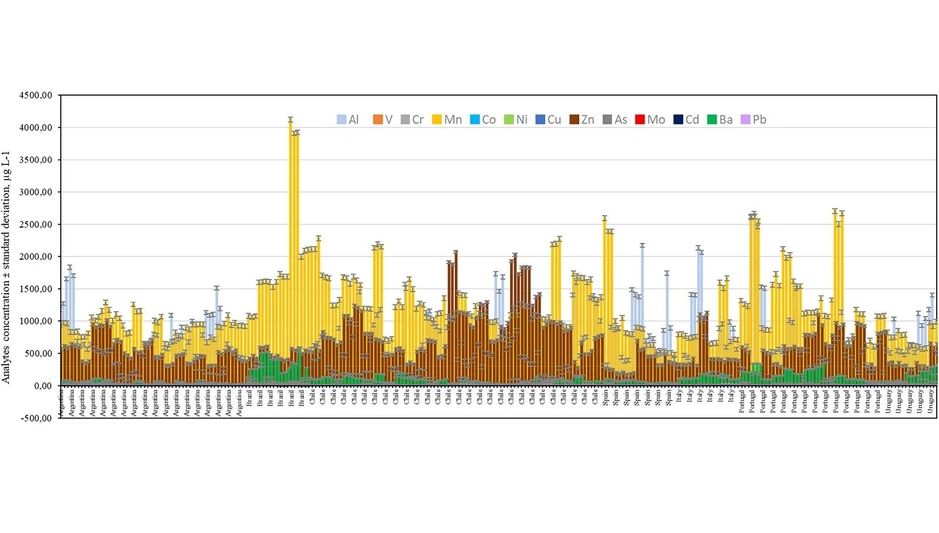
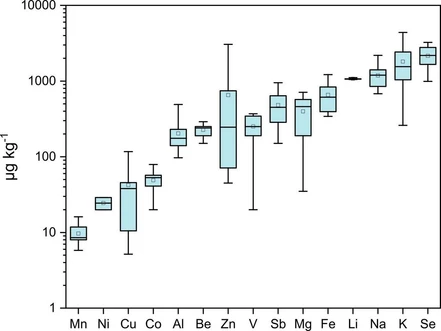
Appl. Food Res. 2026, 102021, Volume 6, Issue 1: Fig. 1. Trace mineral profile in wine samples.
This study combines ICP-MS/MS multi-element analysis with machine learning to classify 290 commercial wines from seven countries according to geographic origin. Thirteen elements were quantified, while PCA and robust PCA showed limited ability to separate samples, highlighting the need for supervised classification methods.
Among support vector machine, random forest, k-nearest neighbors, and gradient boosting, random forest achieved the best performance, with classification accuracy and kappa values above 0.90. Barium was the most important discriminating element, followed by cobalt, molybdenum, and nickel, demonstrating the potential of elemental fingerprinting and artificial intelligence for wine authentication and traceability.
The original article
Analysis of wines elemental composition using ICP-MS/MS and artificial intelligence for classification from different origins
Clara T.N. Lima, Marcos Levi C.M. dos Reis, Jaqueline S. Jesus, Jefferson S. Santos, Sarah A.R. Soares, Kalil L.A. Ferreira, Bruno N. Paulino, Fabio de S. Dias, Maria E.O. Mamede
Appl. Food Res. 2026, 102021, Volume 6, Issue 1
licensed under CC-BY 4.0
Selected sections from the article follow. Formats and hyperlinks were adapted from the original.
Wine is one of the most widely consumed beverages in the world, with a global production of 244 million hectoliters recorded in 2023, according to the Office International de la Vigne et du Vin (OIV) (OIV, 2023). The unique characteristics of wines are strongly influenced by the geographical, cultural, economic, political, and technological attributes of each wine-producing region (Van Leeuwen & Darriet, 2016; Fandl, 2018; Chauvin et al., 2024). These factors contribute to the sensory and chemical complexity that define wine quality and identity.
From a chemical standpoint, wine is a multifaceted matrix comprising various inorganic and organic components. These include inorganic ions such as potassium, sodium, and calcium, as well as organic compounds such as organic acids, polyphenols, polyhydroxy alcohols, proteins, amino acids, and polysaccharides (Jackson, 2008). The determination of these compounds in wine is important for wine quality control (Pohl, 2007). Whereas metals present in wine may originate from natural sources, such as atmospheric deposition or uptake by vine roots, or from anthropogenic contamination during the winemaking process. Excessive levels of certain metals can negatively affect wine quality through precipitation and oxidation reactions (Chen et al., 2024; Ebeler, 2001).
Beyond their impact on chemical stability, metals such as copper, aluminum, iron, and zinc are known to influence turbidity and taste, contributing to the sensory profile of the wine (Riganakos & Veltsistas, 2003; Chen et al., 2024). Additionally, the mineral content of wine can serve as both a nutritional indicator and a marker of geographic origin (Płotka-Wasylka et al., 2018; Fountain et al., 2021). The mineral content of wine comes almost exclusively from the soil of the region where the grape variety is grown, which will give rise to wines with characteristics linked to certain regions (Su et al., 2025). According to Galgano et al. (2008), elemental analysis together with Canonical Variate Analysis (CVA) offers a good perspective for discriminating wines by region, even though the elemental composition depends little on the year of wine production. Martin et al. (2012) discriminated white and red wines based on elemental composition using a large number of Australian wine samples using Linear Discriminant Analysis (LDA) but found it difficult to discriminate when the regions were close together. More recently, Blotevogel et al. (2019) concluded that soil composition is one of the most influential factors in discriminating against wines from different regions of Western Europe. Notably, trace elements such as arsenic, cadmium, barium, molybdenum, cobalt and lead, though potentially harmful, may provide valuable insights for authenticity verification (Blotevogel et al., 2019). Because the mineral composition is closely tied to the terroir, it directly affects the wine’s market value, sensory characteristics and consumer perception (Jackson, 2008; Maitre et al., 2010; Coelho et al., 2025). Research has demonstrated that the origin of a wine can significantly affects perceived quality and purchasing decisions, often having a cognitive effect on consumer expectations (Chauvin et al., 2024; Suárez et al., 2023).
Advanced analytical techniques are essential for quantifying trace metals in wine. Plasma-based spectrometric methods such as inductively coupled plasma optical emission spectrometry (ICP-OES) (Granell et al., 2022) and inductively coupled plasma mass spectrometry (ICP-MS) (Chen et al., 2024) offer sensitive, robust, and multielemental capabilities for trace element determination (Brenner, 2017; Douvris et al., 2023). In addition to elemental quantification, chemometric tools have emerged as powerful strategies for data interpretation and sample classification. Pattern recognition techniques allow the classification of samples into predefined groups based on their measured variables (Carneiro et al., 2023; Varmuza, 1980). Supervised classification methods, in particular, are effective when sample classes are known. These models are built from labeled training data and can transfer learned patterns to new datasets, thereby improving generalization performance, even with small sample sizes (Massart & Kaufman, 1983; Selih et al., 2014; Sharma & Paliwal, 2015; Zhao et al., 2024).
Finally, Pohl (2007) suggests that metals are excellent indicators of the origin of wine and can be used as criteria to guarantee authenticity, since they are not metabolized or modified during winemaking and reflect the average composition of vineyard soils. Thus, a study reported by Pérez-Álvarez et al. (2019) demonstrated that mineral analysis using ICP-MS is a powerful tool for applied wine research, enabling the differentiation of wines based on a range of viticultural and oenological factors. The elemental composition of wines, particularly concentrations of Sr, Ca, Mg, Mn, Ba, Ni, Cu, Cs, Pb, Na, and Zn, allowed accurate classification according to grape variety, geographical origin, soil type, foliar nitrogen application, sulfur dioxide use, and oak ageing. Discriminant analysis achieved high classification accuracy, confirming the relevance of mineral profiling for wine authentication and quality assessment.
In this context, the present study aimed to determinate simultaneously trace elements in wine samples using ICP-MS/MS. Furthermore, an exploratory data analysis was performed using supervised learning methods such as Supervised machine learning techniques such as support vector machine with radial basis function kernel (SVM-RBF), random forest (RF), knearest neighbors (k-NN), and gradient boosting machine (GBM). These methods were systematically compared to evaluate their effectiveness to assess the mineral profiles of wines from diverse regions, in order to accurately classify them based on their elemental signatures.
2. Materials and methods
2.1. Instrumentation
The analytes determination was performed using an inductively coupled plasma mass spectrometer (ICP-MS/MS, Agilent 8800 Triple Quadrupole, USA) equipped with a Micromist nebulizer. The stable isotopes of 27Al, 51V, 52Cr, 55Mn, 59Co, 60Ni, 63Cu, 66Zn, 75As, 95Mo, 111Cd, 137Ba and 208Pb were determined. For all analytes, the collision/reaction cell was used in He mode. The operational conditions used are described in Table S1. For sample preparation, a microwave system (Mars 6, CEM) was used with 55 mL PTFE tubes.
3. Results and discussion
3.1. Descriptive statistical
The trace mineral profile of the 290 wine samples can be seen in Fig. 1, and a large variation in element concentrations is observed between countries. The prevalence of manganese, zinc, aluminum, and barium is prominent in the samples. However, it is not possible to distinguish the origin of the samples based on their mineral profile, since trace elements, which have a subtle influence on the discrimination of samples, cannot be observed or considered through the illustration.
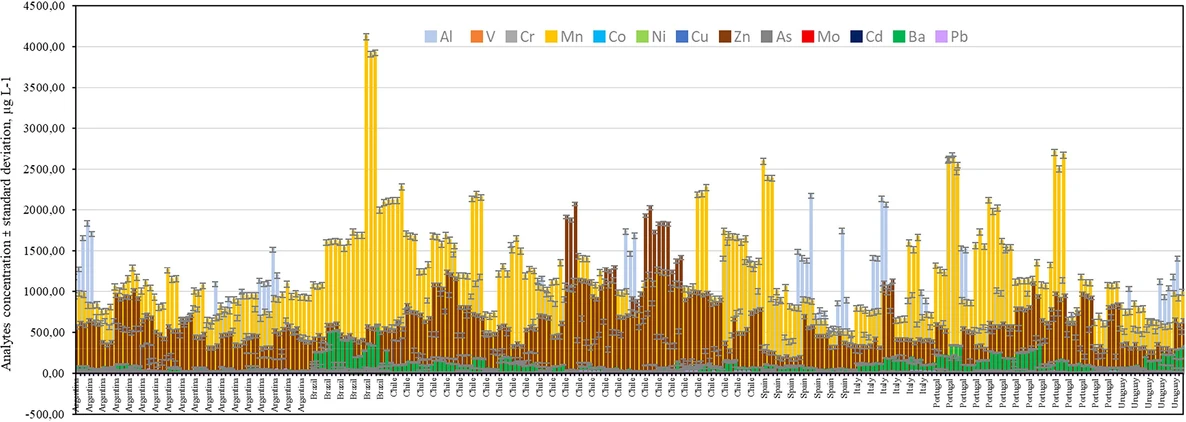 Appl. Food Res. 2026, 102021, Volume 6, Issue 1: Fig. 1. Trace mineral profile in wine samples.
The results of the determination of Al, V, Cr, Mn, Co, Ni, Cu, Zn, As, Mo, Cd, Ba, Pb in wine samples are demonstrated in Table S2 and ranged from 91 to 1014, below the limit of quantification to 77, below the limit of quantification to 743, 2 to 1517, below the limit of quantification to 2078, 7 to19, 15 to 156, 46 to 1047, below the limit of quantification to 495, 2 to 20, below the limit of quantification to 16, below the limit of quantification to 256, and below the limit of quantification to 19 µg l-1, respectively. These results are consistent with the concentration ranges found for the analytes in previous studies that analyzed wine samples (Carneiro et al., 2023; Mladenova, Bakardzhiyski & Dimitrova, 2024; Jakkielska et al., 2023).
From the results obtained and reported, it possible to notice the elemental profile of wine is fundamentally determined by its geographical and botanical origins. Trace mineral concentrations are governed primarily by the vineyard's soil (terroir) and the specific grape variety cultivated. Furthermore, this chemical signature is modulated by environmental conditions, viticultural practices, and oenological processes, ultimately creating a unique multielemental fingerprint that allows for precise geographical differentiation.
3.3. Preprocessing and unsupervised classification analysis
Data preprocessing minimizes differences in magnitude and variability among attributes by standardizing them. This process renders the variables dimensionless, with values expressed in comparable units and retaining meaningful interpretations (Fan et al., 2021). The scale method was used to transform each variable by subtracting its meaning and dividing by its standard deviation, based on the dataset’s overall distribution. As a result, the data are normalized, facilitating more accurate and unbiased analysis (Andrade et al., 2022).
As an unsupervised data analysis tool, Principal Component Analysis (PCA) was evaluated. This methodology reduces dimensionality of the dataset through linear combinations of the original independent variables, grouping the samples according to their similarities PCA was applied to the dataset separated into seven categories of different wines origin. The first principal component (PC1) and the second principal component (PC2) represented 23.1% and 17.2% of the total variance, respectively. The PC1 x PC2 plot can be seen in supplementary material. To capture a greater proportion of the total variance, a three-dimensional plot using PC1, PC2, and PC3 was constructed (Fig. 2 and Figure S7). The resulting plot revealed no significant clustering of wine samples according to their respective categories, with samples from different origins appearing interspersed within a single group. This outcome is consistent with the descriptive statistical analysis, which indicated skewed data distributions, high kurtosis values, and predominantly non-linear behavior among the variables, deviating from a normal distribution.
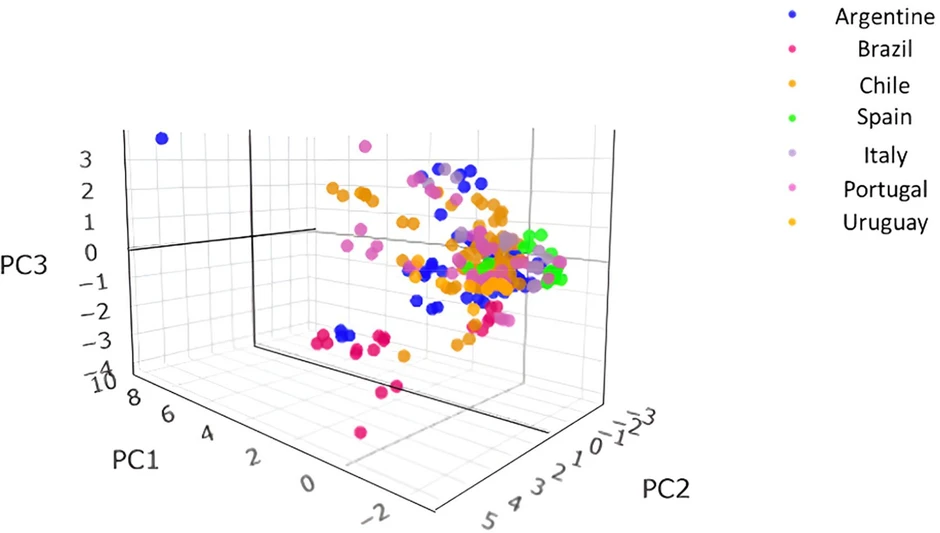 Appl. Food Res. 2026, 102021, Volume 6, Issue 1: Fig. 2. PC1 x PC2 x PC3 plot for mulielement determination by ICP-MS/MS in wine samples from different origins.
Given the limitations of the conventional PCA approach, particularly its sensitivity to anomalous observations (outliers), which can compromise the reliability of the results, a Robust PCA analysis was conducted. This method seeks to extract principal components that are less affected by outliers (Hubert et al., 2005). The robust PCA plot (Fig. 3) similarly showed no distinct grouping of samples by category.
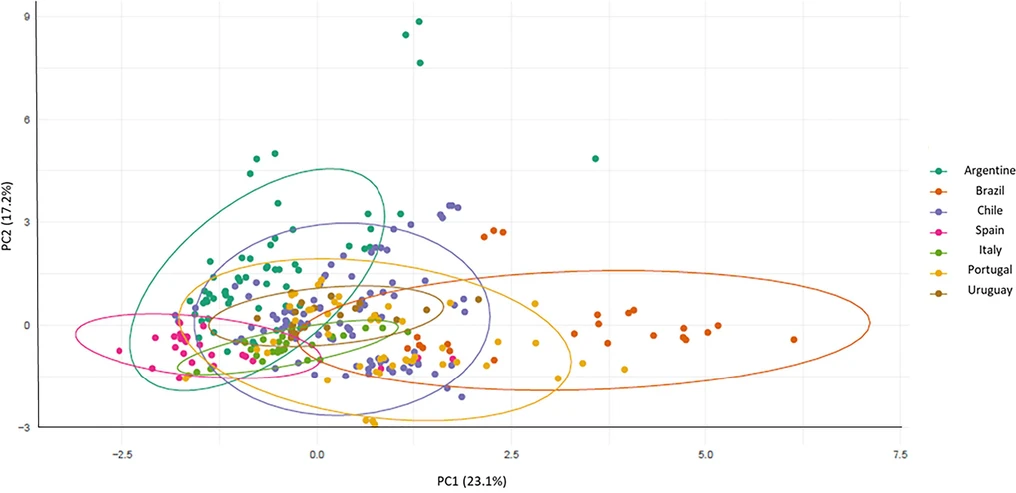 Appl. Food Res. 2026, 102021, Volume 6, Issue 1: Fig. 3. Robust PC1 x PC2 plot for mulielement determination by ICP-MS/MS in wine samples from different origins.
The partial overlap observed in the PCA and robust PCA plots, may reflect underlying regional proximity, similarities in soil composition, climate, or shared enological practices, which can lead to comparable elemental profiles in wines. However, this outcome represents a limitation of PCA and robust PCA themselves, rather than simply a reflection of real-world similarity. Both approaches are unsupervised, linear, dimensionality reduction methods that do not use class labels during decomposition and is therefore limited in its ability to resolve subtle but systematic group differences, particularly when class separation relies on nonlinear combinations of variables. This limitation reinforces the conclusion that linear dimensionality reduction techniques are inadequate for classifying this dataset.
With no efficient clustering of the samples according to their origin, both the PCA and Robust PCA are not adequate for this dataset. Thus, non-parametric, decision tree-based machine learning algorithms were employed for supervised classification analysis.
4. Conclusion
The combination of ICP-MS/MS determination with supervised machine learning enabled efficient classification of wines from different origins based on their elemental composition. While ANOVA indicated significant differences in the concentrations of the 13 elements across the samples, these variations alone were insufficient to group them definitively. Furthermore, the application of unsupervised chemometric tools, such as PCA, proved inefficient for classifying the dataset, clustering the samples into a single overlapping group. Consequently, several supervised machine learning classification methods, SVM, GBM, k-NN and RF were evaluated. Among these, RF demonstrated vastly superior predictive performance, achieving the highest average accuracy (0.925) and kappa coefficient (0.907), representing a highly effective agreement in classifying the samples according to their respective countries of origin.
Feature importance analysis further elucidated the model's decision-making process. According to the Mean Decrease in Gini Index, Ba showed the greatest importance, followed by Co, Mo, Ni, As, and Mn. Similarly, the SHAP interpretation established Ba as the most prevalent variable, followed by Ni, As, and Mn. Both approaches consistently highlighted Ba as the most critical mineral element for discriminating wine samples by geographic origin. Although As and Mn were also identified as important variables, their distribution among the samples was more uniform compared to Ba, suggesting they play a broader, less decisive role in classification.
The successful application of nonparametric machine learning algorithms like Random Forest relies on its ability to capture complex multivariate interactions and consider elements in low concentrations, such as cobalt, highlighting the versatility of advanced chemometric analysis in origin-based classification. Therefore, the RF method presents a highly efficient strategy for discriminating wines based on their elemental fingerprint. This expands the possibilities for ensuring the authenticity and traceability of wine products across different geographic regions, serving as a robust chemometric alternative for determining terroir in areas lacking formal geographical indications.