Mo, 2.11.2026 | Original article from: ACS Meas. Sci. Au (2026) 6 (5): 1537–1548.
SICRIT-cIMS-HRMS enables sensitive aldehyde screening in exhaled breath, revealing matrix-dependent ionization and identifying protonated ions as robust targets.Rapid Screening of Aldehydes by SICRIT-HRMS: Understanding Ionization Behavior in Breath Analysis
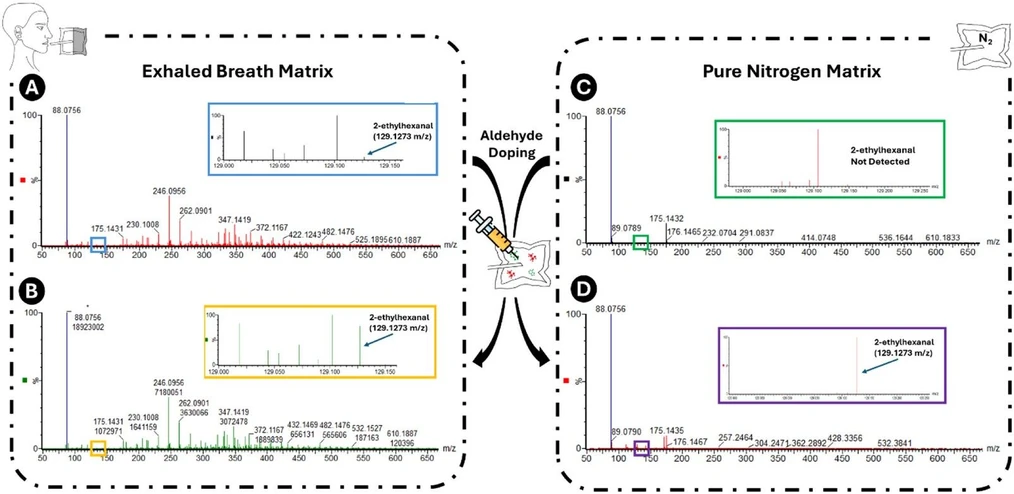
ACS Meas. Sci. Au (2026) 6 (5): 1537–1548: Figure 2. Comparative SICRIT-cIMS-HRMS mass spectra of 2-ethylhexanal in exhaled breath and nitrogen matrices.
This study evaluates SICRIT coupled with cyclic ion mobility high-resolution mass spectrometry for direct detection of 16 clinically relevant volatile aldehydes in exhaled breath. Controlled spiking experiments revealed strong matrix-dependent ionization, with protonated, dehydrated, and oxidation-derived species observed and detection limits ranging from 1.33 to 25.13 ppbv.
Protonated [M+H]⁺ ions showed the best long-term reproducibility and were identified as preferred targets for biomarker monitoring. Cyclic ion mobility provided some discrimination of aldehyde isomers and chemical interferences, although with substantial sensitivity loss. The results establish key analytical parameters for future SICRIT-HRMS breath analysis and respiratory biomarker applications.
The original article
Rapid Screening of Aldehydes by SICRIT-HRMS: Understanding Ionization Behavior in Breath Analysis
Thibault Massenet ∥; Shahd Abuhelal ∥; Leila Rastegar ∥; Amar Rai; Sopika Toumazi; Jean-François Focant; Zoltan Takats; Salman Siddiqui *∥; Pierre-Hugues Stefanuto*
ACS Meas. Sci. Au (2026) 6 (5): 1537–1548.
https://doi.org/10.1021/acsmeasuresciau.6c00102
licensed under CC-BY 4.0
Selected sections from the article follow. Formats and hyperlinks were adapted from the original.
Breathomics, the comprehensive analysis of volatile organic compounds (VOCs) in exhaled breath, has emerged as a powerful approach for noninvasive disease monitoring and metabolomic profiling. (1) Human breath contains over 1000 VOCs originating from endogenous metabolic processes, airway microbiota, the environmental exposome, and dietary intake, providing a potentially rich diagnostic window into physiological and pathological states. (2) Currently gold standard methods for exhaled breath analysis rely on gas chromatography (GC), particularly comprehensive two-dimensional gas chromatography coupled to mass spectrometry (GC × GC-MS). (3) While offering great sensitivity and accurate compound identification, these approaches require sample preconcentration, extended analysis times (typically 30–60 min per sample), and specialized expertise for data handling, limiting throughput and clinical applicability for routine analysis. (4) Consequently, there is an urgent need for direct MS approaches or dedicated sensors enabling real-time breath analysis for rapid clinical decision making and point-of-care applications.
Moving forward toward direct analysis, soft ionization techniques coupled to mass spectrometry have been progressively developed for direct breath analysis. Proton transfer reaction MS (PTR-MS) and selected ion flow tube MS (SIFT-MS) employ controlled chemical ionization mechanisms, enabling real-time monitoring with reduced fragmentation and quantification capabilities based on known reaction kinetics. (5) However, these techniques face inherent limitations: their selective ionization pathways restrict compound coverage, and the predominant detection of protonated molecular ions [M+H]+ or related adducts, in particular for PTR-MS, provides limited structural information for confident compound identification. (6) This makes PTR-MS and SIFT-MS less practicable for comprehensive untargeted metabolic profiling, where unknown compound characterization is essential. (7) Nevertheless, both techniques remain highly valuable for targeted breath analysis, offering excellent sensitivity, reproducibility and the ability to perform absolute quantification of compounds with established reaction kinetics. SIFT-MS further benefits from the use of multiple reagent ions, whereas PTR-MS generally achieves higher sensitivity and can be coupled to time-of-flight analyzers for full high resolution spectrum acquisition.
In parallel, significant advances have been made in ambient soft ionization sources. Unlike SIFT-MS and PTR-MS, these sources can be interfaced with a wide range of commercial MS platforms, offering greater methodological versatility. In addition to traditional electrospray ionization (ESI) and atmospheric pressure chemical ionization (APCI), a variety of new ambient ionization techniques have emerged in the past two decades (8) with a particular use of secondary electrospray ionization (SESI) in breathomics. (9, 10) More recently, plasma-based ionization approaches such as dielectric barrier discharge ionization (DBDI) have attracted increasing interest owing to their broad chemical coverage and ability to generate richer ion patterns through multiple concurrent ionization mechanisms. (11) While these approaches do not yet provide the same straightforward quantitative capabilities as PTR-MS or SIFT-MS and may be more susceptible to matrix effects, they offer enhanced potential for untargeted breath profiling and the characterization of chemically diverse volatile metabolites.
Among the plasma-based methods, DBDI and more specifically the SICRIT (Soft Ionization by Chemical Reaction in Transfer) source, a commercially available DBDI variant, has garnered increasing attention for direct analysis of volatile compounds. (12) Operating at atmospheric pressure with only an electrical power supply required, the SICRIT source offers a straightforward plug-and-play solution for gas-phase analysis. The plasma discharge generates a diverse array of metastable electronically excited atoms and reagent ions which react with the analyte molecules by a variety of mechanisms (Penning ionization, electron transfer, proton transfer and ligand switching in the positive mode). (13) This multimechanism ionization enables the detection of compounds spanning a broader polarity range compared to SESI, (14−16) including small aldehydes. (11) Importantly, the less selective ionization profile of SICRIT is particularly advantageous for untargeted characterization of complex biological matrices such as exhaled breath, where comprehensive chemical coverage is desired. Recent applications have demonstrated the versatility of the SICRIT source across diverse analytical domains, including mass spectrometry imaging, (17, 18) environmental contaminant detection, (19) explosives analysis, (20) food authentication, (21) and microbial volatilome profiling. (22) However, despite these promising developments, the application of SICRIT technology remains limited for online exhaled breath analysis (23, 24) and requires more in-depth work to establish robust methodologies.
Among the complex panel of VOCs in exhaled breath, aldehydes represent a particularly critical class of biomarkers due to their direct association with oxidative stress, lipid peroxidation, and metabolic dysfunction. (25−27) Recent studies have linked specific aldehydes to various pathological conditions including asthma, (28, 29) cardiovascular diseases, (30) and cancer. (31) Despite this clinical relevance, volatile aldehydes pose significant analytical challenges that have hindered their reliable detection and quantification in breath matrices. Their high chemical reactivity with sampling materials, notably, leads to sample modification during collection and storage. (32) Furthermore, aldehydes occur at trace concentrations in healthy human breath at subppbv range (33−35) and (low-)ppbv range for patients with pulmonary disease, (36) requiring sensitive methods. The structural similarity among homologous aldehydes further complicates their accurate discrimination and quantification. Besides these challenges, aldehydes are chemically unstable compounds with inherent volatility and polarity, and these properties make rapid or online analysis essential for obtaining accurate results in biological matrices. (37) Overcoming these analytical barriers would enable online noninvasive monitoring of respiratory inflammation and oxidative stress markers, opening new avenues for early diagnosis, disease progression monitoring, and personalized therapeutic interventions.
In this context, the present study provides a proof-of-concept evaluation of SICRIT ionization coupled with high-resolution cyclic ion mobility mass spectrometry (SICRIT-cIMS-HRMS) for exhaled breath aldehyde analysis. Specifically, we: (1) developed a direct sampling methodology compatible with offline breath analysis, (2) systematically characterized the ionization behavior and adduct formation of 16 clinically relevant aldehydes in authentic breath matrices, (3) assessed instrumental sensitivity and reproducibility through controlled spiking experiments, (4) the effect of matrix on adduct formation and ionization was investigated and (5) evaluated the feasibility of cyclic ion mobility separation for volatile aldehyde isomer differentiation. This work establishes fundamental understanding of SICRIT ionization mechanisms in complex breath matrices and demonstrates the technical feasibility of this approach, laying the groundwork for future clinical validation studies in respiratory disease monitoring.
2. Materials and Methods
2.2. Sample Preparation
A single participant, with no known pulmonary conditions, was recruited to provide all breath samples throughout the entire study. A sample was collected at a maximum rate of one sample every 15 min. No specific diet was required from the participant. The participant’s exhaled breath was used to generate breath-like matrix effect in the study. Only spiked exogenous aldehydes were studied.
All sampling bags were conditioned prior to each use to minimize background contamination, following previously reported procedures. (38−41) Each bag underwent three conditioning cycles consisting of filling with ultrahigh purity nitrogen followed by incubation in an oven at 60 °C for 30 min. After each 30 min heating step, the nitrogen was evacuated under vacuum and the bag was sealed. From each conditioning batch, one bag was randomly selected and analyzed to verify cleanliness and ensure the absence of background contamination prior to use. Breath sampling was performed in the same room for all experiments. This room also contained instruments used for sample analysis. The participant was seated and instructed to breathe normally for 5 min prior to sample collection. Exhaled breath was then collected directly into a 1 L Tedlar bag at 80% of its capacity.
Immediately after sampling, the bag was placed in an Agilent 7890A GC oven at 60 °C for 2 min. Subsequently, 1 μL of the aldehyde standard mixture (ppbv range) in ACN, or pure ACN (blank), was injected into the bag through the septum using a Hamilton 5 μL microsyringe. The bags were then returned to the oven at 60 °C for an additional 50 s. The contents of the bag, consisting of breath, were ultimately analyzed by MS. The analytical workflow is summarized in Figure 1. This method was internally developed to avoid in-source condensation conducting to voltage drop.
2.3. Instrumental Analysis
Multiple exhaled aldehyde screening was performed using a commercially available SICRIT SC-10 active capillary plasma source. This source is based on dielectric barrier discharge ionization (DBDI) first described by Nudnova et al. (42) and provided by Plasmion GmbH, Augsburg, Germany. The SICRIT source was operated for all experiments at an amplitude and a frequency of 1.5 kV and 15 kHz, respectively for the cold plasma. The source was coupled with a Waters Select Series Cyclic IMS mass spectrometer (Wilmslow, UK) for analysis. Bags containing the VOCs were directly connected to the source using a metal L-shaped connector enabling sample introduction into the source as shown in Figure S1. Due to the pressure gradient, VOCs contained in the Tedlar bag were transported into the mass spectrometer. Every 5 injections, blank runs were injected to avoid any cross-contamination in the system. For this, a randomly selected 1 L Tedlar bag containing ultrapure nitrogen was analyzed.
2.4. Data Processing
The first step of the data preprocessing was performed using MassLynx (version 4.2, Waters Corp.). The total ion current (TIC) signal was monitored over time to ensure measurements consistency, as shown in Figure S2. Twenty spectra were combined, corresponding to a region where the TIC varied by no more than 5% compared to the mean value of the five-first spectra. An automatic peak detection was then applied with a lock mass correction (88.0756 m/z; [M+H]+ of N,N-dimethylacetamide).
3. Results and discussion
3.1. Spectral Signature of Aldehydes
To assess matrix effect on the aldehyde signature, 2-ethylhexanal was used as the initial model aldehyde for the first experiments. Exhaled breath and ultrapure nitrogen were used to assess matrix impact (Figure 2). A clear signal observed at m/z 129.1273 and attributed to the [M+H]+ adduct of the 2-ethylhexanal was detected in naïve and spiked exhaled breath (Figure 2A–B). This signal was absent in ultrapure nitrogen (Figure 2C) or ambient air background, ruling out Tedlar bag material as the source and establishing biological origin. Upon spiking exhaled breath or ultrapure nitrogen with 20 ppmv of 2-ethylhexanal (Figure 2B and D), substantial signal enhancement was observed while preserving overall matrix composition. This approach enabled systematic investigation of aldehyde behavior under physiologically relevant conditions without direct participant exposure to toxic compounds. A similar observation was made for the other targeted aldehydes.
ACS Meas. Sci. Au (2026) 6 (5): 1537–1548: Figure 2. Comparative SICRIT-cIMS-HRMS mass spectra of 2-ethylhexanal in exhaled breath and nitrogen matrices. (A) Mass spectrum of naïve exhaled breath collected in Tedlar. (B) Mass spectrum of exhaled breath spiked with 1 μL of 2-ethylhexanal (20 ppmv), demonstrating signal enhancement while preserving matrix composition. (C) Mass spectrum of ultrapure nitrogen in Tedlar bag. (D) Mass spectrum of ultrapure nitrogen spiked with 2-ethylhexanal (20 ppmv). All spectra were acquired under identical SICRIT source conditions and represent averaged signals over 20 spectra. Key aldehyde-related ions are highlighted in bold, and m/z values are provided for major peaks.
Intense signals at m/z 88.0756 ([M+H]+) and 175.1441 ([2M+H]+), corresponding to N,N-dimethylacetamide (DMAc) protonated mono and dimer, were detected across all samples. While representing a sampling material contaminant, (32) DMAc also provided a compound reference for continuous internal mass calibration (see Table S2), enabling real-time verification of mass accuracy and instrument stability.
3.4. Limitations and Perspectives
While the SICRIT source demonstrated promising capabilities for aldehyde detection, two principal limitations must be acknowledged.
First, the ionization complexity in exhaled breath presents significant analytical challenges. The formation of numerous species including protonated, dehydrogenated, dehydrated, oxidized, fragments and other ions, alongside unidentified high-mass adducts, complicates spectral interpretation and quantitative analysis, in particular in a nontargeted context. While this complexity offers rich information for compound identification through fragment analysis similar to EI, it necessitates careful and robust data processing strategies.
Importantly, concentration-dependent shifts in ionization patterns were observed at lower concentrations (210–650 ppbv) as shown in Figures S5–S7 and in contrast to the results presented for exhaled breath in Figure 3. Oxidation-related ionization pathways became more pronounced compared to higher concentrations (20 ppmv) where protonated ions and their dehydrated form dominated. This might be explained by kinetic competition effects at different concentrations. Specifically, saturated aldehydes preferentially formed [M–H]+ and oxidation products [M–3H+O]+, while aromatic aldehydes maintained [M+H]+ preference but with increased [M+OH]+ formation. Unsaturated aliphatic aldehydes (trans-2-octenal, trans-2-nonenal, trans-2-decenal, citral) exhibited mixed ionization patterns with both [M+H]+ and [M+OH]+ adducts, while methacrolein/crotonaldehyde uniquely formed abundant [2M+H]+ dimers. This concentration-dependent behavior suggests that at lower concentrations, breath matrix components exert stronger influence on ionization pathways, as aldehydes compete less effectively for available protons and become more susceptible to in-source oxidation.
A recommended perspective approach would involve a more fundamental investigation to elucidate the underlying ionization pathways, using a permeation gas system with incrementally increasing complexity to systematically build up an artificial exhaled breath matrix. Such controlled approach would allow for the isolation of individual matrix effects and progressive characterization of ionization behavior. Moreover, these findings underscore the necessity of monitoring multiple ion adducts for robust quantification, as relying solely on [M+H]+ could underestimate analytes when matrix effects dominate.
Furthermore, recovery rates at clinically relevant concentrations were not assessed in this proof-of-concept study and will be systematically determined in future validation work using gas permeation systems generating reference concentrations in synthetic breath matrices. A clinical collaboration has already been established to provide access to a cohort of patients with severe asthma, enabling future quantification of exhaled aldehydes at pathologically relevant concentrations and supporting the development of a point-of-care tool for respiratory inflammation monitoring.
Second, the technique cannot differentiate between structural isomers. The SICRIT ionization process, like other direct mass spectrometric approaches without chromatographic separation, provides information based solely on mass-to-charge ratios. Isomeric aldehydes and other chemicals sharing identical molecular formulas therefore yield indistinguishable mass spectra in single-stage MS analysis. Even if the HRMS used in this study is essential for comprehensive exhaled breath profiling, unambiguous identification of individual isomers is still mandatory for accurate profiling.
For this reason, the separation capability of the cyclic ion mobility part of the system used was evaluated (Table S1). While state-of-the-art literature demonstrates clear utility of this technology for more complex molecules such as proteins and peptides, (50, 51) its application for volatile matrices remains limited. Results that were obtained are presented in Figure 6. Exhaled breath was spiked with the aldehyde mixture at the highest studied concentration used for linearity assessment (1.5 ppmv).
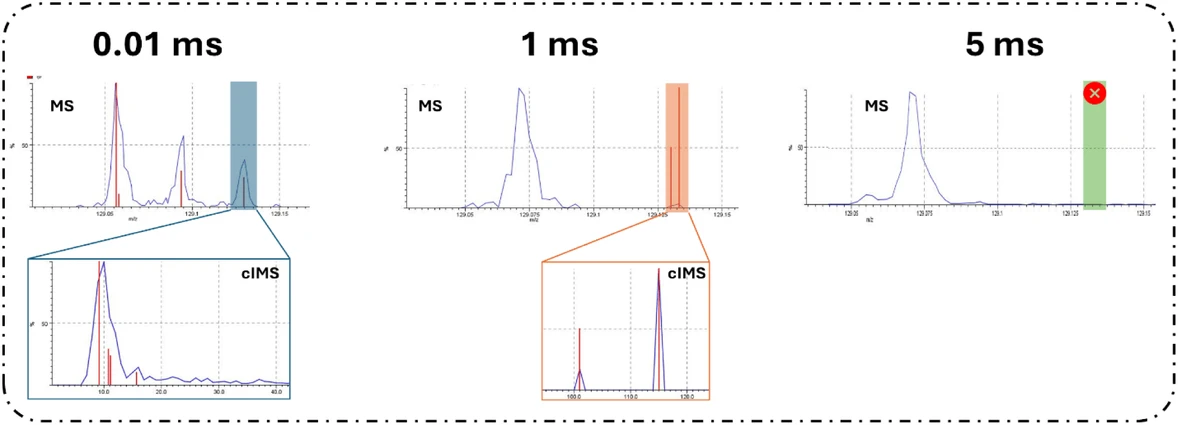 ACS Meas. Sci. Au (2026) 6 (5): 1537–1548: Figure 6. cIMS and MS data obtained. The area highlighted in color corresponds to the [M+H]+ ions of the 2-ethylhexanal and octanal obtained in MS. cIMS mobilograms display intensity vs drift time (bins) of the integrated m/z zone.
Separation times of 0.01, 0.1, 0.5, 1, 2, and 5 ms were evaluated as a perspective to assess the resolving power of the cIMS. Even if the system was optimized to decrease energy and help the transmission of labile analytes in mobility mode, the instrument could not separate the exhaled aldehydes while keeping adequate intensity for detection. When examining the signal corresponding to the [M+H]+ ions of 2-ethylhexanal and octanal with a 1 ms separation time, two distinct peaks were observed. Given the low signal intensities, these results must be confirmed. However, the observed signal intensities corresponded to values referred to as low ppbv, following the calibration curve, indicating a sensitivity loss approaching a factor of 1000. This reinforces the hypothesis that instrument geometry and the traveling wave-based ion mobility separation inherently result in substantial signal loss for small volatile compounds. Future investigations will focus on investigating linear mobility systems, which are known for their better sensitivity compared to cIMS. (51) Nevertheless, the fact that ion mobility separation effectively discriminates VOCs from chemical noise and isobaric interferences is also reassuring and further strengthens the interest in developing these technologies for exhaled breath analysis applications.
4. Conclusions
This study has demonstrated that rapid detection and quantification of biologically relevant aldehydes is possible with the SICRIT-HRMS system but still needs further development. A key advantage of such ambient ionization sources relies in their modularity and compatibility with various mass spectrometry platforms, providing flexibility for tailor analytical methods development. The methodology successfully detected 16 clinically relevant aldehydes with great linearity for most of the aldehydes (R2 ≥ 0.99) and LOD values ranging from 1.33 to 25.13 ppbv. The approach based on Tedlar bags and matrix comparison allowed for the identification of aldehyde-related ions produced. The SICRIT source preferentially generated protonated, dehydrated, and oxidation-derived species, with exhaled breath matrices inducing substantial shifts toward oxygen-containing adducts. Protonated adducts exhibited superior long-term repeatability, making them the preferred choice for clinical biomarker monitoring despite the formation of multiple species. Fragments were also detected, which will help future data handling development toward a more accurate identification. Focusing on small aldehyde molecules provides actionable insights about parameters influencing ionization mechanisms. It allows a fundamental evaluation of the impact of matrix and sample complexity on SICRIT ionization.
Key limitations include competitive ionization from Tedlar bag contaminants and concentration-dependent ionization shifts at ppbv levels, emphasizing the need for monitoring multiple ion adducts and developing controlled synthetic breath matrices for fundamental studies. The inability to resolve isomers remains a fundamental challenge. Evaluation of cyclic ion mobility revealed substantial sensitivity losses for small volatile compounds but also perspectives for separation as it was showed for 2-ethylhexanal/octanal. The cIMS acts as a mass-dependent filter, affecting low m/z species, making it more suitable for breath condensate analysis containing notably bigger lipids, peptides, and proteins.
This approach, combining bag sampling with the rapid and direct analysis capability of SICRIT-HRMS, positions the method as a practical tool for routine clinical applications. Specifically, our recent studies have demonstrated the interest of analyzing aldehydes for asthma monitoring. (28, 44) Future investigations will prioritize linear and compact ion mobility systems for improved sensitivity and aldehyde isomer differentiation, explore alternative sampling materials, and investigate ionization mechanisms to enhance method performance for clinical implementation and disease monitoring.