We, 28.10.2026 | Original article from: LabRulezICPMS Library
This week we bring you application notes by Agilent Technologies, LECO, Shimadzu and Thermo Fisher Scientific.News from LabRulezICPMS Library - Week 44, 2026
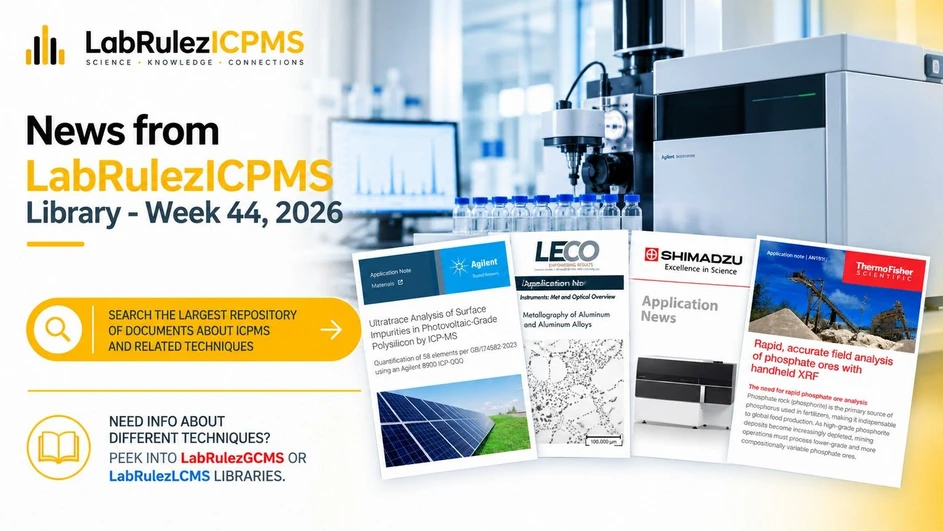
LabRulez / AI: News from LabRulezICPMS Library - Week 44, 2026
Our Library never stops expanding. What are the most recent contributions to LabRulezICPMS Library in the week of 26th October 2026? Check out new documents from the field of spectroscopy/spectrometry and related techniques!
👉 SEARCH THE LARGEST REPOSITORY OF DOCUMENTS ABOUT SPECTROSCOPY/SPECTROMETRY RELATED TECHNIQUES
👉 Need info about different analytical techniques? Peek into LabRulezLCMS or LabRulezGCMS libraries.
1. Agilent Technologies: Ultratrace Analysis of Surface Impurities in Photovoltaic-Grade Polysilicon by ICP-MS
Quantification of 58 elements per GB/T24582-2023 using an Agilent 8900 ICP-QQQ
- Application note
- Full PDF for download
Green and sustainable energy reduces environmental harm, lowers carbon emissions, and supports long-term ecological balance.1 As energy demand rises and climate impacts intensify, transitioning from fossil fuels to renewable sources, such as solar, wind, hydro, geothermal, and biomass, has become essential for sustainability and energy security.2 Solar energy is widely used through technologies such as photovoltaic (PV) cells, which convert sunlight into electricity, and solar thermal systems, which produce heat. PV cells, which are typically made from crystalline silicon, are key to solar technology. The efficiency, cost, and durability of the cells largely depend on the materials used.3,4
PV architectures are fundamentally built upon high-purity silicon ingots— a monocrystalline or polycrystalline mass of semiconductor-grade silicon, typically formed via the Czochralski or directional solidification process.5 These ingots are sliced into thin wafers that serve as the substrate for solar cell fabrication. In this process, doped regions and junctions are engineered to facilitate charge carrier separation and enable the conversion of incident solar radiation into electrical energy via the PV effect.6 Figure 1 depicts the manufacturing process for a PV panel.
The Agilent 8900 Triple Quadrupole ICP-MS (ICP-QQQ) is an advanced analytical platform engineered for ultratrace elemental analysis in high-purity materials such as polysilicon used in PV manufacturing. Its unique tandem mass spectrometry (MS/MS) configuration—comprising two quadrupoles (Q1 and Q2) separated by a collision/reaction cell—enables exceptional control over ion selection and reaction chemistry. Q1 acts as a mass filter to isolate target precursor ions, allowing only specific m/z values into the cell, while Q2 analyzes product ions formed after controlled reactions with gases such as O2, H2, or NH3. This design effectively eliminates complex spectral interferences, including polyatomic and isobaric overlaps that are particularly problematic in high-silicon matrices. As a result, the 8900 achieves sub-parts-per-trillion (ppt) detection limits for critical impurities like alkali and alkaline earth elements that are otherwise difficult to quantify accurately using conventional ICP-MS. Also, its high sensitivity, wide dynamic range, and robust plasma conditions ensure reliable quantification across varying concentration levels. These capabilities make the 8900 ICP-QQQ a useful instrument for QC and contamination monitoring in the semiconductor and solar industries, where even trace impurities can significantly impact PV cell efficiency and performance.
Conclusion
An Agilent 8900 ICP‑QQQ, configured with an s‑lens ion optics system to enhance ion transmission efficiency and sensitivity, was used for the simultaneous quantification of 58 trace and ultratrace elements in two polycrystalline silicon ingot samples. Sample preparation was carried out by acid extraction in accordance with the GB/T 24582‑2023 standard.
Ultratrace detection at sub‑ppt levels was achieved using MS/MS (triple quadrupole) mode, utilizing multiple reaction gases to systematically mitigate spectral interferences via mass‑shift and on‑mass reaction pathways. This approach enabled selective removal of polyatomic interferences commonly associated with silicon matrices, thereby improving analyte selectivity and lowering background noise. The method exhibited strong analytical precision, with relative standard deviations (RSDs) below 10% across six replicate measurements, indicating consistent signal stability, efficient interference control, and robust instrumental performance.
The 0.1 µg/L spike‑recovery results within ± 20% confirmed the accuracy of the quantification. The internal standard recoveries verified stable instrument performance and effective correction for matrix‑induced signal variation, further supporting reliable multi‑element analysis of high‑purity silicon. This level of reliability is essential for maintaining accuracy at sub‑ppb levels in challenging silicon matrices.
The 8900 ICP-QQQ method is well aligned with the demands of advanced manufacturing environments. It is particularly suited to PV production, where precise and reproducible impurity monitoring is vital for ensuring material quality, optimizing process control, and preserving device performance.
2. LECO: Metallography of Aluminum and Aluminum Alloys
- Application note
- Full PDF for download
Aluminum has become a widely used material due to its natural corrosion resistance (oxide layer), manageable weight, high thermal conductivity, and cost-effective machinability. Pure Aluminum is too soft for structural use, so it is often alloyed with other metals such as Copper, Magnesium, Silicon, Zinc, and Manganese to increase its strength and durability for aerospace, automotive, and construction applications. Metallography is an important tool for verifying quality control properties in these materials, including grain size, intermetallic phases, precipitates, and porosity, all of which affect mechanical properties, corrosion resistance, and electrical conductivity. LECO offers complete metallographic solutions made to streamline and optimize every step of the sample preparation process from start to finish.
Sample Sectioning
With any metallographic sample, the most critical step of sample preparation is sectioning. The goal of sectioning is to remove a suitable-sized sample from a larger component with the least amount of deformation. If done incorrectly, thermal damage may occur to the sample's surface, requiring extra steps in the grinding/polishing phase. It could even affect the sample's microstructure, resulting in skewed image analysis results. In extreme cases, it may even require an operator to resection the sample, leading to additional costs and loss of valuable time. To increase efficiency, it is important to choose the correct blade and fixture for your sample.
LECO recommends the use of a Silicon Carbide blade (SiC) for sectioning Aluminum alloys, as they are designed for soft non-ferrous metals, allowing minimal deformation and efficient heat dissipation. The SiC abrasives prevent smearing and tearing, outperforming harder Iron-focused blades on Aluminum structure. LECO offers a variety of fixturing options to accommodate even the most difficult geometries for sectioning (Figures 4 and 5). Fixturing the sample properly is critical to stabilize the sample to prevent unnecessary vibrations and release of the sample during the cutting process.
If thermal degradation occurs after taking these necessary measures, it could be the sectioning method. Although chop cutting (Z-Axis) is the traditional form of operation with sectioning saws, it may be advantageous to try a pulse or planar cut that would provide more relief in the process. This could also be the case for an Aluminum part with complex geometry.
Conclusion
In summary, Aluminum and its alloys remain essential to modern engineering due to their lightweight nature, corrosion resistance, and adaptability. Ensuring these materials meet the demanding requirements of aerospace, automotive, and structural applications depends on precise metallographic evaluation. By characterizing grain structures, intermetallic phases, precipitates, and porosity, metallography provides critical insight into material performance, durability, and quality.
LECO supports this process with a full suite of metallographic solutions designed to enhance efficiency and consistency at every stage of preparation. From robust sectioning systems that ensure clean, controlled cuts, to reliable mounting equipment that protects and preserves sample integrity, LECO enables repeatable, high-quality preparation. Our advanced grinding and polishing platforms deliver uniform, scratch-free surfaces ready for evaluation, while our comprehensive image analysis software provides accurate, data-driven characterization of microstructural features. Together, these tools offer a streamlined, end-to-end workflow that empowers laboratories to maintain stringent quality control and achieve confident, repeatable results.
3. Shimadzu: Analysis of Trace and Major Elements in Steel by ICP-AES
- Application note
- Full PDF for download
User benefits
- The ICPE-9820 enables analysis across a wide concentration range, from trace to major elements in steel.
- Using a torch for high-salt samples and a water bubbler can suppress salt deposition when analyzing high-salt samples.
- The use of a vacuum spectrometer enables rapid startup and quick analysis in the vacuum ultraviolet region (wavelengths below 190 nm).
Steel materials are widely used in a diverse range of industries, including construction, transportation, and machinery manufacturing, and are indispensable in modern society. Steel contains various elements, and the types and concentrations of these elements significantly influence its properties. Accordingly, elemental analysis is essential for quality assurance and performance control.
The elements in steel range from trace constituents to major components, with concentrations spanning a broad range from mg/L levels to percentage levels. Inductively coupled plasma atomic emission spectrometry (ICP-AES) is well suited to the analysis of elements across such a wide concentration range. It enables highly accurate quantitative analysis from trace elementsto major components.
This Application News presents an analysis example of a stainless-steel certified reference material using the Shimadzu ICPE-9820 multi-type ICP atomic emission spectrometer.
Analysis Conditions
The ICPE-9820 enables simultaneous analysis using two view orientations: axial view (AX), which offers higher sensitivity, and radial view (RD), which is suitable for high-concentration analysis.
For major element analysis, quantification was performed using the calibration curve method with the internal standard method. For trace element analysis, quantification was performed using the standard addition method.
Conclusion
In this Application News, trace and major elements in a stainless-steel certified reference material were analyzed using the ICPE-9820. The measured values showed good agreement with the certified values.
The sample introduction system, consisting of a torch for highconcentration salt solution samples and a water bubbler, effectively prevented sensitivity loss from salt deposition. At the same time, the use of a Twister spray chamber enabled finer particle-size selection, thereby improving analytical accuracy for high-salt samples.
In addition, the ICPE-9820 employs a vacuum spectrometer, enabling rapid startup and fast analysis in the vacuum ultraviolet region (wavelengths below 190 nm).
4. Thermo Fisher Scientific: Rapid, accurate field analysis of phosphate ores with handheld XRF
- Application note
- Full PDF for download
The need for rapid phosphate ore analysis
Phosphate rock (phosphorite) is the primary source of phosphorus used in fertilizers, making it indispensable to global food production. As high-grade phosphorite deposits become increasingly depleted, mining operations must process lower-grade and more compositionally variable phosphate ores. This trend places greater emphasis on rapid, accurate elemental analysis to support exploration, grade control, process optimization, and compliance with environmental regulations. Handheld X-ray fluorescence (HHXRF) has become a key analytical tool for these applications by providing fast, non-destructive, multi-element analysis directly in the field or at the production site.
Handheld XRF for rapid phosphate ore analysis
Handheld X-ray fluorescence (HHXRF) analyzers have emerged as valuable tools for on-site elemental analysis of the major and penalty elements in phosphate ores. The analyzers’ portability, ease of use, and ability to deliver analytical results within seconds make them ideal for rapid decision-making in mining exploration as well as mining operations for guiding extraction, stockpile management, quality control and environmental monitoring. While handheld XRF does not replace laboratorygrade analysis for certification purposes, it provides immediate compositional information that can significantly improve operational efficiency.
The Thermo Scientific™ Niton™ XL5 Plus Handheld XRF Analyzer (Figure 1a) combines a compact, lightweight design with advanced analytical performance for field-based elemental analysis. Featuring a 5 W / 50 kV / 500 µA max. proprietary X-ray tube and a large-area silicon drift detector (SDD) with a graphene window, the Niton XL5 Plus analyzer delivers accurate elemental analysis across all stages of mining and exploration. The Mining Mode on the XL5 Plus analyzer can measure 41 elements, from magnesium (Mg) to uranium (U), using four optimized excitation conditions to enhance the signal-to-noise ratios of fluorescence lines across the full energy spectrum. Mining Mode uses a proprietary fundamental parameter (FP) based algorithm that accounts for the high variability of sample composition by correcting for matrix absorption and secondary enhancement effects; this improves analytical accuracy across a wide range of sample compositions. Users can optimize settings of Mining Mode and store that group of preferred settings under Profiles. Profiles enable users to have multiple analytical methods on the same instrument; the most appropriate profile for a given task can be easily selected to perform desired measurements quickly.
Key findings
The Niton XL5 Plus handheld XRF analyzer provides rapid, accurate, multi-element analysis of phosphate ores, enabling informed decision-making throughout exploration, mining, and fertilizer production. Combined with appropriate sample preparation, the analyzer delivers excellent agreement with certified laboratory values for both major constituents and critical penalty elements such as uranium and cadmium. By providing immediate analytical results at the point of need, the Niton XL5 Plus analyzer helps improve ore characterization, optimize process control, and reduce reliance on timeconsuming laboratory analyses.