We, 2.9.2026 | Original article from: LabRulezICPMS Library
This week we bring you brochures by Agilent Technologies and Waters Corporation and application notes by Shimadzu and Thermo Fisher Scientific!News from LabRulezICPMS Library - Week 36, 2026
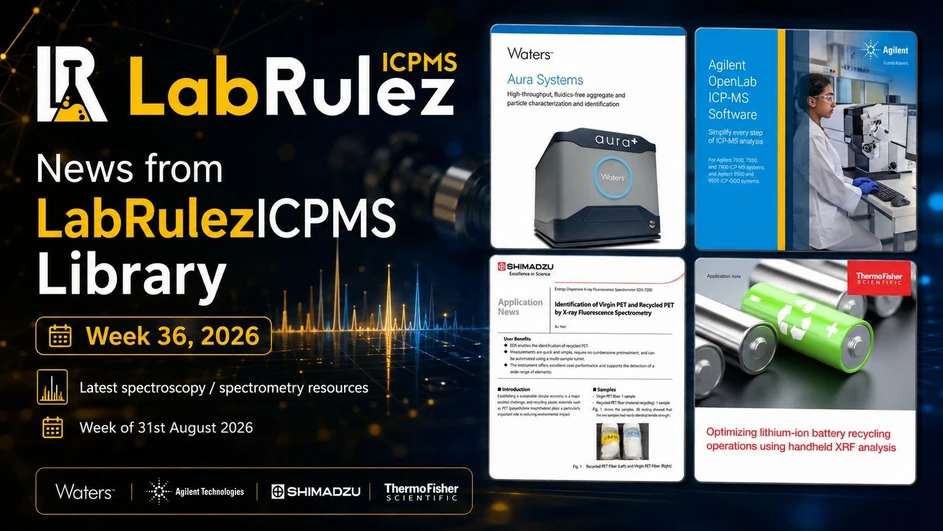
LabRulez / AI: News from LabRulezICPMS Library - Week 36, 2026
Our Library never stops expanding. What are the most recent contributions to LabRulezICPMS Library in the week of 31st August 2026? Check out new documents from the field of spectroscopy/spectrometry and related techniques!
👉 SEARCH THE LARGEST REPOSITORY OF DOCUMENTS ABOUT SPECTROSCOPY/SPECTROMETRY RELATED TECHNIQUES
👉 Need info about different analytical techniques? Peek into LabRulezLCMS or LabRulezGCMS libraries.
This week we bring you brochures by Agilent Technologies and Waters Corporation and application notes by Shimadzu and Thermo Fisher Scientific!
1. Agilent Technologies: Agilent OpenLab ICP-MS Software
Simplify every step of ICP-MS analysis
For Agilent 7800, 7850, and 7900 ICP-MS systems, and Agilent 8900 and 9500 ICP-QQQ systems.
- Brochure
- Full PDF for download
The brochure introduces Agilent OpenLab ICP-MS Software, designed to simplify routine operation and data handling for Agilent 7800, 7850, and 7900 ICP-MS systems and the 8900 and 9500 ICP-QQQ systems. The software supports the complete analytical workflow—from checking instrument readiness and creating batches to acquisition, data review, reporting, and compliance. A central dashboard provides an overview of system status, maintenance requirements, instrument health, and utilization, while Smart EMF and post-run performance checks help users identify when maintenance may be required. Guided Diagnostics, Meter Monitor, and time-stamped system records also support troubleshooting by tracking parameters such as vacuum levels, gas flows, and temperatures.
Method and batch setup are designed to reduce manual configuration. Batches can be created from preset methods, templates, existing batches, Method Wizard, or Method Advisor, and legacy Agilent ICP-MS MassHunter batches can be opened directly in OpenLab ICP-MS. For the 9500 ICP-QQQ, Method Advisor provides an element-focused approach in which users select target elements and calibration information while the software applies recommended acquisition masses and cell-gas conditions. Preset methods are available for applications including EPA 200.8/EPA 6020, USP <232>, ICH Q3D, and Chinese Pharmacopoeia requirements, while an IntelliQuant Screening preset supports semiquantitative screening of unknown samples. Routine instrument tasks can also be automated through autotuning, startup checks, batch queues, end-of-run verification, rinse functions, and automatic shutdown.
For data evaluation, OpenLab ICP-MS provides a real-time workspace where users can review analyte concentrations, internal-standard recoveries, stability plots, spectra or chromatograms, calibration information, QC charts, and IntelliQuant results in a single view. IntelliQuant acquires a complete mass spectrum and displays semiquantitative elemental concentrations using a color-coded periodic table, while IntelliQuant Star Rating assigns a zero-to-five-star data-quality score based on factors such as potential interferences, calibration quality, background, detection limits, and precision. Reporting options include whole-batch reports, elemental impurity reports for USP <232>/<233> and ICH Q3D, customizable reports, structured CSV export, and direct data transfer to LIMS.
The software can be expanded for specialized applications, including LC-ICP-MS and GC-ICP-MS, advanced QC workflows, single-particle ICP-MS and FFF-ICP-MS, ADS 2 automation, semiconductor analysis, and peripheral-device control. Supported analytical approaches include external calibration, standard additions, semiquantitative calibration, isotope ratios, and isotope dilution. For regulated laboratories, OpenLab ICP-MS can be combined with scalable OpenLab compliance solutions providing electronic signatures, user access control, configurable roles, system activity logs, and audit trails, supporting workflows subject to 21 CFR Part 11, EU Annex 11, and equivalent regulations. Overall, the platform is positioned as a unified environment for routine and advanced ICP-MS workflows, combining instrument control, method setup, diagnostics, data-quality assessment, reporting, and compliance support.
2. Shimadzu: Identification of Virgin PET and Recycled PET by X-ray Fluorescence Spectrometry
- Application note
- Full PDF for download
User benefits
- EDX enables the identification of recycled PET.
- Measurements are quick and simple, require no cumbersome pretreatment, and can be automated using a multi-sample turret.
- The instrument offers excellent cost-performance and supports the detection of a wide range of elements.
Establishing a sustainable circular economy is a major societal challenge, and recycling plastic materials such as PET (polyethylene terephthalate) plays a particularly important role in reducing environmental impact. Large numbers of PET bottles and molded products are used every day in the food and beverage sectors. To recycle these materials safely and reliably, technologies are required that can accurately identify their origin. In practice, however, appearance and conventional physical properties alone are insufficient to distinguish virgin material from recycled material, creating a need for a more reliable identification method.
For rapid identification in industrial settings, a method requiring little or no pretreatment is highly desirable. In some cases, nondestructive analysis is also needed to enable subsequent application of other analytical techniques. This article presents a practical approach in which metal catalysts present in PET are detected by EDX (Energy-Dispersive X-ray Spectroscopy) and used to distinguish material-recycled PET from virgin PET.
Principle and Overview
Metal catalysts such as antimony (Sb) and germanium (Ge) are used in the synthesis of PET resin. These catalyst metals have been reported to be useful indicators of material origin. 1),2) For example, Sb and Ge are frequently detected together in material-recycled PET, whereas only one catalyst metal is detected in chemically recycled PET and virgin PET. This likely reflects the fact that material-recycled PET is derived from a mixture of feedstocks using different catalysts.
ICP-AES (ICP optical emission spectrometry) and ICP-MS (ICP mass spectrometry), which are commonly applied to catalyst metal analysis, provide high sensitivity and accuracy. However, they require pretreatment to convert the sample into a solution, thereby lengthening the analytical workflow. By contrast, EDX can measure solid samples directly, making it well-suited to applications requiring rapid results, such as incoming material inspection and in-line analysis in molding plants. Because EDX is non-destructive, it is also suitable for multimodal analytical workflows.
On the other hand, some commercially available handheld EDX instruments do not support elements such as Sb and Ge. At the same time, higher-end systems may not offer the specifications or price range needed for industrial deployment. The EDX-7200 supports a broad range of elements with excellent cost performance. This article describes the analysis of Sb and Ge in PET using this instrument.
Conclusion
EDX enables rapid and straightforward elemental analysis without cumbersome sample pretreatment. Previous studies have shown that the presence of Sb and Ge can be used to identify recycled PET. Building on this concept, this article presents a practical analytical approach based on EDX. Using the EDX-7200, which combines broad elemental coverage with excellent cost performance, the proposed method provides a practical tool for rapid on-site identification, quality control, and traceability management. When combined with physical property data and other information, this approach is expected to contribute to the safety assessment and quality assurance of recycled materials, thereby supporting a more advanced circular economy.
3. Thermo Fisher Scientific: Optimizing lithium-ion battery recycling operations using handheld XRF analysis
- Application note
- Full PDF for download
The shift to a low-carbon economy and the adoption of electric vehicles will drive an exponential increase in the demand for lithium-ion batteries. As a corollary to this, the International Energy Agency expects the demand for some key commodities to increase significantly over the next two decades: the demand for Copper (Cu) is anticipated to increase by more than 40%; for nickel (Ni) and cobalt (Co), by 60-70% each; and for lithium (Li), by nearly 90%.¹ This will translate into increased mining activities and potentially generate larger amounts of deleterious waste.
To reduce the environmental impact and limit reliance on scarce commodities associated with economical and geopolitical implications, several countries have implemented regulations regarding producers’ responsibilities.² These regulations contain both incentives and accountability guidelines for lithium-ion battery and electric vehicles manufacturers. Their goal is to facilitate the emergence of a circular economy in which recycling will increasingly contribute to the supply of the strategic raw materials.
Lithium-ion batteries are made of multiple components, the most valuable being the cathode that contains between 40 and 70% ³, ⁴ of the total value of the battery, depending on its exact chemistry. As of 2023, lithium nickel cobalt manganese oxides (NCM) account for 66% of lithium-ion battery cathode active materials for electric vehicles, followed by lithium iron phosphates (LFP) which account for 24%, and lithium nickel cobalt aluminum oxide (NCA) accounts for the remaining 10%.³
Handheld X-ray Fluorescence Analysis
Handheld X-ray fluorescence analysis (HHXRF) is an elemental analysis technique that has proven to be cost-effective in recycling areas such as scrap metal and automotive catalytic converters. HHXRF can measure elements from magnesium (Mg) to uranium (U) in various types of materials such as metals and alloys; non-metallic inorganic materials such as ceramics; or ores or plastics. The Thermo Scientific™ Niton™ XL2 and Thermo Scientific™ Niton™ XL5 Plus Handheld XRF Analyzers deliver accurate elemental analysis in real time, with little or no sample preparation, across multiple steps of the lithium-ion battery recycling workflow. Although handheld XRF does not detect lithium, it can measure most elements from the periodic table including nickel or cobalt which often command much higher value than the lithium in a lithium-ion battery.⁴
Conclusion
There is no ideal process to recycle lithium-ion batteries that simultaneously incorporates low environmental impact, high metal recovery yield, and economic viability. Because of the variety of technologies and materials used, recycling lithium-ion batteries is a complex journey with multiple possible paths. HHXRF helps recyclers by generating lab-quality data in real time, allowing them to optimize their processes and make fast decisions that generate significant benefits:
- Unwanted materials containing heavy metals such as lead or cadmium can be prevented from entering subsequent steps in the recycling workflow.
- Materials can be accurately sorted and adequate processes for recovery selected depending on the material type (e.g., LFP vs. MCM).
- The economic value of incoming and outgoing material can be more accurately estimated.
4. Waters Corporation: Waters Aura Systems
- Brochure
- Full PDF for download
The presentation introduces the Waters Aura Systems, a family of high-throughput, fluidics-free instruments for the characterization and identification of visible and subvisible particles. All Aura platforms provide particle counting, identification, morphology assessment, and flexible sample volumes ranging from microliters to milliliters. The portfolio includes configurations tailored to different applications: AuraBMI for biologics particle analysis, Aura for particle analysis with identification, AuraPTx for protein formulation development, AuraGT for gene therapy, AuraCL for cell therapy, and Aura+ as the most comprehensive platform. The systems are designed for automation-ready operation, straightforward method transfer, and continuity from research through QC.
A key feature of the Aura platform is the combination of Backgrounded Membrane Imaging (BMI), Fluorescence Membrane Microscopy (FMM), and Side Illumination Membrane Imaging (SIMI). BMI captures particles on a membrane and subtracts the membrane background to improve particle contrast, while FMM uses fluorescent dyes or conjugated antibodies to distinguish specific particle types. This enables differentiation of protein aggregates, cells, viral capsids, degraded excipients, plastics, fibers, and other contaminants that may look similar based on morphology alone. SIMI adds further information for identifying unlabeled inorganic particles such as glass, fibers, and Dynabeads. Together, these techniques provide more specific particle identification than morphology-based classification alone.
The systems are particularly suited to biologics, gene therapy, and cell therapy development. For gene therapy, Aura can evaluate AAV stability, distinguish capsid-related particles, and monitor DNA leakage using SYBR Gold fluorescence, with measurements possible from as little as 5 µL of sample. For cell therapy, the system can differentiate single cells, cell aggregates, protein aggregates, and extrinsic particles. The platform also supports flexible sample volumes and 24- or 96-well membrane formats, allowing the same general approach to be used from sample-limited early development through larger-volume and QC workflows. The brochure reports excellent quantitative linearity across serial dilutions and emphasizes the ability to preserve sample for additional orthogonal analyses.
From a technical perspective, Aura Systems provide 100% sampling efficiency, a particle detection and quantitation range above 1 µm, and can handle concentrations above 3,000,000 particles/mL for 1.6 µm particles. Brightfield membrane imaging takes approximately one minute per sample, while fluorescence measurements require about 15–30 seconds per sample. The instruments are compatible with robotic automation and offer different fluorescence-channel configurations depending on the selected Aura model. Overall, the platform is positioned as a comprehensive solution for obtaining quantitative particle counts together with information on particle identity and composition across the development and quality-control lifecycle.