We, 21.10.2026 | Original article from: LabRulezGCMS Library
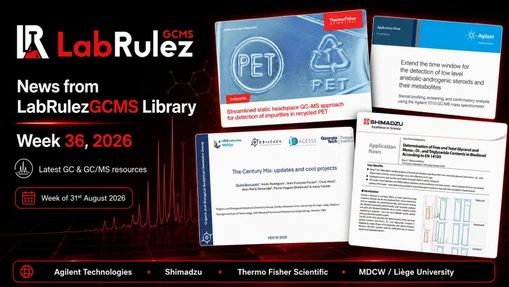
This week we bring you application notes by Agilent Technologies and LECO and brochure by Shimadzu!News from LabRulezGCMS Library - Week 43, 2026

LabRulez / AI: News from LabRulezGCMS Library - Week 43, 2026
Our Library never stops expanding. What are the most recent contributions to LabRulezGCMS Library in the week of 19th October 2026? Check out new documents from the field of the gas phase, especially GC and GC/MS techniques!
👉 SEARCH THE LARGEST REPOSITORY OF DOCUMENTS ABOUT GCMS AND RELATED TECHNIQUES
👉 Need info about different analytical techniques? Peek into LabRulezLCMS or LabRulezICPMS libraries.
This week we bring you application notes by Agilent Technologies and LECO and brochure by Shimadzu!
1. Agilent Technologies: Determination of 366 Pesticides in Cocoa Liquor
Using Agilent Captiva EMR-GPD passthrough cleanup and GC/MS/MS and LC/MS/MS detection
- Application note
- Full PDF for download
Cocoa liquor is a key and central intermediate used in the manufacture of a wide range of cocoa-derived products, including chocolate, cocoa butter, and cocoa powder. Its production begins with the processing of cocoa beans (as shown in Figure 1) and it contains both cocoa butter and cocoa solids, making it the most representative and analytically challenging matrix for studying cocoa flavor, quality, safety, and authenticity.1
As cocoa beans are vulnerable to fungal infections and insect infestation, pesticides are often applied during cultivation and post-harvest processing. Consequently, regulatory agencies worldwide, such as the EU and US FDA, require stringent monitoring of pesticide residues in cacao-derived products to ensure consumer safety and compliance with maximum residue limits (MRLs).2
However, pesticide analysis in cocoa liquor presents significant analytical challenges. The high lipid content, natural pigments, and abundant matrix coextractives can cause severe matrix effects, detector contamination, and reduced method robustness. These issues demand highly sensitive, selective, and rugged instrumentation capable of operating reliably even in the presence of complex sample backgrounds.
To meet these analytical needs, the Agilent 8890/7010D GC/MS/MS and the Agilent 1290 Infinity III/6475 LC/MS/MS systems provide powerful complementary platforms for comprehensive pesticide monitoring. The 7010D GC/MS/MS, equipped with the high-efficiency electron ionization source and the industry-leading femtogram‑level sensitivity, enables confident quantification of pesticide residues with outstanding selectivity through dynamic multiple reaction monitoring (dMRM). For thermally labile or highly polar pesticides that are unsuitable for GC analysis, the 6475 LC/MS/MS system offers superior sensitivity, robust spray stability, and advanced dMRM acquisition tailored for trace-level quantification, even in challenging matrices.
This application note demonstrates a combined GC- and LC-based workflow that is optimized for cocoa liquor, including sample preparation, matrix cleanup strategies, and dMRM method development. As shown in Figure 2, 76 analytes were analyzed by GC/MS/MS and 308 analytes were analyzed by LC/MS/MS. The GC/MS/MS analysis included 18 analytes that can also be determined using LC/MS/MS; thus, this workflow covers a total of 366 unique pesticides. Together, the 7010D GC/MS/MS and 6475 LC/MS/MS deliver a comprehensive solution covering a broad range of pesticide chemistries while maintaining excellent accuracy, precision, and long‑term instrument robustness.
Conclusion
This study successfully demonstrated a robust and sensitive method for the quantitative analysis of 366 pesticides in cocoa liquor using the Agilent 8890/7010D GC/MS/MS and the 1290 Infinity III/6475 LC/MS/MS system.
To achieve the most efficient use of instrument cycle time, both GC/MS/MS and LC/MS/MS data were acquired in dMRM mode. The dMRM methods were created and developed based on the Agilent MRM databases.
The optimized workflow included sample extraction with the Bond Elut QuEChERS AOAC extraction kit followed by cleanup with the Agilent Captiva EMR-GPD kit. This workflow provided excellent linearity, recovery, and reproducibility.
2. LECO: Modern-day Urinalysis; Combining Enhanced Chromatography with High Resolution Time-of-Flight Mass Spectrometry to Discover Potential Prostate Cancer Biomarkers in Human Urine
- Application note
- Full PDF for download
Urinalysis is one of the oldest diagnostic practices in medicine, with origins tracing back to ancient civilizations that recognized urine as a reflection of internal health. Early physicians in Mesopotamia, Egypt, and Greece visually inspected urine for its color, clarity, sediment, and odor, laying the groundwork for uroscopy. By the Middle Ages, urine wheels were developed to standardize interpretations, although these assessments remained largely qualitative and speculative (Figure 1, left). A major shift occurred in the 17th and 18th centuries with advances in chemistry, enabling the identification of specific urinary components such as glucose in diabetic patients. The 19th and early 20th centuries introduced microscopy and standardized chemical assays, solidifying urinalysis as a core clinical tool for detecting infections, metabolic disorders, and renal dysfunction.
Today, urinalysis plays a crucial role in identifying disease-associated biomarkers, particularly for conditions where early detection is crucial. In oncology, urine-based assays are being developed for cancers such as bladder, prostate, kidney, and even systemic malignancies. These assays leverage signatures such as extracellular vesicles, circulating tumor DNA, metabolites, and protein fragments. Machine learning and high-throughput analytical platforms now integrate urinary biomarker profiles to enhance diagnostic accuracy, predict disease progression, and guide personalized therapies. This study describes the utilization of enhanced chromatography and high resolution time-of-flight mass spectrometry for the discovery of potential prostate cancer biomarkers in urine.
Experimental
Data were acquired on a LECO Pegasus HRT 4D system equipped with a Multi-Mode Source™ (MMS™), enabling Electron Ionization (EI), Positive Chemical Ionization (PCI), and Negative Chemical Ionization (NCI) to be performed with the same hardware. Auto Sampler - LECO L-PAL 3, Gas Chromatograph - Agilent 8890 w/ LECO QuadJet Thermal Modulator.
Conclusion
From ancient visual inspection to modern molecular profiling, the evolution of urinalysis reflects continuous scientific progress—positioning urine as a powerful, noninvasive window into human health and a promising frontier for + next-generation disease detection. Today, LECO's Pegasus HRT 4D and ChromaTOF brand software provide robust analytical capabilities for complex biological samples and were used in the annotation of potential prostate cancer biomarkers in urine. The instrument generates comprehensive, untargeted datasets that can be interrogated through a variety of software tools, such as ChromaTOF Tile, which was demonstrated in this note. Automated Peak Find processing delivers extensive lists of annotated sample components through spectral-similarity searches and formula determinations based on high resolution, accurate-mass ions. Confident annotation of biomarkers associated with diseases such as prostate cancer can be accomplished with the workflows demonstrated in this application note.
3. Shimadzu: Run Smarter, Go Greener: Smart Energy Saving In Nexis GC-2060
- Brochure
- Full PDF for download
The New Industry Standard For Sustainable Laboratories
Rising power demand and higher electricity prices highlight the need for smart energy management in modern laboratories. The Nexis GC-2060 delivers the ideal solution, combining energy savings, rapid readiness, and operator convenience. This allows laboratories to reduce running costs, limit heat output, and keep productivity high.
ECO Idling: Smart Standby Without The Wait
ECO Idling is Shimadzu’s smart standby feature that balances productivity with energy and gas savings. The system tracks usage patterns and visualizes workloads to recommend an optimized eco-schedule, automatically switching the GC between active and low-consumption states. The system adapts to your workflow instantly: Start a run, and it automatically resumes analysis ready performance. When work stops, it slips into the ECO state to lower power and gas use. For Nexis GC-2060 systems with a built-in ECO button, operators can turn ECO Idling on or off with a single touch—making it incredibly simple to lower laboratory running costs.
Tech Tip: Why Does GC Require A Stabilization Period Before Analysis?
Moisture adsorbed on columns and detectors is a common cause of prolonged start-up and stabilization times. Maintaining the column at 50°C reduces the relative humidity to approximately 13% (assuming 23°C room temperature).
Use ECO Idling to schedule automated column cleaning followed by an oven warm-up before you start your day. This guarantees the system is fully stabilized and ready when you walk in, eliminating daily start-up delays and maximizing throughput.