We, 7.10.2026 | Original article from: LabRulezICPMS Library
This week we bring you technical note by Agilent Technologies, application notes by LECO and Thermo Fisher Scientific and poster by Shimadzu / AOAC!News from LabRulezICPMS Library - Week 41, 2026
LabRulez / AI: News from LabRulezICPMS Library - Week 41, 2026
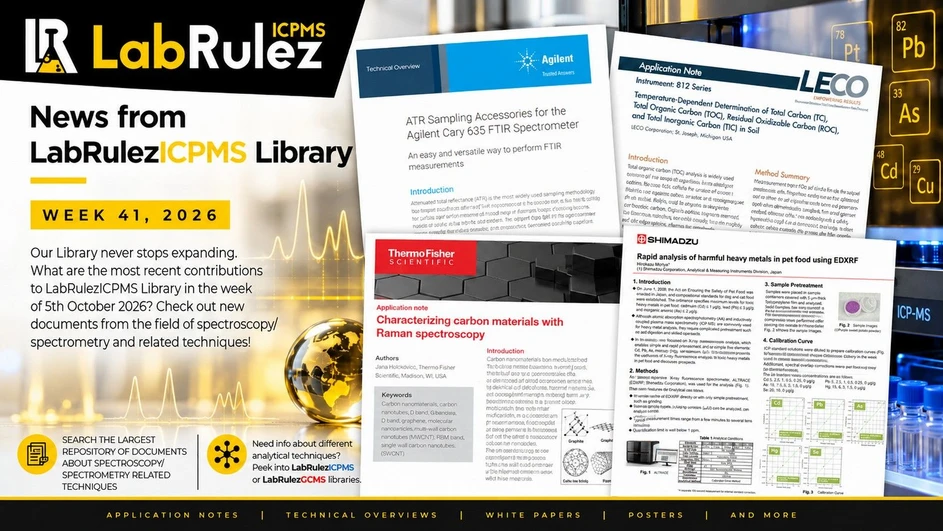
Our Library never stops expanding. What are the most recent contributions to LabRulezICPMS Library in the week of 5th October 2026? Check out new documents from the field of spectroscopy/spectrometry and related techniques!
👉 SEARCH THE LARGEST REPOSITORY OF DOCUMENTS ABOUT SPECTROSCOPY/SPECTROMETRY RELATED TECHNIQUES
👉 Need info about different analytical techniques? Peek into LabRulezLCMS or LabRulezGCMS libraries.
This week we bring you technical note by Agilent Technologies, application notes by LECO and Thermo Fisher Scientific and poster by Shimadzu / AOAC!
1. Agilent Technologies: ATR Sampling Accessories for the Agilent Cary 635 FTIR Spectrometer
An easy and versatile way to perform FTIR measurements
- Technical note
- Full PDF for download
Attenuated total reflectance (ATR) is the most widely used sampling methodology for Fourier transform infrared (FTIR) spectroscopy. This popularity is due to its ability to quickly and easily measure a broad range of sample types, including liquids, solids, powders, semisolids, and pastes. The Agilent Cary 635 FTIR spectrometer uses a versatile modular concept, where precisely optimized sampling modules are attached to the front of the Cary 635 FTIR engine. Depending on the specific application or sample, different ATR sensors are used. Permanently aligned optics allow a wide range of modules to be swapped in seconds, with no user alignment. The Cary 635 FTIR accommodates a wide selection of ATR sensors, and features the ability to switch from one ATR sensor to another instantaneously.
For most applications, single reflection zinc selenide (ZnSe), diamond, and germanium (Ge) ATR sampling modules are available for the Cary 635 FTIR. These modules are used with a sampling press, and are excellent for analyzing solid materials, as well as liquids, pastes, and gels. The diamond sensor is highly durable, and the best choice for harder materials. The ZnSe sensor is a good choice for softer solids. The Ge sensor, with a shorter pathlength, is the best choice for highly absorbing samples. In addition, the multireflection ZnSe ATR sampling module is a great option for the analysis of liquids, pastes, and gels, where extra sensitivity is needed.
Because these sampling technologies are custom engineered for the Cary 635 FTIR, the analyst can have confidence in the results, whichever ATR sensor is chosen for their application. This custom engineering translates into the highest performance, sensitivity, and ease-of-use of any spectrometer in its class.
ATR sensors for the Cary 635 FTIR
Whether your applications require the single reflection ZnSe, diamond or Ge, or the multireflection ZnSe, the Cary 635 FTIR delivers class-leading performance. Unlike other FTIR spectrometers that use third-party accessories, sampling technology for the Cary 635 FTIR is custom designed by Agilent engineers, and perfectly matched to the optical characteristics of the spectrometer. The rugged, no‑alignment design permits instantaneous exchange of these ATR sampling technologies, so that any sample type you might face will readily be accommodated.
Zinc selenide (ZnSe) ATR modules
ZnSe is a semiconductor-type material that has been used for many years as an ATR sensing element. It is relatively hard, has a broad wavelength range, and is insoluble in water. For this reason, it is an excellent choice for pliable solids, pastes, gels, and liquids. It can be used to analyze aqueous solutions in the pH 5 to 9 range. The Cary 635 FTIR has two variations of ZnSe sampling technology available: multireflection and single reflection sensors.
Single reflection ZnSe ATR module
Because of the relatively short pathlength of infrared light into the sample, this sensor is ideal for neat samples; that is, samples that are relatively concentrated or pure. The single reflection ZnSe module is a good choice for identification of softer materials, as well as viscous liquids. When measuring solids, such as polymer films, it can be used with the Cary 635 FTIR.
Multireflection ZnSe ATR module
The exceptional performance of the Cary 635 FTIR, combined with the increased pathlength of the multireflection ATR sensor, demonstrates a spectrometer system of unsurpassed sensitivity. Lower concentration components in pastes, gels and liquids can be measured. Solutes in diluted or concentrated aqueous solutions in the pH range of 5 to 9 can also be analyzed. Since the multireflection sensor is recessed slightly in its stainless steel holder, it is ideal for analyzing nonviscous liquid samples. This sensor is a superior choice when qualitative or quantitative measurements are required. It is not recommended for use with solid materials, since it is not used with the pressure clamp.
2. LECO: Temperature-Dependent Determination of Total Organic Carbon (TOC) in Geological Materials
- Application note
- Full PDF for download
Total Organic Carbon (TOC) determination in geological materials—such as metal-bearing ores, oil shales, minerals, and aggregates—is routinely performed to assess organic matter content. This is an essential quality control procedure used to identify locations of natural hydrocarbon fuel deposits and to ensure the quality and compositional integrity of raw materials used in construction.
The organic Carbon content of rock and shale samples is one of the most important parameters used in the evaluation of sediments as a potential source for petroleum or natural gas. TOC content controls the hydrocarbon generation potential of the rock and the content of adsorbed natural gas within the rock, as it is the source material responsible for the formation of natural hydrocarbon fossil fuel deposits.
The determination of TOC is also an important quality control procedure used during the manufacturing of cement, from the raw material to the final product. TOC content is used to monitor the quality of raw materials such as limestone and shale and manage the kiln operation. This allows manufacturers to ensure that the final product meets the requirements necessary for optimal performance and compliance with environmental regulations.
Instrument Model and Configuration
The LECO RC612 is a multiphase Carbon and moisture determinator with a variable ramp furnace and a wide Carbon detection range that is specifically designed to differentiate various forms of Carbon by the temperature at which they combust or decompose. This capability facilitates the temperature differentiation determination of the different species of Carbon in geological materials. The following application note outlines the instrument parameters and procedure for temperature-dependent Carbon determination using the RC612.
Typical Results
The low Carbon calibration was performed utilizing a single standard, linear, force through origin calibration, using LECO 502-029 Synthetic Carbon (1.00 % C). The high Carbon calibration was performed utilizing a linear, full regression calibration, using LECO 502-030 Synthetic Carbon (4.99 % C) and LECO 501-034 Calcium Carbonate (12.01 % C). The results are reported on a dry basis.
3. Shimadzu / AOAC: Rapid analysis of harmful heavy metals in pet food using EDXRF
- Poster
- Full PDF for download
On June 1, 2009, the Act on Ensuring the Safety of Pet Food was enacted in Japan, and compositional standards for dog and cat food were established. The ordinance specifies maximum levels for toxic heavy metals in pet food: cadmium (Cd) ≤ 1 μg/g, lead (Pb) ≤ 3 μg/g, and inorganic arsenic (As) ≤ 2 μg/g.
Although atomic absorption spectrophotometry (AA) and inductively coupled plasma mass spectrometry (ICP-MS) are commonly used for heavy metal analysis, they require complicated pretreatment such as acid digestion and skilled operators.
In this study, we focused on X-ray fluorescence analysis, which enables simple and rapid pretreatment, and analyzed five elements: Cd, Pb, As, mercury (Hg), and selenium (Se). This poster presents the usefulness of X-ray fluorescence analysis for toxic heavy metals in pet food and discusses prospects.
Methods
An energy-dispersive X-ray fluorescence spectrometer, ALTRACE (EDXRF; Shimadzu Corporation), was used for the analysis (Fig. 1). Table 1 summarizes the analytical conditions.
The main features of EDXRF are as follows:
- Samples can be analyzed directly or with only simple pretreatment, such as grinding.
- Elements from sodium (11Na) to uranium (92U) can be analyzed.
- Various sample types, including solids, powders, and liquids, can be analyzed.
- Typical measurement times range from a few minutes to several tens of minutes.
- Quantification limit is well below 1 ppm.
Conclusion
X-ray fluorescence analysis enables the determination of harmful heavy metals with simple sample pretreatment. ALTRACE, characterized by its high sensitivity, demonstrated a lower limit of quantification sufficient for analysis at the level of a few ppm, as well as good reproducibility.
Since XRF is an elemental analysis technique, separate analysis is required to distinguish between the chemical forms of inorganic and organic arsenic; however, it is considered useful for the screening of hazardous heavy metals.
4. Thermo Fisher Scientific: Characterizing carbon materials with Raman spectroscopy
- Application note
- Full PDF for download
Carbon nanomaterials have revolutionized the field of material science in recent years. Individual carbon nanomaterials offer a wide range of useful properties pertaining to electrical conductance, thermal resistance, and exceptional strength, making them very interesting materials to a broad range of industries. The high-level of interest in the processing, modification, and customization of these materials has created a strong demand for techniques that can be used to characterize carbon nanomaterials. Raman spectroscopy is one technique that has proven to be very well suited to many of the characterization needs with these materials.
Raman spectroscopy is most sensitive to highly symmetric covalent bonds with little or no natural dipole moment. The carbon-carbon bonds that make up these materials fit this criterion perfectly and as a result Raman spectroscopy is highly sensitive to these materials and able to provide a wealth of information about their structure. As we shall see, Raman spectroscopy is capable of discerning even slight changes in structure making it a very valuable tool in the characterization of carbon nanomaterials.
Raman highly sensitive to morphology
Raman spectroscopy is particularly well suited to molecular morphology characterization of carbon materials. Every band in the Raman spectrum corresponds directly to a specific vibrational frequency of a bond within the molecule. The vibrational frequency and hence the position of the Raman band is very sensitive to the orientation of the bands and weight of the atoms at either end of the bond. Figure 2 shows an example in which the Raman spectrum of diamond is compared to the Raman spectra of crystalline silicon and germanium. These spectra show us several things. First, note that in the case of diamond, where the material consists of highly uniform C-C bonds in a tetrahedral crystal structure, the Raman spectrum is very simple. It consists of only a single band because all of the bonds in the crystal are of the same orientation and strength resulting in a single vibrational frequency. We also see that the spectrum of diamond is easily distinguished from the spectra of silicon and germanium by the frequency (cm-1 position) of the band even though they share the same tetrahedral crystal configuration. The heavier atoms of silicon and germanium slow the vibrational frequency and shift the corresponding Raman band to lower frequency as well.
Conclusions
Raman is a very powerful and valuable technique that can be of great benefit to characterization of carbon nanomaterials. Raman is particularly well suited to detect small changes in structural morphology of carbon nanomaterials making it an indispensable tool for many material scientists working with carbon nanostructures. Raman instruments are very fast and provide a great deal of flexibility in samples that can be accommodated. Every lab that is characterizing carbon nanomaterials will benefit from having access to Raman instrumentation.