Mo, 5.10.2026 | Original article from: J. Hazard. Mater. 2026, 143283, Volume 516
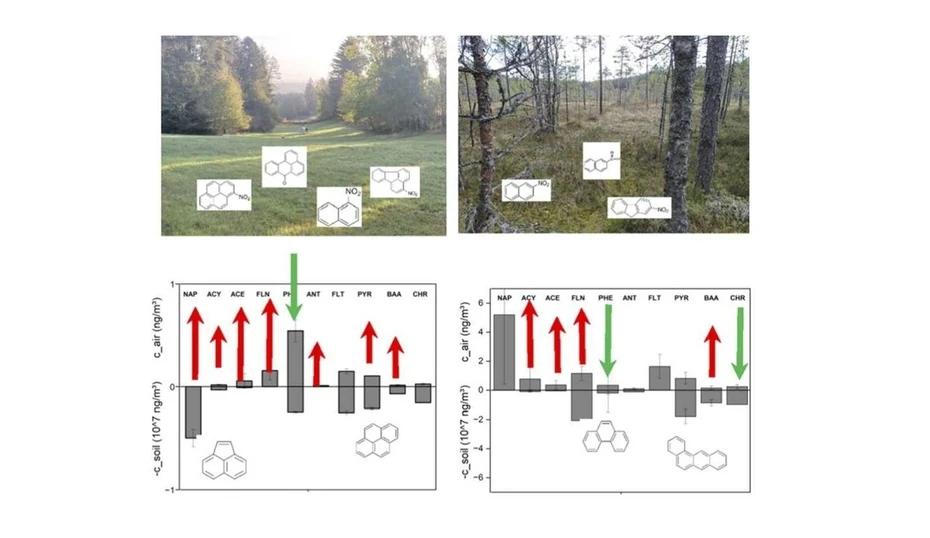
GC-MS/MS and flux analysis show that soils can re-emit PAHs and related compounds, with secondary emissions potentially rivaling local primary sources.Polycyclic aromatic compounds in air – importance of re-volatilisation from soils
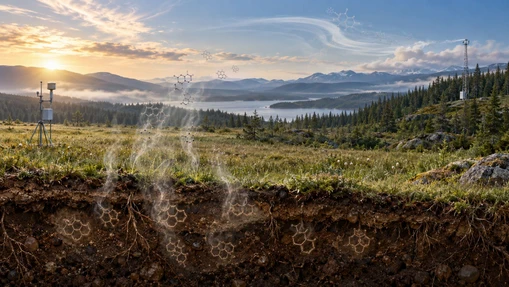
J. Hazard. Mater. 2026, 143283, Volume 516: Graphical abstract
This study investigates the exchange of polycyclic aromatic compounds (PACs), including PAHs, NPAHs, and OPAHs, between soil and air at rural grassland and boreal forest sites. Air and soil samples were analyzed by GC-MS/MS, while fugacity calculations and micrometeorological measurements were used to assess the direction and magnitude of air–soil fluxes.
Upward fluxes were observed for several low-molecular-weight PAHs and an oxygenated derivative, with quantified emissions at the boreal site ranging from 0.5 to 12 ng m⁻² h⁻¹. The results indicate that re-volatilization from soils can represent an important secondary source of atmospheric PACs, potentially comparable to domestic primary emissions in receptor regions.
The original article
Polycyclic aromatic compounds in air – importance of re-volatilisation from soils
Gerhard Lammel, Dominika Bezdeková, Jakub Martiník, Karsten Baumann, Rostislav Červenka, Petr Kukučka, Ondřej Letocha, Ludovic Mayer, Petra Přibylová, Roman Prokeš, Üllar Rannik, Risto Taipale
J. Hazard. Mater. 2026, 143283, Volume 516
licensed under CC-BY 4.0
Selected sections from the article follow. Formats and hyperlinks were adapted from the original.
Because of their genotoxicity and mutagenicity, polycyclic aromatic hydrocarbons (PAHs) in the atmospheric environment have been identified as a human health concern [1], [2], [3], and many of their nitrated (NPAHs) and oxygenated (OPAHs) have been found to be more mutagenic than their parent PAHs [3], [4], [5], [6], [7], [8], [9]. The main source of PAHs and OPAHs is incomplete combustion of fossil and biomass fuels [10], [11]. In addition, many OPAHs and NPAHs are partly or even exclusively formed in the tropospheric chemistry of parent PAHs [10], [12], [13], [14], [15]. Deposition to soils and surface waters are the major removal routes from air [16], [17], [18], and soils store the largest share of PAHs’ reservoir in the terrestrial environment [19], [20], [21]. Soil PAC may be increasing in polluted and unpolluted regions worldwide [21], [22]. In forests, PAHs are uptaken by the litter and foliage [23], [24].
While PAHs have been the focus of extensive atmospheric research, NPAHs and OPAHs have received attention only recently, mostly in studies addressing urban air pollution (e.g., [25], [26], [27], [28], [29]), less so regarding their atmospheric cycling in background or remote areas[12], [30], [31], [32], [33] and 2020; [28], [34], [35].
PAHs and their derivatives are semivolatile substances which may be subject to re-volatilisation from surfaces following atmospheric deposition corresponding to soil and atmospheric pollution levels [10], [19]. Re-volatilisation is a key process of semivolatile organics’ environmental fate and has been studied for organochlorine pesticides (OCPs), PCBs and PACs (e.g., [36], [37], [38], [39]). It is understood to be controlled by the phase equilibria in the soil multiphase system composed of soil organic carbon (SOC), mineral surfaces, soil water and soil pore air space [40], [41], [42], and may preserve historic contamination [21], [43]. For PAHs, the volatilisation of 2–4 ring PAHs was observed in urban and rural environments, whereby SOC and indirect parameters of organic matter mineralization and aromaticity have been found to be associated with strong sorption or suppressed volatilisation [20], [35], [36], [39]. Air-soil exchange of PAH derivatives has been less studied, with volatilisation of 2–4 ring OPAHs and 2–3 ring NPAHs observed from both grassland and forest soils, also in a receptor area with regard to PAC pollution [35]. Unlike for one OCP (DDT; [38]), PAC re-volatilisation fluxes have not been experimentally quantified. Important sinks of PACs in soil are biodegradation, leaching with water [19], [44] and chemical reaction with the matrix, leading to so-called bound residue. This is formed influenced by SOC quality on a long time scale (months; [45], [46], [47], [48]). The main fate of PAHs, in particular high-molecular compounds should be microbial degradation [49], [50], [51]. Atmospheric deposition is the main source of PACs in soils of remote areas (such as the Arctic permafrost soils), of rural areas and also in most soils of urban and industrially impacted areas [22], [52], [53], [54], [55], [56], [57].
Biogenic sources may contribute to low-molecular PAHs in soil, such as phenanthrene (PHE; [20]), and formation of OPAHs from PAHs in soil (Wilcke, 2021). PAC sorption and chemical transformation processes in soil and the chemodynamics of air-soil cycling are incompletely understood on both short and long spatiotemporal scales.
The novelty of this study lies in our investigation of the air-soil cycling of PACs by increasing the temporal resolution of air sampling and the vertical resolution of controlling soil parameters than previously done. By including a boreal forest site, a receptor area with regard to PAC pollution, we extend the investigation of PAC atmospheric fate, distributions and air-soil exchange to the boreal zone. By quantifying vertical PAC fluxes at the air-soil interface for the first time using a flux-gradient method, we test the hypothesis that air-soil cycling could contribute significantly to the sources of PAC in air.
2. Methodology
2.4. Sample preparation and analysis
Filter, PUF and soil samples were extracted with dichloromethane (DCM) using an automated Soxhlet extractor. Prior to instrumental analysis, syringe internal standards were added, specifically p-terphenyl for PAHs (200 ng per sample; Wellington, USA) and 13C12-PCB95 for NPAHs and OPAHs (10 ng per sample; Wellington) quantification, and such prepared samples were stored in a freezer at −18°C a GC- triple quadrupole MS (8890 A, 7000D MS, Agilent, USA) while NPAHs and OPAHs were analysed using GC (7890 A, Agilent, USA) coupled to an atmospheric pressure chemical ionization tandem MS (GC-APCI-MS/MS, Waters, Mildford, USA). Sample preparation and analysis, as well as the quality assurance and control are described in the SI, S1.2.1 and S1.2.2. Filter and soil samples were analysed for elemental and organic carbon fractions (EC, OC), using a Lab OC-EC Aerosol Analyzer (Sunset Laboratory Inc., USA) and a Vario TOC Cube analyzer (Elementar, Langenselbold, Germany), respectively, described in SI, S1.2.3.
3. Results and discussions
3.1. PAC levels in air
PACs concentrations in air, ca, are summarized in Tables 1a, S7a, c and Fig. S4, and in air equilibrated with soil, csa in Table 1b, S7b, d.
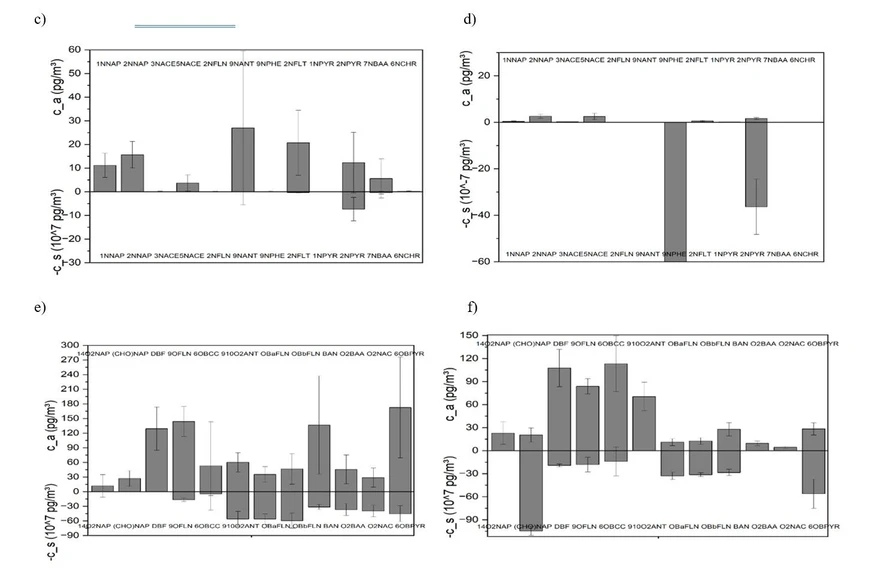 J. Hazard. Mater. 2026, 143283, Volume 516: Figure S4. Concentrations of (a, b) PAHs (2-4 rings and 5-7 rings), (c, d) NPAHs and (e, f) OPAHs in soil (mean of 5 cm depth) and in air (total concentrations ctot = cg + cp) at the (a, c, e) rural grassland and (b, d, f) boreal forest site. Note: Concentrations in soil are calculated using soil density and scaled by 10-7.
Air concentrations of PAHs and NPAHs are higher by 1 order of magnitude at the rural grassland site than at the boreal forest site, whereas OPAH concentrations are similar (Table 1). This is expected as reflecting the distance to sources. No or negligible sources had recently influenced air received at the boreal site during the first week, while source areas in the Baltic countries, northern Germany and northern Poland i.e., 600–2000 km away presumably influenced air received during the second week (back-trajectories, Fig. S3d, e, f). ∑12OPAH/∑PAC is much higher at the boreal site than at the central European site i.e., 28 vs. 5%, whereas ∑14NPAH/∑PAC are similar, 0.5 and 0.6%, respectively. These ratios will be dominated by the kinetics of photochemical formation of OPAH and NPAH along transport from PAC sources which are farther from the boreal than from the rural site. This is reflected by the most abundant OPAH at either site, which are gaseous 6-OBCC (mean ca = 113 ng m−3, cN/cD = 0.6) at the boreal site, 2 times higher than at the other site, and 6-OBPYR (mean ca = 170 ng m−3, cN/cD = 2.3) at the rural site, 6 times higher than at the other site (Table S7c). While the latter is mostly emitted from fossil fuel combustion [83], [84] and its night-to-day ratio, cN/cD, explained by diel boundary layer variation, 6-OBCC is a photochemical product of PHE [85] and both its absolute concentration and its product-to-precursor ratio c6-OBCC/cPHE is much higher at the receptor site than at the rural site, located in a PAC source area (0.21 vs. 0.02; Table S7a, c). Moreover, 9-OFLN, BAN and O2ANT, are understood to have both primary (road traffic, besides other; [86], [87], [88]) and photochemical sources, and are found similarly high concentrated at both sites (149, 123 and 9.5 pg m−3 at the rural, 84, 108 and 10 pg m−3 at the boreal forest site, respectively). Formation of NPAHs from parent PAHs might be overall faster than of OPAHs [10], [13], [89], hence NPAH/PAH ratios stabilise in shorter distance to sources than OPAH/PAH. Correspondingly, and related to insignificance of local sources as compared with advection, eventually also influenced by differing boundary layer depths, the diel variability of PAC in air is weaker at the boreal forest site, the concentration ratio during day over during night, D/N, being 1.8 and 1.7 for ∑27PAHs and ∑12OPAHs, respectively, at the rural site, but only 1.3 and 0.9, respectively, at the boreal forest site (Table 1a). The gradient applies also for the most mutagenic species i.e., BAP and DBA. These NPAH and OPAH levels of the rural grassland site reflect the levels found at similar sites in Europe [14], [90], [91], while no data exist from continental sites in unpolluted areas to compare with. The particulate mass fractions θ of ∑29PAHs are in the range 0.19–0.23 at both sites, while θ of ∑12OPAHs and ∑14NPAHs is 0.19 and 0.26 at the forest site but significantly higher, 0.60 and 0.62, respectively, at the grassland site (t-test, P < 0.01; Tables 1a, S7a, c). While ambient temperature ranged very similar at both sites (Table S1, Fig. S1a, b), air pollution was significantly higher at the rural than the boreal site. This is reflected in higher levels of trace gases indicating air pollution i.e., carbon monoxide (OC) and nitrogen oxides (NOx), by a factor of ≈ 3 and ≈ 9, respectively (Table S1), and higher PM10, OC and EC by a factor of 2, 3 and 7, respectively (Fig. S1e, f, Table S8). This might exclude slightly polar (low Koa) molecules from partitioning to the particles. An apparent exception is θ = 1.0 for RET at the boreal site (Table S7a), which is explained by a very high MDL of the gaseous concentration (Table S4a).
3.2. PAC levels in soil
Concentrations of targeted PACs in soil are presented in Table 1b, S7b, d, and Fig. S4. Corresponding to the choice of sites, the PAH and OPAH levels identify ‘low contamination’ [56], with total PAC concentration in the grassland soil exceeding the concentration in the forest soil by 35%. The levels in forest soil, ∑16PAH = 60 ng g−1 (upper 5 cm), are lowest among soils in Europe, higher only than some soils in Norway [39], [102]. Much lower levels in forest soil in Finland than grassland soil in central Europe, again, may be explained by distance from source, possibly partly compensated for by the ‘forest filter effect’ leading to enhanced deposition into forests and forest soils [103], [104]. Accordingly, previous investigation at the rural site showed higher PAH and OPAH in forest than in grassland soil, but not for NPAH [35]. The ∑16PAHs levels found in forest soil is at the lower end of previous observations in forest soils in Europe and Canada, which mediansof temperate climate, which range 32–1342 ng g−1 in background forests and up to 8465 ng g−1 in urban forests [105]. Note that at both sites a very high spatial variability of cs is found on the scale of 10 m (distance between soil samples 10–20 m). The PAH, NPAH and OPAH patterns in soil differ quite noticeably from the patterns in air (Fig. S4). In soil samples, ∑12OPAH/∑PAC is much higher at the forest site than at the grassland site i.e., 8.1 vs. 1.2%, similar for ∑14NPAH/∑PAC i.e., 2.1 vs. 0.05%, respectively (Table 1). This reflects the higher contribution of secondary OPAH and NPAH following longer reaction time in air from PAC sources to the site, possibly enhanced by microbial transformation of PAHs to OPAHs in the soil. Microbial transformation is considered to be the main reason for high OPAH/PAH in soils at remote sites [44], [56]. ∑12OPAH/∑PAC was the same in both soil layers sampled at the grassland site, but was significantly higher in the upper than the lower layer (0–2.5 vs. 2.5–5 cm of depth) at the forest site (12 vs. 3%). This may indicate that preferred leaching of moderately polar as compared to apolar compounds did not occur. Results are not conclusive, though, considering the very strong spatial variability of cs values (Table 1).
NPAHs’ and OPAHs’ contributions to PAC in the soil are less than in air, with ∑14NPAH/∑16PAH and ∑12OPAH/∑16PAH being one order of magnitude lower than in air (Table 1b). In soil samples, cs, and in air equilibrated with soil, csa, the concentrations of PAHs and OPAHs are similar across sites, unlike to the air samples, ctot (Table 1). This is certainly due to the organic horizon sampled (much higher SOC, namely 22% as opposed to 4.7% at the grassland soil; Table S2). Correspondingly, in a previous study at the rural site [35], PAH and OPAH concentrations were found to be higher by one order of magnitude in forest topsoil than in nearby grassland topsoil. The 2-rings NAP and BIP are found accumulated in forest soil, both layers (i.e., O and A horizons), but not in the grassland soil. Besides, RET and 9-NPHE stand out in forest soil samples: RET dominates ∑29PAHs (contributes 49% by average in 4 samples; 8950×107 pg m−3 or 85 ng g−1 in Fig. S4b) and 9-NPHE dominates ∑14NPAHs (contributes 87%; 156×107 pg m−3 or 2.5 ng g−1 in Fig. S4d). Both compounds are not prominent in the grassland soil samples (Table 1d). In soil, negative vertical concentration gradients (i.e., higher concentration in the lower of the 2 layers) prevail at the rural grassland site, the opposite at the boreal forest site (Table 1). The latter is explained by horizons O and A in forest soil (and corresponding SOC, Table S2), whereas the layers correspond with A and A/B horizons of the grassland soils. In the grassland soil, a negative vertical gradient was statistically significant for BKF, BAP, INP, DBA, BPE, BJF, BGF, TPH, BEP, PER, DCA, COR and 9-OFLN, while for ACE, PHE, and ATT a positive vertical gradient was significant. Both positive and negative concentration gradients had previously been reported for PAHs and OPAHs in soils, also in remote forest soils [106], [107], though the vertical resolution was lower in these studies. Negative gradients have been explained by association with transported dissolved OM [19]. The positive gradient in the forest soil might reflect the gradient in SOC, which is found to be almost 4 times higher in the upper layer (Table S2).
At the rural grassland site in soil and air equilibrated with soil, OPAHs were dominated by OBFLNs and 6-OBPYR and by 9-OFLN and 6-OBPYR, respectively. At the boreal forest site, 6-OBCC and (CHO)NAP showed the highest concentrations in soil, while (CHO)NAP dominated air equilibrated with soil. 6-OBCC and OFLN are photochemical products of PHE, OFLN also of FLN, while (CHO)NAP’s parent PAH is methylnaphthalene [10]. (CHO)NAP had previously only been reported from urban environments (e.g., [99], [108]). Note that comparability across campaigns is limited, because of different seasons.
4. Conclusions
At two very different sites with regard to land use, proximity to primary PAC sources and contamination history similar numbers of PACs are found to have the potential to volatilise encompassing most of the 2–4 ring PAHs, some 2–3 ring NPAHs and also two 5-ring PAHs, which are BJF and BBN at the rural grassland site, and BAP and CPP at the boreal forest site. Thus, the group of PACs found to potentially volatilise also includes mutagenic species i.e., BAA, BAP, CPP and BJF with toxic equivalency factors of 0.2, 1.0, 0.4 and 0.2, respectively (normalised to BAP; [122]), as well as NPAHs which mutagenicities are largely unknown.
The observations of effective emissions of 3 low molecular weight PAHs, ACY, ACE and RET, and one OPAH, (CHO)NAP, at the boreal site (fs/fa, Table 2) confirm the multihopping potential of low molecular weight PACs which implies an enhanced long-range transport potential in air. This is relevant for environmental and human exposure. In order to quantify secondary PAC sources on large spatiotemporal scales, PAC fate modelling should be developed, accounting for PAC partitioning to SOC of various quality and mineral surfaces, and PAC loss processes in soil. PAC bioavailability and biodegradation lifetimes in soil are not well known [43], [123], [124].
At the boreal site, the diffusive air-soil mass flux of four 3 ring PAHs and one OPAH was quantified, the first measurement of this kind. The magnitude of these fluxes suggest that this secondary source is on the order of magnitude of domestic primary emission fluxes of a country mostly receiving air pollution from abroad. This comparison is an order of magnitude estimate only, as our measurements were temporally sporadic and limited to one, the dominant land use of the boreal climate zone and one season. In order to assess the significance of the secondary source re-volatilisation, longer field data sets covering all seasons and various land use and contamination history would be wishful. Nevertheless, the comparison shows that the neglect of secondary sources in emission inventories may lead to significant bias in particular in countries located in receptor regions. A high spatial variability of soil contamination across land use categories and within same land (Table 3; [107], [8]) use constitutes a big challenge for spatial extrapolations. In future field experiments, the set of controlled soil parameters should be increased (e.g., soil wetness, soil matrix composition), in order to validate parameterisations of air-soil exchange used in modelling.