Study reveals an unexpectedly large contribution to air pollution from soils

Th, 17.9.2026 | Original article from: RECETOX-MUNI
A study involving RECETOX reveals that soils can re-emit polycyclic aromatic compounds into the air. In Finland, these emissions may rival those from industry, household heating and traffic.
<p><strong>LabRulez/AI:</strong> Study reveals an unexpectedly large contribution to air pollution from soils</p>

LabRulez/AI: Study reveals an unexpectedly large contribution to air pollution from soils

International team of scientists shed light on the processes that drive the global distribution of air pollutants - the re-emission of polycyclic aromatic compounds (PACs). The new study was published in the Journal of Hazardous Materials.

PACs are long-lived toxic substances contributing significantly to air pollution in the industrialized world. They are inevitable byproducts of all kinds of fossil fuel and wood combustion, and following dry or wet deposition (rainfall), PACs are transferred to and stored in soils. In response to continued pollution and wind conditions for transport and deposition, PACs may volatilize from the soil surface and be re-released into the air. That way, soils become secondary sources of these air pollutants.

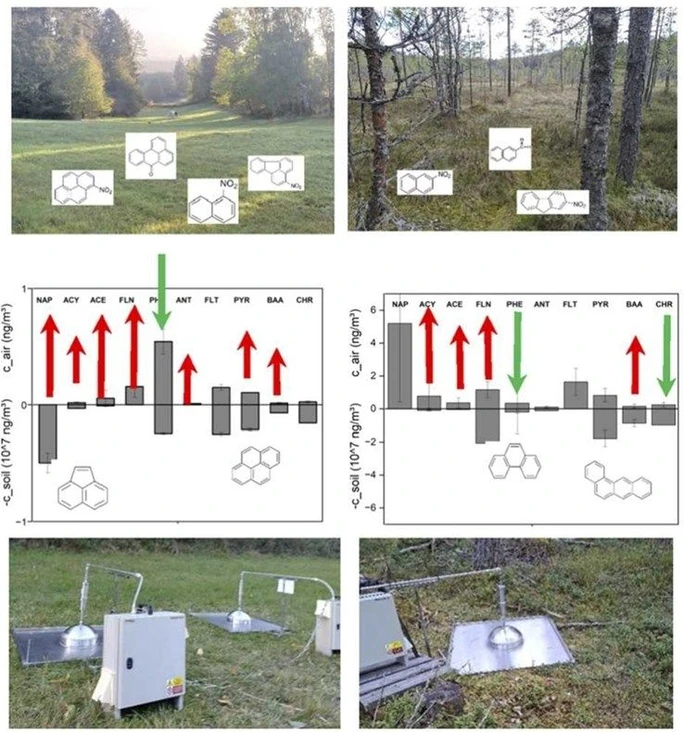
By determining air and soil contamination as well as the exchange between air and soil in rural grassland and in a remote forest, the scientists identified a number of substances being potentially re-emitted.

“Such re-emissions might add significantly to the concentrations of PACs in ambient air far from source areas," emphasizes the importance of these findings Gerhard Lammel from the RECETOX center.

For the first time, they also quantified the soil’s re-emission flux (mass of PACs volatilised per time and area) in a boreal forest in Finland. When extrapolating this flux to the country scale, they found it comparable to the primary emissions from industry, household heating, and motor vehicle traffic in Finland. The results of the study, published in the Journal of Hazardous Materials, suggest that such secondary emissions in countries receiving air pollution from neighboring states might even exceed the domestic primary emissions.

"Our results suggest that emission inventories at least in the less populated countries of Europe should account for this additional type of sources. We need more measurements to help identify sensitivities towards certain soil conditions driving these re-emissions to ultimately arrive at more accurate emission inventories across landscapes,” adds Lammel.

Furthermore, the research highlights the 'grasshopper effect’, meaning that the potential of re-emission enhances the widespread distribution and environmental lifetimes of substances hazardous for human health and ecosystems.

The research was supported by the Czech Science Foundation (25-17534S); Research Infrastructure ACTRIS-CZ (No. LM2023030) and RECETOX (No. LM2023069) financed by the Ministry of Education, Youth and Sports, and the OP RDE (the CETOCOEN EXCELLENCE project No. CZ.02.1.01/0.0/0.0/17_043/0009632).
RECETOX-MUNI: Study reveals an unexpectedly large contribution to air pollution from soilsRECETOX-MUNI: Study reveals an unexpectedly large contribution to air pollution from soils

The original article

Polycyclic aromatic compounds in air – importance of re-volatilisation from soils

Gerhard Lammel, Dominika Bezdeková, Jakub Martiník, Karsten Baumann, Rostislav Červenka, Petr Kukučka, Ondřej Letocha, Ludovic Mayer, Petra Přibylová, Roman Prokeš, Üllar Rannick, Risto Taipale

J. Hazard. Mater., 2026, 516, 143283 

https://doi.org/10.1016/j.jhazmat.2026.143283

licenced under CC-BY 4.0

Abstract

Polycyclic aromatic hydrocarbons (PAHs) and their nitrated and oxygenated derivatives (NPAHs, OPAHs) are semivolatile air pollutants which may re-volatilise following atmospheric deposition to soil. Here, we determined polycyclic aromatic compounds’ (PACs) concentrations in air, topsoil and air equilibrated with soil at a rural grassland site and a boreal forest site. The samples were analysed by GC-MS/MS and the flux was studied by fugacity calculations and a micrometeorological flux-gradient method. In soil at the boreal site, OPAH and NPAH contributed much higher fractions to PAC contamination of air and soil than at the rural site, reflecting the conversion of primary PACs during transport from sources. The same number of PACs in soil have reached equilibrium concentration with air, despite one site being in a polluted and PAC source region and the other in a much less polluted and PAC receptor region. The direction of air-soil exchange was found insensitive to the modest day-night temperature variation at both sites. Upward diffusive flux was observed for one PAH, triphenylene, at the rural grassland site, and for three 3-ring PAHs and naphthaldehyde at the boreal forest site. There, emission fluxes were quantified and ranged 0.5–12 ng m−2 h−1. The results indicate that low molecular weight PAH secondary emissions in a receptor region may be of same order of magnitude as domestic primary emissions.


RECETOX - Centrum pro výzkum toxických látek v prostředí
LinkedIn Logo
 

Related articles

Monitoring of Persistent Organic Pollutants in Ambient Air by Passive Sampling
Video | Article

Monitoring of Persistent Organic Pollutants in Ambient Air by Passive Sampling

They serve as a vital source of data for long-term monitoring of persistent organic pollutants (POPs), in addition to other pollutants of interest, in various environmental compartments.
Study reveals soil's role in air pollution and human health hazard
Scientific article | Environment

Study reveals soil's role in air pollution and human health hazard

A new study recently published by an international team of scientists has uncovered a significant yet previously overlooked environmental concern.
Development of GC-ITQ-MS chromatographic system for the identification of hydroxy derivatives of polycyclic aromatic hydrocarbons in wastewater
Scientific article | Science and research

Development of GC-ITQ-MS chromatographic system for the identification of hydroxy derivatives of polycyclic aromatic hydrocarbons in wastewater

This study developed and validated a GC-ITQ-MS method for detecting OH-PAHs in wastewater, focusing on sample prep optimization and pollutant stability in real samples.
Long-Term Air Monitoring Shows Pesticides Aren’t Gone—They’re Coming Back
Article | Science and research

Long-Term Air Monitoring Shows Pesticides Aren’t Gone—They’re Coming Back

A decade-long study from the Czech National Atmospheric Observatory shows that banned pesticides persist in the air decades later, driven by soil re-emission and slow environmental degradation.
 

Related articles

Monitoring of Persistent Organic Pollutants in Ambient Air by Passive Sampling
Video | Article

Monitoring of Persistent Organic Pollutants in Ambient Air by Passive Sampling

They serve as a vital source of data for long-term monitoring of persistent organic pollutants (POPs), in addition to other pollutants of interest, in various environmental compartments.
Study reveals soil's role in air pollution and human health hazard
Scientific article | Environment

Study reveals soil's role in air pollution and human health hazard

A new study recently published by an international team of scientists has uncovered a significant yet previously overlooked environmental concern.
Development of GC-ITQ-MS chromatographic system for the identification of hydroxy derivatives of polycyclic aromatic hydrocarbons in wastewater
Scientific article | Science and research

Development of GC-ITQ-MS chromatographic system for the identification of hydroxy derivatives of polycyclic aromatic hydrocarbons in wastewater

This study developed and validated a GC-ITQ-MS method for detecting OH-PAHs in wastewater, focusing on sample prep optimization and pollutant stability in real samples.
Long-Term Air Monitoring Shows Pesticides Aren’t Gone—They’re Coming Back
Article | Science and research

Long-Term Air Monitoring Shows Pesticides Aren’t Gone—They’re Coming Back

A decade-long study from the Czech National Atmospheric Observatory shows that banned pesticides persist in the air decades later, driven by soil re-emission and slow environmental degradation.
 

Related articles

Monitoring of Persistent Organic Pollutants in Ambient Air by Passive Sampling
Video | Article

Monitoring of Persistent Organic Pollutants in Ambient Air by Passive Sampling

They serve as a vital source of data for long-term monitoring of persistent organic pollutants (POPs), in addition to other pollutants of interest, in various environmental compartments.
Study reveals soil's role in air pollution and human health hazard
Scientific article | Environment

Study reveals soil's role in air pollution and human health hazard

A new study recently published by an international team of scientists has uncovered a significant yet previously overlooked environmental concern.
Development of GC-ITQ-MS chromatographic system for the identification of hydroxy derivatives of polycyclic aromatic hydrocarbons in wastewater
Scientific article | Science and research

Development of GC-ITQ-MS chromatographic system for the identification of hydroxy derivatives of polycyclic aromatic hydrocarbons in wastewater

This study developed and validated a GC-ITQ-MS method for detecting OH-PAHs in wastewater, focusing on sample prep optimization and pollutant stability in real samples.
Long-Term Air Monitoring Shows Pesticides Aren’t Gone—They’re Coming Back
Article | Science and research

Long-Term Air Monitoring Shows Pesticides Aren’t Gone—They’re Coming Back

A decade-long study from the Czech National Atmospheric Observatory shows that banned pesticides persist in the air decades later, driven by soil re-emission and slow environmental degradation.
 

Related articles

Monitoring of Persistent Organic Pollutants in Ambient Air by Passive Sampling
Video | Article

Monitoring of Persistent Organic Pollutants in Ambient Air by Passive Sampling

They serve as a vital source of data for long-term monitoring of persistent organic pollutants (POPs), in addition to other pollutants of interest, in various environmental compartments.
Study reveals soil's role in air pollution and human health hazard
Scientific article | Environment

Study reveals soil's role in air pollution and human health hazard

A new study recently published by an international team of scientists has uncovered a significant yet previously overlooked environmental concern.
Development of GC-ITQ-MS chromatographic system for the identification of hydroxy derivatives of polycyclic aromatic hydrocarbons in wastewater
Scientific article | Science and research

Development of GC-ITQ-MS chromatographic system for the identification of hydroxy derivatives of polycyclic aromatic hydrocarbons in wastewater

This study developed and validated a GC-ITQ-MS method for detecting OH-PAHs in wastewater, focusing on sample prep optimization and pollutant stability in real samples.
Long-Term Air Monitoring Shows Pesticides Aren’t Gone—They’re Coming Back
Article | Science and research

Long-Term Air Monitoring Shows Pesticides Aren’t Gone—They’re Coming Back

A decade-long study from the Czech National Atmospheric Observatory shows that banned pesticides persist in the air decades later, driven by soil re-emission and slow environmental degradation.