We, 30.9.2026 | Original article from: LabRulezGCMS Library
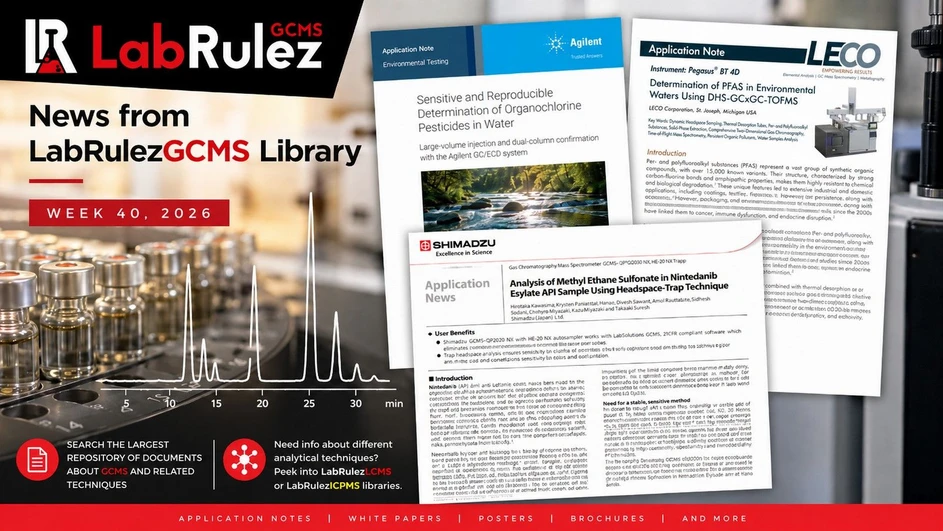
This week we bring you application notes by Agilent Technologies, LECO and Shimadzu!News from LabRulezGCMS Library - Week 40, 2026
LabRulez / AI: News from LabRulezGCMS Library - Week 40, 2026
Our Library never stops expanding. What are the most recent contributions to LabRulezGCMS Library in the week of 29th September 2026? Check out new documents from the field of the gas phase, especially GC and GC/MS techniques!
👉 SEARCH THE LARGEST REPOSITORY OF DOCUMENTS ABOUT GCMS AND RELATED TECHNIQUES
👉 Need info about different analytical techniques? Peek into LabRulezLCMS or LabRulezICPMS libraries.
This week we bring you application notes by Agilent Technologies, LECO and Shimadzu!
1. Agilent Technologies: Sensitive and Reproducible Determination of Organochlorine Pesticides in Water
Large volume injection and dual-column confirmation with the Agilent GC/ECD system
- Application note
- Full PDF for download
Organochlorine pesticides (OCPs) remain important environmental contaminants due to their persistence, bioaccumulation potential, and toxicity. Regulatory laboratories often require sensitive and robust analytical methods capable of detecting these compounds at trace levels in environmental samples. USEPA Method 8081B is commonly used for the analysis of organochlorine pesticides using GC/ECD due to the strong electron-capturing properties of halogenated compounds.1
Large volume injection (LVI) techniques can significantly improve detection sensitivity by introducing more analyte mass into the GC system. However, successful LVI implementation requires careful optimization to minimize solvent flooding, peak distortion, and poor chromatographic performance. The Agilent Multimode Inlet (MMI) provides a flexible solvent vent mode that simplifies LVI method development while maintaining analytical robustness.
In this work, an Agilent GC/ECD system equipped with MMI was evaluated for the quantitative analysis of 31 organochlorine pesticides using two analytical columns DB-5ms and DB-1701. The use of two columns follows the recommendations of USEPA Method 8081, which requires compound identification based on a primary column to be confirmed on a second column with a different stationary phase to improve analyte identification confidence. Calibration performance, unknown sample quantification, IDL determination, and multiday stability performance were assessed.
Conclusion
The Agilent GC/ECD system equipped with a Multimode Inlet successfully demonstrated robust quantitative analysis of 31 organochlorine pesticides using large volume injection technology. The solvent vent LVI approach enabled high sensitivity while maintaining good chromatographic performance and excellent reproducibility.
Key performance highlights included:
- Successful dual-column setup meeting EPA 8081 confirmatory identification requirements
- Excellent calibration linearity with R² values greater than 0.992
- IDLs of 2.39 ppb or lower for all analytes
- Excellent retention time repeatability with %RSD ≤ 0.07%
- Stable multiday peak area reproducibility with %RSD ≤ 7.83%
The combination of Agilent GC/ECD instrumentation, MMI solvent vent technology, and optimized large volume injection workflow provides an effective solution for routine environmental monitoring of organochlorine pesticides.
2. LECO: Determination of PFAS in Environmental Waters Using DHS-GCxGC-TOFMS
- Application note
- Full PDF for download
Per- and polyfluoroalkyl substances (PFAS) represent a vast group of synthetic organic compounds, with over 15,000 known variants. Their structure, characterized by strong carbon-fluorine bonds and amphipathic properties, makes them highly resistant to chemical 1 and biological degradation. These unique features led to extensive industrial and domestic applications, including coatings, 1 textiles, firefighting foams, packaging, and cosmetics. However, their persistence and mobility in the environment, along with their bioaccumulative nature, have raised serious health and ecological concerns. PFAS have been detected in human blood, breast milk, and umbilical cords, and studies since the 2000s have linked them to cancer, immune dysfunction, and endocrine 2 disruption.
Their recognition as persistent organic pollutants (POPs) under the Stockholm Convention in 2001 has prompted global efforts 3 to limit their release. Yet treating PFAS-contaminated water remains challenging, particularly for short-chain congeners that are not included in conventional removal methods. Monitoring is further complicated by their low concentrations and the interference of complex sample matrices. In addition, traditional sample preparation techniques like liquid-liquid extraction 4,5 (LLE) and solid-phase extraction (SPE) are laborious, solvent intensive, and prone to contamination. In this context, the use of thermal desorption tubes (TDTs) is well suited for trace-level compounds. They enable effective preconcentration while 6 minimizing solvent use and sample handling, reducing the risk of contamination.
This research aimed to leverage dynamic headspace extraction (DHS) combined with thermal desorption as an alternative for the extraction of volatile and semi-volatile PFAS in water samples. Advanced analytical techniques such as gas chromatography coupled to time-of-flight mass spectrometry (GC-TOFMS) and comprehensive two-dimensional gas chromatography (GCxGC)-TOFMS were used to enhance resolution, sensitivity, and selectivity.
Experimental
Both GC-TOFMS and GCxGC-TOFMS analyses were performed on a Pegasus BT 4D GCxGC-TOFMS system (LECO Corporation, MI, USA) equipped with an Agilent 8890 GC and an RTC-PAL autosampler capable of automated handling of desorption tubes by employing a Capping/Decapping tool from GL Sciences (Eindhoven, The Netherlands). Sample injections were carried out using an Optic-4 multimode inlet (GL Science, Eindhoven, The Netherlands) with Peltier cooler and a liner exchanger (i.e., LINEX). The GC system was also equipped with a cryogenic trap, used for the secondary trapping/release stage. ® 7 The instrument parameters are summarized in Table 1. Data were acquired and processed using ChromaTOF software.
Conclusions
The use of dynamic head-space extraction and thermal-desorption GC(xGC)-TOFMS using the LECO Pegasus BT 4D enabled the determination of nine volatile PFAS targets, including fluorotelomer alcohols, acrylates, and alkyl sulfonamides. The method achieved sensitive and precise quantification, with LOQs down to 6.6 ng L⁻¹ and repeatability between 1.4-7.9% RSD. When compared with 1D GC, the enhanced sensitivity of GCxGC allowed reliable detection of PFAS even at much lower concentrations. Moreover, the superior separation power of GCxGC supported effective non-target screening, enabling the identification of additional environmentally relevant compounds in an industrial water case study.
The combination of DHS-TD with GC-TOFMS, and particularly with GCxGC, provides a versatile platform that ensures robust quantification, high sensitivity, and expanded capabilities for both targeted PFAS analysis and non-targeted screening, supporting its application in environmental monitoring. Given the presence of hundreds of molecules, many of which are still poorly known and characterized, future studies will extend the workflow by including GC(xGC)-HRMS, which represents an important step toward a more comprehensive characterization of this emerging class of (semi-)volatile contaminants and will support the discovery of unknown congeners.
3. Shimadzu: Analysis of Methyl Ethane Sulfonate in Nintedanib Esylate API Sample Using Headspace-Trap Technique
- Application note
- Full PDF for download
User Benefits
- Shimadzu GCMS-TQ8050 NX with HS-20 NX autosampler works with LabSolutions GCMS 21CFR compliant software which extendsits utilization in compliance environment like pharmaceuticals
- Trap headspace enables concentrating the analytes in cold trap with multi-injection count and helps to achieve higher sensitivity overstatic headspace, especially for trace level quantitation
Overview: Alkyl and aryl sulfonic acids have been used in the synthesis of active pharmaceutical ingredients (APIs) in various measures. They are known for their acid catalytic properties, sulfonamide intermediates and as agents to enhance solubility through salt formation. However, as the reactions progress, they form their respective esters, which are well-known potent genotoxic impurities (GTIs), that act as DNA-alkylating agents in biological systems posing mutagenic and carcinogenic risks even at trace levels. Hence, it is necessary to categorize, qualify, and control these impurities to limit the potential carcinogenic risks, as mentioned in ICH M7(R2).
Nintedanib Esylate API belongs to a family of kinase inhibitors, used primarily to treat idiopathic pulmonary fibrosis (IPF). It acts as a triple angiokinase inhibitor which targets receptors involved in pulmonary fibrosis. The synthesis of the API often involves the reaction of Nintedanib free base with Ethane Sulfonic Acid in a process called as salification. The salt formed in the form of yellow crystals is used further in formulations to enhance stability as well as solubility. The by-product of this reaction, often due to presence of residual short-chain alcohols, is Methyl Ethane Sulfonate (MES).
As per the ICH M7(R2) guidelines, a TTC (Threshold of Toxicological Concern) based acceptable intake of a mutagenic impurity of 1.5 μg/day which can be used for most pharmaceuticals as a default value, to derive an acceptable limit for control [2,3]. Nintedanib Esylate is supposed to be administered orally. Strength of the Nintedanib Esylate API in most of the medicines is 150 mg per capsule and prescribed dose is twice in a day. [4]
Irrespective of the limit calculated from maximum daily dose, Shimadzu has worked upon developing a method for quantification of MES at lowest possible detection so that it will be beneficial for the concern pharmaceuticals even if daily dose exceeds 0.3 g/day.
Need for a robust analytical method
Nintedanib Esylate API shows high solubility in acidic pH of about 3. To inject acidic aqueous media into GC via direct injection technique creates the risk of very high vapor pressure at the injector port. Further, its entry into the column might affect the stationary phase, thereby drastically reducing the shelf-life of the column. As a result, sensitivity of the analytical method becomes questionable. In order to overcome the said issues, it is imperative to develop a robust analytical method pertaining to high sensitivity, repeatability and reproducibility of the results.
In this regard, Shimadzu GCMS-TQ8050 NX triple quadrupole system with HS-20 NX (Trap) as shown in Figure 2, was used to develop a selective and sensitive method for the determination of Methyl Ethane Sulfonate in Nintedanib Esylate API at trace levels.
Further, development and partial validation were performed at significantly lower concentrations which clearly evidences the capability of instrument and suitability of the developed method.
To evaluate the method suitability, few validation parameters were performed such as system suitability, LOQ precision, Linearity and accuracy in terms of spike recovery. Refer Table 1 for the concentration levels of method validation parameters.
Conclusion
- Shimadzu GCMS-TQ8050 NX with HS-20 NX (Trap) autosampler enables accurate quantification of Methyl Ethane Sulfonate in Nintedanib Esylate API sample at ppb level.
- Trap mode in the HS-20 NX auto sampler benefits in extracting the analyte multiple times which enhances sensitivity