Mo, 28.9.2026 | Original article from: J. Pharm. Biomed. Anal. Open., 2026, 100111, Volume 7
A derivatization-assisted chiral LC-MS/MS method separates and quantifies carnitine and acetylcarnitine enantiomers in meat, milk, and fermented foods.Development of a chiral liquid chromatography-tandem mass spectrometry for simultaneous determination of carnitine and acetylcarnitine enantiomers in food samples
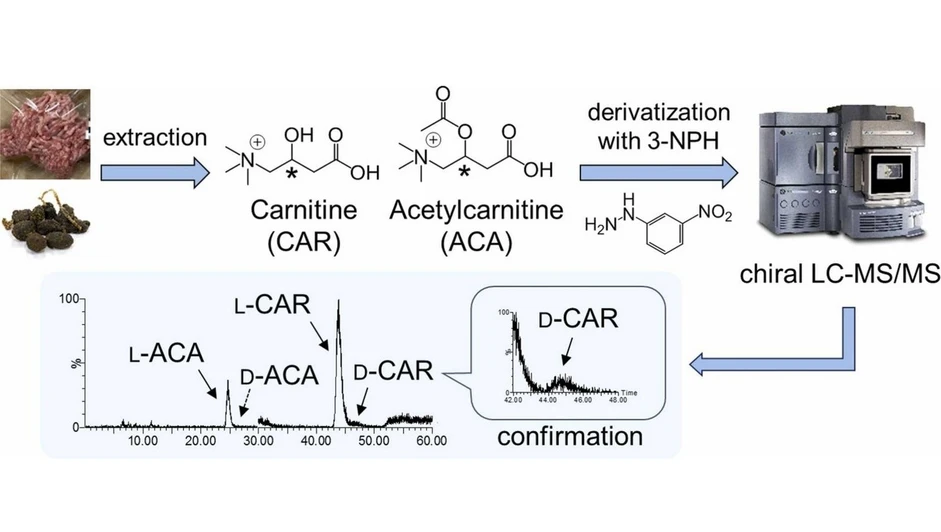
J. Pharm. Biomed. Anal. Open., 2026, 100111, Volume 7: Graphical abstract
This study develops a chiral LC-MS/MS method with pre-column derivatization for simultaneous determination of carnitine (CAR) and acetylcarnitine (ACA) enantiomers in food. Conversion to 3-nitrophenylhydrazine derivatives followed by separation on a CHIRALPAK ZWIX (−) column provided resolution values above 1.57 for the respective enantiomers.
After validation, the method was applied to meat, milk, and fermented soybean products. L-CAR and L-ACA were detected in all tested foods, while trace amounts of D-CAR were identified in the traditional Japanese fermented food Hama-natto, demonstrating the method’s suitability for selective food analysis.
The original article
Development of a chiral liquid chromatography-tandem mass spectrometry for simultaneous determination of carnitine and acetylcarnitine enantiomers in food samples
Aogu Furusho, Hiroki Mizuno, Yutaro Nakayama, Eiji Sugiyama, Kenji Kojima, Kenichiro Todoroki
J. Pharm. Biomed. Anal. Open., 2026, 100111, Volume 7
licensed under CC-BY 4.0
Selected sections from the article follow. Formats and hyperlinks were adapted from the original.
Carnitine (CAR) is a functional endogenous compound found in various animals [1]. Since CAR has one asymmetric carbon in its structure, the l- and d-enantiomers are present. l-CAR is a cofactor that transports long-chain fatty acids into the mitochondria and promotes energy production via β-oxidation [2]. Humans biosynthesize 25% of the required amounts of l-CAR from l-lysine and l-methionine and ingest the remaining 75% from foodstuffs [3], [4]. The insufficient intake of l-CAR induces a CAR deficiency [5], and levocarnitine (l-form) is used as the therapeutic drug. Acetylcarnitine (ACA) is an acetylated molecule of CAR and is converted from CAR by carnitine O-acetyltransferase in the human body [6]. ACA is also related to energy production and is essential for storing acetyl groups to produce acetylcholine [7]. A previous study demonstrated that l-ACA taken from foods was partially hydrolyzed in the body and increased the l-CAR concentration within the tissues of aged rats [8], indicating that CAR and ACA are interconverted. Furthermore, l-ACA has some therapeutic effects to downregulate inflammation-induced angiogenesis [9] and to reduce nerve pain [7], [10], making it a promising drug candidate. Both CAR and ACA are also commercially available as supplements to reduce body fat.
Meanwhile, the d-isomers don’t have the above functions and are not thought to be present in the human body. Previous studies have revealed some specific functions such that d-CAR inhibited the l-CAR absorption causing CAR deficiency [11], and d-ACA enhanced the efficiency of the drug for the Pompe disease [12]. Since the physiological actions of the d-forms and l-forms differ, enantioselective analysis of the CAR and ACA enantiomers is desirable for studying their functions and biokinetics.
Several analytical methods have been already developed for the determination of the CAR and ACA enantiomers. In these methods, two approaches were mainly taken; i.e., the reversed-phase separation with the combination of diastereomeric derivatization and the direct separation by an enantioselective column. To convert enantiomers to diastereomers, chiral reagents, such as (+)-1-(9-fluorenyl)ethyl chloroformate [13] and l-alanine-β-naphthylamide [14], were used. The conventional ODS column successfully separated the CAR and ACA enantiomers as their diastereomeric derivatives, and the methods were reported to be applicable for the enantiomeric purity check of drug substances. Regarding the chiral liquid chromatographic (LC) method, various types of enantioselective columns have been tested, but it was revealed that the separation of the CAR and ACA enantiomers was quite difficult [15]. A CHIRALCEL OD-R column based on the polysaccharide structure was among the few that achieved simultaneous separation of the CAR and ACA enantiomers. The target analytes were derivatized with (α-bromo)methyl phenyl ketone, and the method was applied to the analysis of drug substances [16]. However, the measurement of foods, pharmaceutical agents, and biological samples has scarcely been performed, likely due to the low selectivity of the LC separation and ultraviolet/fluorescence detection used in these methods. Thus, improving the selectivity of the method is required to expand the range of the measurable samples.
In the present study, a chiral LC-tandem mass spectrometric (MS/MS) method has been developed for the simultaneous determination of the CAR and ACA enantiomers. Direct separation using an enantioselective column enables the analysis independent of the optical purity of the reagents, and MS/MS could provide a higher selectivity than those of the previous methods. Furthermore, because CAR and ACA possess an ammonium cation which contributes to the high ionization efficiency, a high sensitivity by MS could also be expected. After the method development and validation, the content analyses of the CAR and ACA enantiomers were performed for meat, milk, and soybean fermented food samples.
2. Experimental
2.4. LC-MS conditions
The LC-MS/MS system consisted of ultra-high performance liquid chromatographic systems (ACQUITY H-class and I-class, Waters, Milford, MA, USA) and triple quadrupole mass spectrometers (Xevo TQ-S and TQ-S micro, Waters). The chiral separation of CAR and ACA was performed on a CHIRALPAK ZWIX (-) column (3.0 mm I.D.×250 mm, 3 µm, Daicel Corporation, Osaka, Japan) at room temperature. The mobile phases were 5 mM FA/NH4FA in H2O/MeOH/MeCN (A: 2/9/89 and B: 2/19/79, v/v/v) at the flow rate of 0.25 mL/min. The LC gradient property was as follows: 0–25 min, 100% A; 25.1–45 min, 100% B; 45.1–60 min, 100% A. The MS detection was performed with the following conditions: 3.0 kV spray voltage for ESI positive ionization; 150 L/hr cone gas flow rate; 1000 L/hr desolvation gas flow rate; 150°C source temperature; 500°C desolvation temperature. The selected reaction monitoring (SRM) mode was used for the detection, and the set transitions, cone voltage (CV), and collision energy (CE) for the target compounds are summarized in Table 1. The different CEs were used for 3-NPH-ACA on Xevo TQS (10 eV) and Xevo TQ-S micro (20 eV). Data processing was performed using MassLynx v4.2 software (Waters).
3. Results and discussion
3.4. Determination of the CAR and ACA enantiomers in food samples
The developed method was applied to the analysis of the CAR and ACA enantiomers in food samples. CAR and ACA are known to be abundant in animal-based foods [23], thus, beef, pork, chicken, and milk were measured. The measured cuts of meat were the shank for beef, thigh for pork, and thigh for chicken in this study, and these parts are commonly used in commercially-available ground meats. Fermented foods are reported to contain relatively high levels of d-amino acids, and some of them are considered to be produced by bacteria during the fermentation process [24]. To investigate the production of CAR and ACA by bacteria, three fermented foods made from soy beans (miso, soy sauce, and Hama-natto) were analyzed. Hama-natto is a traditional food from the Hamamatsu City area in Shizuoka Prefecture, Japan. Steamed soybeans are fermented with koji mold, then salted and dried in the sun.
The chromatograms of the beef and Hama-natto samples are shown in Fig. 4. l-CAR and l-ACA were clearly observed in both samples. The l-forms were also found in the other tested samples, and their quantified values are summarized in Table 4. Comparing the amounts of l-CAR in the meat samples, beef had the highest levels, followed by pork and chicken. The l-ACA levels were also the highest in beef, and chicken contained more than pork.
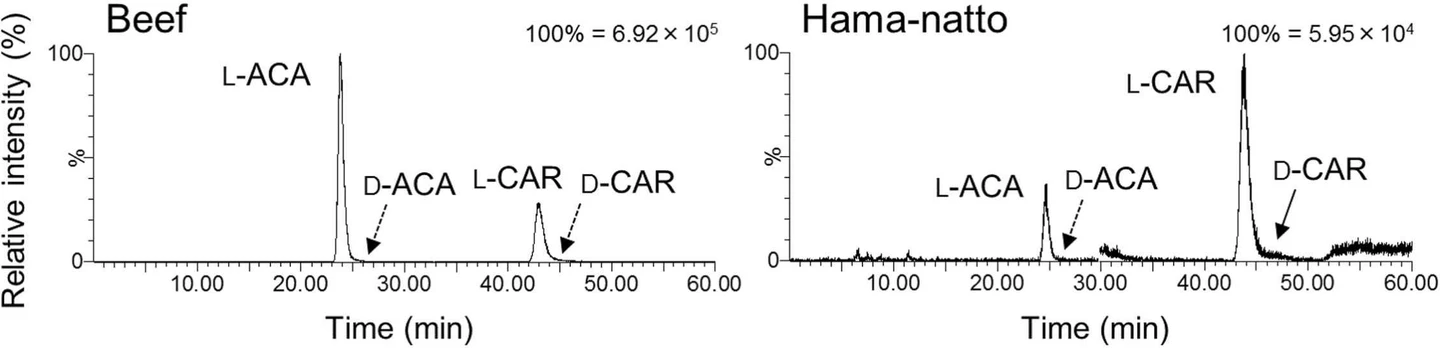 J. Pharm. Biomed. Anal. Open., 2026, 100111, Volume 7: Fig. 4. Determination of the CAR and ACA enantiomers in beef and Hama-natto samples as their 3-NPH derivatives. The selected ion chromatogram of ACA is shown for 0–30 min, and that of CAR is shown for 30–60 min.
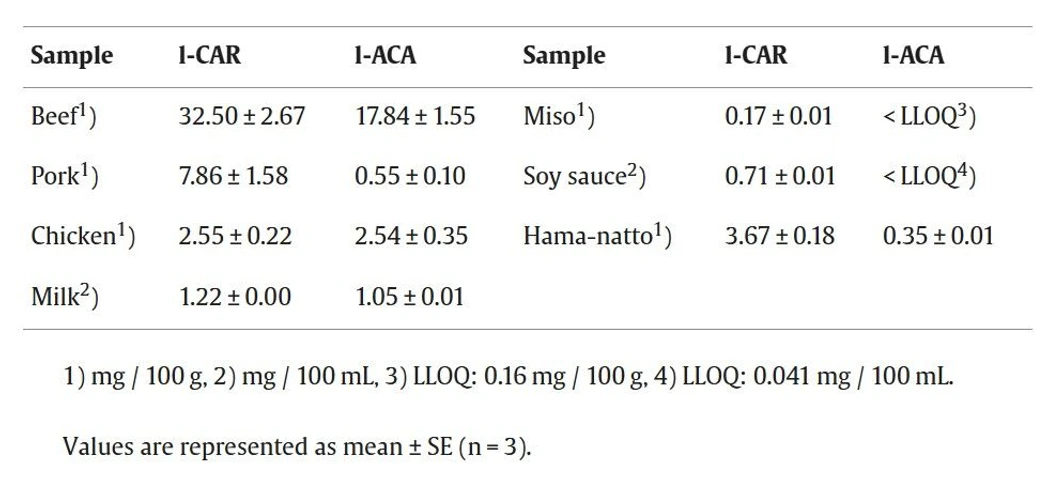 J. Pharm. Biomed. Anal. Open., 2026, 100111, Volume 7: Table 4. Amounts of l-CAR and l-ACA in the food samples.
3.5. Confirmation of D-CAR in the Hama-natto sample
To confirm the presence of d-CAR in the Hama-natto, four approaches were conducted; i.e., remeasurement of the fraction, detection with a different SRM transition, separation under different LC conditions and use of high-resolution MS. The fraction was placed in a 1.5 mL tube for three min before the MS to purify the d-CAR. The solution (total 750 µL) was dried and dissolved in 50 µL of the mobile phase. The chromatogram obtained by the remeasurement is shown in Fig. 5A, and the result detected by a different SRM transition (297.1 > 102.1) is in Fig. 5B. The peak of d-CAR was clearly observed in both measurements, and the peak shapes were similar. However, the amount of d-CAR was under the LLOQ and could not be quantified. As shown in Fig. 5C, d-CAR was also detected using the different LC conditions described in Section 2.6, suggesting that the peak was definitely derived from the d-CAR. A high-resolution MS analysis detected a molecule with m/z 297.155, which closely matched with the exact mass of 3-NPH-CAR (m/z 297.156). The extracted ion chromatogram of that molecule is shown in Fig. 5D, and the d-CAR peak was clearly observed. These results demonstrated that trace amounts of d-CAR were present in the Hama-natto sample. To the best of our knowledge, this is the first report to find natural d-CAR in foods. One possible origin of this d-CAR is a production by bacteria including koji mold. Some bacteria are known to produce d-amino acids for cell wall formation [32]. The bacteria capable of producing d-CAR may exist and be involved in the fermentation of Hama-natto. Since the l-CAR and l-ACA concentrations in the other fermented foods were lower than that in Hama-natto, there is a possibility to also detect the d-forms from other foods by the improvement of the extraction process. Further research using various food samples is expected.
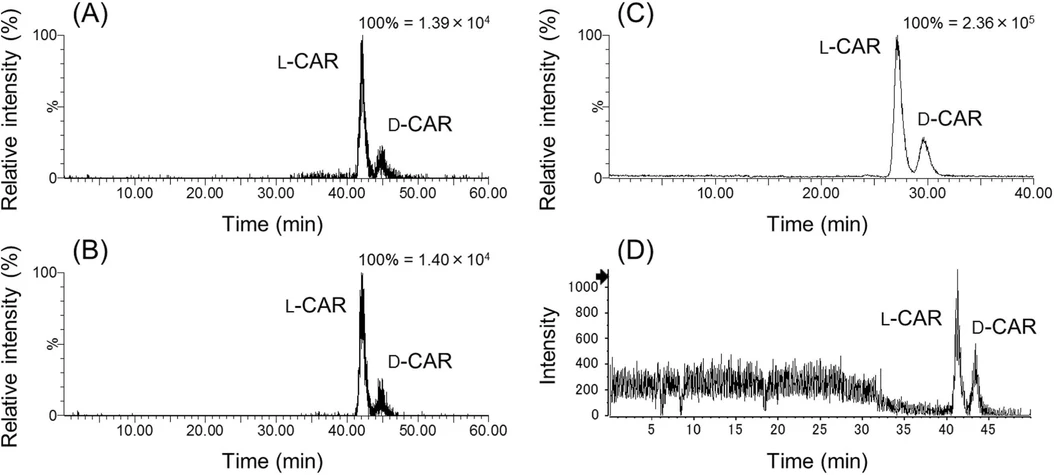 J. Pharm. Biomed. Anal. Open., 2026, 100111, Volume 7: Fig. 5. Chromatograms of the 3-NPH-d-CAR fractions analyzed by the different analytical methods. The SRM transitions were 297.1 > 102.1 (A) and 145.1 (B). The fraction was analyzed by LC-MS/MS under the different conditions (C) and LC-TOF-MS (D). The detailed analytical conditions are described in Section 2.6.
4. Conclusion
In the present study, a chiral LC-MS/MS method has been developed for the simultaneous determination of the CAR and ACA enantiomers in food samples. The derivatization with 3-NPH extended the retention time and improved the enantiomeric separations especially for CAR. The validated method was successfully applied to the analysis of meat, milk, and soybean fermented food samples, and trace amounts of d-CAR were discovered in Hama-natto. The present method is able to distinguish enantiomers in various samples and can contribute to clarifying the origin of d-CAR in food samples and searching/developing for new functional food products.