Mo, 28.9.2026 | Original article from: Microchemical Journal, 2026, 119216, Volume 228
A benzoylation strategy enables GC-EI-MS analysis of acidic and basic nerve-agent degradation products, with benzoic anhydride providing the best performance.Benzoylation strategy for GC–EI–MS analysis of alkyl methylphosphonic acids, amidines and guanidines as retrospective markers of nerve chemical warfare agent use
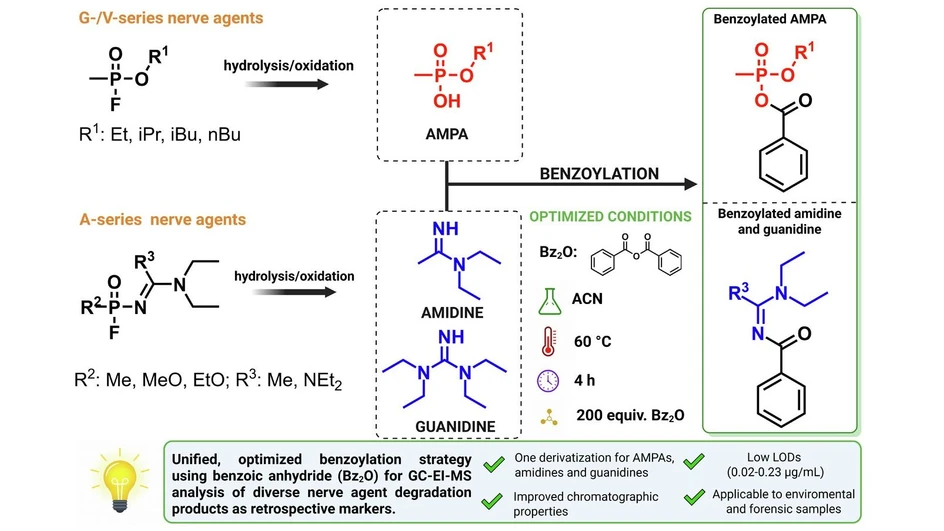
Microchemical Journal, 2026, 119216, Volume 228: Graphical abstract
This study evaluates benzoylation as a unified derivatization strategy for GC-EI-MS analysis of persistent degradation products associated with G-, V-, and A-series nerve agents. Alkyl methylphosphonic acids, amidines, and guanidines were derivatized using benzoyl chloride and benzoic anhydride, with reaction conditions, solvent effects, derivative stability, and reagent excess systematically optimized.
Benzoic anhydride provided superior derivative stability and handling characteristics, with optimized conditions enabling detection limits of 0.02–0.23 μg/mL. The method was successfully applied to contaminated sand, concrete, and water extracts, demonstrating its potential for retrospective forensic analysis of chemically diverse nerve-agent degradation markers.
The original article
Benzoylation strategy for GC–EI–MS analysis of alkyl methylphosphonic acids, amidines and guanidines as retrospective markers of nerve chemical warfare agent use
Tomas Rozsypal, Vladimir Finger, Lukas Prchal
Microchemical Journal, 2026, 119216, Volume 228
licensed under CC-BY 4.0
Selected sections from the article follow. Formats and hyperlinks were adapted from the original.
Organophosphorus nerve agents remain among the most toxic synthetic chemicals ever developed and continue to represent a major concern in the fields of chemical security and forensic science. Their intentional misuse in recent decades has renewed global interest in analytical strategies capable not only of identifying the parent agents, but also of detecting their transformation products in complex realworld samples [1,2]. In practical scenarios, the parent compounds undergo hydrolysis and other degradation processes after release, whereas more stable degradation products may persist for substantially longer periods and therefore provide valuable retrospective evidence of contamination [3,4]. For this reason, the analysis of degradation markers has become an essential component of modern forensic and environmental investigations involving nerve agents.
Among the most relevant degradation products are alkyl methylphosphonic acids (AMPAs) originating from G-series and V-series nerve agents, as well as nitrogen-containing amidine and guanidine derivatives associated with A-series (Novichok) nerve agents [5–7]. AMPAs are well-established hydrolysis products that are chemically stable, water-soluble, and frequently encountered in environmental and biomedical matrices [4]. In contrast, amidine and guanidine degradation products of A-series agents have received considerably less experimental attention despite their growing relevance in contemporary chemical forensics. These highly polar and strongly basic compounds often exhibit poor chromatographic behavior, limited volatility, and strong interactions with active surfaces, making their analysis particularly challenging [8–11].
Gas chromatography–mass spectrometry (GC–MS) remains one of the principal techniques for the analysis of chemical warfare agents (CWAs) and related compounds [12]. However, polar degradation products often do not possess physicochemical properties suitable for direct GC–MS analysis due to their high polarity and low volatility [13]. Derivatization therefore remains one of the most effective strategies for overcoming these analytical limitations by converting polar or ionic analytes into more hydrophobic, thermally stable, and chromatographically amenable derivatives [14]. Numerous derivatization approaches have been reported for AMPAs, including conversion to silyl derivatives [15,16], alkyl esters [17–20], and esters derived from aromatic alcohols [21–27]. However, these methods may suffer from moisture sensitivity, incomplete reactions, unstable products, or limited applicability across matrices. Moreover, conventional derivatization procedures are generally not suitable for amidines and guanidines, which has stimulated the development of new robust derivatization protocols for routine forensic analysis [9,10].
Acylation is a well-established derivatization approach in analytical chemistry and has previously been applied to several compounds related to CWAs, particularly alcohols [28–31] and chlorides [32]. Among available reagents, benzoylation agents appear especially promising. In GC–MS, benzoylation may improve retention, peak shape, and structural identification through characteristic aromatic fragmentation pathways [28,31]. The introduced phenyl group also provides strong UV absorbance useful in liquid chromatography, where these reagents have been widely employed for the determination of amines, phenols, and other polar compounds in environmental, pharmaceutical, food and biological analysis [33–37]. In addition, unlike many conventional halogenated acylating reagents, benzoylation reagents may offer a more favorable environmental profile. Despite these advantages, benzoylation has not yet been systematically explored for AMPAs or amidine and guanidine degradation products related to A-series nerve agents prior to GC–MS identification.
The aim of the present study was therefore to investigate benzoylation as a unified derivatization strategy for two analytically challenging classes of nerve-agent degradation products: alkyl methylphosphonic acids and amidine/guanidine markers of A-series nerve agents. Emphasis was placed on selection of suitable reagent, optimization of reaction conditions, and suitability for GC–MS analysis. By evaluating a common derivatization platform across structurally distinct analytes, this work seeks to expand the toolbox available for retrospective identification of degraded nerve agents in environmental and forensic samples.
2. Experimental
2.2. Instrumental
2.2.1. GC–FID and GC–MS
For the development of derivatization methods, a Trace 1310 gas chromatograph equipped with a flame ionization detector (GC–FID) and a TG-5MS column (30 m × 0.32 mm × 0.50 μm; Thermo Scientific, Waltham, USA) was used. The injection port temperature was set to 250 ◦C with a split ratio of 1:20. Helium (99.999% purity) was used as the carrier gas at a constant flow rate of 1.5 mL/min. The detector temperature was maintained at 280 ◦C, with gas flow rates of 350 mL/ min for air, 40 mL/min for hydrogen, and 30 mL/min for nitrogen makeup gas (all 5.0 purity). The oven temperature program started at 80 ◦C (held for 2 min), then increased at 20 ◦C/min to 280 ◦C (held for 2 min). Injections (1 μL) were performed using TriPlus RSH autosampler. Data acquisition and processing were carried out using Chromeleon 7.3.0 software (Thermo Scientific, Waltham, USA).
For acquisition of mass spectrometric (MS) data and further method optimization, a GC–MS system Trace 1610 coupled with ISQ 7610, equipped with a TG-5MS capillary column (30 m × 0.25 mm, 0.25 μm film thickness; all Thermo Scientific, Waltham, USA). Samples were injected in split mode (1:5) into a deactivated liner packed with glass wool. The injector temperature was set to 250 ◦C. Helium (99.999% purity) was used as the carrier gas at a constant flow rate of 1.0 mL/min.
The oven temperature program started at 80 ◦C (held for 2 min), ramped at 10 ◦C/min to 280 ◦C, and was held at the final temperature for an additional 2 min. The ISQ mass spectrometer operated in electron ionization (EI) mode at 70 eV. The MS parameters were as follows: transfer line temperature 275 ◦C, ion source temperature 230 ◦C, and ion optics temperature 233 ◦C. Data were acquired in full-scan mode over a mass range of m/z 40–400. Sample injections were performed using a TriPlus RSH autosampler, and chromatographic control and data processing were conducted using Chromeleon 7.3.2 software (Thermo Scientific, Waltham, USA).
3. Results and discussion
3.7. Chromatograms (TICs) and mass spectra
Representative chromatograms obtained after derivatization using Bz2O are shown in Fig. 5. All investigated analytes produced wellresolved chromatographic peaks without significant coelution between individual derivatives. Due to the introduction of aromatic benzoyl groups, the formed derivatives exhibited relatively high retention indices ranging from 1692 to 2072. Such retention behavior may be advantageous in practical GC–MS analysis, as late-eluting compounds are generally less affected by volatile matrix interferences and solventrelated background signals commonly occurring in the early part of chromatograms [17,18,27,28,31]. The highest retention was observed for DEA and particularly TEG, reflecting both their molecular size and the contribution of multiple ethyl substituents in combination with benzoylation.
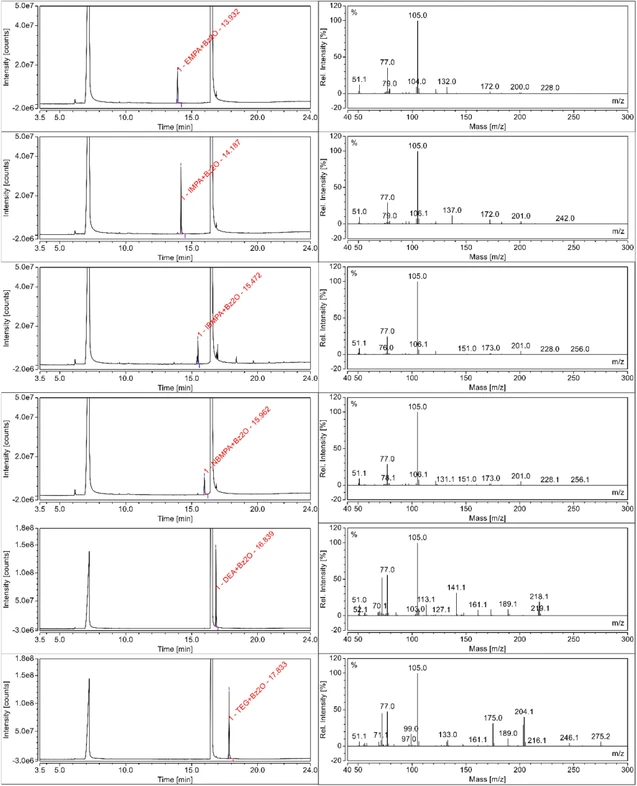 Microchemical Journal, 2026, 119216, Volume 228: Fig. 5. Representative GC–EIMS total ion chromatograms and corresponding mass spectra of benzoylated derivatives of investigated AMPAs, amidine, and guanidine obtained after derivatization with benzoic anhydride (Bz2O). Chromatograms are presented without background subtraction.
Several background peaks originating from the derivatization system were also observed. The dominant late-eluting signal at 16.56 min corresponded to residual benzoic anhydride reagent. Despite its relatively high intensity, this peak did not interfere with identification of the target analytes due to sufficient chromatographic separation. At the same time, its presence further emphasizes the importance of optimizing reagent excess in derivatization-based analytical procedures in order to minimize unnecessary background contribution from residual derivatization reagents. The optimized reagent volume selected in this study therefore represents a compromise between efficient derivatization and maintaining the residual Bz2O peak as small as reasonably achievable. An additional smaller background signal was observed at 7.25 min identified as benzoic acid. Nevertheless, as with other derivatizationbased GC–MS methods, routine maintenance of the injector liner, the use of glass-wool-packed deactivated liners and guard columns, and periodic trimming of the analytical column are recommended during prolonged routine use to minimize gradual accumulation of non-volatile reaction by-products and maintain stable chromatographic performance.
Mass spectra of all benzoylated derivatives were characterized by the presence of molecular ions, which represents an important feature for molecular-weight confirmation and reliable identification. For AMPA derivatives, the spectra were dominated by the benzoyl-related ion at m/ z 105, accompanied by characteristic aromatic fragments at m/z 77 and m/z 51. Molecular ions were observed at m/z 228 for EMPA, m/z 242 for IMPA, and m/z 256 for both IBMPA and NBMPA. The isomeric derivatives of IBMPA and NBMPA exhibited very similar fragmentation patterns, but they were clearly differentiated by their retention times and retention indices (Table 2), demonstrating the importance of combining MS data with chromatographic information.
 Microchemical Journal, 2026, 119216, Volume 228: Table 2. Analytical performance parameters of the developed GC–MS method following derivatization with benzoic anhydride (Bz2O) in acetonitrile, including retention times (RT), retention indices (RI), calibration parameters, coefficients of determination (R2), limits of detection (LOD), limits of quantification (LOQ), and intra−/interday precision expressed as relative standard deviation (RSD) for retention times and peak areas.
The benzoylated DEA and TEG derivatives also showed prominent benzoyl-related ions at m/z 105 and m/z 77, together with analytespecific fragments. DEA exhibited a molecular ion at m/z 218, with additional characteristic ions at m/z 141, m/z 113, and m/z 189. TEG showed a molecular ion at m/z 275, accompanied by diagnostic ions at m/z 204, m/z 175, m/z 246, and m/z 216. The presence of molecular ions for all derivatives, together with compound-specific fragments and RI data, provided sufficient selectivity for confirmation of structurally related degradation products.
4. Conclusions
Benzoylation has previously been reported in the field of chemical weapons primarily for derivatization of alcohol-containing compounds. In the present study, the approach was successfully extended to analytically challenging alkyl methylphosphonic acids together with amidine and guanidine degradation products related to A-series nerve agents. The developed procedure therefore represents a versatile derivatization strategy applicable to several important classes of retrospective CWA degradation markers within a single analytical workflow.
Compared with previously used benzoyl chloride-based procedures, replacement of BzCl by benzoic anhydride significantly improved the practical applicability of the method. Bz2O exhibited superior derivative stability, safer handling properties, lower volatility, and elimination of corrosive hydrogen chloride formation during derivatization. In addition, the reagent was readily soluble in ACN, and the prepared 10% solution remained stable for at least 14 days when stored under refrigerated and dark conditions, supporting its suitability for routine analytical use. Successful derivatization in both ACN and EtOAc further demonstrated that the developed approach is not dependent on chlorinated solvents or highly hazardous derivatization media, improving its practical flexibility and environmental acceptability.
The introduced benzoyl moiety substantially increased chromatographic retention of all investigated analytes on a conventional DB-5- type stationary phase compared with many commonly used volatile derivatives. Such behavior may be advantageous for analysis of complex environmental or forensic samples, where numerous matrix-derived compounds are typically concentrated in the early-eluting region of the chromatogram together with residual parent CWAs. The obtained derivatives additionally produced characteristic and structurally informative mass spectra, including observable molecular ions for all investigated analytes. Moreover, the introduced aromatic substituent enabled UV detection of the derivatized compounds by conventional reversedphase HPLC. These preliminary results demonstrate the potential of the benzoylation strategy for complementary HPLC-based analysis, although further chromatographic optimization is required, particularly for the TEG derivative.
Optimal derivatization conditions consisted of heating at 60 ◦C for 4 h using Bz2O in ACN without any additional treatments. Nevertheless, substantial analytical responses were already achieved at significantly shorter reaction times, indicating that the method may also be applicable in time-constrained analytical scenarios. Together with the demonstrated stability of the reagent solution and robustness of the derivatization system, this suggests potential applicability not only in stationary reference laboratories but also in mobile analytical laboratories involved in operational and forensic investigations following suspected CWA release.