We, 16.9.2026 | Original article from: LabRulezGCMS Library
This week we bring you application note by Agilent Technologies, poster by Shimadzu / AOAC and brochure by Thermo Fisher Scientific!News from LabRulezGCMS Library - Week 38, 2026

LabRulez / AI: News from LabRulezGCMS Library - Week 38, 2026
Our Library never stops expanding. What are the most recent contributions to LabRulezGCMS Library in the week of 14th September 2026? Check out new documents from the field of the gas phase, especially GC and GC/MS techniques!
👉 SEARCH THE LARGEST REPOSITORY OF DOCUMENTS ABOUT GCMS AND RELATED TECHNIQUES
👉 Need info about different analytical techniques? Peek into LabRulezLCMS or LabRulezICPMS libraries.
This week we bring you application note by Agilent Technologies, poster by Shimadzu / AOAC and brochure by Thermo Fisher Scientific!
1. Agilent Technologies: Analysis of Ethylene Glycol and Diethylene Glycol in Oral Syrup Containing Glycerin
Using the Agilent 8890 GC system coupled with the Agilent 5977C GC/MSD
- Application note
- Full PDF for download
This study demonstrates the use of an Agilent 8890 GC system coupled with the Agilent 5977C single quadrupole GC/MSD to detect and quantify ethylene glycol (EG) and diethylene glycol (DEG) in oral syrups containing glycerin per United States Food and Drug Administration (USFDA) recommendations.1 Samples were extracted using methanol, filtered through nylon filters, then followed by GC/MS analysis. Instrument Limit of Quantification (iLOQ) of 0.1 ppm was achieved using internal standard calibration. A solvent-based calibration range was established from 0.1 to 4 ppm.
Experimental
GC parameters
- Inlet Temperature: 240 °C
- Analytical Column: DB-WAX GC column, 30 m × 0.25 mm, 0.50 µm
- Injection Volume: 1 µL
- Column Flow: Helium; 1.0 mL/min, constant flow
- Injection Mode: Split (20:1)
- Oven Program: Start at 130 °C (hold for 4 min), ramp at 17 °C/min to 195 °C (hold for 4 min), then at 35 °C/min to 240 °C (hold for 4 min).
- MS Transfer Line Temperature: 240 °C
MS Parameters
- SIM Ions: 31, 33, 43, 75, 113
- Ion Source Temperature: 230 °C
- Quadrupole Temperature (Q1 and Q2): 150 °C
Conclusion
A sensitive and robust method was optimized for analysis of EG and DEG in oral syrups containing glycerin. The method uses an internal standard calibration using 2,2,2-trichloroethanol. Instrument LOQ was established at 0.1 ppm level for both EG and DEG. This method meets the requirements per US FDA recommendations for EG and DEG testing.1 Therefore, this study demonstrates the usefulness of the developed method for routine analysis of oral syrup samples for EG and DEG analysis using GC/MS.
2. Shimadzu / AOAC: Investigation of Varietal Classification Method for Coffee Beans Using Aroma Compounds
- Application note
- Full PDF for download
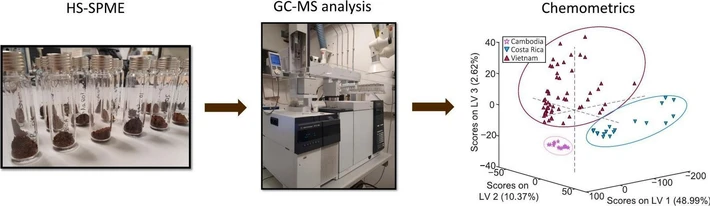
Common coffee bean species are broadly classified into two types: Coffea arabica (Arabica) and Coffea canephora (Robusta). Among them, Arabica is superior in flavor and is highly favored as a specialty beverage. However, in recent years, there have been multiple reports of products sold claiming to be 100% Arabica while being adulterated with Robusta1) . A reported method for discriminating between the two is the analysis of lipophilic extracts of coffee beans using a benchtop NMR spectrometer1) . This method uses 16- O-Methylcafestol, which is present in Robusta but almost undetectable in Arabica, as a marker. However, it requires complicated pretreatment such as extraction and concentration. Therefore, in this Application News, we investigated a method to discriminate between Arabica and Robusta more easily and rapidly using GC-MS/MS and the statistical analysis software eMSTAT Solution.
Methods
Analytical Methods
Volatile compounds were concentrated and introduced into the GC-MS using the HS-SPME method and then analyzed under the conditions registered in the GCMS(/MS) Smart Aroma Database (Table 2). The GCMS-TQTM8040 NX and the AOC-6000 multifunctional autosampler system were used as the analytical instruments (Fig. 1). To verify whether rapid analysis is possible, a temperature ramp of 10˚C/min was adopted, and a low-polarity column was used to obtain stable retention times for each compound. Data acquisition was performed in Scan mode or MRM mode, and each sample was analyzed three times.
Conclusions
- Clear Group Separation: Statistical analysis (PCA and cluster analysis) of data acquired in highly sensitive MRM mode clearly separated the two coffee bean types into distinct groups.
- Successful Discrimination: Our investigation suggested that the discrimination of Arabica and Robusta coffee beans based on aroma compounds is possible using the GCMS-TQ8040 NX, the Smart Aroma Database, and eMSTAT Solution.
- Intuitive and Comprehensive Workflow: Using eMSTAT Solution, statistical analysis and the creation of discrimination models can be easily performed without advanced expertise. Additionally, this method provides a comprehensive workflow that allows for the qualitative identification of key compounds contributing significantly to the discrimination
3. Thermo Fisher Scientific: On-site gas analysis for ABO Thermo Scientific Antaris FTIR Aviator’s Breathing Oxygen (ABO) Gas Analysis System
- Brochure
- Full PDF for download
The Thermo Scientific™ Antaris™ FTIR Aviator’s Breathing Oxygen (ABO) Gas Analysis System is a rugged, portable system that enables rapid validation of the compressed oxygen used by pilots and crew during flight operations. Use of sophisticated FTIR spectroscopic analysis enables detection of common contaminants that may be present due to the manufacturing process— contaminants such as methane, acetylene, and CFC/HCFC can be readily spotted and identified. The instrument’s sturdy design and FTIR spectroscopy’s ability to quantify multiple compounds in a single analysis make the Antaris ABO Analyzer a robust, readily deployable solution for validating the quality of aviator breathing oxygen.
Antaris FTIR Aviator’s Breathing Oxygen (ABO) Analyzer at a glance:
- Components measured: Up to 25 components can be measured simultaneously, including freons, hydrocarbons, carbon monoxide, and carbon dioxide
- Sample type: Gas
- Dimensions: 51 in. (H) x 30.25 in. (W) x 41.5 in. (D)
- Weight: 240 kg
- Optional accessories: Purge gas generator, uninterruptible power supply, oxygen analyzer
- Voltage: 120/240V