We, 2.9.2026 | Original article from: LabRulezLCMS Library
This week we bring you application notes by Agilent Technologies, Thermo Fisher Scientific, Shimadzu and Waters Corporation!News from LabRulezLCMS Library - Week 36, 2026
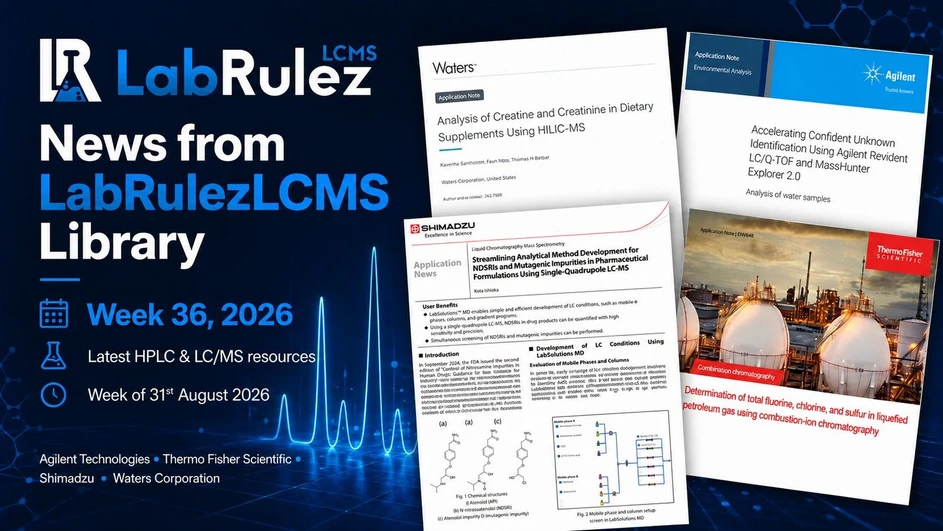
LabRulez / AI: News from LabRulezLCMS Library - Week 36, 2026
Our Library never stops expanding. What are the most recent contributions to LabRulezLCMS Library in the week of 31st August 2026? Check out new documents from the field of liquid phase, especially HPLC and LC/MS techniques!
👉 SEARCH THE LARGEST REPOSITORY OF DOCUMENTS ABOUT LCMS AND RELATED TECHNIQUES
👉 Need info about different analytical techniques? Peek into LabRulezGCMS or LabRulezICPMS libraries.
This week we bring you application notes by Agilent Technologies, Thermo Fisher Scientific, Shimadzu and Waters Corporation!
1. Agilent Technologies: Accelerating Confident Unknown Identification Using Agilent Revident LC/Q-TOF and MassHunter Explorer 2.0
Analysis of water samples
- Application note
- Full PDF for download
The assessment of water quality and environmental contamination represents a critical component of public health protection and regulatory compliance. Traditional approaches to water quality monitoring have relied on targeted analysis of a predefined set of known contaminants, enabling quantification of specific compounds of regulatory concern. However, this methodology presents a significant limitation: it provides only a narrow view of the actual pollutant burden present in environmental samples.1 By focusing exclusively on known analytes, targeted screening approaches may substantially underestimate both the exposure to, and the risk posed by, emerging contaminants, previously unidentified pollutants, and transformation products that escape conventional detection schemes.
The shift toward non-targeted analysis using high-resolution mass spectrometry addresses this critical knowledge gap by enabling comprehensive, unbiased screening of complex environmental matrices. High-resolution liquid chromatography coupled with quadrupole time-of-flight mass spectrometry (LC/Q-TOF) provides the analytical sensitivity and mass accuracy necessary to detect and characterize unknown compounds across a broad chemical space. However, the application of such powerful analytical platforms generates substantial data complexity; non-targeted datasets typically contain hundreds to thousands of detected features, the vast majority of which represent background noise, matrix components, or artifacts rather than true pollutants of interest.
The bottleneck in non-targeted analysis has traditionally resided not in data acquisition but in data interpretation. Manual peak picking, feature alignment, and compound identification are labor-intensive processes prone to operator bias and inconsistency. Furthermore, distinguishing true positive identifications from false positives—compounds present in both sample and control matrices—requires sophisticated statistical and chemometric approaches integrated seamlessly with spectral library matching and structure elucidation tools.
This study demonstrates a streamlined, integrated workflow for unknown compound identification in environmental water samples that combines high-resolution LC/Q-TOF analysis with advanced data processing and chemometric analysis. By leveraging automated feature extraction, fold-change statistical analysis, multi-database spectral matching, and machine learning-based structure prediction, this approach substantially reduces analytical workload while improving confidence in compound identification and minimizing the risk of false positive assignments. The methodology is presented as a generalizable solution applicable to diverse fields, including environmental monitoring, food safety, and biomarker discovery.
Experimental
Instrumentation
Liquid Chromatography System:
- Agilent 1290 Infinity III High-Speed Pump, G7120A
- Agilent 1290 Infinity III Multisampler, G7167B
- Agilent 1290 Infinity III Multicolumn Thermostat, G7116B
- Agilent InfinityLab Assist Hub, G7180A
Mass Spectrometry System:
- Agilent Revident Quadrupole Time-of-Flight LC/MS, G6575A
- Agilent Dual Spray Jet Stream Technology Ion Source (AJS), G1959A
- Analytical Column: Altura ZORBAX Eclipse Plus C18 2.1 × 100 mm, 1.8 µm
Conclusion
Unknown compound identification in a fortified water sample was successfully demonstrated using an Agilent Infinity III UHPLC coupled to an Agilent Revident LC/Q-TOF. The integrated workflow combined base peak chromatogram comparison, chemometric analysis (fold change), and library matching to Agilent personal compound databases with SIRIUS validation using MassHunter Explorer 2.0. Incorporation of fold change analysis (> 90% data reduction from 528 to 51 features) effectively eliminated false positives while reducing manual peak picking effort and analysis bias. Twenty pesticides were detected in fortified water and putatively identified with excellent mass accuracy (less than 1 ppm) and confirmed via SIRIUS molecular formula prediction and structure database searching. This streamlined workflow offers a powerful and scalable solution for non-targeted compound identification applicable to environmental monitoring, food safety, and biomarker discovery settings.
2. Shimadzu: Streamlining Analytical Method Development for NDSRIs and Mutagenic Impurities in Pharmaceutical Formulations Using Single-Quadrupole LC-MS
- Application note
- Full PDF for download
User Benefits
- LabSolutions MD enables simple and efficient development of LC conditions, such as mobile phases, columns, and gradient programs.
- Using a single-quadrupole LC-MS, NDSRIs in drug products can be quantified with high sensitivity and precision.
- Simultaneous screening of NDSRIs and mutagenic impurities can be performed.
In September 2024, the FDA issued the second edition of “Control of Nitrosamine Impurities in Human Drugs: Guidance for Industry.”1) This guidance classifies nitrosamines into two categories: “small-molecule nitrosamines” and “nitrosamine drug substance-related impurities(NDSRIs).”
NDSRIs are formed through the reaction (nitrosation) of the active pharmaceutical ingredient (API) or API-related impurities with nitrites and related species. Unlike small-molecule nitrosamines, NDSRIs have structuressimilar to that of the API and exhibit a wide variety of API-derived structures. As a result, their toxicity varies depending on their structure. To address this issue, the FDA and EMA have developed the Carcinogenic Potency Categorization Approach (CPCA)2), which estimates the carcinogenic risk of NDSRIs based on partialstructural information and establishes acceptable intake limits (AI limits). Under the CPCA, NDSRIs are classified into Categories 1 to 5 according to their predicted toxicity, and different AI limits are assigned to each category. Furthermore, because NDSRIs differ in structure depending on the API, analytical methods need to be developed for each target NDSRI.
Atenolol (Fig. 1(a)) is a β-blocker used to treat mild to moderate hypertension, angina pectoris, and arrhythmia (premature beats), and its maximum daily dose is 100 mg/day. The NDSRI potentially formed from atenolol, N-nitrosoatenolol (Fig. 1(b)), is classified as Category 4 under the CPCA, with an AI limit of 1,500 ng/day. 3) In this application, single-quadrupole LC-MS was used to analyze the API and NDSRI in an atenolol drug product, along with atenolol impurity D, a mutagenic impurity (Fig. 1(c)). LabSolutions MD (analytical method development support software) enabled efficient development of LC conditions, while the LCMS-2050 enabled simple, highly sensitive, and highly accurate analysis.
Analytical Conditions
- System: Nexera X3
- Column:
- Shim-pack Velox SP-C18*1 (50 mm×2.1 mm I.D., 2.7 µm)
- Shim-pack Scepter C18-120*2 (50 mm×2.1 mm I.D., 3 µm)
- System: LCMS-2050 (DUIS Positive/Negative)
Conclusion
- LabSolutions MD enabled simple and efficient development of LC conditions (mobile phases, columns, and gradient programs) capable of separating the API, NDSRI, and impurities.
- Using the optimized LC conditions, the LCMS-2050 enabled highly sensitive detection of the NDSRI and impurities.
- In spike recovery tests using the API sample, good recovery and repeatability were confirmed for the NDSRI at one-tenth of the AI limit concentration and for the mutagenic impurity at a concentration equivalent to the AI limit.
- In the drug product sample, good recovery and repeatability were also confirmed for the NDSRI at one-tenth of the AI limit concentration and for the mutagenic impurity at a concentration equivalent to the AI limit, even with simple pretreatment consisting only of methanol extraction.
These results confirmed that the combination of LC conditions optimized using LabSolutions MD and the LCMS-2050 enables highly sensitive and highly precise quantification of NDSRIs in drug products. In addition, mutagenic impurities could also be quantified simultaneously at concentrations equivalent to the AI limit, demonstrating the applicability of single-quadrupole LC-MS to screening analysis of impuritiesin drug products.
3. Thermo Fisher Scientific: Determination of total fluorine, chlorine, and sulfur in liquefied petroleum gas using combustion-ion chromatography
- Application note
- Full PDF for download
Natural gas is an important energy source used to generate electricity and as feedstock for plastics.1 Though natural gas is predominantly methane gas, it comprises many C₁ to C₅ hydrocarbons and contaminants. The gas source has the biggest influence on the type and quantity of contaminants. For example, carbon dioxide, sulfur, and cyanide gases are common contaminants from hydraulic fracking well extractions, but less common from traditional oil wells.2 These contaminants are not desirable because of their toxicity. Additionally, sulfur species can foul metal catalysts used in hydrogenation and dehydrogenation processing.3–5 Amine gas treatment, also named amine scrubbing and gas sweetening, is commonly used to neutralize the gas contaminants in natural gas, thereby generating numerous halide salts and sulfur species.3 Ion chromatography (IC) with suppressed conductivity is the analytical method often used to monitor these liquid processes.6–13
For more convenient storage and transportation, natural gas is often pressurized to a liquid state, producing liquefied petroleum gas (LPG). Liquid gas and gaseous samples are not directly suited for IC analysis because it is an aqueous chromatography technique. C-IC has been previously demonstrated as an ideal approach to eliminate the sample matrix, such as liquid gas, and increase sample homogeneity for various sample matrices.14–17 Additionally, C-IC is recognized as a standardized method (D7994) by the US American Standards Test Method (ASTM) organization to determine halogens and sulfur in LPG.18
Here, we determine halides and sulfur species in LPG using C-IC, leveraging advances in the Thermo Scientific™ Cindion™ C-IC system using the Thermo Scientific™ Cindion™ LPG/Gas Module with built-in safety venting features.19 In this method, single or multiple 25 µL aliquots of LPG are combusted at 1000 °C under argon and oxygen in the presence of water vapor. During the combustion process, the halobenzene and dimethylsulfide additives in the LPG were converted to HX (gas) and SOx (gas), respectively, and absorbed in 2.0 mL of 100 mg/L hydrogen peroxide (Figure 1). The sulfur species were oxidized by peroxide to sulfate. The solution is then analyzed by IC. Reliable and accurate calibration curves are generated by incrementally combusting multiple aliquots of standards into the absorption solution. Method reproducibility was demonstrated with relative standard deviations (RSDs) <6% and recoveries ranging from 88 to 99%.
Experimental
Equipment
Thermo Scientific™ Cindion™ Combustion Ion Chromatography System, including:
- Thermo Scientific™ Cindion™ Combustion/Absorption Module (Part No. B51006425)
- Cindion LPG/Gas Module (Part No. B51006428)
- Thermo Scientific™ Dionex™ Inuvion™ IC System with RFIC (Part No. 22185-60108)
- Thermo Scientific™ Dionex™ Eluent Monitor, optional, 4 L (Part No. 22185-62708)
- Stainless steel tubing with CGA 510 P SS fittings to connect LPG tanks to the Cindion LPG/Gas Module
- Two-stage gas tank regulator for inert gas
- Two-stage gas tank regulator for oxygen gas
Software
Thermo Scientific™ Chromeleon™ Chromatography Data System (CDS) software version 7.4 with Cindion C-IC and eluent monitor drivers.
Conclusion
The Cindion C-IC system using the Cindion LPG/Gas Module provides an automated and fast method to determine total halides and total sulfur in complex and challenging samples, such as LPG, by eliminating the sample matrix and converting the organohalide and organosulfur compounds to halides and sulfate. The Cindion LPG/Gas Module allows easy management of LPG with built-in safety venting features. The Cindion LPG/Gas Module has the added advantage of loading multiple aliquots of the LPG standard to generate calibration curves. This feature provides added convenience, reducing the number of costly calibration standards required for this analysis while achieving high reproducibility and accuracy.
The method was applied to 2 LPG standards that were also used as samples and was accurate for total fluorine, chlorine, bromine, and sulfur, with recoveries between 81 and 99% and with RSDs <5%.
The Cindion C-IC system with the Cindion LPG/Gas Module provides key benefits such as:
- Simplified workflows using the Chromeleon CDS single software solution
- Reduced lab operating costs by minimizing costly LPG standards needed to generate calibration curves
- Demonstrated use of ASTM Method D7994
- Provision of improved quality assurance tools to measure lower contamination levels which allow the development of lower-contamination, higher-profit products
4. Waters Corporation: Analysis of Creatine and Creatinine in Dietary Supplements Using HILIC-MS
- Application note
- Full PDF for download
Benefits
- Strong retention for creatine and creatinine was achieved using hydrophilic interaction liquid chromatography (HILIC) with an ACQUITY™ Premier BEH™ HILIC Column
- A linear response was obtained for creatine and creatinine over a concentration range of 1–200 µg/mL using an ACQUITY QDa™ Mass Detector
- The method provided creatine concentrations that were consistent with the label claims for three dietary supplements
Creatine has traditionally been used as a dietary supplement to enhance workout routines by providing added energy to muscles by increasing the content of phosphocreatine, which is a critical component of adenosine triphosphate formation.1,2 More recently, the use of creatine supplements has expanded to improving cognitive function, as an added therapy for certain medical conditions, and as dietary support for vegetarians.3 Due to the increase in use cases, there is a need for tighter control over the manufacturing of creatine supplements, which are regulated in the United States as dietary supplements and not as pharmaceutical drugs. This means that safety, quality and labeling compliance – are the responsibility of the manufacturer. Regulatory requirements vary globally, with some countries requiring premarket notification, registration, or authorization for dietary supplements. While creatine monohydrate is generally regarded as safe, having good manufacturing practices and control is critical in providing a high-quality product. One important quality attribute is minimizing the formation of creatinine, a degradation product of creatine.
Creatinine is formed from creatine in muscles in a non-enzymatic cyclization and dehydration reaction.4 Creatinine can also be formed during manufacturing of creatine supplements, especially in acidic environments or at elevated temperatures.4-6 Minimizing creatinine formation is an important aspect of quality control because it helps maintain product quality and preserves the labeled creatine content. This application note focuses on the analysis of three commercially available creatine supplements using HILIC with MS detection. HILIC was used because both creatine and creatinine are highly polar, leading to poor retention in reversed-phase LC. Some published methods for analyzing creatine and creatinine use ion-pairing reversed-phase or ion chromatography. 7,8 However, these often require dedicated systems and are not compatible with MS detection.
HILIC employs polar stationary phases, and high-organic, less polar starting mobile phase conditions, usually containing a high percentage of acetonitrile. Retention in HILIC is driven by partitioning of the analytes into an adsorbed aqueous layer, ionic interactions between the stationary phase and the analytes as well as hydrogen bonding interactions.9-11 In addition to retaining polar analytes, HILIC also improves MS detection compared to reversed-phase LC, as the mobile phases typically contain predominantly acetonitrile, which desolvates more readily than mostly aqueous mobile phases.12 MS provides more selective and sensitive detection than UV allowing accurate quantitation even in the presence of sample components that are incompletely separated from the analytes of interest.
Experimental
- LC system: ACQUITY UPLC™ H-Class Plus System with Column Manager (CM), 2 CM-Aux, ACQUITY UPLC PDA Detector and
- Detection: ACQUITY QDa Mass Detector
- Columns:
- ACQUITY Premier BEH™ Amide Column, 2.1 x 50 mm, 1.7 µm
- ACQUITY Premier BEH HILIC Column, 2.1 x 50 mm, 1.7 µm
- Atlantis™ Premier BEH Z-HILIC Column, 2.1 x 50 mm, 1.7 µm
- Chromatography software: Empower™ Chromatography Data System (CDS)
Conclusion
Successful quantitation of creatine was demonstrated for three dietary supplements using HILIC-MS with an ACQUITY Premier BEH HILIC Column. Good linearity was obtained for creatine and creatinine over a concentration range of 1–200 µg/mL as well as good agreement between the experimental and nominal creatine concentrations. Lastly, the method achieved adequate separation of creatine, creatinine and additional components including amino acids and flavorants.