NIST26 Advanced Course LC-MS/MS Identifications of Unknowns

Tu, 28.7.2026 | Original article from: Mass Spec Interpretation Services/James Little
Discover the new NIST26 LC-MS/MS workflow with integrated chromatogram analysis, expanded MS/MS libraries, hybrid searching, and advanced tools for confident unknown compound identification.
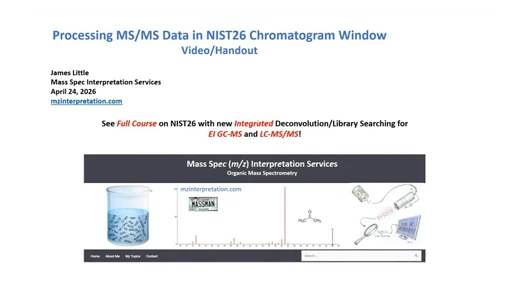
  • Photo: James Little: NIST26 Advanced Course LC-MS/MS Identifications of Unknowns
  • Video: james little: (2 minutes) Exciting New Integrated Processing Tools in NIST26 Mass Spec Software Release!

Unknown identification by LC-MS/MS has become increasingly challenging as laboratories encounter more compounds, adducts, metabolites, contaminants, and transformation products. NIST26 provides a powerful integrated workflow that combines chromatographic processing, accurate-mass measurements, isotopic fidelity, and one of the world's largest curated MS/MS spectral libraries to improve confidence in compound identification. With the V4.0 (2026) release, NIST has integrated chromatogram-level analysis directly into its MS/MS library search program. This is a significant advance that could position MS/MS libraries as central to LC-MS workflows as EI libraries have long been for GC-MS.

A very significant increase is found in the new MS/MS libraries.  The library now included over 68,600 compounds, 567,000 precursor ions, and 3.2 million MS/MS spectra.

If you are beginning today, NIST26 is the recommended version.

However, if your laboratory is using NIST20 or NIST23, these courses remain highly relevant. The core principles of LC-MS/MS unknown identification—including spectral library searching, structure searching, MS Interpreter, and building personal libraries—have remained somewhat consistent across all three releases. Once these concepts are understood, moving to NIST26 is straightforward.  This course focuses on the new capabilities introduced in NIST26 while building upon the same proven identification strategies developed in the earlier releases.

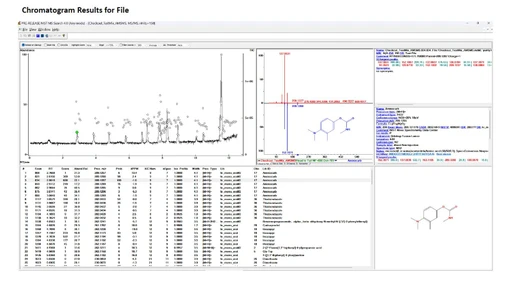
The workflow now supports XIC-based analysis, enhanced hybrid searching, background MS2 filtering, and combined MS1/MS2 identification, enabling deeper interrogation of LC-MS/MS datasets which initially described in the XIC-reference journal article spectra noted in the Resources.  Together, the new LC-MS/MS analysis capabilities and the major expansion of the NIST MS/MS library create a powerful combination for compound identification.  In addition, multiple libraries can be searched including free public and user libraries when available in NIST format.

Many topics in the documentation (Videos and Handouts) previously written for V3.0 and V2.4 will still be useful to new users of the NIST Search Software. Also, data can still be imported from Agilent MassHunter and Thermo FreeStyle, but that process is very ineffective compared to the new integrated approach in NIST V4.0.

You can look forward to the first part (Processing LC-MS/MS Data in the NIST26 Chromatogram Window) as early as next week!


James Little/Mass Spec Interpretation Services
LinkedIn Logo
 

Related articles

NIST26 EI GC/MS Software and Libraries
Article | Product

NIST26 EI GC/MS Software and Libraries

NIST EI Search V4.0 (2026) introduces integrated GC/MS deconvolution, accurate mass EI data support, and an expanded EI library with more than 431,000 spectra for more confident compound identification.
Processing MS/MS Data in NIST26 Chromatogram Window
Article | Academy

Processing MS/MS Data in NIST26 Chromatogram Window

A practical guide to processing LC-MS/MS data in the NIST26 Chromatogram Window, from parameter setup and library searching to identification review and result export.
In-Source Fragmentation Searches in NIST26 Chromatogram Window
Article | Academy

In-Source Fragmentation Searches in NIST26 Chromatogram Window

Learn how to recognize and search in-source fragmentation spectra in NIST26 using chromatogram results, Score (Unfiltered), and MS/MS Library Search for compound identification.
Theoretical and Practical Understanding of XICs (Extracted Ion Chromatograms)
Article | Academy

Theoretical and Practical Understanding of XICs (Extracted Ion Chromatograms)

Learn how extracted ion chromatograms support LC–MS/MS identification, quantitation, isotope validation, and troubleshooting in the NIST XIC Analyzer workflow.
 

Related articles

NIST26 EI GC/MS Software and Libraries
Article | Product

NIST26 EI GC/MS Software and Libraries

NIST EI Search V4.0 (2026) introduces integrated GC/MS deconvolution, accurate mass EI data support, and an expanded EI library with more than 431,000 spectra for more confident compound identification.
Processing MS/MS Data in NIST26 Chromatogram Window
Article | Academy

Processing MS/MS Data in NIST26 Chromatogram Window

A practical guide to processing LC-MS/MS data in the NIST26 Chromatogram Window, from parameter setup and library searching to identification review and result export.
In-Source Fragmentation Searches in NIST26 Chromatogram Window
Article | Academy

In-Source Fragmentation Searches in NIST26 Chromatogram Window

Learn how to recognize and search in-source fragmentation spectra in NIST26 using chromatogram results, Score (Unfiltered), and MS/MS Library Search for compound identification.
Theoretical and Practical Understanding of XICs (Extracted Ion Chromatograms)
Article | Academy

Theoretical and Practical Understanding of XICs (Extracted Ion Chromatograms)

Learn how extracted ion chromatograms support LC–MS/MS identification, quantitation, isotope validation, and troubleshooting in the NIST XIC Analyzer workflow.
 

Related articles

NIST26 EI GC/MS Software and Libraries
Article | Product

NIST26 EI GC/MS Software and Libraries

NIST EI Search V4.0 (2026) introduces integrated GC/MS deconvolution, accurate mass EI data support, and an expanded EI library with more than 431,000 spectra for more confident compound identification.
Processing MS/MS Data in NIST26 Chromatogram Window
Article | Academy

Processing MS/MS Data in NIST26 Chromatogram Window

A practical guide to processing LC-MS/MS data in the NIST26 Chromatogram Window, from parameter setup and library searching to identification review and result export.
In-Source Fragmentation Searches in NIST26 Chromatogram Window
Article | Academy

In-Source Fragmentation Searches in NIST26 Chromatogram Window

Learn how to recognize and search in-source fragmentation spectra in NIST26 using chromatogram results, Score (Unfiltered), and MS/MS Library Search for compound identification.
Theoretical and Practical Understanding of XICs (Extracted Ion Chromatograms)
Article | Academy

Theoretical and Practical Understanding of XICs (Extracted Ion Chromatograms)

Learn how extracted ion chromatograms support LC–MS/MS identification, quantitation, isotope validation, and troubleshooting in the NIST XIC Analyzer workflow.
 

Related articles

NIST26 EI GC/MS Software and Libraries
Article | Product

NIST26 EI GC/MS Software and Libraries

NIST EI Search V4.0 (2026) introduces integrated GC/MS deconvolution, accurate mass EI data support, and an expanded EI library with more than 431,000 spectra for more confident compound identification.
Processing MS/MS Data in NIST26 Chromatogram Window
Article | Academy

Processing MS/MS Data in NIST26 Chromatogram Window

A practical guide to processing LC-MS/MS data in the NIST26 Chromatogram Window, from parameter setup and library searching to identification review and result export.
In-Source Fragmentation Searches in NIST26 Chromatogram Window
Article | Academy

In-Source Fragmentation Searches in NIST26 Chromatogram Window

Learn how to recognize and search in-source fragmentation spectra in NIST26 using chromatogram results, Score (Unfiltered), and MS/MS Library Search for compound identification.
Theoretical and Practical Understanding of XICs (Extracted Ion Chromatograms)
Article | Academy

Theoretical and Practical Understanding of XICs (Extracted Ion Chromatograms)

Learn how extracted ion chromatograms support LC–MS/MS identification, quantitation, isotope validation, and troubleshooting in the NIST XIC Analyzer workflow.