Parallel Gradients 2DLC-HRMS of complex protein digest
Th, 4.7.2024 | Original article from: Chemometrics and Advanced Separations Team
CAST scientist Rick van de Hurk published a manuscript on the use of parallel gradients in 2DLC-HRMS analysis of complex protein digests.
<ul>
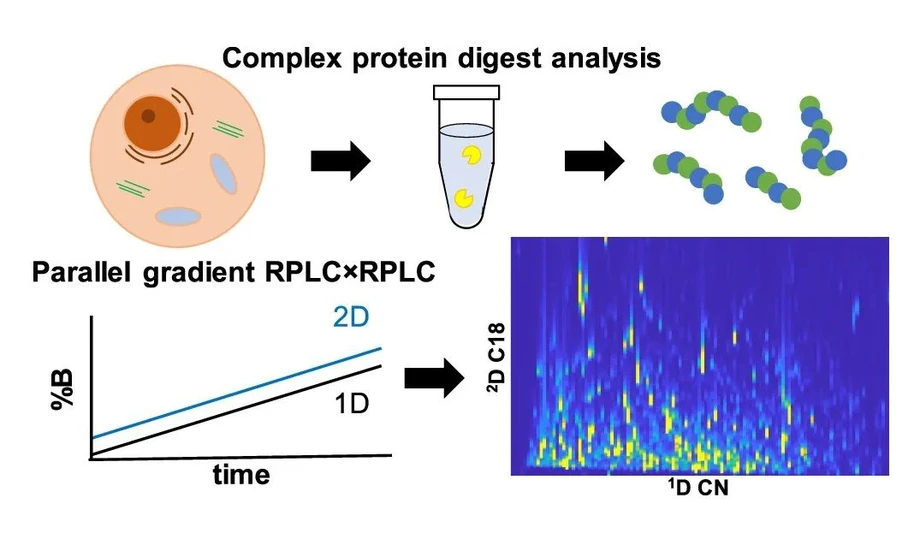
<li><strong>Photo:</strong> CAST: Parallel Gradients 2DLC-HRMS of complex protein digest.</li>
</ul>
  • Photo: CAST: Parallel Gradients 2DLC-HRMS of complex protein digest.

CAST scientist Rick van de Hurk published a manuscript on the use of parallel gradients in 2DLC-HRMS analysis of complex protein digests. Peptide features of about 1-second FHWM are obtained throughout the 60 min of separation, giving high peak capacity. The work is also done at “reduced” flow rates (with respect to analytical 2DLC flows) and has a sensitivity in the same order as 1DRPLC-HRMS.

Investigating the proteins in biological samples can help us understand and identify diseases and improve the effectiveness of medication. To study proteins in these samples, they are typically digested into peptides and subsequently analyzed by liquid chromatography (LC) hyphenated with high-resolution mass spectrometry (HRMS).

Comprehensive two-dimensional LC (LC×LC) offers increased separation power over traditional LC methods. However, most common gradient designs require re-equilibration of every second-dimension run, resulting in high flow rate operations to limit the empty separation space. This also limits MS sensitivity as flow splitting is required to handle such flow rates.

In this work, we developed an LC×LC method using a so-called parallel-gradient design, which omits the need for column re-equilibration and enables the use of the entire separation space. Moreover, this allows for lower flow rates and maintains the sensitivity for low-abundant analytes. The parallel-gradient design achieved higher surface coverages and sensitivity at lower effective peak capacities. Most importantly, both methods were applied to analyze a Human IMR90 lung fibroblast cell line digest to assess its applicability to real complex samples. The parallel-gradient method was able to identify significantly more proteins than the current state-of-the-art methods while using the same analysis time and at a lower solvent consumption. The applicability of the parallel-gradient design could be improved even further by shortening the modulation times, as it was not limited by column re-equilibration.

Resources

The study is a collaborative work done thanks for the contribution of many colleagues and students. The link to the publication is reported below.


Chemometrics and Advanced Separations Team (CAST)
LinkedIn Logo
 

Related articles

Novel MS hyphenated separation methods for complex mixtures of peptides and proteins
Article | Video

Novel MS hyphenated separation methods for complex mixtures of peptides and proteins

Two recently published articles describing the use of advanced separation methods to study complex mixtures of peptides and proteins.
News from LabRulezLCMS Library - Week 15, 2025
Article | Application

News from LabRulezLCMS Library - Week 15, 2025

This week we bring you application notes by Agilent Technologies, Shimadzu, Thermo Fisher Scientific and Waters Corporation!
News from LabRulezLCMS Library - Week 19, 2026
Article | Application

News from LabRulezLCMS Library - Week 19, 2026

This week we bring you application notes by Agilent Technologies, Metrohm and Thermo Fisher Scientific, technical note by Shimadzu and poster by Waters Corporation / AAPS!
Seeing is Believing – Detection Made Easy Part 2: Detector Characteristics
Article | Academy

Seeing is Believing – Detection Made Easy Part 2: Detector Characteristics

Explore the key performance criteria of HPLC detectors, including sensitivity, selectivity, sampling rate, noise, drift, dynamic range, and practical guidance for choosing the right LC detector.
 

Related articles

Novel MS hyphenated separation methods for complex mixtures of peptides and proteins
Article | Video

Novel MS hyphenated separation methods for complex mixtures of peptides and proteins

Two recently published articles describing the use of advanced separation methods to study complex mixtures of peptides and proteins.
News from LabRulezLCMS Library - Week 15, 2025
Article | Application

News from LabRulezLCMS Library - Week 15, 2025

This week we bring you application notes by Agilent Technologies, Shimadzu, Thermo Fisher Scientific and Waters Corporation!
News from LabRulezLCMS Library - Week 19, 2026
Article | Application

News from LabRulezLCMS Library - Week 19, 2026

This week we bring you application notes by Agilent Technologies, Metrohm and Thermo Fisher Scientific, technical note by Shimadzu and poster by Waters Corporation / AAPS!
Seeing is Believing – Detection Made Easy Part 2: Detector Characteristics
Article | Academy

Seeing is Believing – Detection Made Easy Part 2: Detector Characteristics

Explore the key performance criteria of HPLC detectors, including sensitivity, selectivity, sampling rate, noise, drift, dynamic range, and practical guidance for choosing the right LC detector.
 

Related articles

Novel MS hyphenated separation methods for complex mixtures of peptides and proteins
Article | Video

Novel MS hyphenated separation methods for complex mixtures of peptides and proteins

Two recently published articles describing the use of advanced separation methods to study complex mixtures of peptides and proteins.
News from LabRulezLCMS Library - Week 15, 2025
Article | Application

News from LabRulezLCMS Library - Week 15, 2025

This week we bring you application notes by Agilent Technologies, Shimadzu, Thermo Fisher Scientific and Waters Corporation!
News from LabRulezLCMS Library - Week 19, 2026
Article | Application

News from LabRulezLCMS Library - Week 19, 2026

This week we bring you application notes by Agilent Technologies, Metrohm and Thermo Fisher Scientific, technical note by Shimadzu and poster by Waters Corporation / AAPS!
Seeing is Believing – Detection Made Easy Part 2: Detector Characteristics
Article | Academy

Seeing is Believing – Detection Made Easy Part 2: Detector Characteristics

Explore the key performance criteria of HPLC detectors, including sensitivity, selectivity, sampling rate, noise, drift, dynamic range, and practical guidance for choosing the right LC detector.
 

Related articles

Novel MS hyphenated separation methods for complex mixtures of peptides and proteins
Article | Video

Novel MS hyphenated separation methods for complex mixtures of peptides and proteins

Two recently published articles describing the use of advanced separation methods to study complex mixtures of peptides and proteins.
News from LabRulezLCMS Library - Week 15, 2025
Article | Application

News from LabRulezLCMS Library - Week 15, 2025

This week we bring you application notes by Agilent Technologies, Shimadzu, Thermo Fisher Scientific and Waters Corporation!
News from LabRulezLCMS Library - Week 19, 2026
Article | Application

News from LabRulezLCMS Library - Week 19, 2026

This week we bring you application notes by Agilent Technologies, Metrohm and Thermo Fisher Scientific, technical note by Shimadzu and poster by Waters Corporation / AAPS!
Seeing is Believing – Detection Made Easy Part 2: Detector Characteristics
Article | Academy

Seeing is Believing – Detection Made Easy Part 2: Detector Characteristics

Explore the key performance criteria of HPLC detectors, including sensitivity, selectivity, sampling rate, noise, drift, dynamic range, and practical guidance for choosing the right LC detector.