
Inactive
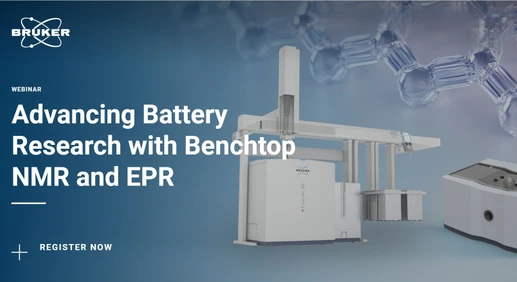
Advancing Battery Research with Benchtop NMR and EPR
Discover how benchtop NMR and EPR advance battery research. Learn to study electrolytes, electrodes, and redox flow batteries with accessible, high-quality spectroscopy.

Thermal & IR Studies Advancing Biofuel Production & Performance
Explore how TGA, DSC, and IR techniques enhance biofuel quality testing—from fatty acid decomposition to freezing point analysis—and enable advanced SAF and bio-based fuel workflows.

Explore damage-free XPS depth profiling with the Hypulse Surface Analysis System
Join us as we introduce the Hypulse System and highlight how it can help you revolutionize XPS depth profiling.
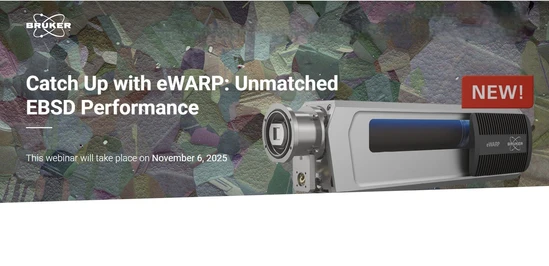
Catch Up with eWARP: Unmatched EBSD Performance
This webinar will show you how eWARP, powered by a custom hybrid pixel sensor designed for EBSD applications, redefines EBSD performance.

Quantitative CEST MRI: From Principles to Applications in Cancer and Neuroimaging
Explore the theory, challenges, and applications of CEST MRI. Learn correction strategies and see how preclinical imaging advances clinical cancer and neuroimaging research.
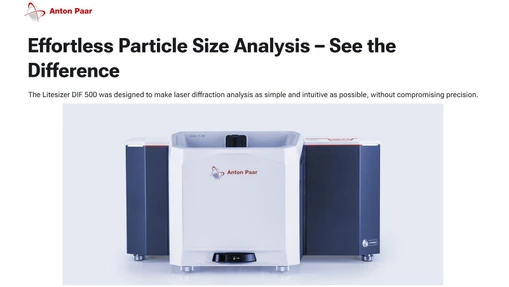
Effortless Particle Size Analysis – See the Difference
Discover how the Anton Paar Litesizer DIF 500 simplifies laser diffraction analysis. Explore its Quick-Click modules, modular design, intuitive Kalliope™ software, and wide particle-size range.
Enhancing Pharmaceutical Manufacturing Using Raman Spectroscopy
.Discover how Raman spectroscopy streamlines pharmaceutical manufacturing with rapid, non-destructive testing. Learn about compliance, efficiency, and future innovations.

Avoiding Double Charged Interferences on Single Quadrupole ICP-MS
How to set the half-mass measurement up in your software.
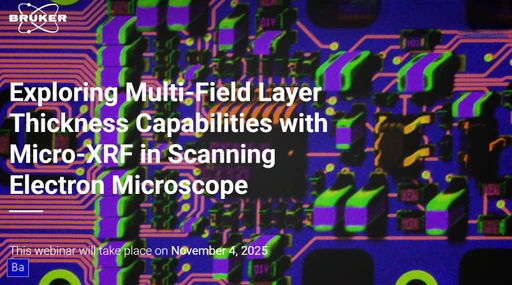
Exploring Multi-Field Layer Thickness Capabilities with Micro-XRF in Scanning Electron Microscope
In this webinar, we will introduce the physical principles behind micro-XRF-based layer thickness analysis and demonstrate the layer thickness calculation procedures.

Flow Chemistry Meets AI and NMR for Next-Gen API Production
Discover how the PIPAc project integrates AI, NMR, flow chemistry, and 3D-printed reactors to transform API manufacturing with real-time control, scalability, and sustainability.
Related content
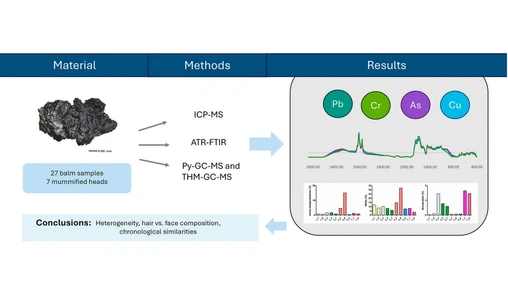
Combining elemental analysis and molecular techniques to characterize Ancient Egyptian mummification balms
Webinars LabRulezICPMS Week 39/2026
