Inactive

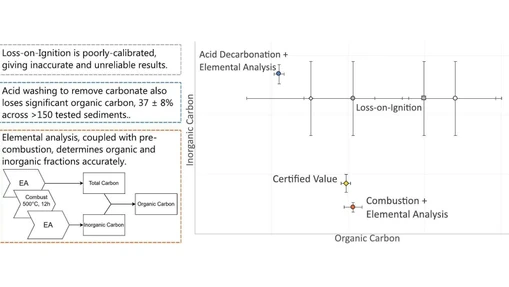
TOC Calibration, System Suitability, and Verification: Ensuring Accuracy and Compliance in Water Quality Analysis
Total Organic Carbon (TOC) analysis plays a critical role in ensuring water quality across pharmaceutical, environmental, and high purity industrial applications.
FTIR in Action: From Spectroscopy Fundamentals to Oil and Grease Analysis in Water
Learn FTIR fundamentals and practical workflows for oil and grease determination in water. Discover how ClearShot™ extraction and the Agilent Cary 630 enable fast, reliable environmental monitoring.

Carbon and Nitrogen Determination in Adhesives, Laminates, and Cement Fiber Board
Discover how carbon and nitrogen analysis supports quality control in adhesives, laminates, and cement fiber board, optimizing resin performance and regulatory compliance.
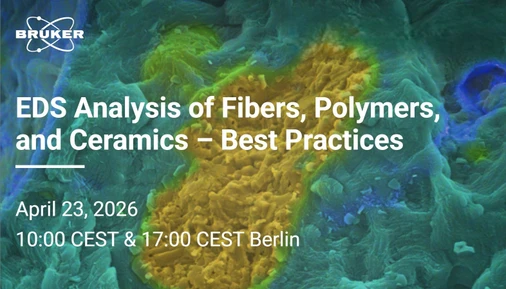
EDS Analysis of Fibers, Polymers, and Ceramics – Best Practices
Different EDS measurement approaches using conventional geometry and an annular approach (QUANTAX FlatQUAD) making the best choice for challenging analytical tasks.
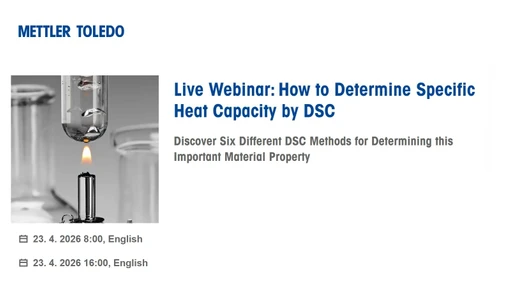
How to Determine Specific Heat Capacity by DSC
Explore six DSC techniques for measuring specific heat capacity and understand its importance in material performance, processing, and safety. Join the live webinar.
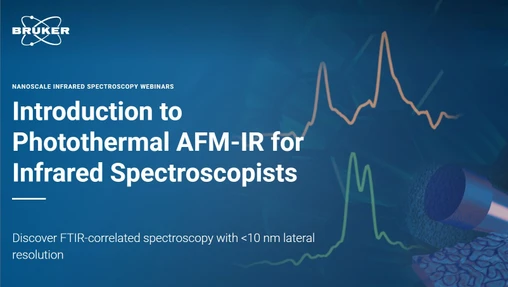
Introduction to Photothermal AFM-IR for Infrared Spectroscopists
With photothermal atomic force microscope infrared spectroscopy (AFM-IR), chemical identification at the nanoscale is achieved by measuring local IR spectra directly at the AFM tip.

What’s in your hydrogen? Analytical toolkits for fuel purity analysis
Join this dual-session webinar on hydrogen impurity testing and ISO 14687 fuel quality. Learn how GC, GC-MS, IC, and FTIR workflows support safe, compliant hydrogen production and fuel-cell applications.
Accurate Determination of Chlorine Isotope Ratio Analysis by 8900 ICP-MS
This session discusses techniques for low level chlorine analysis and isotope ratio on the 8900 QQQ-ICPMS.

NMR-augmented Workflows: Most Modern Integration into Laboratories
From high resolution instruments in smaller footprints to smarter software that enhances data quality and streamlines analysis.

Lunch and Learn Tips and Tricks Series: Qtegra Part 2
Part two explores efficient Qtegra ISDS workflows and integrated tools designed to improve laboratory productivity and enhance trace elemental analysis quality.
Related content

News from LabRulezICPMS Library - Week 38, 2026
Wiley Launches Its First Spectral Analysis API Portfolio