Mo, 14.9.2026 | Original article from: Organic Geochemistry, Volume 218, 2026, 105215
A comparison of sediment carbon methods shows that combustion-based elemental analysis is accurate and precise, while LoI and acid decarbonation can substantially bias OC results.Comparing loss-on-ignition, acid decarbonation and combustion elemental analysis for measuring organic carbon concentrations – recommendations for best practice
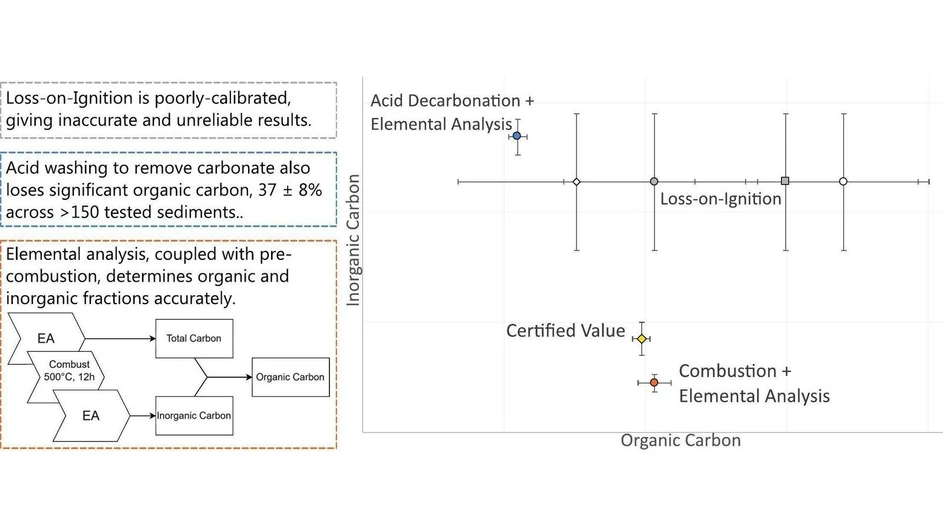
Organic Geochemistry, Volume 218, 2026, 105215: Graphical abstract
This study compares loss-on-ignition, acid decarbonation, and combustion elemental analysis for measuring organic carbon in sediments using certified reference materials and real samples. Loss-on-ignition conversions were inaccurate, while acid washing before elemental analysis caused significant organic carbon loss and poor precision.
Combustion pretreatment followed by elemental analysis provided accurate and precise organic and inorganic carbon measurements, confirmed by temperature-dependent combustion. Across more than 150 intertidal sediment samples, acid decarbonation underestimated organic carbon by 37% ± 8%, supporting combustion-based elemental analysis as the preferred approach for reliable sediment carbon determination.
The original article
Comparing loss-on-ignition, acid decarbonation and combustion elemental analysis for measuring organic carbon concentrations – recommendations for best practice
Robert B. Sparkes, Stuart A. Rae, Lucy McMahon, Hannah L. Mossman, David McKendry, Clare E. Dean, Graham Tinsley, Frances Fowden, Connor J. Grisdale, Hafiza Begum, Holly Hope, Charlotte McEnhill, Samuel O’Boyle, Nawal Sohail, Marvyn Wachira, Rachel M. Dunk
Organic Geochemistry, Volume 218, 2026, 105215
licensed under CC-BY 4.0
Selected sections from the article follow. Formats and hyperlinks were adapted from the original.
Environmental and Earth scientists frequently require measurements of carbon contents, including both the total carbon concentration (TC) and the fractions contributed by carbon from organic matter (organic carbon; OC) and carbonate minerals (inorganic carbon; IC; Bendle et al., 2009, Radabaugh et al., 2018, Saderne et al., 2019, Scheingross et al., 2019, Smeaton et al., 2021, Vonk et al., 2012, Wood et al., 2021).
Accurate, precise, and affordable carbon concentration measurements are critical to the drive towards net-zero emissions, which requires monitoring, reporting and verification of carbon burial and release from an array of global environments (Post et al., 2001, Smith, 2004, Smith et al., 2020). Carbon concentration measurements also underpin further analyses (e.g. normalising the concentration of individual biomarker compounds against the total organic carbon concentration, calculating elemental carbon to nitrogen ratios (van Dongen et al., 2008), determining the correct sample load for isotope ratio measurements). Despite carbon concentration measurements being ubiquitous throughout multiple disciplines there is no standard approach for making these, especially determining the organic component of the sedimentary carbon (Fest et al., 2022, Young et al., 2018). Different disciplines have often generated their own consensus approach, which may not align with studies from another field, even those working on similar samples and asking similar questions (Farmer et al., 2014). Use of an agreed standard measurement protocol for carbon concentrations, or understanding the agreement/variability between protocols, is vital for regulatory monitoring, reporting and verification (MRV), such as the ongoing development of carbon offsetting standards that, if implemented robustly, could provide real-world benefits to climate mitigation (Bonn et al., 2014, Burden et al., 2023, Guizar-Coutiño et al., 2022, Needelman et al., 2018, Pan et al., 2022). Determining a standardised, verified approach to carbon measurement is important for those performing MRV, who may not have access to advanced and/or expensive analytical instrumentation.
This study compares three common methods for quantifying the total and organic carbon concentrations in sedimentary samples: i) loss-on-ignition, ii) elemental analysis combined with acid decarbonation, and iii) elemental analysis combined with organic matter combustion. The comparison focuses on assessing the accuracy, precision, and repeatability of each method, identifying their respective strengths and weaknesses, and independently confirming findings via a fourth method (temperature dependent combustion and infrared CO2 measurement) to provide recommendations for best practice. A summary review of these methods is provided below.
2. Materials and methods
2.3. Independent testing of reference materials via TDC
Standards were analysed by the supplier (Elemental Microanalysis Ltd, UK) as part of the certification process: 15/30 elemental analysis measurements gave expected values of TC, OC and IC and the uncertainty for TC, following ISO/IEC17025. These values were independently checked using an Elementar SoliTOC cube instrument at the instrument manufacturer’s headquarters (Elementar Analysensysteme, Hanau, Germany), which used the TDC method. Two combustion ramps were applied, first a two-step OC and IC determination at 500 °C and 900 °C, and then a three-step programme at 400 °C and 600 °C for easily-combustible and residual OC fractions and 900 °C for IC, with three repeat measurements of each. The SoliTOC cube instrument also analysed the agricultural soil sample, again making three repeat measurements of both the two-step and three-step temperature dependent combustion protocols (see Supplementary Table 3).
2.5. Elemental analysis
Total carbon concentrations were measured following the protocol described in Mossman et al. (2022). 20 mg of either untreated or pre-treated sample was weighed into tin capsules (Elemental Microanalysis Ltd.) and analysed for carbon concentrations using a Vario EL cube elemental analyser (Elementar Ltd.). Before each analytical run, the instrument was cleaned using three blanks without oxygen and seven blanks with oxygen, and calibrated using five analyses of up to 14 mg ethylenediaminetetraacetic acid (EDTA) standard (Elemental Microanalysis Ltd.) and three analyses of an independent Soil Standard (Clay) CRM, acquired separately to the Soil Standard (Clay) CRM used to create analytical samples for this study (Elemental Microanalysis Ltd.). Three analyses of the EDTA calibration standard were repeated after every twenty samples. Long-term drift was monitored by repeated measurements of an internal laboratory standard sample, which has been analysed since 2015. Over the course of 65 measurements across 10 instrument runs for this study the laboratory standard showed no systematic drift.
3. Results and discussion
3.1. Testing of certified reference materials (CRMs) using temperature dependent combustion (TDC)
Both two-step and three-step TDC protocols consistently measured carbon contents close to but slightly below the supplier-certified values (see Fig. 1). For Soil Standard (Clay), the TDC instrument under-estimated OC by 0.10 wt% (two-step) and 0.14 wt% (three-step) and IC by 0.15 wt% (two-step) and 0.087 wt% (three-step). For Soil Standard (Peaty) the TDC instrument underestimated OC by 0.26 wt% (two-step) and 0.34 wt% (three-step), and IC by 0.021 wt% (two-step) and 0.090 wt% (three-step). Relative differences for OC are small, 5.1 – 7.0% for Clay and just 1.7 – 2.2% for Peaty, but higher for IC due to the small amount of IC present in the standards (25 – 44% for Clay, 7.0 – 30% for Peaty).
 Organic Geochemistry, Volume 218, 2026, 105215: Fig. 1. Comparison of organic carbon and inorganic carbon measurements on two certified reference materials using four methods. Upper panel is Soil Standard (Clay) and lower panel Soil Standard (Peaty). Yellow diamonds show the certified value (Elemental Microanalysis Ltd) with manufacturer stated uncertainty in total carbon used as error bars for OC and IC (n = 30). White and grey symbols represent Loss-on-Ignition results using four different organic matter to organic carbon conversion equations (grey sqaures use the “van Bemmelen” scaling factor (Pribyl, 2010), grey circles the Craft et al. (1991) factor, white diamonds the Ouyang and Lee (2020) equation and white circles the Smeaton et al. (2022) equation. IC values for all LoI results use the C/CO2 mass fraction (Wang et al., 2011). Blue circles show the acid decarbonation and elemental analysis protocol, orange circles the combustion and elemental analysis protocol. Green and purple circles show mean results from temperature dependent combustion method (2-step and 3-step protocols respectively). Error bars represent one standard deviation after multiple measurements (n = 2 to n = 4). (For interpretation of the references to colour in this figure legend, the reader is referred to the web version of this article.)
3.4. Reproducibility tests
Having shown that combustion coupled with elemental analysis was the most robust method for measuring OC in pure and diluted standards, the next experiment tested the reproducibility of these protocols over multiple implementations. A dried, ground agricultural soil sample was repeatedly analysed using each method (separate aliquots were measured using LoI at 500 °C and 800 °C, separate untreated aliquots were analysed via EA, separate aliquots were combusted at 500 °C and analysed via EA, and separate acid decarbonations were carried out prior to EA measurements). This required a large amount of starting material, more than was available in the CRMs. Independent external measurement of the soil sample using temperature dependent combustion (Elementar, Germany) gave mean OC = 2.50 ± 0.002 wt% and IC = 1.29 ± 0.008 wt% for combustion to 500 °C (n = 3), whereas combustion to 600 °C gave OC = 2.52 ± 0.075 and IC = 1.12 ± 0.010 wt% (n = 3).
LoI showed differences in mean OC depending on the equation chosen (Fig. 2). The conversions of Craft et al. (1991) and Ouyang and Lee (2020) were similar to the independent measurements (2.90 ± 0.05 wt% and 2.60 ± 0.07 wt% respectively; n = 9 for each), but the equations of Smeaton et al. (2022) and van Bemmelen over-estimated OC (4.19 ± 0.05 and 4.21 ± 0.08 wt% respectively; n = 9 for each). IC estimates using the C/CO2 mass fraction conversion were higher than the expected value (1.91 ± 0.06 wt%, n = 9). Note that the relative standard deviation for OCLoI was ∼ 1.8%, and 3.2% for ICLoI, showing acceptable run-to-run precision.
 Organic Geochemistry, Volume 218, 2026, 105215: Fig. 2. Organic and inorganic carbon measurements following repeated analysis of a homogenised soil sample via multiple methods. Markers for each method are shown in the legend and are the same as Fig. 1. Small black circles and error bars show the mean and one standard deviation after multiple repetitions of each protocol (n = 9 for LoI, C-EA and AD-EA, n = 3 for TDC).
Since OCC-EA and ICAD-EA were calculated by subtraction from mean TCEA, all data from the C-EA and AD-EA methods plotted on a straight line in Fig. 2, representing OC + IC = TC. However, position and scatter along that line varied between the two pre-treatment techniques. OCC-EA clustered just higher than the independent measurements using TDC (2.60 ± 0.03 wt%, n = 9). Propagating the errors in TC and IC gave a combined error estimate of ± 0.1 wt% for the repeated OCC-EA measurements. ICC-EA was also close to but slightly higher than the TCD results, 1.35 ± 0.03 wt%. AD-EA, however, gave mean OC values of 2.00 ± 0.12 wt% (n = 9) which was more variable run-to-run than the other methods and gave a significantly (p < 0.0001) lower mean OC value than the TCD results. Once again, acid decarbonation results suggested that a large amount of organic matter was lost during the acid treatment, tested further in the next section.
4.3. Conclusions
An accurate, precise, efficient, and standardised method for measuring total, organic and inorganic carbon contents of sediment samples is critical for both scientific research and environmental monitoring and reporting and verification. We rigorously tested three methods for measuring carbon contents in soils and intertidal sediments, using certified reference materials and > 150 sediment samples. Loss-on-ignition (LoI) is cheap and easy but showed moderate run-to-run variability and, without careful calibration, it is not accurate.
Elemental analysis (EA) is an accurate and precise method for total carbon (TC) analysis. Measuring organic and inorganic carbon via EA requires pre-treatment of the sample, and this study tested both acid decarbonation and combustion preparation techniques. Acid decarbonation led to significant and variable organic carbon loss, meaning that true organic carbon concentrations are likely higher than those measured following acidification. Combustion pre-treatment was shown to efficiently remove organic matter, leading to accurate and precise results, and we would recommend making organic carbon measurements in this way.