

The RapidVap N₂/48 Evaporation System combines nitrogen blowdown, vortex motion, and controlled heat to accelerate evaporation of up to 48 small samples or eight 450 mL samples simultaneously. A stream of nitrogen or dry gas reduces the partial pressure over the liquid, speeding solvent removal, while microprocessor-controlled vortex motion increases surface area and continuously mixes samples for maximum recovery.
Nitrogen delivery can be applied to 2, 4, 6, or all 8 clusters of six ports, conserving gas when processing fewer samples. Using a dry block heating method, the RapidVap N₂/48 offers a reliable, low-maintenance alternative to water bath systems and is ideal for applications such as drug development, bioresearch, combinatorial chemistry, environmental testing, forensics, and toxicology.
- Dry Block: Dry heating system prevents potential contamination source
- Increased Surface Area: Vortex motion increases surface area for faster evaporation
- PTFE-Coated Chamber: Aluminum with PTFE coating for broad range of chemical compatibility
- End-Point Detection: Signal completion of run allows samples to be left unattended while drying to desired end point
In partnership with Labconco.
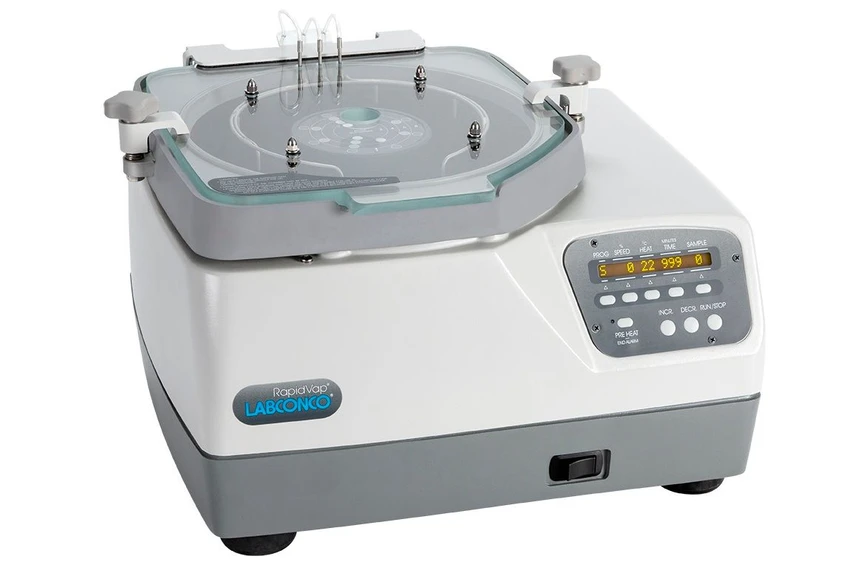 Organomation RapidVap N2_48 Nitrogen Evaporator
STANDARD FEATURES
- Dry block heating system prevents adding potential contamination source
- Vortex action, heat, and vacuum combine to accelerate evaporation
- PTFE-coated chamber for broad range of chemical compatibility
- Microprocessor-controlled vortex motion increases surface area for faster evaporation
- Signal completion of run allows samples to be left unattended while evaporation to desired end point
- Microprocessor-controlled nitrogen blow down manifold to facilitate liquid to gas phase change
REQUIREMENTS (not included)
- Sample block
- Glassware
- Nitrogen source with flow rate of 3.5 CFM/100 LPM minimu
- Gas pressure regulator
OPTIONS
- RS-232 Link for two-way communication (Cat# LC-7910014)
SPECIFICATIONS
- Instrument: RapidVap N2/48
- Instrument Catalog Number: LC-7910012
- Bath Type: Dry aluminum blocks
- Number of Sample Positions: Up to 48
- Dimensions (w x d x h): 21.7 x 19.0 x 13.5 in
- Weight: Net: 92 lbs. (42 kg)
- Weight: Gross: 100 lbs. (45 kg)
- Sample Layout: Circular
- Lid Material: Glass
- Pressure Regulator: 0–20 psi
- Temperature Range: 0–100 °C
- Warranty: 1 year
- Electrical Requirements: 115V, 60 Hz
- Vortex Motion: Up to 500 RPM
Nitrogen Requirements
- Flow Rate: 3,5 CFM / 100 LPM minimum
- Pressure: 5–10 psi
ACCESSORIES
- PTFE-coated aluminum blocks
- Borosilicate glass tubes
- 600 mL tubes with stems
- 170 mL tubes with stems
- Flat bottom tubes
- Eight-place stainless steel racks
- Glassware caps