Tu, 17.11.2026 | Original article from: Thermo Fisher Scientific / Ema Ruzic
Discover how Thermo Scientific TSQ Certis MS and nano LC-MS enable ultra-sensitive, robust quantification of proinsulin forms and C-peptide for clinical diabetes research.TSQ Certis MS Enables Robust Low-Flow LC-MS for Clinical Protein Biomarker Quantitation
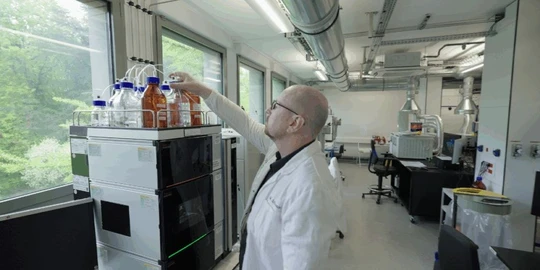
- Foto: Thermo Fisher Scientific: TSQ Certis MS Enables Robust Low-Flow LC-MS for Clinical Protein Biomarker Quantitation
- Video: Chromatography & Mass Spectrometry Solutions: ASMS 2026 | Clinical Research | Targeted Clinical Disease Markers | Jun Qu | SUNY Buffalo
Low-flow LC-MS has long offered the promise of higher sensitivity for protein biomarker quantitation, but robustness and reproducibility have been major hurdles for routine clinical laboratory use. In this ASMS 2026 Clinical Research session, Jun Qu, Ph.D., from SUNY Buffalo, presents recent work using low-flow LC-MS, specifically nano LC-MS, to develop ultra-sensitive and robust clinical assays.
 Thermo Fisher Scientific: TSQ Certis MS Enables Robust Low-Flow LC-MS for Clinical Protein Biomarker Quantitation
A difficult biomarker challenge: proinsulin forms
Dr. Qu opens with a challenging clinical biomarker case: measuring different forms of proinsulin. Impaired proinsulin processing is associated with beta cell function loss during diabetes, making these forms important to quantify.
The analytical problem is difficult for two reasons. First, these proteins are at very low levels in blood, often in the low picogram-per-mL range. Second, the different proinsulin forms differ by only a few amino acids, creating specificity challenges for immunoassay-based approaches.
Dr. Qu explains that LC-MS is a logical choice, but sensitivity has historically been a barrier. Previous published approaches could quantify proinsulin in only a subset of clinical samples, could not quantify des 31,32 proinsulin, and could not detect the 64,65 form, which turns out to be critical markers.
Combining enrichment, trapping nano LC, FAIMS, and MS
To address these challenges, Dr. Qu’s team developed a strategy combining antibody cocktail capture with highly sensitive trapping nano LC, FAIMS, and mass spectrometry. The workflow uses unique signature peptides for each proinsulin form, along with antibody cocktail enrichment to support high immunocapture coverage and accurate ratio measurement.
For the LC-MS portion, the team used trapping nano LC to enable fast, high-capacity sample loading while selectively delivering a cleaner fraction of the biological sample to the nano LC column. This helped improve both sensitivity and robustness.
Dr. Qu also highlights the role of the Thermo Scientific OptiSpray ion source, describing its preassembled cartridge format and strong reproducibility. In benchmark data shared during the talk, retention time variation was below 0.25% over seven days, and peak area reproducibility was below 5% CV without internal standard calibration.
Improving sensitivity and robustness
A key theme of the presentation is that sensitivity is often limited not only by signal intensity, but by background and interference. Dr. Qu discusses how the newer Thermo Scientific TSQ triple quadrupole systems, including the Thermo Scientific TSQ Certis triple quadrupole mass spectrometer, helped reduce background noise and improve signal-to-noise ratios in the assay. Excitedly he states, “We have been deeply impressed about the performance of the recent TSQ series for their high sensitivity, excellent selectivity and a good robustness.”
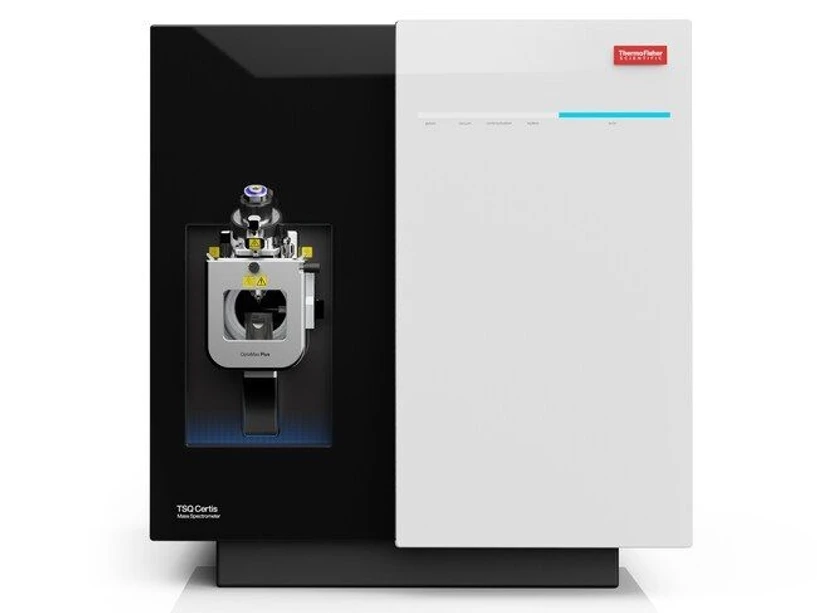 Thermo Fisher Scientific: TSQ Certis MS Enables Robust Low-Flow LC-MS for Clinical Protein Biomarker Quantitation: TSQ Certis MS featured in Dr. Qu’s presentation
FAIMS added another dimension of separation orthogonal to LC and MS. Dr. Qu explains that optimizing FAIMS parameters is not simply about maximizing peptide intensity; it is about finding a compensation voltage window where interference is selectively reduced to substantially improve signal-to-noise ratio. In this assay, FAIMS further reduced chemical noise and supported robust quantification even at low signal intensity.
Dr. Qu also reports strong robustness, including more than 1,600 injections of dirty samples while maintaining signal, and notes that the platform required very infrequent MS cleaning.
Quantifying proinsulin forms in clinical samples
Dr. Qu reports assay sensitivity in the range of approximately 1–3 pg/mL in plasma for the target proteins. In an 80-subject application comparing type 1 diabetes and healthy control samples, the team quantified proinsulin and des 31,32 proinsulin in all samples, and 64,65 proinsulin in 70% of samples.
The presentation also highlights a comparison with an ELISA method. Dr. Qu explains that LC-MS results suggested the ELISA may measure a mixture of proinsulin forms rather than a single specific form, underscoring the salient advantage of a sensitive and selective LC-MS assay.
One particularly important finding was that the des 31,32 proinsulin-to-C-peptide ratio appeared to be a stronger discriminator of beta cell function loss than proinsulin alone. This was supported in both the 80-subject study and a larger longitudinal study.
Reproducibility across labs
For clinical workflows, transferability matters. Dr. Qu notes that the method was transferred to another laboratory led by Dr. Wei-jun Qian in PNNL, where the team obtained highly comparable quantitative results for proinsulin, C-peptide, and des forms. Working lower limit of quantification studies also showed strong agreement, with differences within 10%.
Toward routine nano LC-MS in clinical laboratories
Dr. Qu closes by putting nano LC-MS into historical context. Technologies once considered too difficult for routine clinical use can become practical when instrumentation, methods, and workflows mature. In this work, the team achieved high sensitivity, high robustness, and reasonable throughput using a nano LC platform.
The presentation suggests that validated nano LC-MS strategies may become an important tool for clinical protein biomarker analysis, particularly where sensitivity, specificity, and reproducibility are all required.
Watch the on-demand presentation
Watch the ASMS 2026 session featuring Jun Qu, Ph.D., SUNY Buffalo, to learn how low-flow LC-MS workflows are being used to develop ultra-sensitive and robust assays for clinical protein biomarkers. Watch the on-demand recording & explore more clinical research presentations from ASMS 2026 on our ASMS video playlist.
Resources
The assay was developed under the leadership of the NIH/NIDDK TaMADOR consortium (Targeted Mass Spectrometry Assays for Diabetes and Obesity Research), led by Dr. Salvatore Sechi, with the task of developing and disseminating robust, transferable targeted mass spectrometry assays for the reproducible quantification of plasma proteins and peptides relevant to type 1 diabetes and obesity.
Check out the publication for the assay: An Antibody Cocktail-Based Immunoaffinity-LC-MS Method Enabled Ultra-Sensitive and Robust Quantification of Circulating Proinsulin Proteoforms and C‑Peptide
Are you a current customer interested in presenting at one of our upcoming conferences and sharing your work? Contact Ema Ruzic to learn more.
- Visit us on LinkedIn: #TSQCertis, #LCMS, #ClinicalResearch, #ProteinBiomarkers