We, 11.11.2026 | Original article from: LabRulezICPMS Library
This week we bring you application notes by LECO, Shimadzu, Thermo Fisher Scientific and Waters Corporation.News from LabRulezICPMS Library - Week 46, 2026
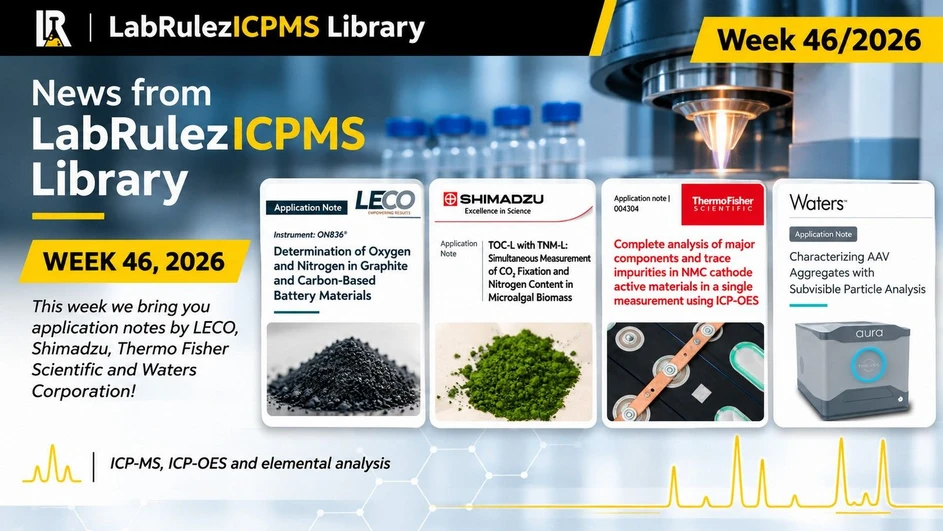
LabRulez / AI: News from LabRulezICPMS Library - Week 46, 2026
Our Library never stops expanding. What are the most recent contributions to LabRulezICPMS Library in the week of 9th November 2026? Check out new documents from the field of spectroscopy/spectrometry and related techniques!
👉 SEARCH THE LARGEST REPOSITORY OF DOCUMENTS ABOUT SPECTROSCOPY/SPECTROMETRY RELATED TECHNIQUES
👉 Need info about different analytical techniques? Peek into LabRulezLCMS or LabRulezGCMS libraries.
1. LECO: Determination of Oxygen and Nitrogen in Graphite and Carbon-Based Battery Materials
- Application note
- Full PDF for download
The determination of Oxygen and Nitrogen in Carbonbased battery materials is used in optimizing performance and ensuring reliability. Oxygen influences Lithium-ion intercalation and structural stability, affecting energy density and cycle life. Nitrogen, often introduced through doping, can enhance electronic conductivity, catalytic activity, and reaction kinetics. Accurate measurement of these elements is essential for quality control, process optimization, and advanced electrode material development in battery research and manufacturing. This is typically achieved using inert gas fusion combined with infrared and thermal conductivity detection, providing precise and efficient determination of these key elements.
Instrument Model and Configuration
The ON836 is designed for simultaneous dynamic-range measurement of Oxygen and Nitrogen content. A preweighed sample is placed in the instrument's automated sample drop mechanism and automatically transferred into a graphite crucible. The graphite crucible with sample is heated in an impulse furnace to release analyte gases. Oxygen present in the sample reacts with the graphite crucible to form CO and CO . An inert gas carrier (Helium 2 or Argon) sweeps the liberated analyte gases out of the furnace, through a mass flow controller, then through a series of detectors. CO and CO2 are detected using nondispersive infrared (NDIR) cells. The gas then flows through a heated reagent where the CO is oxidized to form CO2, and H2 is oxidized to form H2O. The gas continues through another NDIR cell where CO2 is detected. CO2 and H2O are then scrubbed out of the carrier gas stream, leaving Nitrogen as the only analyte gas remaining. A Thermal Conductivity (TC) detector is then used to detect Nitrogen.
Typical Results
Data was generated utilizing a linear, force through origin calibration for Oxygen using ~0.75 g (for high range calibration) and ~0.25 g (for low range calibration) of LECO 502-702 (Lot 1000) LCRM Iron Powder (1.10 % O) and a linear, force through origin calibration for Nitrogen using ~0.5 g of LECO 502-904 (Lot 0566) LCRM Steel Pin (0.0923 % N). The high range Oxygen calibration was verified using ~0.70 g of JK47A Iron Powder (0.69 % O). The low range Oxygen calibration was verified using ~1.0 g of LECO 503-514 (Lot 0742-1) LCRM Steel Pin (0.0023 % O). The Nitrogen calibration was verified using ~0.1 g of JK47A Iron Powder (0.0062 % N).
2. Shimadzu: TOC-L with TNM-L: Simultaneous Measurement of CO2 Fixation and Nitrogen Content in Microalgal Biomass
- Application note
- Full PDF for download
Global demand for sustainable aviation fuel (SAF) has been rising sharply, amid international CO2 reduction efforts and the decarbonization goals of both Japan and the United States. Among various feedstocks, microalgae-derived bio-jet fuel has emerged as a promising candidate for SAF, with extensive research and development underway toward its industrialization. A harmonized resource assessment by U.S. national laboratories indicates that the domestic resource base could support the production of more than 75 billion liters of algal biofuel annually at full deployment of large-scale cultivation1). Projections on this scale point to the magnitude of the contribution microalgae could make toward carbon neutrality, and to the industrial potential of the field.
However, realizing that potential requires the sustainability of microalgae-derived fuels to be verified by life cycle assessment (LCA). Such an assessment weighs the CO2 fixed during cultivation against the greenhouse gas emissions generated across the entire production chain, including SAF conversion and upgrading. A key inventory item that must be established experimentally is the amount of CO₂ converted into organic carbon. Total organic carbon (TOC) analysis provides a direct measure of this quantity. Because the measurement is performed on liquid suspensions, the carbon content of a culture can be determined without a drying step2).
The nitrogen status of the cells is equally important. Microalgae accumulate lipids in response to intracellular nitrogen depletion, so cellular nitrogen content is closely linked to the balance between biomass productivity and lipid yield, and hence the value of the biomass as a SAF feedstock. The Shimadzu TOC-L analyzer equipped with a TNM-L total nitrogen unit measures TOC and total nitrogen (TN) simultaneously on the same sample, allowing carbon fixation and nitrogen status to be monitored together within a single workflow.
In the present study, we applied the TOC-L system to Chlamydomonas reinhardtii CC-1010, a model green alga whose physiological responses to nutrient limitation are well characterized, in order to evaluate its CO₂ fixation potential and to analyze how changes in cellular nitrogen content affect lipid accumulation.
Method
TOC and TN measurement
CO2 fixation was evaluated by quantifying total organic carbon (TOC) using a TOC-L analyzer equipped with a total nitrogen measuring unit (TNM-L; Shimadzu) (Fig.1). To distinguish intracellular organic carbon incorporated into biomass from extracellular organic carbon released by the cells, such as extracellular polysaccharides secreted by some microalgal species, the culture broth was separated into a microalgal cell fraction and a supernatant fraction, and both fractions were subjected to TOC and TN analysis.
Briefly, the culture broth was centrifuged at 5,000×g for 5 min at room temperature to separate the algal cells (pellet) from the supernatant. The supernatant was retained for direct measurement of extracellular TOC and TN.
The cell pellet was resuspended in an equal volume of ultrapure water relative to the original sample volume to remove residual extracellular material, and the suspension was centrifuged again at 5,000×g for 5 min at room temperature. The resulting pellet, representing the purified intracellular fraction, was collected and resuspended in ultrapure water. Each prepared sample was homogenized by sonication prior to measurement with the TOC analyzer.
Total carbon (TC), inorganic carbon (IC), and total nitrogen (TN) were measured using the TOC analyzer. Calibration curves were prepared using potassium hydrogen phthalate for TC, sodium bicarbonate for IC, and potassium nitrate for TN (all from Nacalai Tesque) (Tables 1, 2). Injection volumes were set at 50 μL for TC and TN, and 250 μL for IC. TOC was calculated by subtracting IC from TC.
Conclusion
Meeting the growing global demand for SAF requires two key elements: maximizing the lipid productivity of microalgae, and quantifying CO2 fixation for use in LCA.
This application note used the Shimadzu TOC-L, equipped with a TNM-L total nitrogen unit, to evaluate CO2 fixation in the microalga Chlamydomonas reinhardtii CC-1010, while also monitoring intracellular nitrogen content as an indirect indicator of lipid accumulation. The results suggest that appropriate management of nitrogen availability during the exponential growth phase is linked to sustained biomass productivity and CO2 fixation efficiency, and that nitrogen depletion following the rise in cell density may serve as an effective switch for inducing lipid accumulation. The TOC-L, capable of measuring TOC and TN simultaneously, enables integrated monitoring of these complex phase transitions between growth and lipid accumulation, thereby supporting precise nutrient management.
Understanding the physiological characteristics of the target microalgal species and monitoring nutrient status across these distinct cultivation phases are essential to achieving this balance between lipid accumulation and carbon fixation performance. By providing rapid analytical data, the TOC-L is well positioned to support process optimization and carbonneutrality assessment in the production of SAF feedstocks.
3. Thermo Fisher Scientific: Complete analysis of major components and trace impurities in NMC cathode active materials in a single measurement using ICP-OES
- Application note
- Full PDF for download
Lithium-ion batteries (LIBs) provide a compact and versatile solution for energy storage, powering a wide range of products from consumer electronics to electric vehicles (EVs) and battery energy storage systems (BESS). Currently, they are the most important power storage solution for EVs due to their power density and life cycle performance. The performance, longevity, and safety of a battery heavily depend on the purity and the composition of the components, especially the cathode material. One of the key materials used in state-of-the-art batteries is based on a combination of nickel, manganese, and cobalt (NMC) in different compositions.
To meet the required performance criteria (i.e., lifetime and capacity), it is important to monitor not only the concentration ratio of the main components but also trace impurities in both the precursor materials and the finished products.
Inductively coupled plasma optical emission spectroscopy (ICP-OES) is well established for the analysis of elemental impurities in various materials, providing accurate results for even the most demanding sample types. However, the high concentrations of major components often lead to highly complex spectra, which may create interferences with signals of other elements present in lower concentrations. Whereas dilution is a way to reduce the impact of the matrix, it also leads to reduced detection capabilities for potentially critical impurities and means more complex sample preparation.
This application note describes an optimized analytical method for the analysis of nickel, manganese, and cobalt, along with other trace level impurities, performed in a single solution of different compositions of cathode active materials.
Experimental
Instrument parameters and experimental conditions
In this study, a Thermo Scientific™ iCAP™ PRO XP ICP-OES Duo instrument, equipped with a ceramic D-Torch and operated in Intelligent Full Range (iFR) mode, was used to analyze a total of 25 analytes, comprising 21 trace level impurities and four major components (Li, Ni, Mn, and Co) typically analyzed in NMC. The major components were measured using radial viewing mode, while trace elements were measured using the axial viewing mode of the ICP-OES instrument due to its higher sensitivity. To enable determination of major components and trace level impurities in single sample measurements, it is inevitable to optimize the method to cover elevated concentration levels for major components while maintaining the required sensitivity for accurate determination of trace analytes. The use of an additional flow of argon gas, introduced using a sheath gas adaptor, allows a reduction in the dispersion of the sample aerosol and has been key to achieve the extended linear range for Li, Ni, Mn, and Co. In addition to the extended linear range for major components, the introduction of sheath gas reduces matrix load on the plasma, preventing plasma instability and helping to maintain cleanliness of the entire system over extended runtimes.
Details of the sample introduction system components and instrument parameters used are given in Table 1. Automated sample introduction was carried out using a Thermo Scientific™ iSC-65 Autosampler. A solution containing 30 mg·L-1 yttrium as internal standard, prepared in a matrix of 0.5% (v/v) nitric acid, was added online to correct for any drift or physical interferences such as signal suppression.
Conclusion
The iCAP PRO XP ICP-OES enables laboratories, both supporting production facilities or driving research activities towards new cathode active materials, to analyze major components (Ni, Mn, Co, and Li) as well as impurities accurately and precisely in the same analytical run, increasing the overall efficiency of the laboratory. The key attributes of the developed methodology are summarized below:
- The use of additional flow of argon as sheath gas helps extend the linear range of major components up to 2,000 mg∙L-1, enabling accurate quantification of these important analytes without the need of any liquid dilution of digested samples following digestion.
- The improved handling of the sample matrix is enabled by utilizing a sheath gas adapter and the ceramic torch in combination, allowing analysts to run samples for longer without having to perform maintenance on the sample inlet system components.
- The DUO configuration of the iCAP PRO XP ICP-OES allows simultaneous determination of trace level impurities in axial mode while analyzing major components using the radial view of the system.
- The results obtained during the study indicate that the optimized workflow can provide accurate and precise analytical data for even long analytical batches, involving hundreds of samples every day.
4. Waters Corporation: Characterizing AAV Aggregates with Subvisible Particle Analysis
- Application note
- Full PDF for download
Benefits
- Detects and characterizes particles not measured by DLS or SEC
- Requires only 5 μL per sample
- Analyzes up to 96 samples in less than two hours
- Provides highly resolved particle images, count, and size distribution information
- Measures particles from 1 μm to 5 mm
- Detects changes as a function of stress and solution conditions
Subvisible particles are particles that are too large for analysis by SEC (SEC; ~ > 0.1 μm), but too small to be visible to the unaided eye (< 100 μm). Evidence suggests that their presence in parenterally administered drugs can lead to dangerous immunogenic reactions. The FDA tightly monitors particulates in parenteral protein drug formulations, referencing guidelines for subvisible particles >10 μm established by the US Pharmacopeia <788>.1
However, measuring subvisible particles in viral vector formulations for gene therapy poses challenges. Due to the complexity of manufacturing, availability of sample formulation or quality testing limits the number and type of analytics that can be performed. Standard methods for subvisible particle measurement such as flow microscopy are impractical because they can consume large amounts of sample (> 1 mL).
Conclusion
In conclusion, the Aura System detects and characterizes particles from 1 μm to 5 mm in gene therapy samples, including particles that are often missed by DLS or SEC. It only requires as little as 5 μL of sample per test to provide detailed information on particle size, morphology, counts, and distribution. Its 96-well automation format makes it possible to test many conditions in one experiment, and it takes about 1 minute per sample for analysis.
The Aura System generates high-quality images for each particle without interference from buffers or different matrices. The Aura System also has the sensitivity to detect changes as a function of stress and solution conditions.
Combined with 21 CFR Part 11 Software, the Aura System supports viral vector quality assessment.