How to tame random motion inside a molecule? Scientists can do it with light

Fr, 6.11.2026 | Original article from: IOCB Prague
Scientists at IOCB Prague have developed a molecular system that uses light to slow down random rotation within a molecule by up to 300,000 times, opening new possibilities for molecular machines.
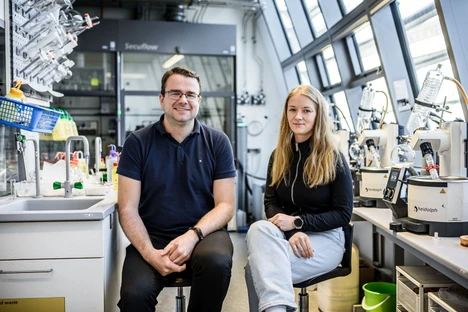
  • Photo: IOCB Prague/Tomáš Belloň: Lukáš Severa and Jiří Kaleta
  • Video: IOCB Prague: How to tame random motion inside a molecule? Scientists dan do it with light 

Molecules are never still. Driven by thermal energy, they are constantly moving through space, while their individual parts also rotate relative to one another. Scientists at IOCB Prague have now shown that random motion within a molecule can be dramatically suppressed. Using light, they can slow down the relative rotation of two different parts of a single molecule by up to five orders of magnitude, paving the way for more complex molecular machines.

Driven by thermal energy, individual parts of molecules are constantly vibrating, rotating, and changing their positions – a phenomenon known as Brownian motion. Unlike conventional engineers, scientists building molecular machines therefore work with components that are constantly in motion. To assemble them into a functioning mechanism, they need to be able to control this motion. This is precisely what the team of Jiří Kaleta at IOCB Prague has achieved.

The scientists created a molecular system incorporating two key components: a light-controlled molecular motor and a rotor that randomly rotates around its axis because of thermal motion. “When we shine light on the molecule, the motor changes its spatial arrangement, which in turn affects the motion of the rotor. In the ‘unbraked’ state, the rotor can rotate easily, while in the ‘braked’ state, the motor physically obstructs its motion and significantly increases the energy barrier the rotor must overcome to turn,” explains Lukáš Severa, first author of the study.

The principle can be pictured as a hand freely mounted on an axis and constantly jostled by tiny vibrations. If nothing stands in its way, it can rotate easily. But when an obstacle is placed in its path, its rotation slows dramatically. In the molecule, this obstacle is created by the moving part of the molecular motor.

Video

Up to a 300,000-Fold Slowdown

The difference between the two states is striking. “In previous similar systems, it was possible to change the rotation rate by no more than a factor of one hundred. With our approach, we have achieved a slowdown of approximately 300,000-fold, which represents a major breakthrough,” says Jiří Kaleta.

The difference between the two states becomes even more dramatic as the temperature decreases. If, at a very low temperature, the unbraked rotor completed one rotation per second, under the same conditions the braked rotor would take approximately 350 billion years to complete a single rotation – about twenty-five times the current age of the universe.

The ability to control the motion of individual components is essential for constructing more complex molecular machines. “If you want to build a more complex mechanism, having a motor alone is not enough. You also need elements that can regulate and coordinate the motion of individual components. We are demonstrating one principle for achieving this at the molecular level,” concludes Jiří Kaleta.
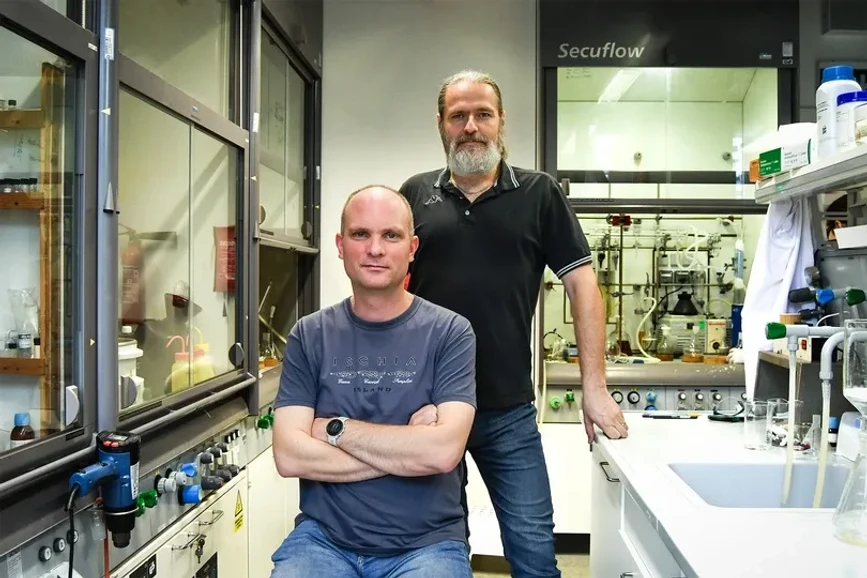
IOCB Prague/Tomáš Belloň: How to tame random motion inside a molecule? Scientists can do it with light: Lukáš Severa and Jiří KaletaIOCB Prague/Tomáš Belloň: How to tame random motion inside a molecule? Scientists can do it with light: Lukáš Severa and Jiří Kaleta

The original article

Light-Gated Control of Brownian Rotation by a Molecular Motor

Severa, L., Bezděková, K., Majerová Varga, K., Bastien, G., Stroka, M., Císařová, I., Dračínský, M., & Kaleta, J. 

Angew. Chem. Int. Ed., 2026, 65, e7061287

https://doi.org/10.1002/anie.7061287

Licensed under CC-BY 4.0

Institute of Organic Chemistry and Biochemistry of the Czech Academy of Sciences
LinkedIn Logo
 

Related articles

Surface-mounted regular arrays of fullerene-based molecular rotors
Article | Scientific article

Surface-mounted regular arrays of fullerene-based molecular rotors

Scientists from IOCB Prague, the University of Colorado, and the University of Oxford prepared an array composed of a unique type of fullerene-based molecular rotors with a relatively high dipole moment.
IOCB researchers take a key step toward fully controllable molecular machines
Article | Science and research

IOCB researchers take a key step toward fully controllable molecular machines

IOCB Prague scientists have developed light-driven molecular motors that remain fully functional even when anchored to metal surfaces, marking a major step toward controllable nanoscale machines.
Stick and Glue! Tomáš Slanina and his team introduce a new biomolecule-labeling method for more precise observation of cellular processes
Article | Science and research

Stick and Glue! Tomáš Slanina and his team introduce a new biomolecule-labeling method for more precise observation of cellular processes

Researchers at IOCB Prague developed a highly precise and ultra-stable fluorescent labeling method that stays attached even inside cells, enabling long-term, reliable tracking of biomolecules.
Accurate NMR chemical shifts through machine-learned dynamics
Article | Science and research

Accurate NMR chemical shifts through machine-learned dynamics

Scientists at IOCB Prague combine ML molecular dynamics with ShiftML3 to improve NMR chemical-shift predictions for exchangeable protons in solution.