Accurate NMR chemical shifts through machine-learned dynamics

Fr, 25.9.2026 | Original article from: IOCB Prague
Scientists at IOCB Prague combine ML molecular dynamics with ShiftML3 to improve NMR chemical-shift predictions for exchangeable protons in solution.
<p><strong>IOCB Prague:</strong> Martin Dračínský, Head of the NMR Spectroscopy Group. Photo: IOCB Prague</p>

IOCB Prague: Martin Dračínský, Head of the NMR Spectroscopy Group. Photo: IOCB Prague

Accurately predicting NMR chemical shifts remains difficult for protons that can exchange with their environment in solution. These protons are covalently bound to electronegative atoms in hydroxyl (-OH), amine (-NH), and thiol (-SH) group. Their NMR signals are highly sensitive to hydrogen bonding, interactions with the solvent, and the continuous motion of molecules. Conventional DFT calculations typically treat the solvent in a simplified manner, often overlooking important interactions between dissolved molecules and their surroundings. A new computational approach developed by scientists led by Martin Dračínský from IOCB Prague addresses this problem by combining machine-learning (ML) molecular dynamics (MD) with ShiftML3, a machine-learning model for rapid prediction of NMR shielding.

The method first uses ML-based molecular dynamics to generate realistic ensemble of molecular structures in solution, capturing the constantly changing hydrogen-bonding patterns. ShiftML3 then predicts the chemical shifts for each configuration within fractions of a second. Although the model was originally developed for molecular solids, it also performs remarkably well in solutions. In molecular crystals, molecules are surrounded by close neighbors and experience a wide variety of intermolecular contacts, many of which closely resemble the interactions found in liquids.
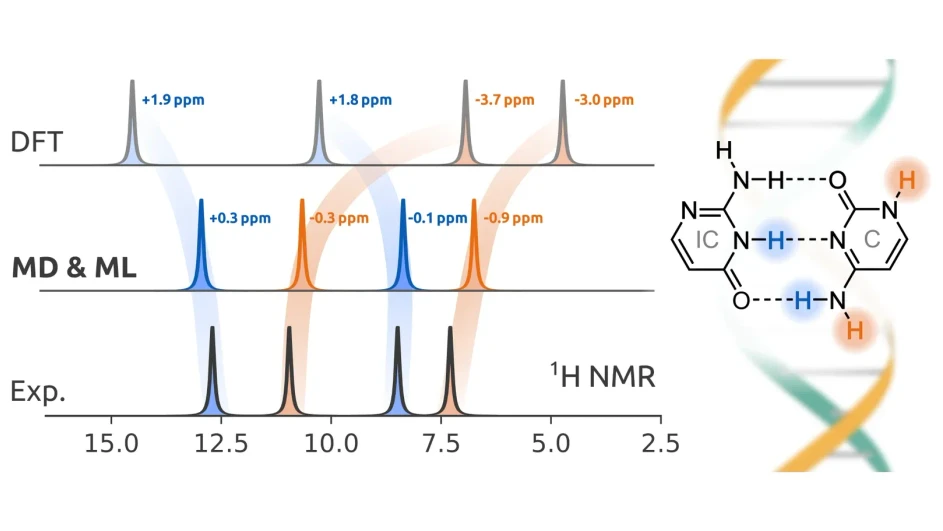
IOCB Prague: Accurate NMR chemical shifts through machine-learned dynamics: A new computational approach developed by scientists led by Martin Dračínský from IOCB Prague addresses addresses often overlooked issues with simplified conventional DFT calculations. Nat. Commun. 2026, 17, 8842.IOCB Prague: Accurate NMR chemical shifts through machine-learned dynamics: A new computational approach developed by scientists led by Martin Dračínský from IOCB Prague addresses addresses often overlooked issues with simplified conventional DFT calculations. Nat. Commun. 2026, 17, 8842.

The researchers validated the approach on chemically diverse systems, including water in organic solvents, alcohols, hydrogen-bonded nucleobases, glucose anomers, and alkylated acetamides. In all cases, the combination of ML-based molecular dynamics and ShiftML3 reproduced experimental chemical shifts with high accuracy, especially for exchangeable protons in OH and NH groups, whose signals are particularly sensitive to their local environment.

The results show that combining ML-based molecular dynamics with rapid NMR chemical-shift prediction can substantially improve the accuracy of calculations for flexible and hydrogen-bonded molecules in solutions. The main advantage of the framework is that it can evaluate hundreds or thousands of solvent configurations without requiring an expensive quantum-mechanical calculation for each one. This opens the way to faster and more reliable prediction of NMR spectra, with potential applications in signal assignment, molecular structure determination and structural validation.

The original article

Quantitative Prediction of Exchangeable Proton Chemical Shifts

Ondřej Socha, Jana Pavlišová, Debashree Manna & Martin Dračínský

Nat. Commun., 2026, 17, 8842

https://doi.org/10.1038/s41467-026-75743-w 

licenced under CC-BY 4.0

Abstract

Accurately predicting NMR chemical shifts of exchangeable protons in solution remains challenging because of the combined influence of solute–solvent interactions and molecular dynamics. We introduce a framework that integrates machine-learning molecular dynamics (ML-MD) with the ShiftML3 machine-learning shielding model for rapid and accurate prediction of NMR spectra in solvated molecules. Although originally developed for solids, ShiftML3 effectively captures intermolecular contributions to shielding in solution. We validate the method across a range of chemically diverse systems, including water in organic solvents, solvated alcohols, hydrogen-bonded nucleobases, glucose anomers, and alkylated acetamides. The ML-MD + ShiftML3 framework reproduces experimentally observed chemical shifts of exchangeable protons with near-quantitative accuracy, resolving subtle hydrogen-bonding and conformational effects that implicit-solvent DFT fails to capture. These results establish ML-MD + ShiftML3 as a transferable and computationally efficient way of incorporating solvation and dynamics into NMR spectroscopy, enabling realistic chemical shift predictions for flexible, hydrogen-bonded, and complex molecular systems.


Institute of Organic Chemistry and Biochemistry of the Czech Academy of Sciences
LinkedIn Logo
 

Related articles

Progress, Challenges and Opportunities of NMR and XL-MS for Cellular Structural Biology
Article | Scientific article

Progress, Challenges and Opportunities of NMR and XL-MS for Cellular Structural Biology

In the article in the JACS Au, the researchers summarized the recent advancements in in-cell nuclear magnetic resonance (NMR) and in vivo cross-linking mass spectrometry (XL-MS) for studying protein structures.
Ensemble NMR Prediction
Article | Product

Ensemble NMR Prediction

Since the very first release of Mnova, we have been (and still are!) very fortunate to include in the software the prediction of NMR spectra provided by Modgraph Consultants.
Electron spectroscopy for chemical analysis of liquids
Scientific article | Science and research

Electron spectroscopy for chemical analysis of liquids

This study establishes ESCAL reference data for liquid-phase chemical analysis, revealing solvent-dependent core-level chemical shifts.
CEITEC Chemists Capture Electron Storms in Gold and Mercury
Article | Science and research

CEITEC Chemists Capture Electron Storms in Gold and Mercury

CEITEC Masaryk University researchers have mapped magnetically induced electron currents in molecules containing gold, mercury and astatine, revealing new insights into chemical bonding.
 

Related articles

Progress, Challenges and Opportunities of NMR and XL-MS for Cellular Structural Biology
Article | Scientific article

Progress, Challenges and Opportunities of NMR and XL-MS for Cellular Structural Biology

In the article in the JACS Au, the researchers summarized the recent advancements in in-cell nuclear magnetic resonance (NMR) and in vivo cross-linking mass spectrometry (XL-MS) for studying protein structures.
Ensemble NMR Prediction
Article | Product

Ensemble NMR Prediction

Since the very first release of Mnova, we have been (and still are!) very fortunate to include in the software the prediction of NMR spectra provided by Modgraph Consultants.
Electron spectroscopy for chemical analysis of liquids
Scientific article | Science and research

Electron spectroscopy for chemical analysis of liquids

This study establishes ESCAL reference data for liquid-phase chemical analysis, revealing solvent-dependent core-level chemical shifts.
CEITEC Chemists Capture Electron Storms in Gold and Mercury
Article | Science and research

CEITEC Chemists Capture Electron Storms in Gold and Mercury

CEITEC Masaryk University researchers have mapped magnetically induced electron currents in molecules containing gold, mercury and astatine, revealing new insights into chemical bonding.
 

Related articles

Progress, Challenges and Opportunities of NMR and XL-MS for Cellular Structural Biology
Article | Scientific article

Progress, Challenges and Opportunities of NMR and XL-MS for Cellular Structural Biology

In the article in the JACS Au, the researchers summarized the recent advancements in in-cell nuclear magnetic resonance (NMR) and in vivo cross-linking mass spectrometry (XL-MS) for studying protein structures.
Ensemble NMR Prediction
Article | Product

Ensemble NMR Prediction

Since the very first release of Mnova, we have been (and still are!) very fortunate to include in the software the prediction of NMR spectra provided by Modgraph Consultants.
Electron spectroscopy for chemical analysis of liquids
Scientific article | Science and research

Electron spectroscopy for chemical analysis of liquids

This study establishes ESCAL reference data for liquid-phase chemical analysis, revealing solvent-dependent core-level chemical shifts.
CEITEC Chemists Capture Electron Storms in Gold and Mercury
Article | Science and research

CEITEC Chemists Capture Electron Storms in Gold and Mercury

CEITEC Masaryk University researchers have mapped magnetically induced electron currents in molecules containing gold, mercury and astatine, revealing new insights into chemical bonding.
 

Related articles

Progress, Challenges and Opportunities of NMR and XL-MS for Cellular Structural Biology
Article | Scientific article

Progress, Challenges and Opportunities of NMR and XL-MS for Cellular Structural Biology

In the article in the JACS Au, the researchers summarized the recent advancements in in-cell nuclear magnetic resonance (NMR) and in vivo cross-linking mass spectrometry (XL-MS) for studying protein structures.
Ensemble NMR Prediction
Article | Product

Ensemble NMR Prediction

Since the very first release of Mnova, we have been (and still are!) very fortunate to include in the software the prediction of NMR spectra provided by Modgraph Consultants.
Electron spectroscopy for chemical analysis of liquids
Scientific article | Science and research

Electron spectroscopy for chemical analysis of liquids

This study establishes ESCAL reference data for liquid-phase chemical analysis, revealing solvent-dependent core-level chemical shifts.
CEITEC Chemists Capture Electron Storms in Gold and Mercury
Article | Science and research

CEITEC Chemists Capture Electron Storms in Gold and Mercury

CEITEC Masaryk University researchers have mapped magnetically induced electron currents in molecules containing gold, mercury and astatine, revealing new insights into chemical bonding.