Mo, 2.11.2026 | Original article from: ACS Agric. Sci. Technol. (2026) 6 (5): 753–765.
GC×GC-MS and UHPLC-MS/MS characterize Brazilian-grown Comet hops, revealing consistent phytochemical profiles, high essential oil yields, and antioxidant potential.Phytochemical Profiling of Brazilian-Grown Comet Hops Revealed by GC×GC-MS and UHPLC-MS/MS and Antioxidant Activity Assessment Supported by in Silico Prediction

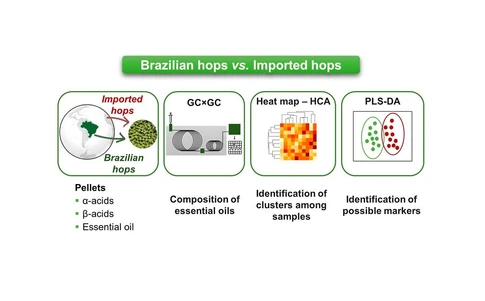
ACS Agric. Sci. Technol. (2026) 6 (5): 753–765: Graphical abstract
This study provides a comprehensive phytochemical characterization of Comet hops cultivated in Brazil during the 2024 and 2025 harvests. GC×GC-MS/FID was used to profile essential oils, while UHPLC-MS/MS characterized ethanolic extracts containing bitter acids, phenolics, and other non-volatile constituents.
Essential oil yields exceeded values previously reported for Comet hops grown elsewhere, with β-myrcene, (E)-caryophyllene, selinenes, and (E)-β-ocimene as major volatiles. Bitter acids and phenolic compounds showed the highest predicted antioxidant potential, while the overall chemical profile remained consistent across harvest years, supporting the adaptability and potential applications of Brazilian-grown Comet hops.
The original article
Phytochemical Profiling of Brazilian-Grown Comet Hops Revealed by GC×GC-MS and UHPLC-MS/MS and Antioxidant Activity Assessment Supported by in Silico Prediction
Mariana N. F. Cabral; Filipe P. G. Bonfim; Guilherme P. Pinheiro; Júlio C. R. L. Silva; Vitor Augusto dos Santos Garcia; Paulo H. Furlan; Roselaine Facanali; Viviany Viriato; Gustavo C. Fernandes; Flávia Myllena S. Araújo; Alexandra C. H. F. Sawaya; Marcia Ortiz M. Marques *
ACS Agric. Sci. Technol. (2026) 6 (5): 753–765.
https://doi.org/10.1021/acsagscitech.5c00953
licensed under CC-BY 4.0
Selected sections from the article follow. Formats and hyperlinks were adapted from the original.
In Brazil, commercial hop cultivation began in 2016, driven largely by the growth of the craft beer market. (18) Since then, several varieties have been introduced and studied. Some studies have evaluated the performance of hop varieties under Brazilian conditions, highlighting those that show greater adaptation to tropical environments (19) and chemical quality within accepted standards. (20)
Among the most promising cultivars in the Brazilian market is Comet, a U.S. variety developed through the USDA hop breeding program at Oregon State University and registered in 1962 as a “high-alpha” variety. (21) It was later surpassed by newer high-alpha aroma varieties. However, interest in this variety has recently re-emerged, as Comet has shown evidence of adaptability to Brazilian conditions (22) with chemical profiles comparable to those of crops grown in the U.S. (10) Commercial hops suppliers like Yakima Valley Hops provide reference ranges for key chemical constituents of Comet, such as α-acids (commonly 9−12% or 8−10.5% depending on the source), β- acids (3−6%), and for the composition of hop essential oils (e.g., β-myrcene 40−65% of total oil, α-humulene 1−2%, (E)-caryophyllene 5−7%). The variety is widely appreciated in the brewing industry for its characteristic citrusy aroma and high α-acid content. (23) According to Brazil’s Ministry of Agriculture, Livestock, and Supply, Comet is the second most produced hop variety in Brazil, just behind Cascade. (24)
Studies have shown that the chemical profile of hops can vary between harvests due to factors such as genotype, environmental conditions (e.g., temperature and sunlight), harvest maturity, and stress, making phytochemical profiles useful indicators of cultivation conditions. As a result, phytochemical profiles can be used as indicators of a variety’s adaptability across different cultivation environments. (25) Seasonal variation in hop chemistry is influenced not only by terroir but also by environmental fluctuations, which must be considered when assessing chemical stability across years. (26) The extent of this influence varies among hop compounds and varieties, as each responds differently to climatic conditions. (10) Evaluating successive crop years of the Comet variety is essential to assess its consistency in producing compounds of interest and to determine its adaptability to subtropical environments, providing insights relevant for brewing and other hop applications. (27)
The challenges posed by hop cultivation in Brazil were initially related to productivity. Despite these early difficulties, research has shown that Brazil offers favorable conditions for hop cultivation, with climatic and management practices, such as supplemental lighting, allowing growth patterns different from those in traditional temperate regions. (28) These unique conditions may influence the chemical composition of hops, making local characterization studies essential. In this context, the Comet variety represents a valuable case study of the chemical composition of Brazilian-grown hops. Therefore, it is important not only to evaluate its chemical profile but also to assess how the main specialized metabolites behave across harvests.
The aim of this study, therefore, was to characterize the Comet hop variety cultivated under subtropical conditions in Brazil, where environmental factors may influence the consistency of phytochemical expression, with emphasis on compounds relevant to both the brewing industry and other applications. To achieve this, we investigated the chemical composition of its essential oils, non-volatile fraction, and total phenolic content, as well as antioxidant activity, over two consecutive crop years (2024 and 2025). In addition, in silico prediction of antioxidant activity was performed for the individual compounds identified in the essential oil and non-volatile fraction.
2. Materials and Methods
2.3.1. Comprehensive Two-Dimensional Gas Chromatography Analysis (GC×GC-MS/FID)
The essential oil was analyzed using a GC×GC system on a TRACE 1310 gas chromatograph equipped with a flame ionization detector (FID) and a mass ISQ spectrometer (Thermo Fisher Scientific, Waltham, MA, USA). Essential oil samples were diluted in ethyl acetate (chromatographic grade, 1 mg·mL−1). An aliquot of 1 μL solution was injected with a split ratio of 1:20. The injector was kept at 220 °C. Helium (5.0 grade) was used as carrier (0.5 mL·min−1) and auxiliary gas (20 mL.min-1).
The mass spectrometer (MS) operated in full scan mode with an acquisition range from 40 to 450 m/z. Electron ionization (EI) was used at 70 eV. The transferline temperature was kept at 230 °C. The FID operated at 250 °C. The first and second columns consisted of an Rtx-5 MS capillary column (20 m × 0.18 mm × 0.2 μm) (1D) and an Rtx Wax column (5 m × 0.25 mm × 0.25 μm) (2D).
The temperature program was set from 60 °C to 240 °C heated at 3 °C·min−1. The effluent of the second column was passively divided using a SilFlow 3 Port GC splitter and two deactivated capillaries (5 m × 0.18 mm and 5 m × 0.32 mm), yielding a split ratio of 1:3 for MS and FID, respectively. (36,37) The modulation period was set to 6.0 s with reinjection (flush) pulse of 250 ms. Chromeleon software (Thermo Scientific, Waltham, MA, USA) was used for data acquisition.
2.4.2. UHPLC-MS/MS
An analytical approach was conducted using liquid chromatography coupled to high-resolution mass spectrometry using a Vanquish Orbitrap Exploris 120 Mass Spectrometer (Electrospray Ionization, operated in both positive and negative ionization modes) with a Hypersil GOLD aQ column (50 × 2.1 mm, 1.9 μm; Thermo Scientific, USA). Mobile phase A consisted of water containing 0.1% (v/v) formic acid, and mobile phase B consisted of acetonitrile, used for both ionization modes. A sample injection of 5 μL was performed in triplicate for each sample, using the following gradient of the chromatographic run with flow of 400 μL/min: the gradient started with 5% of phase B, reaching 100% of phase B at 8.0 min, which was kept until 11.0 min; at 11.1 the gradient returned to 5% of phase B until 14.0 min. The default global parameters of the ion source for LC flow of 400 μL/min were used and the analyses were performed in full scan as well as MS2 mode, with normalized HCD collision energies of 30, 50 and 150% simultaneously.
3. Results and Discussion
3.1.2. Essential Oil Composition
Comprehensive two-dimensional gas chromatography coupled with mass spectrometry (GC×GC-MS) has become an established technique for the detailed characterization of volatile compounds in complex matrices, owing to its high resolution and sensitivity. With hops, a rich chemical source of volatile compounds, this approach typically reveals dozens to hundreds of substances, including trace components relevant to beer aroma, stability, and sensory quality. (51−53)
Previous studies have shown that GC×GC-MS can detect subtle differences in monoterpene and sesquiterpene composition, which may vary between harvests due to environmental and seasonal factors. (54) Table 2 presents the relative percentages of the identified substances in the essential oil, along with in silico predictions (%Pa) of antioxidant activity. The 2024 and 2025 crop years were compared, and potential variation in essential oil chemical profile was evaluated, by Student’s t-test. In addition to differences observed in the major compound (β-myrcene), minor constituents, such as methyl esters and linalool, exhibited significant interannual variation, indicating subtle year-to-year differences. Experimental linear retention indices (LRIexp) closely matched literature values (LRIlit) (R2 = 0.9995), confirming the reliability of compound identification.
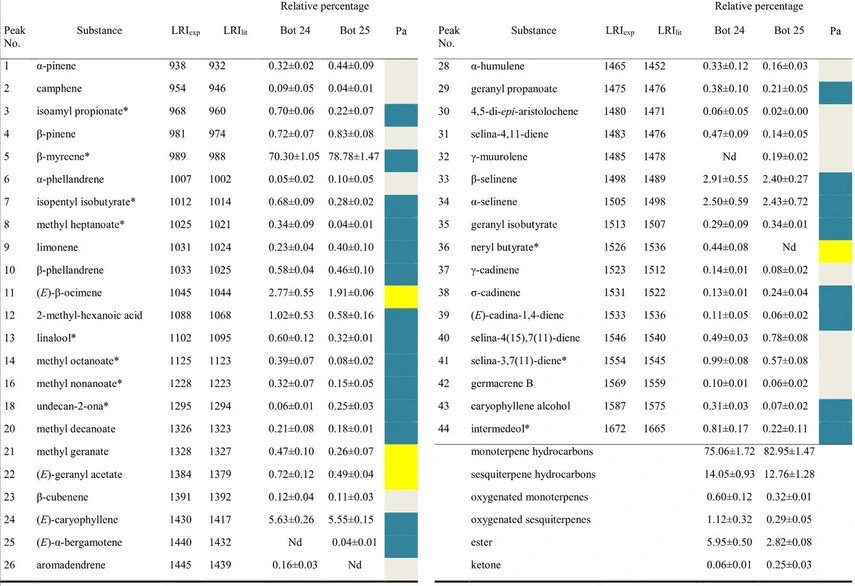 ACS Agric. Sci. Technol. (2026) 6 (5): 753–765: Table 2.Essential Oil Composition Determined by GC×GC-MS/FID for Comet Hops from Consecutive Crop Years 2024 (Bot24) and 2025 (Bot25) Cultivated in Botucatu, São Paulo, Brazil
The analysis revealed that the essential oil composition was primarily dominated by monoterpene hydrocarbons, such as β-myrcene and (E)-β-ocimene, along with sesquiterpene hydrocarbons, including (E)-caryophyllene, α-selinene, and β-selinene, with a stable chemical profile between the two harvest years for the major compounds. Comparing the results with those of the literature, (E)-β-ocimene appears to be associated with Comet, as it is more commonly found in this variety than in others. (49) The compounds α-selinene and β-selinene were abundant (>2.0%) in the hop essential oil of Bot24 and Bot25. In the second year, (E)-α-bergamotene was detected in trace amounts (0.04%). These substances have previously been reported as discriminants for Brazilian hops. (55) As shown in Table 2, there were significant differences between Bot24 and Bot25 for thirteen compounds (Student’s t-test at 1% significance level).
Significant differences between crop years were observed for the chemical classes of monoterpene hydrocarbons, sesquiterpene hydrocarbons, and esters. The 2024 harvest had a higher ester content, which may indicate an adaptive or stress-related response. In contrast, oxygenated monoterpenes and oxygenated sesquiterpenes were less abundant in the samples and showed no significant differences between 2024 and 2025, suggesting greater stability. Box plots further illustrate the chemical differences between the two harvests (Figure 2).
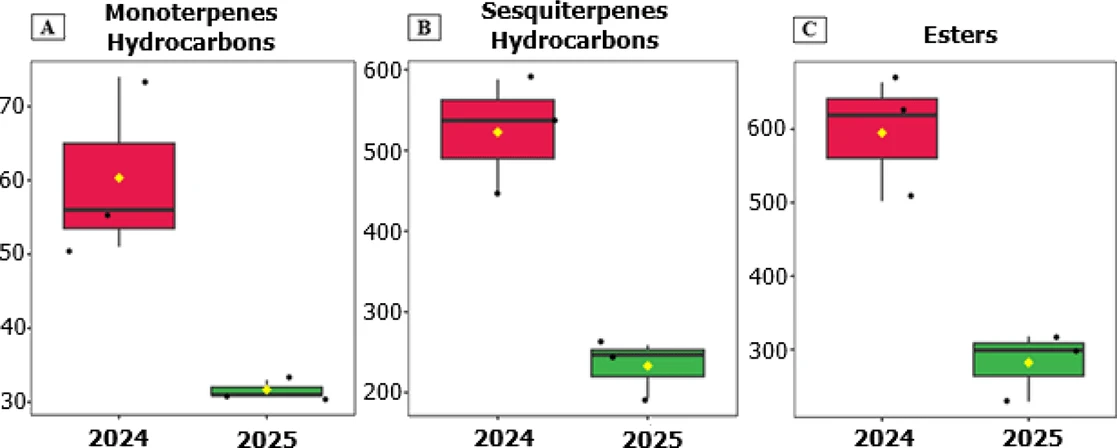 ACS Agric. Sci. Technol. (2026) 6 (5): 753–765: Figure 2. Boxplots showing the distribution of monoterpene hydrocarbons (A), sesquiterpene hydrocarbons (B), and esters (C) in Comet hops for the 2024 and 2025 crop years.
3.2. Ultra-High Performance Liquid Chromatography-MS/MS (UHPLC-MS/MS)
3.2.1. Chemical Composition of Hop Extracts
The chemical composition of ethanolic extracts from Comet hops harvested in the 2024 and 2025 crop years were analyzed in both positive and negative ionization modes. Data processing generated 75 molecular features as putative candidates for annotation, of which four were confidently identified through comparison with the ICE-4 standard and 19 tentatively annotated. Table 3 summarizes the identified substances, including retention time (min), molecular formula, mass feature (m/z), product ion, and in silico prediction (%) of antioxidant activity. Notably, both Bot24 and Bot25 crop years exhibited the same set of compounds, indicating a qualitatively stable profile across harvests.
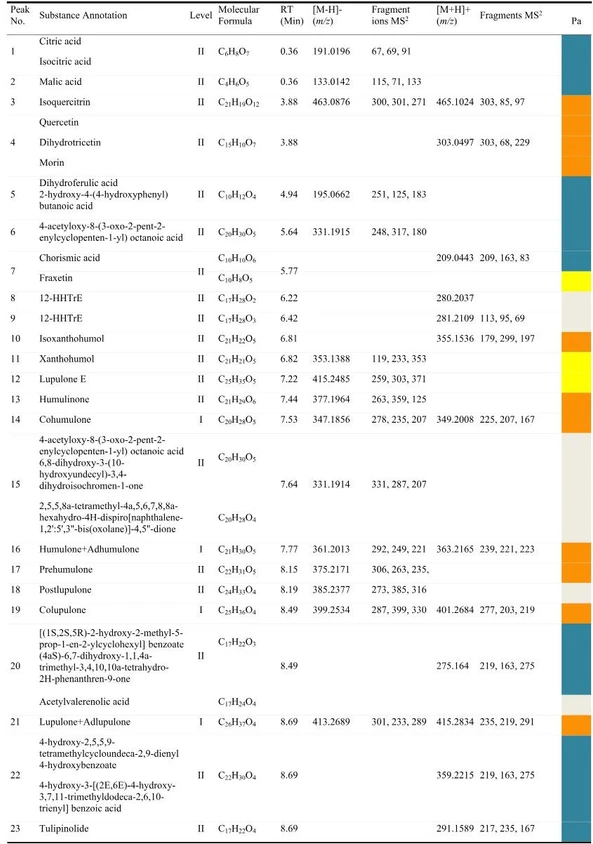 ACS Agric. Sci. Technol. (2026) 6 (5): 753–765: Table 3.Substances Tentatively Identified in Comet Hops from 2024 and 2025 Crop Years Cultivated in Botucatu, São Paulo, Brazil
To the best of our knowledge, this study provides the first comprehensive characterization of the chemical composition of ethanolic extracts of Comet hops cultivated in Brazil using UHPLC-MS/MS, revealing a range of biologically active substances. The analysis enabled the annotation of numerous compounds, including phenolic acids, flavonoids, and bitter acid derivatives. Various extract concentrations and ethanol proportions were tested, and 70% ethanol was selected as the optimal condition. This choice was based not only on extraction yield but also on the consistency of results with antioxidant activity data, making it the most reliable condition for subsequent analyses.
Citric acid (Peak No. 1, neutral mass 192.0270 Da) and malic acid (Peak No. 2, neutral mass 134.0215 Da) are relevant to beer flavor and its prosecretory potential. (63) Organic acids represent one of the main classes of substances in hop varieties. Phenolic compounds such as quercetin and isoquercitrin are well-established constituents of hop extracts, along with rutin, astragalin, 8-prenylnaringenin, xanthohumol, 4-deoxycohumulone, and 4-deoxyhumulone, reported in methanolic extracts of various hop varieties from Germany. (64) Hop extracts from Turkey have shown a range of phenolic compounds, including kaempferol 3-O-glucoside, quercetin, ascorbic acid, ferulic acid, gallic acid, ellagic acid, p-coumaric acid, epigallocatechin, and pyrogallol. (65)
Specialized metabolites also serve important ecological roles, acting as defense mechanisms against herbivores and pathogens, attracting pollinators, assisting in seed dispersal, mediating plant-plant interactions, and contributing to light absorption. Consequently, variation due to environmental conditions, even within the same variety, can be expected. (66)
Xanthohumol, one of the most important compounds in hops and a metabolite unique to the species, is classified as a chalcone, an open-chain flavonoid with a wide range of applications, particularly in cancer chemoprevention. (4) Its chemical structure, featuring a chalcone backbone with hydroxyl groups and a prenyl side chain, confers strong radical scavenging capacity. The conjugated system allows electron delocalization, stabilizing reactive oxygen species through electron or hydrogen donation. (67) One study has reported twice the amount of xanthohumol in Comet compared to Cascade hops. (10) Additionally, the hop plant produces 8-prenylnaringenin, an important phytoestrogen, through cyclization of desmethylxanthohumol. This compound is typically present at approximately 1/5 the concentration of xanthohumol, (68) often below 0.01%, (69) which may explain why it was not detected in the present analysis.