Mo, 26.10.2026 | Original article from: ACS Omega (2026) 11 (40): 61241–61255.
Integrated LC-MS and GC-MS profiling characterizes cocoa pod husk, pulp juice, and syrup, revealing distinct metabolites with potential for side-stream valorization.Compositional and Metabolomic Characterization of Major On-Farm Side Streams and Derived Products of Industrial Fine-Flavor Cocoa Processing
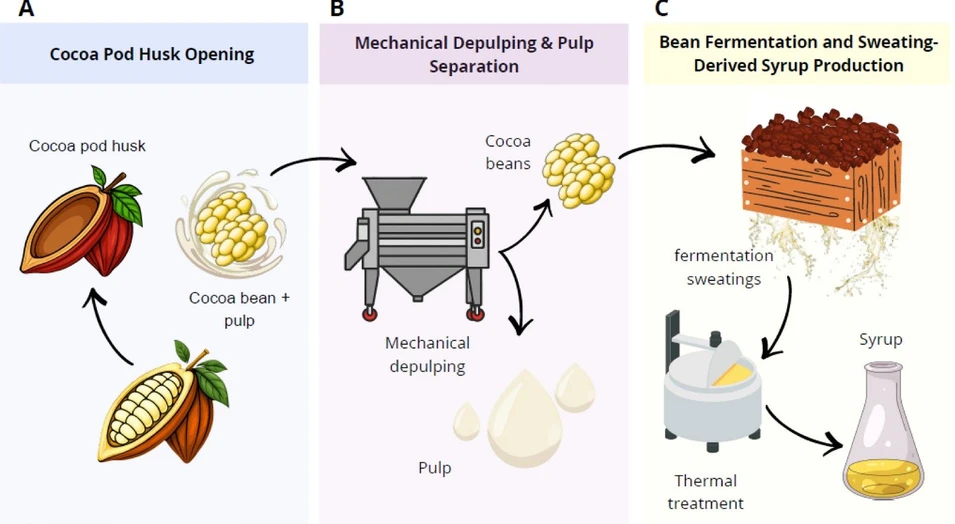
ACS Omega (2026) 11 (40): 61241–61255: Figure 1. Industrial generation of on-farm cocoa byproducts during fine-flavor cocoa processing.
This study provides an integrated compositional and metabolomic characterization of cocoa pod husk, cocoa pulp juice, and cocoa syrup generated during industrial fine-flavor cocoa processing. Mineral analysis revealed substantial differences among matrices, while complementary LC-MS and GC-MS enabled annotation of 82 metabolites across the three side streams.
Distinct chemical profiles were identified, including caffeic acid, epicatechin, and procyanidin B1 in pod husk; glutamine and glutathione in pulp juice; and N-(deoxyfructosyl) amino acid derivatives in cocoa syrup. The results establish a compositional baseline for targeted quantification and support future recovery and valorization of bioactive compounds from cocoa processing side streams.
The original article
Compositional and Metabolomic Characterization of Major On-Farm Side Streams and Derived Products of Industrial Fine-Flavor Cocoa Processing
Daniela Burgos-Toro; Ana M. León-Inga; María J. Chica; José M. Guillamón; Mónica P. Cala; Miguel Fernández-Niño*
ACS Omega (2026) 11 (40): 61241–61255
https://doi.org/10.1021/acsomega.6c06084
licensed under CC-BY 4.0
Selected sections from the article follow. Formats and hyperlinks were adapted from the original.
The cultivation of cacao (Theobroma cacao L.) has significant economic, social, and cultural relevance at the global level, driven both by the sustained growth of chocolate consumption and by the consolidation of specialized value chains. In 2023, global production reached nearly 5 million tons, with Africa as the main producing region (73.4%), followed by Latin America and the Caribbean (20%). (1) In the Latin American context, cacao has also played a strategic socio-cultural role in rural development dynamics and territorial strengthening; in countries such as Colombia, it has been promoted as a productive alternative in processes of substitution of illicit economies and reconstruction of the agricultural fabric in postconflict scenarios. (2, 3) In parallel, several countries in the region have consolidated the production of fine-flavor cocoa because of domestication and selection processes that have made it possible to obtain differentiated and competitive sensory profiles in specialized market niches. (4, 5) Despite this relevance, only a small fraction of the cocoa fruit is ultimately used for chocolate production, while most of the biomass remains underutilized, representing a largely unexplored resource for the development of new value-added ingredients and sustainable product streams. (6)
During cocoa processing, different on-farm side streams and derived products are generated at clearly differentiated stages of postharvest handling. During fruit opening, the beans are separated, and the cocoa pod husk is generated, constituting the main unavoidable solid residue of this initial stage. Subsequently, before the beginning of fermentation, part of the pulp (mucilage) surrounding the beans may be removed as a liquid fraction, hereafter referred to as cocoa pulp juice, as a practice commonly implemented in industrial systems to control the fermentation process. (7) Finally, during fermentation, the exuded liquids known as sweatings are generated, resulting from the drainage of the mucilage, which may be recovered and subjected to thermal treatment to control additional microbial activity, giving rise to products such as cocoa syrup in a process currently employed by the company CasaLuker S.A.S. This differentiation is relevant since these materials do not belong to a single category of waste nor are they generated under equivalent conditions. The term byproduct is used throughout, in this broad sense, encompassing both unavoidable residues and materials that have already undergone a first processing step, rather than as a synonym for waste. Instead, they represent distinct process-derived streams within on-farm industrial postharvest systems, each with specific origins, degrees of intentionality, and technological handling.
While the cocoa pod husk is generated as a structural residue associated with the opening of the fruit, the juice from the cocoa pulp represents a liquid fraction deliberately recovered before fermentation, and cocoa syrup is the product of an initial valorization stage that has already been applied to the fermentation exudates. Thus, the three materials occupy different positions along the same processing chain, ranging from the unavoidable residue to the deliberately recovered fraction and the stabilized derivative product, and are included here precisely because this gradient has not been previously characterized within the same production system.
In terms of yield, only between 5% and 10% of the fruit corresponds to the beans used for chocolate production, while the remaining 90–95% is distributed among the cocoa pod husk, pulp, and bean shell. (8−11) The cocoa pod husk represents approximately 70–80% of the total fruit volume, followed by the pulp and bean shell, which account for around 20%. (12−15) This disproportion highlights the relevance of these byproducts as abundant, yet underexploited, raw materials with potential for valorization within circular and sustainable cocoa production systems. When these materials are not properly managed, their direct disposal may favor the proliferation of pests and pathogens and contribute to greenhouse gas emissions such as methane and carbon dioxide. (16, 17)
Studies have shown that these byproducts present complex chemical compositions. The cocoa pod husk and the bean shell contain high levels of fiber, protein, and lignocellulosic components, as well as lipid fractions with saturated, monounsaturated, and polyunsaturated fatty acids, (16, 18) in addition to volatile compounds, polyphenols, and methylxanthines. (11, 19) The pulp contains high concentrations of methylxanthines and phenolic compounds, (16, 20) while sweatings are characterized by high contents of soluble carbohydrates and minerals (13) and have been explored in food applications. (12, 20) However, although there is a growing number of studies on cocoa-derived materials, many focus on isolated components or on small-scale experimental systems. (22−25) Comparative studies integrating multiple on-farm byproducts under real industrial-scale postharvest conditions remain limited, particularly in large-scale monoclonal fermentation systems.
Particular terminological ambiguity surrounds the liquid fractions generated during this processing chain. The translucent, sugar-rich liquids recovered before or during cocoa fermentation have been variously described as cocoa honey, cocoa sweat, cocoa exudate, and cocoa pulp juice, with these designations often used interchangeably. (13, 22) This interchangeable terminology obscures process-relevant distinctions among materials recovered at different stages and by different means, including juice mechanically separated from the pulp before fermentation, exudates drained from the fermenting mass as pulp depectinization progresses, and products subsequently obtained from these liquid streams through further processing. Existing characterizations of cocoa honey and cocoa sweat have been predominantly physicochemical, reporting soluble solids, pH, titratable acidity, reducing sugars, pectin, and mineral composition, (22, 26, 27) while applied studies have evaluated these fractions as fermentation substrates, beverage bases, sourdough ingredients, and additives during bean fermentation. (21, 28, 29) More recently, cocoa pulp juice concentrate has been combined with the pectin-rich pod endocarp to produce a sweetening gel capable of replacing refined sugar in chocolate formulations, further illustrating the technological relevance of these liquid fractions beyond fermentation-related uses. (30) Thus, these overlapping designations encompass materials that may differ in their stage of recovery, processing history, and status as unprocessed process streams or defined industrial products.
These distinctions are also analytically relevant. Untargeted metabolomic descriptions of cocoa liquid fractions remain scarce, particularly for materials subjected to processing after recovery. To our knowledge, no study has jointly characterized a thermally concentrated product derived from fermentation exudates, such as the syrup examined here, and the prefermentation pulp juice recovered from the same production batches. These two materials represent distinct process-defined streams: the juice is recovered before microbial fermentation, whereas the syrup is derived from exudates generated during fermentation and subsequently subjected to thermal stabilization and concentration. Their compositional equivalence, therefore, cannot be assumed from studies of fresh or pasteurized cocoa honey, or other cocoa-derived liquid fractions, supporting the need for separate characterization.
Taken together, three gaps emerge in the available literature. First, cocoa by-products have rarely been comparatively characterized within the same production system and using a common analytical framework, limiting the extent to which differences reported across independent studies can be attributed to the materials themselves rather than to production or analytical variability. Second, overlapping terminology for cocoa liquid fractions often fails to distinguish materials according to their recovery stages and subsequent processing history. Third, untargeted metabolomic information on these process-defined liquid streams remains limited, with no joint characterization, to our knowledge, of prefermentation pulp juice and a thermally concentrated, fermentation-exudate-derived product recovered within the same industrial production batches.
In this context, it is pertinent to generate integrated information that combines proximate analyses and metabolomic approaches to comparatively describe the on-farm byproducts generated at different stages of industrial fine-flavor cocoa processing. The present study was conducted using the fine-flavor cocoa clone Luker 40, cultivated and processed within a large-scale industrial production system associated with one of the world’s major fine-flavor cocoa networks, encompassing more than 73,000 tons of cocoa produced annually, approximately 18,587 ha under sustainable management, and over 15,000 farming families. This framework provides a highly standardized and traceable model for the study of industrial cocoa byproducts generated under real postharvest conditions. Therefore, the present study aimed to perform an integrated compositional and metabolomic characterization of three materials generated at different stages of industrial fine-flavor cocoa processing: cocoa pod husk, cocoa pulp juice, and a syrup obtained by thermal treatment of fermentation sweatings. By jointly examining an unavoidable solid residue, a deliberately recovered prefermentation liquid fraction, and a processed product derived from fermentation exudates, this study captures compositionally distinct streams occupying different positions along the same industrial postharvest chain. Rather than demonstrating direct functional applications, this work provides a compositional basis that may support future studies oriented toward process optimization, targeted extraction, and possible utilization strategies within circular cocoa production systems.
Materials and Methods
Source and Sampling of On-Farm Side Streams and Derived Products
Three cocoa-derived matrices were obtained from industrial fine-flavor cocoa processing carried out by CasaLuker S.A. at the Villa Nueva Farm (Casanare, Colombia; 4°35′35.4“N, 72°49′34.3”W), under standard production conditions. The processing system is based on large-scale monoclonal fermentations performed in wooden boxes with a capacity of approximately 500 kg per fermentation batch. Fermentation containers, collection vessels, and transfer lines are food-grade materials managed under the certified quality system of the producing company, and no mineral additives are used at any stage of the post-harvest chain. The analyzed by-products were generated at different stages of the on-farm post-harvest processing chain (Figure 1).
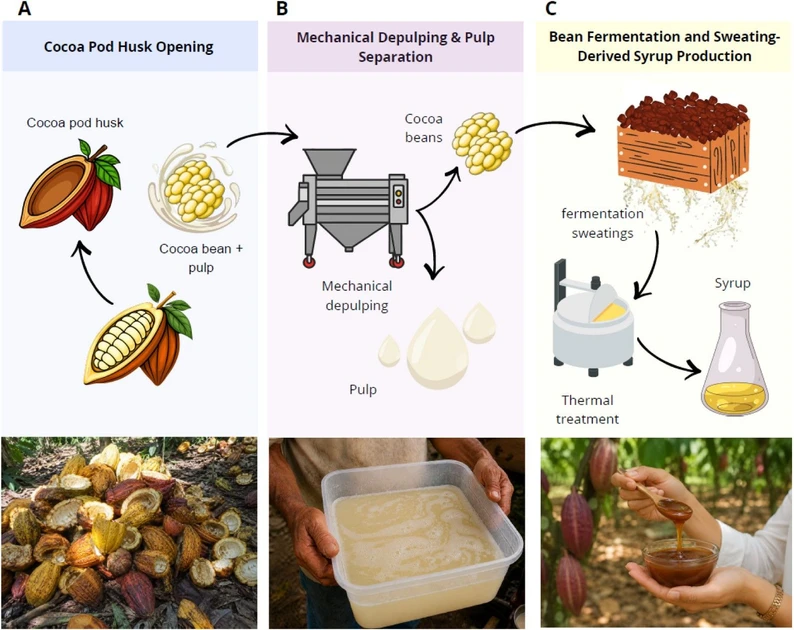 ACS Omega (2026) 11 (40): 61241–61255: Figure 1. Industrial generation of on-farm cocoa byproducts during fine-flavor cocoa processing. (A) Cocoa pod husk generated during fruit opening, including the intact pod, mechanical opening, and the resulting chipped husk. (B) Cocoa pulp juice deliberately recovered prior to fermentation through mechanical depulping, corresponding to the liquid fraction of the mucilage. (C) Cocoa syrup obtained from fermentation sweatings, including fermentation in wooden boxes, collection of exudates, and subsequent thermal treatment to stabilize the product. The three photographic-style images shown at the bottom of panels A–C were generated using artificial intelligence and are included for illustrative purposes only.
Metabolite Characterization of On-Farm Cocoa Side Streams and Derived Products through LC-MS Analysis
Sample Preparation and LC-MS Analysis
Chromatographic separation was performed using an Agilent 1260 liquid chromatography system coupled to a 6545 Quadrupole Time-of-Flight (Q-TOF) mass analyzer with an electrospray ionization (ESI) source. Source parameters were set as follows: capillary voltage (3000 V), drying gas temperature (325 °C), drying gas flow (8 L/min), nebulizer pressure (50 psi), sheath gas temperature (350 °C), sheath gas flow (11 L/min), fragmentor voltage (175 V), skimmer voltage (65 V), and octopole RF (750 V). A 10 μL aliquot of each sample was injected into an InfinityLab Poroshell 120 EC-C18 column (3.0 × 100 mm, 2.7 μm) at 30 °C, operated at a flow rate of 0.4 mL/min. The mobile phase consisted of (A) water with 0.1% (v/v) formic acid and (B) acetonitrile with 0.1% (v/v) formic acid. The gradient started at 2% B, increased to 30% over 15 min, then to 98% at 17 min, was held for 3 min, and finally returned to the initial conditions for re-equilibration. Mass detection was performed in both positive and negative ionization modes under full scan and Auto MS/MS acquisition over a mass range of m/z 100–1700 at a rate of 3 spectra/s. MS/MS spectra were acquired using collision energies ranging from 20 to 40 eV. Data acquisition was performed using Agilent MassHunter Data Acquisition software (version 10.0). Continuous mass correction was applied using reference ions at m/z 121.0509 [C5H4N4]+ and m/z 922.0098 [C18H18O6N3P3F24]+ in positive mode, and m/z 112.9856 [C2H4O2NF3-(NH4)]− and m/z 1033.9881 [(C18H18O6N3P3F24 + trifluoroacetic acid)-H]− in negative mode.
Data Processing and Compound Annotation
Data were processed using Agilent MassHunter Profinder 10.0 software with the Recursive Molecular Feature Extraction algorithm. Features were filtered using solvent blanks, and relative abundance was calculated for each biological replicate by dividing the peak area of each feature by the total peak area of the corresponding sample. For the LC-MS data set, to ensure high MS/MS spectral quality and minimize false-positive annotations, only features with relative abundance above 1.0% were selected for compound identification. The identification process was carried out considering monoisotopic patterns, adduct formation, molecular formulas, and MS/MS fragmentation. Databases including METLIN, KEGG, LIPID MAPS, and HMDB were used for compound assignment. Identification levels were assigned according to Blaženović and collaborators, (31) who established increasing levels of confidence, including level 4 (exact-mass match/unknown feature), level 3 (possible structure, confirmation with molecular formula), level 2 (likely structure or consistency with literature spectra), level 1 (a confident 2D structure or confirmation with in-house standards), and level 0 (an unambiguous 3D structure). Caffeic acid, the only metabolite assigned to identification level 1, was confirmed by comparison with an authentic standard analyzed under the same experimental conditions.
Sample Preparation and GC-MS Analysis
For GC-MS analysis, 100 μL of cocoa pulp juice and 5 mg each of cocoa pod husk and cocoa syrup were used, with the syrup weighed due to its viscous nature. Samples were extracted with 200 μL of methanol, followed by vortex-mixing for 5 min and sonication for 10 min. The extracts were then centrifuged at 15,000 rpm for 10 min at room temperature. A 50 μL aliquot of the supernatant was subjected to a two-step derivatization procedure. First, methoximation was performed by adding 20 μL of O-methoxamine hydrochloride in pyridine (15 mg/mL) and incubating under appropriate conditions. Subsequently, silylation was carried out using 20 μL of N,O-bis(trimethylsilyl)fluoroacetamide (BSTFA) with 1% trimethylchlorosilane (TMCS). Prior to GC-MS analysis, 80 μL of an internal standard solution (C18) was added to each sample. Chromatographic analysis was performed using an Agilent 7890B gas chromatograph coupled to an Agilent quadrupole time-of-flight (Q-TOF-7250) mass detector. Samples were introduced through a split/splitless injector operated in split mode (250 °C, split ratio 1:30) with an automatic injector (Agilent Technologies 7693A). Separation was achieved using an Agilent J&W HP-5MS column (30 m × 0.25 mm × 0.25 μm), with helium as the carrier gas at a constant flow rate of 0.7 mL/min. The oven temperature program started at 60 °C (held for 1 min), increased at 10 °C/min to 325 °C, and was held for 10 min. The temperatures of the transfer line to the detector, the ion source filament, and the quadrupole were maintained at 280 °C, 230 °C, and 150 °C, respectively. Electron ionization (EI) was performed at 70 eV with a filament emission current of 5 μA. Automated mass calibration and tuning (Autotune) were conducted prior to the analytical sequence. Mass spectra were acquired at a rate of 5 scans per second over a mass range of m/z 50–600. Data acquisition was performed using Agilent MassHunter Data Acquisition software (version 10.0).
Results
Cocoa Side Streams and Derived Products Exhibit Distinct Metabolic Signatures
Heatmaps of the metabolites annotated by LC-MS and GC-MS showed distinct descriptive relative-abundance patterns across the three cocoa matrices (Figure 2A,B).
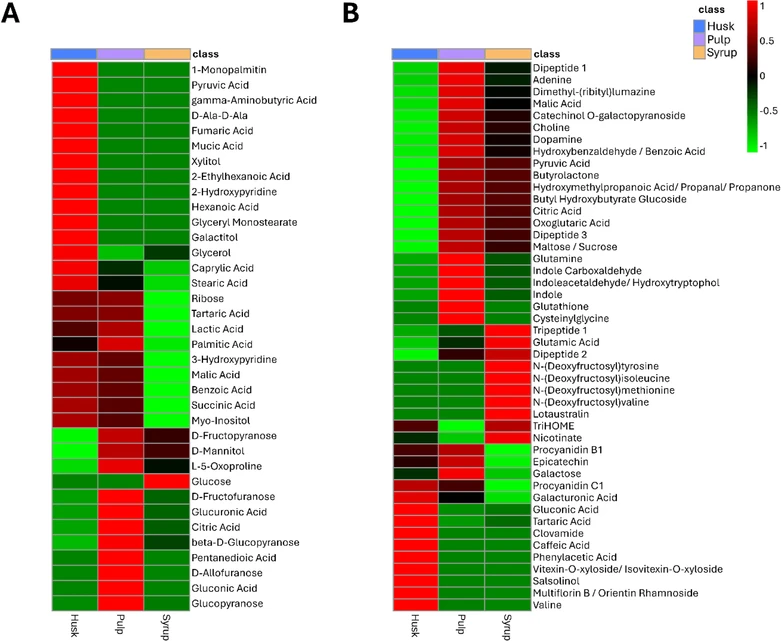 ACS Omega (2026) 11 (40): 61241–61255: Figure 2. Heatmaps of metabolite profiles across cocoa by-products analyzed by GC-MS (A) and LC-MS (B). Rows represent individual annotated metabolites, while columns correspond to the analyzed cocoa byproducts (cocoa pod husk, cocoa pulp juice, and cocoa syrup). Both analytical platforms display matrix-specific metabolic signatures across byproducts. The color scale represents autoscaled values of the total area–normalized relative abundances (row-wise z-scores), where red indicates higher, and green lower, relative levels within each metabolite.
In both data sets, cocoa pulp juice, cocoa syrup, and cocoa pod husk displayed matrix-dependent patterns in their annotated metabolite profiles. These patterns were particularly apparent in the LC-MS data set, where structurally complex metabolites showed matrix-specific distributions. In contrast, GC-MS profiles showed broader similarities across matrices, particularly among low-molecular-weight compounds such as organic acids, sugars, and polyols. Notably, cocoa syrup exhibited a metabolic profile with features shared with both pulp-derived and structurally complex matrices, reflecting its origin as a fermentation-derived liquid fraction subjected to subsequent processing. Overall, these results indicate that each cocoa matrix possesses a distinct metabolic profile, shaped by both biological origin and process-driven transformations.
At the compound level, this separation was driven by a small set of matrix-restricted metabolites: Amadori derivatives (N-(deoxyfructosyl)valine, isoleucine, methionine, and tyrosine) in cocoa syrup; flavan-3-ols and phenolic amides (epicatechin, procyanidins B1 and C1, clovamide, and caffeic acid) in cocoa pod husk; and glutathione, glutamine, cysteinylglycine, and indole-derived compounds in cocoa pulp juice.
In contrast, cocoa syrup displayed a metabolomic profile shaped by both microbial activity during fermentation and subsequent processing steps, including concentration and thermal stabilization. LC-MS analysis (Table 2) revealed soluble carbohydrates such as maltose and sucrose and organic acids including malic and citric acids, together with multiple N-(deoxyfructosyl) amino acid derivatives, such as N-(deoxyfructosyl)valine and N-(deoxyfructosyl)isoleucine. These Amadori compounds were detected in cocoa syrup but were not detected in either the prefermentation pulp juice or cocoa pod husk generated within the same production system (Table 2), including derivatives annotated at identification level 2. Amadori compounds are recognized as early-stage Maillard reaction products arising from reactions between reducing sugars and amino compounds, and their detection in the processed syrup is consistent with chemical transformations occurring during the processing history of this matrix. (40, 41) Together with the distinct mineral profile described above, these findings provide compositional evidence that the cocoa syrup investigated here constitutes a distinct processed matrix rather than being compositionally interchangeable with the unprocessed liquid cocoa fractions described in the literature. Nitrogen-containing metabolites such as choline and related compounds were also detected. GC-MS data (Table 3) further indicated high abundances of polyols and carbohydrate-derived acids, particularly mannitol, glucuronic acid, and gluconic acid. Compared to the other matrices, cocoa syrup exhibited a lower diversity of lipophilic compounds, consistent with its liquid nature. Overall, this fraction represents a compositionally distinct intermediate integrating pulp-derived compounds with fermentation- and processing-derived metabolites.
Cocoa pod husk, representing the outer pericarp of the fruit, exhibited a markedly different metabolomic profile consistent with a structurally complex plant matrix. LC-MS analysis (Table 2) revealed phenolic compounds and flavonoids characteristic of cocoa tissues, including epicatechin, clovamide, and procyanidins (B1 and C1), as well as flavones. (42) Organic acids and amino acids were also detected, although their relative distribution differed from that of the pulp-derived fractions. GC-MS analysis (Table 3) showed comparatively lower relative abundances of simple sugars and a greater representation of organic acids, fatty acids (such as palmitic and stearic acids), and structural metabolites, including myo-inositol. This composition is consistent with lignocellulosic plant tissues, in which structural and phenolic components dominate the chemical profile. (23) The lignocellulosic fraction of cocoa pod husk has been extensively characterized elsewhere, with reported contents of cellulose, hemicellulose, lignin, and pectin, making it a recognized source of dietary fiber, including pectin. (11, 23, 33) That fraction was not quantified here and is complementary to the soluble metabolite pool described in this work; together, both dimensions would provide a more comprehensive compositional basis for assessing the valorization potential of this matrix.
Beyond these matrix-specific signatures, several metabolites were consistently detected across multiple matrices, reinforcing the presence of shared biochemical pathways within the cocoa processing system. In the LC-MS data set (Table 2), compounds such as choline and malic acid were detected in all three matrices, while central metabolites including pyruvic acid, oxoglutaric acid, citric acid, glutamic acid, and disaccharides such as maltose/sucrose were shared between cocoa pulp juice and cocoa syrup. Similarly, GC-MS analysis (Table 3) revealed conserved sugar-derived acids and polyols across matrices, particularly glucuronic acid, gluconic acid, and mannitol, which were consistently detected across all three analyzed byproducts. The persistence of these compounds suggests continuity of carbohydrate-derived metabolic pools along the cocoa processing chain. This study indicates that cocoa byproducts are characterized by both distinct and shared metabolomic features, suggesting the interplay between biological origin and process-driven transformations. While the relative abundance profiles capture the global organization of this metabolic space, compound-level annotation provides insight into the specific biochemical patterns underlying these profiles.
Conclusion
The three by-products generated along the on-farm fine-flavor cocoa chain share a comparable proximate composition but diverge sharply in mineral content and metabolite profiles. Cocoa syrup emerged as a mineral-enriched fraction whose enrichment relative to its own prefermentation precursor is selective rather than purely concentrative. Among the 82 metabolites annotated, each matrix showed a distinctive signature: glutamine, cysteinylglycine, glutathione, and indole derivatives in cocoa pulp juice; Amadori derivatives in cocoa syrup; and clovamide, caffeic acid, epicatechin, and procyanidins B1 and C1 in cocoa pod husks.
The main contribution of this work lies in the comparative analysis of three coexisting byproducts within the same production system and under a single analytical protocol. This design also provides a basis for distinguishing compounds associated with the raw material from those associated with processing, an interpretation that is more difficult to make when a derived product is characterized in isolation. This includes, to our knowledge, the first joint compositional and metabolomic description of a thermally concentrated, fermentation-derived cocoa syrup together with prefermentation cocoa pulp juice recovered from the same production batches, two liquid materials that are frequently grouped under overlapping terminology in the literature.
In practice, these profiles provide a baseline for prioritizing byproducts and candidate compounds for subsequent investigation: phenolic compounds and selected lipids point to cocoa pod husks, soluble primary metabolites to cocoa pulp juice, and process-derived compounds to cocoa syrup. Because all three matrices were characterized using a single analytical protocol, this mapping provides a basis for selecting candidate source matrices for subsequent targeted studies without relying exclusively on comparisons across independent studies. This prioritization is intended to serve as a starting point for hypothesis-driven research rather than as a demonstration of industrial viability or suitability for food use.