Mo, 26.10.2026 | Original article from: ACS Polym. Au (2026) 6 (5): 1422–1434
An optimized HS-SPME-GC-MS workflow provides broad screening of hazardous VOCs in recycled polypropylene across a wide range of volatility and polarity.Development of a Property-Guided HS-SPME-GC-MS Method for Broad-Range Qualitative Screening of Potentially Hazardous VOCs in Recycled Polypropylene
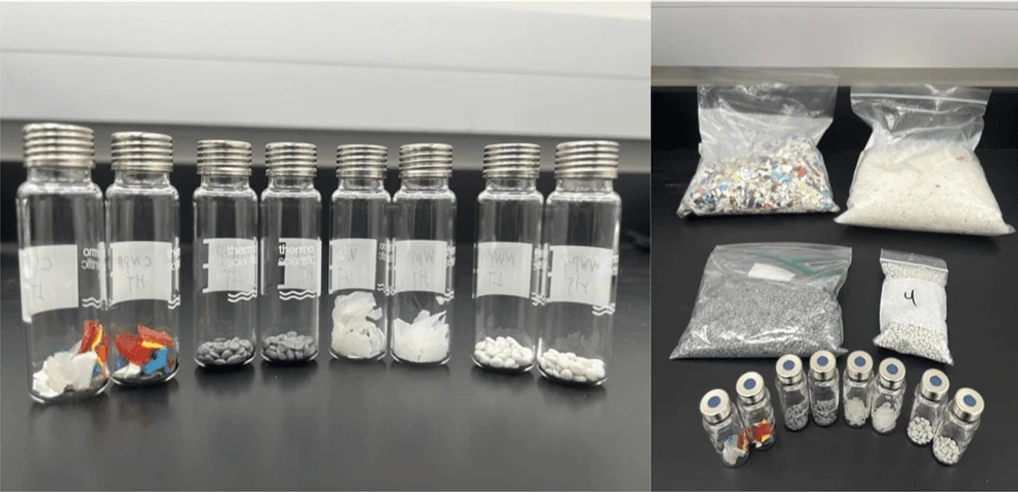
ACS Polym. Au (2026) 6 (5): 1422–1434: Figure 7. Industrial recycled PP samples analyzed in this study.
This study develops a property-guided HS-SPME-GC-MS method for broad qualitative screening of potentially hazardous volatile organic compounds in recycled polypropylene. From 622 candidate contaminants, 274 hazardous VOCs were prioritized and representative compounds spanning broad volatility and polarity ranges were used to optimize fiber selection and extraction conditions.
DVB/C-WR/PDMS provided the broadest compound coverage, while vapor pressure was identified as the main factor governing extraction behavior. Application to industrial recycled polypropylene detected aliphatic and aromatic hydrocarbons, oxygenated compounds, and lindane, demonstrating the method’s potential for quality control, emission assessment, and optimization of plastic recycling processes.
The original article
Development of a Property-Guided HS-SPME-GC-MS Method for Broad-Range Qualitative Screening of Potentially Hazardous VOCs in Recycled Polypropylene
Wei Jiang; Huijun Yi; Caleb Chatfield; Chloe Higdon; Nathan Mancos; Shaoyang Liu *
ACS Polym. Au (2026) 6 (5): 1422–1434
https://doi.org/10.1021/acspolymersau.6c00124
licensed under CC-BY 4.0
Selected sections from the article follow. Formats and hyperlinks were adapted from the original.
Plastic waste has become a major source of environmental pollution, posing persistent threats to both terrestrial and aquatic ecosystems worldwide. (1, 2) Since the mid-20th century, the rapid growth in plastic production and consumption has resulted in a substantial accumulation of plastic waste. Global plastic production reached approximately 8300 million metric tons (Mt) in 2017, while plastic waste generation exceeded 6300 Mt. (3) Recycling is widely recognized as an effective strategy to reduce plastic pollution and conserve natural resources. (4, 5) However, despite increasing awareness and policy efforts, the global plastic recycling rate remains low. After accounting for processing losses, only approximately 9% of plastic waste is ultimately recycled, whereas the majority is landfilled, incinerated, or mismanaged, leading to long-term environmental contamination. (6)
Improving recycling rates requires not only the expansion of collection and processing capacity but also enhancements in the quality and safety of recycled plastic products. In recent years, the performance of recycled plastics has become a critical factor influencing their market acceptance and broader application. (7) Mechanical recycling, which dominates current recycling systems, often leads to materials with degraded properties and undesirable sensory characteristics, limiting their use in high-value products. (8) Among these quality-related challenges, the presence and release of volatile organic compounds (VOCs) have attracted growing attention. Recycled plastics can emit complex mixtures of VOCs originating from polymer thermo-oxidative degradation during service life and reprocessing, as well as residual additives, absorbed contaminants, and substances introduced during previous use cycles and recycling processes. (9) These VOCs can be released during recycling operations such as washing, drying, melting, and extrusion, as well as during subsequent product use, leading to unpleasant odors and raising concerns regarding potential health risks. Recently, some VOCs detected in recycled plastics, including aromatic hydrocarbons and low-molecular-weight oxygenated compounds, are classified as hazardous substances by international authorities. (10, 11) These concerns highlight the importance of reliable VOC detection for improving the quality and safety of recycled plastics and strengthening public confidence in recycled materials. Consequently, the development of systematic and sensitive analytical methods for characterizing VOCs in recycled plastics has become a pressing need to support sustainable recycling practices and circular economy goals.
Over the past decade, substantial progress has been made in characterizing VOCs emitted from recycled plastics. Gas chromatography–mass spectrometry (GC–MS) remains the principal analytical technique because of its high separation efficiency and capacity for structural identification. (9) Among GC-MS-based approaches, headspace solid-phase microextraction coupled with GC–MS (HS-SPME-GC-MS) has emerged as a powerful and versatile method for this application. HS-SPME is a solvent-free sample preparation method that integrates sampling, enrichment, and matrix isolation in a single step. By extracting analytes directly from the headspace, HS-SPME minimizes interference from nonvolatile matrix components and is particularly well-suited for solid polymer materials. (12, 13) The extraction efficiency of HS-SPME can be tuned by selecting appropriate fiber coatings and optimizing experimental parameters such as SPME temperature, incubation time, and extraction time, allowing coverage of VOCs with diverse physicochemical properties. (13, 14) Several studies have demonstrated the applicability of HS-SPME-GC-MS for investigating VOC emissions from recycled plastics, particularly in relation to unpleasant odors that limit material acceptance. HS-SPME-GC-MS was applied to identify odor-causing compounds in recycled polyolefin resins, while subsequent studies used similar approaches to track changes in VOC profiles during mechanical recycling and to evaluate mitigation strategies. (15−17) However, many existing studies have primarily focused on VOCs that could cause undesirable odors or were present in high concentrations but overlooked trace-level hazardous contaminants, which could pose safety concerns for recycled plastic products. Systematic method-development approaches targeting potentially hazardous VOCs across a broad range of physicochemical properties remain scarce.
In this study, we developed and optimized practical HS-SPME-GC-MS methods for the detection of a broad range of potentially hazardous VOCs in recycled polypropylene (rPP). Relevant physicochemical property ranges were first established through an extensive survey of potentially hazardous VOCs in recycled plastics. Representative target compounds were then systematically selected to cover the broad ranges of volatility and polarity. Different SPME fiber coatings were evaluated, and key HS-SPME parameters were optimized using response surface methodology. The applicability of the optimized method was further demonstrated using industrial rPP samples. Overall, this work provides a robust analytical framework for VOC screening that can support quality assurance, emission assessment, and process optimization in plastic recycling systems.
2. Materials and Methods
2.4. HS-SPME-GC-MS Analysis
HS-SPME-GC-MS analyses were performed using an Agilent 8890 gas chromatograph coupled with an Agilent 7250 GC/Q-TOF mass spectrometer (Agilent Technologies, USA). VOCs were separated on a low-polarity capillary column suitable for volatile and semivolatile organic compounds (DB-5 ms, 30 m × 0.25 mm × 0.25 μm).
2.5. Data Analysis Methods
GC–MS data were processed using Agilent MassHunter software. VOCs were identified based on retention times, characteristic mass spectral fragments, and comparisons with reference standards and mass spectral libraries. For each target VOC, one quantifier ion and two qualifier ions were selected to ensure reliable identification.
3. Results and Discussion
3.1. Selection of Representative Hazardous VOCs
An extensive survey was conducted to identify potentially hazardous VOCs associated with recycled plastics. A total of 622 potential contaminants were compiled from three categories: VOCs previously reported in recycled plastics (n = 435), commonly used household and commercial pesticides and herbicides (n = 114), and widely used plastic additives (n = 73). NFPA health hazard ratings for all candidates were obtained from government agencies, major chemical manufacturers, and other credible sources (Table S1). Among the 622 evaluated chemicals, 14 received a hazard rating of 4, 96 a rating of 3, 257 a rating of 2, 149 a rating of 1, and 106 a rating of 0. Chemicals with NFPA health hazard ratings ≥2 (n = 367) were classified as potentially hazardous contaminants.
Vapor pressure at room temperature and logP values were subsequently compiled for these 367 chemicals as indicators of volatility and polarity, respectively. Sixty-one chemicals were excluded due to the absence of reliable data. An additional 32 chemicals were excluded because their vapor pressures were below 1 × 10⁻⁷ mmHg, indicating negligible volatility and limited suitability for extraction by HS-SPME. The remaining 274 chemicals were therefore considered as potentially hazardous VOCs in recycled plastics for this study (Table S2).
These compounds were categorized based on volatility and polarity, which are the two key parameters influencing SPME extraction efficiency, to ensure systematic coverage of their diverse physicochemical properties. The one-third and two-third quantiles of each parameter were used to divide the data set into three levels (high, medium, and low), resulting in a 3 × 3 classification matrix comprising nine physicochemical groups (Figure 1). Three representative VOCs were randomly selected from each group, yielding 27 compounds in total, for optimization of the HS-SPME-GC-MS analytical method (Table S3).
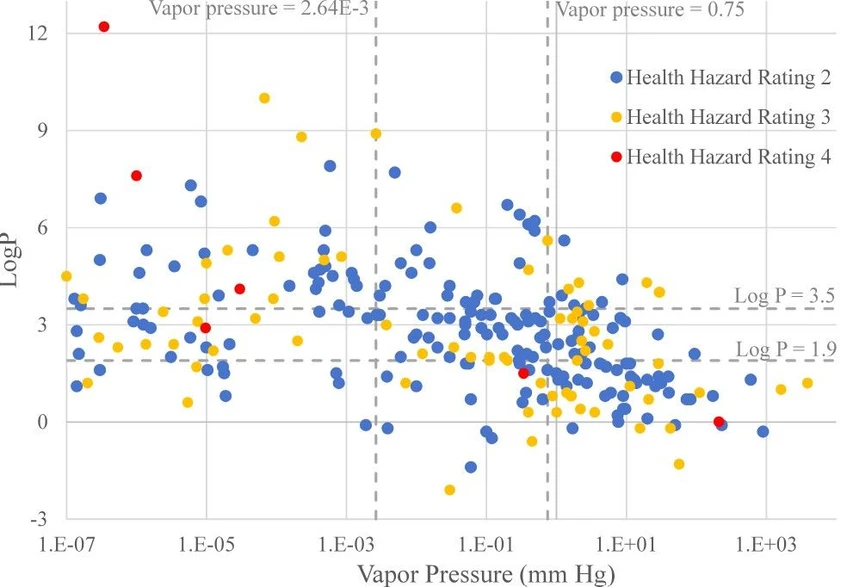 ACS Polym. Au (2026) 6 (5): 1422–1434: Figure 1. Classification of candidate VOCs based on vapor pressure and polarity.
The NFPA health hazard rating was used in this study as a practical screening criterion to prioritize compounds for analytical method development rather than as a definitive assessment of exposure or risk. Actual emission and exposure potential in recycled-plastic systems may also depend on analyte concentration, volatility, retention within the polymer matrix, processing and end-use conditions, and exposure duration. Consequently, compounds with NFPA health hazard ratings ≥2 may have limited emission potential if they are weakly volatile or strongly retained within the polymer, whereas some lower-rated VOCs may still be relevant when present at high concentrations or readily emitted.
3.6. Applicability of the HS-SPME-GC-MS Method to Industrial Recycled PP
Four industrial recycled PP samples, including mixed-color and natural-color materials collected before and after pelletization, were analyzed under the two optimized HS-SPME conditions established for the high-/medium-vapor-pressure and low-vapor-pressure VOC categories (Figure 7). A representative TIC obtained under the optimized conditions for the high- and medium-vapor-pressure VOC category is shown in Figure S2. Similar to what was observed for the PP model samples, the recycled PP sample exhibited a highly complex VOC profile. Therefore, the characteristic quantifier and qualifier ions of each target VOC were examined within the corresponding previously established retention-time window to ensure accurate detection. Several VOCs, including 2,4-dimethyl-1-heptene, p-cymene, toluene, m-xylene, 1-decanol, n-pentadecane, tetrahydrolinalool, ethyl salicylate, and lindane, were detected in one or more recycled PP samples (Table 8). These results demonstrate the applicability of the developed HS-SPME-GC-MS method for VOC screening in real recycled plastic matrices. Since this study was designed as a qualitative screening method and no calibration was performed, the peak areas reported in Table 8 represent instrument responses only and should not be used for quantitative or direct comparisons among different VOCs or samples. Since no analyte-specific calibration was conducted, limits of detection (LODs) and limits of quantification (LOQs) were not determined in this work. Accordingly, the sensitivity of the method at concentrations relevant to health-based or regulatory thresholds remains to be established and represents a limitation of the present study.
ACS Polym. Au (2026) 6 (5): 1422–1434: Figure 7. Industrial recycled PP samples analyzed in this study.
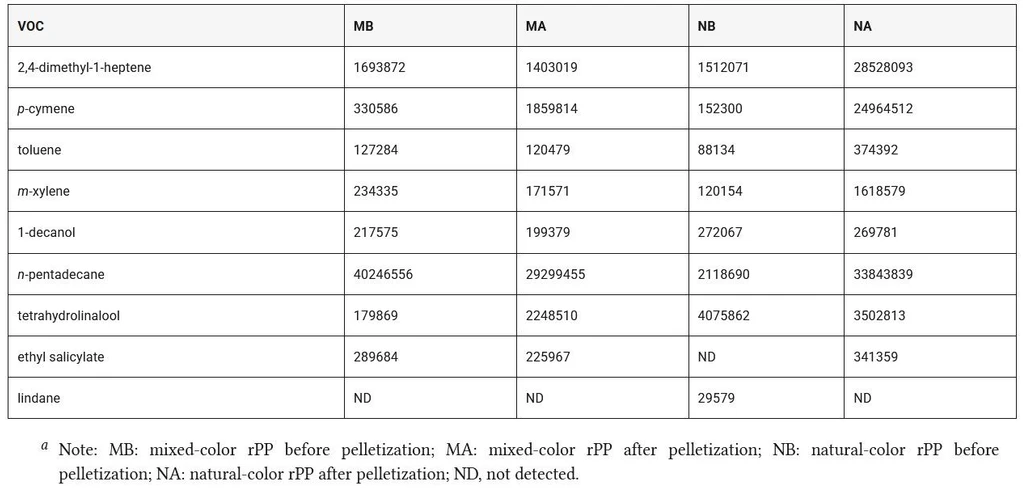 ACS Polym. Au (2026) 6 (5): 1422–1434: Table 8. Chromatographic Peak Areas of VOCs Identified in Recycled PP Samples
The detected VOCs likely originated from multiple sources associated with the life cycle and reprocessing of plastics. Hydrocarbons such as 2,4-dimethyl-1-heptene and n-pentadecane may be related to thermo-oxidative or mechanical degradation of PP, in which polymer chain scission can generate low-molecular-weight branched alkenes and alkanes. Aromatic compounds, including toluene, m-xylene, and p-cymene, may be associated with external contamination sources such as printing inks, solvents, adhesives, or absorbed residues from previous product use. Oxygenated compounds, including 1-decanol, tetrahydrolinalool, and ethyl salicylate, are more plausibly associated with consumer-product residues, such as fragrances, flavoring agents, surfactants, detergents, or personal-care products. The occurrence of these compounds suggests that part of the recycled PP stream may have originated from packaging or consumer products previously exposed to scented materials, cleaning agents, or personal-care formulations. Lindane was the only low-vapor-pressure VOC detected in the recycled PP samples and was observed only in the natural-color sample before pelletization. Its presence may indicate residual contamination from pesticide-related containers. Since only a single aliquot of each recycled PP sample was analyzed under each optimized condition, replicate variability and the potential effects of sample heterogeneity were not evaluated. Therefore, the recycled-sample results should be interpreted as a qualitative demonstration of method applicability.
4. Conclusions
This study established a property-guided HS-SPME-GC-MS workflow for the qualitative screening of potentially hazardous VOCs in recycled PP. From 622 candidate compounds, 367 substances were classified as potentially hazardous based on NFPA health hazard ratings, and 274 compounds with sufficient volatility were retained as relevant VOC candidates. Twenty-seven representative target compounds were then selected across vapor-pressure and polarity domains, enabling method development to reflect the broad physicochemical diversity of the VOCs expected in real recycled plastic materials. Among the five SPME fiber coatings evaluated, DVB/C-WR/PDMS provided the broadest overall coverage, detecting 24 of the 27 representative VOCs, and was therefore selected for method optimization.
Response surface methodology was used to optimize key HS-SPME parameters. SPME temperature was identified as the dominant factor controlling extraction efficiency, and VOC vapor pressure was the primary physicochemical parameter associated with optimal SPME temperature. High- and medium-vapor-pressure VOCs generally exhibited reduced responses at elevated temperatures, whereas low-vapor-pressure VOCs required higher temperatures to enhance transfer from the PP matrix to the headspace. These contrasting behaviors indicate that two separate extraction conditions are necessary for broad VOC screening. The optimized condition for high- and medium-vapor-pressure VOCs was an SPME temperature of 68.7 °C, incubation time of 5.5 min, and extraction time of 10.4 min. For low-vapor-pressure VOCs, 110 °C was identified as a suitable compromise SPME temperature when the incubation and extraction times were fixed at 7.0 min.
Application of the optimized method to industrial recycled PP samples demonstrated its applicability, with hydrocarbons, aromatic compounds, oxygenated compounds, and lindane detected in real recycled PP. Overall, the developed method provides a practical qualitative screening approach for characterization of potentially hazardous VOCs in recycled PP and can support quality control, emission assessment, and process optimization in plastic recycling systems.