Fr, 23.10.2026 | Original article from: Concentrating on Chromatography
Viktoria Müller explores PFAS beyond routine target lists, from ski waxes and wastewater to honeybees, wildlife, fluorine mass balance, and emerging environmental pathways.PFAS Are Everywhere — And 99% Go Undetected
- Photo: Concentrating on Chromatography: PFAS Are Everywhere — And 99% Go Undetected
- Video: Concentrating on Chromatography: PFAS Are Everywhere — And 99% Go Undetected
If you take a handful of dirt from the roadside, it contains PFAS. The challenge isn't finding forever chemicals — it's finding all of them. Standard monitoring methods cover 40 to 50 PFAS species. Thousands more go completely unmeasured. That's the gap Dr. Viktoria Müller has spent her career trying to close.
Viktoria is a postdoctoral researcher at the University of Graz specializing in PFAS environmental fate, transport, and the fluorine mass balance. Her work spans ski slopes, rivers, wastewater treatment plants, bees, wild deer, shrimp, and the Ganges River — and it has made international headlines. In this episode, she breaks down what we're missing, why routine analysis creates a false sense of security, and what wildlife can tell us that instruments alone cannot.
Video Transcription
PFAS are often discussed as a single group of “forever chemicals,” but their environmental behavior is far more complex than routine monitoring can reveal. Viktoria Müller, a postdoctoral researcher at the University of Graz, studies how PFAS move through soils, water, wildlife, consumer products, and even recreational environments. Her work combines targeted analysis with approaches that measure broader fluorine content, helping uncover the large fraction of fluorinated compounds that conventional PFAS methods can miss.
Müller’s research is centered on understanding how PFAS are transported, transformed, and taken up in environmental systems. Over the course of her career, this has led her from agricultural soils to snow, rivers, wildlife, wastewater, food-contact materials, ski waxes, and biomonitoring.
The common thread is straightforward: PFAS are highly persistent, widespread, and frequently encountered in places where they might not initially be expected.
PFAS are everywhere – but routine analysis sees only part of the picture
For people outside analytical chemistry, Müller often explains PFAS through familiar everyday products. Water-resistant clothing, fire-retardant materials, takeaway cups, and grease-resistant food packaging may rely on fluorinated chemistries to provide their functional properties.
That widespread use has translated into widespread environmental occurrence. Soil collected beside a road, for example, can already contain detectable PFAS.
The analytical challenge is that PFAS is not one compound or even a small group of compounds.
Routine targeted methods usually monitor a defined panel of perhaps several dozen individual PFAS. These compounds are often the best characterized, the easiest to quantify reliably, and the ones most frequently included in regulatory frameworks.
But thousands of other fluorinated substances may exist outside those target lists.
This creates what Müller describes through the concept of the fluorine mass balance: How much of the total fluorine present in a sample can actually be explained by the individual PFAS compounds identified through conventional targeted analysis?
Closing that gap requires expanding beyond compound-specific methods and measuring fluorine more broadly.
Why “PFAS-free” can be analytically complicated
One striking example comes from the analysis of ski waxes.
Fluorinated ski waxes became popular because fluorinated compounds can improve performance and reduce friction, providing a competitive advantage in skiing. Restrictions have since been introduced in organized competition, and manufacturers have increasingly moved away from traditional highly fluorinated formulations.
Analytical measurements, however, revealed a much more complicated chemical picture.
When Müller and colleagues compared targeted PFAS measurements with broader fluorine analysis, the routinely monitored PFAS species explained less than 1% of the fluorine present in some ski waxes. The remainder consisted of fluorinated material not captured by the conventional target list.
Some of this unexplained fluorine was associated with fluorinated polymers and volatile fluorinated compounds, but the precise composition – and consequently the environmental behavior and toxicological relevance – remains much less well understood.
This illustrates an important limitation of targeted analysis: a result showing low concentrations of regulated PFAS does not necessarily mean that the sample contains little fluorinated chemistry overall.
Targeted LC-MS/MS versus total fluorine approaches
Most routine PFAS monitoring relies heavily on LC-MS/MS, particularly electrospray ionization methods.
There is a good reason for this. Many well-known PFAS, including perfluorinated carboxylic and sulfonic acids, ionize efficiently by electrospray and can be measured at the very low concentrations relevant to drinking water and environmental monitoring.
LC-MS/MS therefore excels at speciation – determining which specific PFAS compounds are present and at what concentrations.
Its limitation is equally important: it detects the compounds included in the analytical method and, more fundamentally, compounds compatible with the selected ionization and separation conditions.
Müller’s work therefore also uses techniques capable of measuring fluorine more broadly.
ICP-MS/MS for fluorine analysis
Fluorine is traditionally considered one of the difficult elements for ICP-MS because of its high ionization energy and analytical interferences. Müller’s research group has been developing approaches for fluorine determination using ICP-MS/MS.
The advantage is that the measurement is no longer limited to individual PFAS species. Instead, the technique can provide information about fluorine as a broader elemental parameter.
The challenge is sensitivity. Environmental PFAS concentrations can be extremely low, and detection limits for bulk fluorine approaches remain higher than those achieved by targeted LC-MS/MS.
Combustion ion chromatography
Combustion ion chromatography (CIC) offers another route to measuring fluorine.
Depending on sample preparation, it can be used for parameters such as total fluorine or extractable organic fluorine. This provides valuable complementary information when researchers want to understand how much fluorinated material exists beyond the compounds quantified by targeted LC-MS/MS.
However, CIC faces similar challenges with detection limits and blank contamination.
When measuring total fluorine, almost any fluorinated material in the laboratory can potentially contribute to the background.
PFAS analysis starts with controlling the laboratory blank
Blank contamination is one of the persistent practical problems in PFAS research.
The analytical laboratory itself can contain fluorinated materials in tubing, consumables, equipment, refrigerants, chromatographic components, and other sources. When researchers attempt to measure trace environmental concentrations or total fluorine, these background contributions can become significant.
Müller described investigations into unexpectedly high fluorine blanks where conventional laboratory sources had gradually been ruled out. Even fluorinated refrigerants used in laboratory equipment were considered as possible contributors.
The problem becomes especially challenging when different analytical workflows share the same laboratory. A neighboring method using fluorinated mobile-phase additives, for example, can potentially create an unsuitable environment for ultratrace PFAS or fluorine determination.
For PFAS laboratories, understanding the chemical background of the entire analytical environment is therefore just as important as optimizing the instrument method itself.
No single PFAS method answers every question
Targeted LC-MS/MS, ICP-MS/MS, and CIC do not compete for exactly the same analytical task. Each answers a different question.
- LC-MS/MS is highly sensitive and provides compound-specific information.
- ICP-MS/MS and CIC can contribute to fluorine mass-balance studies by measuring broader pools of fluorinated material, including compounds that may not appear on conventional PFAS target lists.
Their higher detection limits can make them less suitable for some environmental samples, but they become extremely valuable when fluorine concentrations are sufficient and the objective is to understand total or extractable fluorine rather than only individual PFAS species.
For this reason, the most informative PFAS studies increasingly combine multiple analytical approaches.
What can the TOP assay really tell us?
The total oxidizable precursor (TOP) assay is another important tool for assessing PFAS contamination. Instead of attempting to identify every precursor individually, the method uses strong oxidative conditions to convert certain PFAS precursors into measurable terminal perfluoroalkyl acids. Comparing concentrations before and after oxidation provides an estimate of the hidden precursor pool.
Müller emphasizes, however, that the TOP assay is not a complete measure of total PFAS. Only compounds susceptible to the oxidation conditions contribute to the final signal, and different transformation processes can produce different distributions of degradation products.
Comparisons between TOP assay oxidation and processes such as ozonation demonstrate why transformation chemistry matters. A single precursor can generate different proportions of products depending on the degradation mechanism.
The TOP assay is therefore highly valuable for estimating oxidizable precursors, but its results should not be interpreted as a direct measurement of every PFAS compound present in the sample.
Wastewater treatment can transform PFAS rather than create it
A similar phenomenon can complicate interpretation of wastewater data.
In some studies, concentrations of individual target PFAS appeared higher in wastewater treatment plant effluent than in influent. Viewed only through targeted analysis, this could appear to suggest that the treatment plant was somehow generating PFAS.
Broader fluorine measurements provided a different explanation.
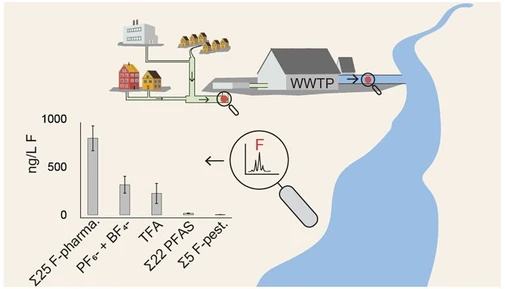
When extractable organic fluorine was compared before and after treatment, the overall fluorine balance remained similar. This indicated that the treatment plant was not producing additional fluorinated material. Instead, PFAS precursors were being transformed into compounds included in the targeted analytical list.
The apparent increase in measured PFAS therefore reflected chemical transformation and improved visibility to the targeted method rather than the creation of new fluorine.
This example demonstrates why mass-balance approaches can fundamentally change the interpretation of environmental monitoring data.
Honeybees as rapid indicators of local contamination
One of Müller’s more unusual biomonitoring projects uses honeybees.
Her research initially included larger animals such as deer and wild boar, which can accumulate PFAS over long periods. Bees provide almost the opposite type of information.
Worker honeybees live for a relatively short time and forage within a limited geographic area. Their chemical burden therefore reflects contamination from a relatively narrow location and recent time window.
This makes them potentially useful as short-term local biomonitors.
Repeated sampling could reveal emerging contamination more quickly than long-lived organisms, although long-term monitoring is still necessary to distinguish meaningful trends from short-term variation.
The work also raises an interesting analytical question: is a contaminant actually accumulated by the animal, or is it simply carried on its external surface?
One practical way to differentiate these scenarios is washing. Material removed from the outside of the organism represents external contamination, whereas compounds remaining in tissues, digestive systems, hair, or other biological structures are more consistent with biological uptake and accumulation.
Wildlife archives reveal the long-term effects of regulation
Long-lived wildlife provides a complementary perspective. In one project, archived deer liver samples made it possible to examine changes in PFAS contamination over more than two decades, from the late 1990s to 2022.
The samples came from a specimen bank with carefully controlled sampling procedures. Individual annual samples were prepared from multiple animals of a standardized age, providing a more representative picture than isolated opportunistic samples.
The results showed a substantial decline in total PFAS over time, broadly coinciding with industry phase-out initiatives and regulatory measures.
Yet concentrations had not fallen to zero. This is one of the defining characteristics of PFAS contamination: reducing production or banning a substance does not immediately remove the historical burden already present in products, soils, sediments, water, organisms, and waste streams.
Existing stocks of older products can remain in circulation, while persistent compounds released years earlier can continue moving through ecosystems.
Recreational activities can also leave a PFAS footprint
Industrial facilities, airports, firefighting foams, wastewater treatment plants, and contaminated manufacturing sites are well-recognized PFAS sources.
Recreational activities receive much less attention.
The ski-wax studies demonstrate that activities such as skiing can generate identifiable local PFAS contamination. Soils from skiing areas can show elevated concentrations compared with nearby locations that are not exposed to the same activity.
For Müller, this is significant because recreational sources represent a portion of the PFAS footprint that individuals and organizations may actually be able to reduce directly.
Skiing does not inherently require fluorinated ski wax. Hiking does not necessarily require PFAS-treated waterproof clothing.
These may be smaller sources than major industrial releases, but their importance lies in demonstrating how deeply fluorinated chemistry has entered everyday activities – and where avoidable emissions might still be reduced.
PFAS contamination is not equally understood worldwide
Environmental PFAS knowledge also varies strongly between regions. Research and monitoring have historically been concentrated in the Northern Hemisphere, particularly Europe and North America. Australia is increasingly generating PFAS occurrence data, but large information gaps remain in regions including Africa and Latin America.
This makes global comparisons difficult. Low reported PFAS contamination can sometimes reflect genuinely lower emissions, but it can also simply mean that monitoring is limited or that regulatory requirements have not yet created demand for routine commercial testing.
As regulations expand, laboratories are increasingly being asked not merely to demonstrate that regulated individual PFAS are below specific limits, but potentially to show that products contain no intentionally added or otherwise restricted PFAS at all.
That is a far more difficult analytical question.
From rain and particles to clouds
One of the next questions Müller hopes to investigate concerns PFAS in the atmosphere.
Atmospheric monitoring commonly collects rainwater and particulate fractions such as PM10 or PM2.5. But these measurements may capture only parts of a much more complex atmospheric transformation process.
Clouds could potentially serve as reaction environments, transport media, or intermediate reservoirs within this system.
Understanding their role could help connect atmospheric precursors, transformation chemistry, deposition, and the PFAS ultimately measured in soil and water.
It is another example of the same scientific question that runs throughout Müller’s research: where does the fluorine go, what does it become, and how can analytical chemistry reveal the part we currently cannot see?
Moving beyond the target list
The central lesson from Müller’s research is that PFAS contamination cannot be understood from a targeted list alone.
Targeted LC-MS/MS remains indispensable for sensitive, compound-specific monitoring and regulatory analysis. But fluorine mass-balance approaches, precursor assays, environmental monitoring, and complementary elemental techniques reveal a much larger chemical space.
This matters because unidentified fluorinated compounds can still move through ecosystems, transform into regulated PFAS, accumulate in organisms, and persist long after the original source has disappeared.
The analytical challenge is therefore shifting from simply asking “How much PFOA or PFOS is present?” toward a broader question:
“How much fluorinated material is actually here – and how much of it do we truly understand?”
This text has been automatically transcribed from a video presentation using AI technology. It may contain inaccuracies and is not guaranteed to be 100% correct.
Concentrating on Chromatography Podcast
Dive into the frontiers of chromatography, mass spectrometry, and sample preparation with host David Oliva. Each episode features candid conversations with leading researchers, industry innovators, and passionate scientists who are shaping the future of analytical chemistry. From decoding PFAS detection challenges to exploring the latest in AI-assisted liquid chromatography, this show uncovers practical workflows, sustainability breakthroughs, and the real-world impact of separation science. Whether you’re a chromatographer, lab professional, or researcher you'll discover inspiring content!
You can find Concentrating on Chromatography Podcast in podcast apps:
and on YouTube channel