Mo, 19.10.2026 | Original article from: ACS Food Sci. Technol. (2026)
HS-GC-IMS with MS-supported identification differentiates Origanum species and detects selected adulterants, including marjoram and myrtle.Gas Chromatography-Ion Mobility Spectrometry for Characterizing Different Species of Origanum and Detecting Blends of Its Products

ACS Food Sci. Technol. (2026): Figure 1. Total ion current (TIC) chromatogram of a leaf from O. vulgare ssp. hirtum measured by headspace gas chromatography-ion mobility spectrometry (HS-GC-IMS) (upper part) and HS-GC mass spectrometry (HS-GC-MS) (lower part). The intensity of the HS-GC-MS-TIC is given on a log10 scale for better visualization, since the intensity range is 3 orders of magnitude and small peaks would not be visible in linear scaling.
This study evaluates headspace gas chromatography–ion mobility spectrometry (HS-GC-IMS) for characterizing the volatile profiles of five Origanum species and detecting blends with nonoregano leaves. MS-supported compound identification revealed species-specific differences, particularly in carvacrol/thymol and sesquiterpene profiles, while the method showed good repeatability and stable profiles over six weeks.
Authenticity experiments using oregano blended with marjoram, myrtle, thyme, olive, and hoary rock-rose showed that potential marker compounds could be identified for marjoram and myrtle. The results demonstrate that HS-GC-IMS offers a sensitive and cost-effective approach for Origanum characterization and selected oregano adulteration screening.
The original article
Gas Chromatography-Ion Mobility Spectrometry for Characterizing Different Species of Origanum and Detecting Blends of Its Products
Modestus Wigger* ; Phil Carbow; Daria Garder; Silke Hillebrand; Ursula Telgheder; Stefanie Sielemann*
ACS Food Sci. Technol. (2026)
licensed under CC-BY 4.0
Selected sections from the article follow. Formats and hyperlinks were adapted from the original.
Gas chromatography-ion mobility spectrometry (GC-IMS) has emerged as a complementary technique to GC-MS for food-aroma analysis and offers several advantages for aroma profile characterization. Applications include the authentication of olive oils, (14) monofloral honeys, (15) and many more. (16)
Many GC-IMS approaches in food analysis use HS sampling. (16) It eliminates the need for sample preparation and is optimal for transferring the compounds of interest into the GC system. After GC separation, IMS provides an additional dimension via drift time. Furthermore, it is a very sensitive, less costly method compared to a conventional quadrupole MS. Unfortunately, the capabilities for identifying compounds in IMS are limited, as it lacks the powerful databases that MS have. Therefore, in the analytical setup used, a quadrupole MS is installed on a separate flow line, as described by Budzyńska et al. (17) and Augustini et al. (18) Coupled with the NIST MS database and the peak-assignment approach of Augustini et al., (18) this method enables reliable identification of most GC-IMS signals. Using this HS-GC-MS/-IMS configuration, it is demonstrated how GC-IMS can characterize Origanum volatilomes by analyzing five (sub)species, including one species represented by material from two geographic origins. To minimize environmental effects on volatile expression, reference seeds were grown under identical conditions in an indoor greenhouse prior to analysis. This approach helps to compare chemotypic differences among taxa and origins under controlled growth conditions.
Beyond chemotaxonomy and quality control, a further motivation for robust analytical fingerprinting of Origanum is the widespread issue of oregano adulteration. According to the European Spice Association, only the leaf product derived from Origanum vulgare ssp. hirtum and Origanum onites may be called oregano, while the International Organization for Standardization defines oregano in ISO 7925:1999–10 as leaves from the genus Origanum except Origanum majorana. ISO also specifies that the proportion of stalks and other plant parts shall not exceed 3% and that extraneous matter shall not exceed 1%, a requirement often violated in commercial oregano for economic reasons. Maquet et al. (19) reported that 48% of oregano samples collected across the supply chain in the European Union were adulterated. Common adulterants include leaves from Cistus spp. for a dark green color, from olive (Olea europaea), and myrtle (Myrtus communis) for financial reasons. Another possibility could be an accidental admixture with other herbs, such as marjoram (O. majorana) or thyme (Thymus spp.). (20) These types of food fraud are challenging for consumers and regulatory authorities to identify. One possibility is to analyze leaf material macroscopically or microscopically for foreign matter. (21) However, a variety of analytical approaches have been developed to detect oregano adulteration. Fourier-transform infrared (FT-IR) spectroscopy has been used to screen for olive, myrtle, sumac, hoary rock-rose, and hazelnut leaf adulterants. (22) Flügge et al. (23) combined next-generation sequencing (NGS) with nuclear magnetic resonance (NMR) spectroscopy to detect olive, myrtle, hazelnut, and pink rock-rose (Cistus) leaves. Liquid chromatography–mass spectrometry (LC-MS) targeting oleuropein has been developed specifically to identify olive leaf adulteration (24) and is also used by Maquet et al. (19) as an analytical method for an EU-wide control of adulteration. Rocomora-Rivera et al. (25) were the first to apply GC-IMS for the detection of oregano adulteration. Using orthogonal partial least-squares discriminant analysis (OPLS-DA), they identified admixtures containing olive leaves, but they did not test other potential adulterants. They also applied the method to commercially available oregano samples. However, their results were not verified by other analytical techniques. In the presented study, the feasibility of GC-IMS for detecting common adulterants in oregano, namely the leaves of hoary rock-rose, olive, myrtle, thyme, and marjoram, is tested by identifying marker compounds. Because only one authentic oregano type and no commercially adulterated samples were available, blends were prepared by combining oregano with candidate adulterant leaf material to simulate adulteration scenarios.
The objectives of this study are to evaluate HS-GC-IMS for volatilome profiling of five Origanum (sub)species grown under controlled conditions and assess the technique’s ability to detect common leaf adulterants in oregano blends.
2. Material and Methods
2.3. Analysis
An AOC5000 (Shimadzu Corporation, Kyoto, Japan) HS sampler incubating for 30 min at 120 °C was used for the static HS analysis of the samples. 500 μL of the HS was injected into a GC 2010-Plus (Shimadzu Corporation), equipped with two split injectors with a split of 1:20 and two identical analytical columns (HP-5 MS UI 30 m × 0.25 mm × 0.5 μm; Agilent, Santa Clara, CA, USA), each leading to one spectrometer (IMS or MS). A constant flow rate (35 cm/s) of helium 5.0 (Messer Industriegase, Siegen, Germany) was used. The GC temperature program started at 40 °C, held for 4 min, then heated with 3 °C/min to 150 °C, then heated 10 °C/min to 220 °C, held for 12.33 min, for a total program time of 60 min.
One analytical column was connected to the quadrupole MS QP-2010 Ultra (Shimadzu Corporation) in scan mode (m/z 32–300 at 3.3 Hz) with electron ionization (70 eV) and the other to the ion mobility spectrometer (G.A.S. Gesellschaft für analytische Sensorsysteme mbH, Dortmund, Germany). The drift tube (dimensions: 15.2 mm × 53 mm; temperature: 80 °C) was flushed with 75 mL/min drift gas (nitrogen 5.0, produced by an in-house generator), and ionization was performed by atmospheric-pressure chemical ionization with a 3H source. The field strength was 500 V/cm.
3. Results and Discussion
3.1. Identification of Volatiles in Origanum
For the characterization of the volatilome of different Origanum species, it is necessary not only to detect compounds sensitively using HS-GC-IMS but also to identify them. For identification, HS-GC-MS was used in addition to HS-GC-IMS. The HS-GC-MS enables identification of unknowns through database comparison of fragmentation patterns.
Figure 1 shows the total ion current (TIC) chromatograms for both HS-GC-IMS and HS-GC-MS of a fresh leaf from O. vulgare ssp. hirtum, with retention time on the x-axis, the integrated ion current for the IMS, and the intensity for MS on the y-axis. The y-axis of the HS-GC-MS chromatogram is logarithmically scaled, because it shows significant intensity differences (3 orders of magnitude between baseline and the highest peak), and linear scaling would discriminate small peaks in visualization. Most analytes are properly separated within the 60 min analysis time. When comparing the signals in both chromatograms, it is noticeable that they are shifted by several minutes. For example, an analyte (marked with an arrow), eluting at 35.8 min in the IMS flow line, elutes at 27.6 min in the MS flow line. However, the shift in retention times does not allow direct peak assignment. Using the 2-alkanone standard mixture as a reference, the retention times can be converted to retention indices using eqs 1 and 2, which can then be used to derive retention times for the GC-MS. An example calculation is provided in the Supporting Information. To demonstrate the effectiveness of this method, the TIC chromatograms shown in Figure 1 are replotted in Figure 2, with the calculated retention index on the x-axis instead of the retention time. The marked substance in Figure 1 is visible at a retention index of 992 in the HS-GC-IMS and 986 in the HS-GC-MS, corresponding to a deviation of only 6 RI units (≈0.6%), indicating very good assignment between the two methods. It is noticeable that, due to the logarithmic scaling of the intensity in the HS-GC-MS chromatogram, the peak pattern resembles that of the HS-GC-IMS. The IMS exhibits a nonlinear response over the measured intensity range. Therefore, logarithmic scaling of the MS signal intensity provides a representation that more closely matches the response characteristics of the IMS. Although the retention index still shows a slight shift, peak assignments are possible by comparing peak patterns. Additionally, within the retention index range of 600 to 700 (highlighted in gray), it is noticeable that the HS-GC-IMS exhibits more intense peaks than the HS-GC-MS. Peaks with a retention index above 700 become broader in the HS-GC-IMS, which can be explained by a less heated transfer and detector setup. Regarding sensitivity and separation power, the HS-GC-IMS is therefore more suitable for higher volatiles, while the HS-GC-MS is more suitable for lower volatiles, as it is also shown in Schanzmann et al. (33) The results show that the IMS has comparable analytical power to the MS, but is more cost-effective, as it requires no vacuum and less maintenance.
ACS Food Sci. Technol. (2026): Figure 1. Total ion current (TIC) chromatogram of a leaf from O. vulgare ssp. hirtum measured by headspace gas chromatography-ion mobility spectrometry (HS-GC-IMS) (upper part) and HS-GC mass spectrometry (HS-GC-MS) (lower part). The intensity of the HS-GC-MS-TIC is given on a log10 scale for better visualization, since the intensity range is 3 orders of magnitude and small peaks would not be visible in linear scaling.
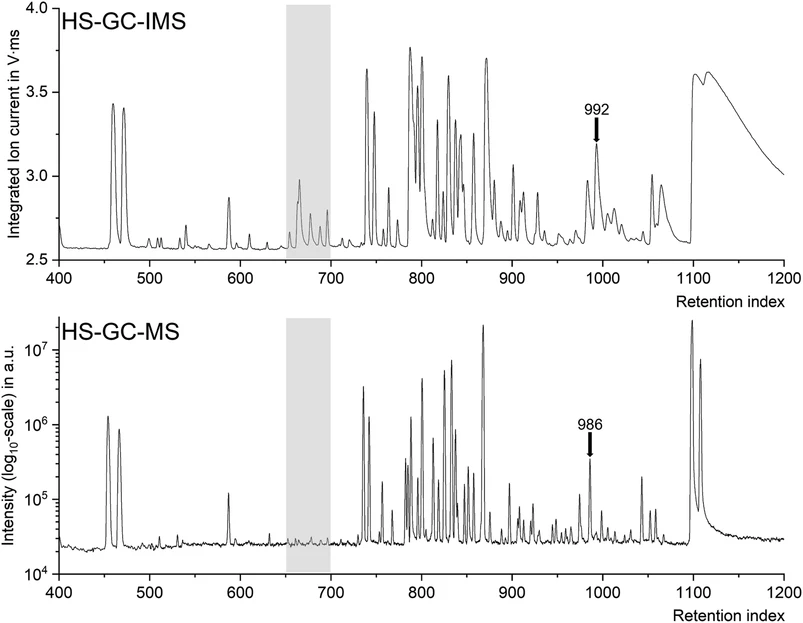 ACS Food Sci. Technol. (2026): Figure 2. Total ion current (TIC) chromatogram of a leaf from O. vulgare ssp. hirtum measured by headspace gas chromatography-ion mobility spectrometry (HS-GC-IMS) (upper part) and HS-GC mass spectrometry (HS-GC-MS) (lower part) with the calculated retention index based on 2-alkanones on the x-axis. The intensity of the HS-GC-MS-TIC is given on a log10 scale for better visualization, since the intensity range is 3 orders of magnitude and small peaks would not be visible in linear scaling.
3.4. Comparison of the Species
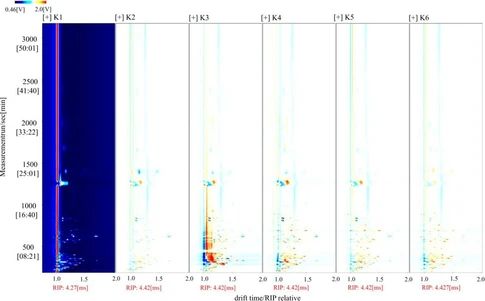
The first main topic of this study is to investigate species-specific variations in the volatilome. The HS-GC-IMS chromatograms for each species are illustrated in Figure 6, where all Origanum species can be compared visually. Distinct differences in peak pattern and intensity between the samples are evident.
 ACS Food Sci. Technol. (2026): Figure 6. Headspace gas chromatography-ion mobility spectrometry (HS-GC-IMS) chromatograms of five different species, one from two origins, Germany (DE) and Greece (GR), with the drift time on a reactant ion peak (RIP) relative scale (RIP position: ∼4.9 ms), the retention time in seconds on the y-axis, and the intensity in V on a color scale.
It can be seen that the species O. vulgare ssp. hirtum contains more monoterpenes/monoterpenoids, especially carvacrol, than O. vulgare ssp. vulgare, which shows higher amounts of sesquiterpenes. This comparison provides insight into the profile of each species, as even two different plants of the same species can exhibit distinct profiles.
3.5. Detection of Blends in Oregano
After investigating the volatilomes of different Origanum species, the potential of this technique to detect food fraud can be demonstrated by comparing the volatilomes of oregano and its adulterants. The capabilities and limitations of GC-IMS for identifying oregano adulteration were assessed within this feasibility study by using self-made blends, as no intentionally fraudulent samples were available. For this purpose, common adulterants for oregano, namely leaves from olive, thyme, marjoram, myrtle, and hoary rock-rose, were added in different mass ratios (10%, 30%, and 50%) to ground oregano known to be pure and from O. vulgare ssp. hirtum. The sample material is shown in Figure 9 as a photograph.
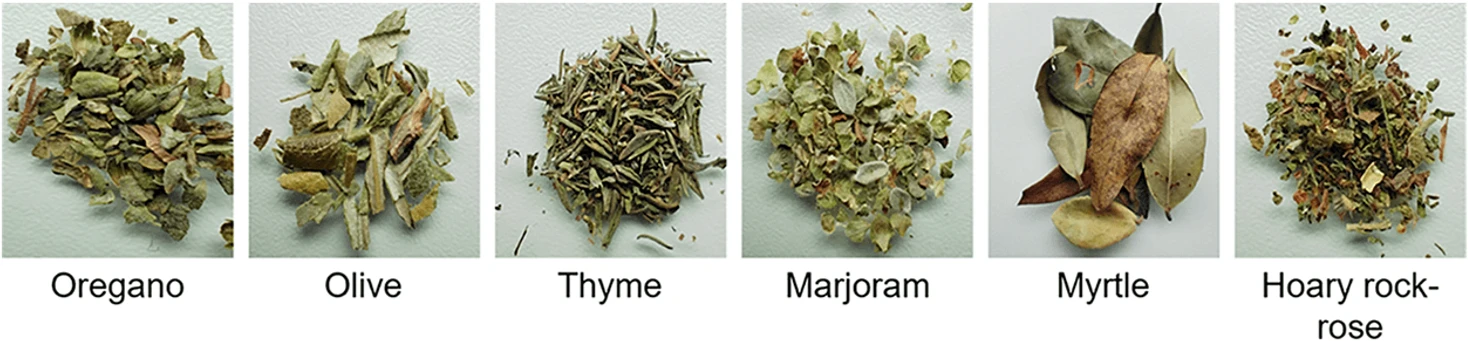 ACS Food Sci. Technol. (2026): Figure 9. Photograph of the sample material: Oregano (O. vulgare ssp. hirtum), olive (O. europaea L.), thyme (Thymus vulgaris L.), marjoram (O. majorana L.), myrtle (M. communis L.), hoary rock-rose (C. incanus L.).
These pure samples were analyzed by HS-GC-IMS, and the chromatograms in the Supporting Information generally show lower numbers and lower intensities of volatiles in olive leaves and hoary rock-rose than in oregano. In contrast to oregano, the volatilome of thyme and marjoram is comparably complex, with thyme exhibiting a very similar pattern with high proportions of thymol/carvacrol and a variety of monoterpenes and sesquiterpenes. Marjoram also contains many monoterpenes and some sesquiterpenes, but no carvacrol/thymol. The chromatogram of myrtle shows some monoterpenes, but not in the same numbers and intensity as oregano.
Potential marker substances were identified by analyzing all individual signals in the blending material and excluding those present in dried oregano or the fresh leaves of the different Origanum plants. Additional GC-MS measurements, the previously described peak assignment, and the NIST database enabled tentative identifications.
In marjoram piperityl acetate (RI = 1305, DT = 6.15 ms) is found, which has been tentatively identified by the described procedure. The peak intensity has a coefficient of variation of 29.9% for the lowest blend (10% marjoram in oregano) in technical triplicate. The high variation can be explained by coelution of the peak with the dominant carvacrol. The limit of detection (LOD) for marjoram in oregano using piperityl acetate as the marker was estimated at 4.1% based on the signal-to-noise (S/N) approach of Schanzmann et al. (33) The S/N was determined for the 10% blend, and the blend ratio corresponding to S/N = 3 was calculated assuming proportionality between signal intensity and blend level. Creydt et al. identified blumeatin as a marker for marjoram adulterations using liquid chromatography–mass spectrometry and established a LOD of approximately 5%. (41) Consequently, both volatile and nonvolatile analytes yielded comparable detection limits.