Scientists show how gold can improve detection of dopamine and serotonin
Th, 1.10.2026 | Original article from: CATRIN / Martina Šaradínová. Monika Klimparová
CATRIN researchers used gold nanostructures to develop highly sensitive methods for detecting very low concentrations of dopamine and serotonin, with potential for personalised diagnostics.
<p><strong>CATRIN: </strong>Scientists show how gold can improve detection of dopamine and serotonin</p>

CATRIN: Scientists show how gold can improve detection of dopamine and serotonin

Researchers from CATRIN at Palacký University have used gold nanostructures to develop new methods capable of detecting very low concentrations of substances important for the functioning of the human body, including dopamine and serotonin. The results, achieved by researchers from the Nanomaterials in Biomedicine group in collaboration with other colleagues, have significant potential for future rapid, sensitive and personalised diagnostics.

CATRIN: Scientists show how gold can improve detection of dopamine and serotoninCATRIN: Scientists show how gold can improve detection of dopamine and serotonin

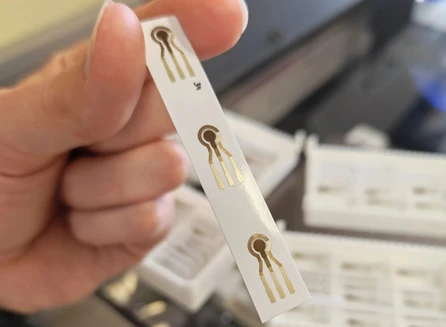
In a study published in Sensing and Bio-Sensing Research, the researchers developed a special “plasmonic paper” coated with gold nanostars. “It enables tears to be collected easily and subsequently analysed for dopamine levels. These levels may be associated with Sjögren’s syndrome, an autoimmune disease that is sometimes mistaken for dry eye syndrome,” explained first author Klára Dzurillová.

Plasmonic paper for point-of-care SERS biosensing of dopamine from tears

Klára Gajdošová, Zuzana Chaloupková, Jana Soukupová, Jiří Hošek, Kateřina Poláková, Václav Ranc 

Sens. BioSensing Res., 2026, 52, 101026

https://doi.org/10.1016/j.sbsr.2026.101026 

licenced under CC-BY 4.0

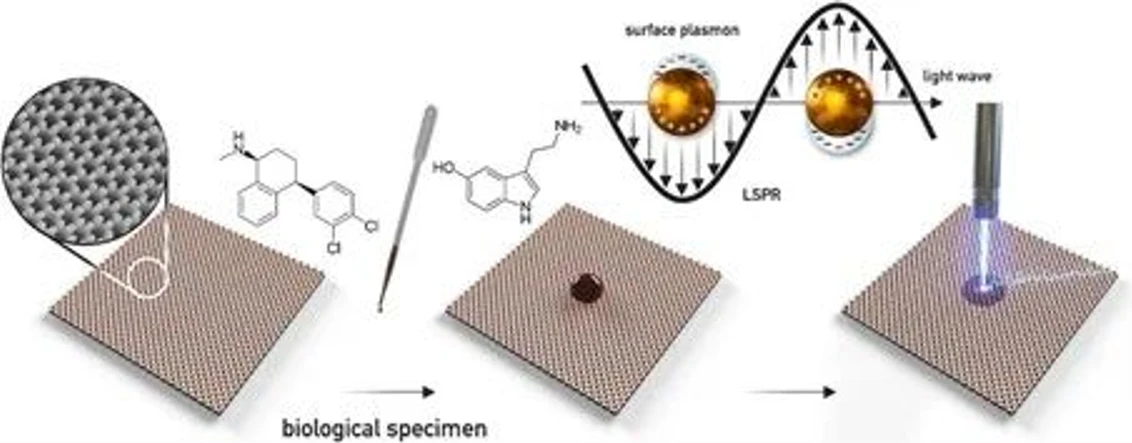
The second study, published in Microchimica Acta, focused on the simultaneous detection of serotonin and sertraline, a commonly used antidepressant belonging to the SSRI group. The use of SERS technology (surface-enhanced Raman spectroscopy) made it possible to significantly amplify the signal from the molecules being monitored using a specially modified surface. In this case, the researchers used very small gold nanocones separated by gaps of less than 20 nanometres. These gaps create so-called hot spots, areas where the electromagnetic field is greatly enhanced, making it possible to detect even very small amounts of the target substance.

Precise and simultaneous SERS detection of sertraline and serotonin on large-scale sub-20 nm plasmonic gold nanocone arrays

Klára Gajdošová, Thanh-Lam Bui, Zuzana Chaloupková, S. M. Hossein Hejazi, Radek Zbořil, Štěpán Kment, Václav Ranc & Kateřina Poláková

Microchim. Acta, 2026, 193, 450

https://doi.org/10.1007/s00604-026-08164-7 

licenced under CC-BY 4.0

“Using the new approach, we were also able to detect serotonin and sertraline simultaneously. In the future, the method could therefore make it possible to monitor both the concentration of the antidepressant and serotonin, whose level is affected by the treatment. This could contribute to a more accurate assessment of treatment efficacy and its adjustment to the individual patient,” said corresponding author Kateřina Poláková, Leader of the Nanomaterials in Biomedicine research group.

Both approaches use surface-enhanced Raman spectroscopy (SERS) and achieved very low detection limits even in the presence of other substances that can interfere with the measurements.


CATRIN
LinkedIn Logo
 

Related articles

Optical Microscopy and Deep Learning for Absolute Quantification of Nanoparticles on a Macroscopic Scale and Estimating Their Number Concentration
Scientific article | Science and research

Optical Microscopy and Deep Learning for Absolute Quantification of Nanoparticles on a Macroscopic Scale and Estimating Their Number Concentration

This study presents the evaporated volume analysis (EVA) method for accurately estimating nanoparticle concentration using optical microscopy and AI-based counting.
Revolutionary sensor can measure pH inside living cells with unprecedented accuracy
Article | Science and research

Revolutionary sensor can measure pH inside living cells with unprecedented accuracy

Czech researchers developed carbon-dot nanosensors that precisely measure pH inside living cells. The technology offers stable, calibration-free fluorescence detection for biomedical use.
Customized microreactors: 3D printing has facilitated the development of polymer brushes for biosensors
Article | Science and research

Customized microreactors: 3D printing has facilitated the development of polymer brushes for biosensors

Researchers from the Czech Academy of Sciences developed a 3D-printed microfluidic reactor enabling faster, greener, and higher-quality synthesis of polymer brushes — the foundation of modern biosensors.
Atom by atom. Scientists reveal a new direction in medical diagnostics
Article | Science and research

Atom by atom. Scientists reveal a new direction in medical diagnostics

Researchers developed a graphene ink with single copper atoms for inexpensive, highly sensitive printed sensors capable of detecting dopamine.
 

Related articles

Optical Microscopy and Deep Learning for Absolute Quantification of Nanoparticles on a Macroscopic Scale and Estimating Their Number Concentration
Scientific article | Science and research

Optical Microscopy and Deep Learning for Absolute Quantification of Nanoparticles on a Macroscopic Scale and Estimating Their Number Concentration

This study presents the evaporated volume analysis (EVA) method for accurately estimating nanoparticle concentration using optical microscopy and AI-based counting.
Revolutionary sensor can measure pH inside living cells with unprecedented accuracy
Article | Science and research

Revolutionary sensor can measure pH inside living cells with unprecedented accuracy

Czech researchers developed carbon-dot nanosensors that precisely measure pH inside living cells. The technology offers stable, calibration-free fluorescence detection for biomedical use.
Customized microreactors: 3D printing has facilitated the development of polymer brushes for biosensors
Article | Science and research

Customized microreactors: 3D printing has facilitated the development of polymer brushes for biosensors

Researchers from the Czech Academy of Sciences developed a 3D-printed microfluidic reactor enabling faster, greener, and higher-quality synthesis of polymer brushes — the foundation of modern biosensors.
Atom by atom. Scientists reveal a new direction in medical diagnostics
Article | Science and research

Atom by atom. Scientists reveal a new direction in medical diagnostics

Researchers developed a graphene ink with single copper atoms for inexpensive, highly sensitive printed sensors capable of detecting dopamine.
 

Related articles

Optical Microscopy and Deep Learning for Absolute Quantification of Nanoparticles on a Macroscopic Scale and Estimating Their Number Concentration
Scientific article | Science and research

Optical Microscopy and Deep Learning for Absolute Quantification of Nanoparticles on a Macroscopic Scale and Estimating Their Number Concentration

This study presents the evaporated volume analysis (EVA) method for accurately estimating nanoparticle concentration using optical microscopy and AI-based counting.
Revolutionary sensor can measure pH inside living cells with unprecedented accuracy
Article | Science and research

Revolutionary sensor can measure pH inside living cells with unprecedented accuracy

Czech researchers developed carbon-dot nanosensors that precisely measure pH inside living cells. The technology offers stable, calibration-free fluorescence detection for biomedical use.
Customized microreactors: 3D printing has facilitated the development of polymer brushes for biosensors
Article | Science and research

Customized microreactors: 3D printing has facilitated the development of polymer brushes for biosensors

Researchers from the Czech Academy of Sciences developed a 3D-printed microfluidic reactor enabling faster, greener, and higher-quality synthesis of polymer brushes — the foundation of modern biosensors.
Atom by atom. Scientists reveal a new direction in medical diagnostics
Article | Science and research

Atom by atom. Scientists reveal a new direction in medical diagnostics

Researchers developed a graphene ink with single copper atoms for inexpensive, highly sensitive printed sensors capable of detecting dopamine.
 

Related articles

Optical Microscopy and Deep Learning for Absolute Quantification of Nanoparticles on a Macroscopic Scale and Estimating Their Number Concentration
Scientific article | Science and research

Optical Microscopy and Deep Learning for Absolute Quantification of Nanoparticles on a Macroscopic Scale and Estimating Their Number Concentration

This study presents the evaporated volume analysis (EVA) method for accurately estimating nanoparticle concentration using optical microscopy and AI-based counting.
Revolutionary sensor can measure pH inside living cells with unprecedented accuracy
Article | Science and research

Revolutionary sensor can measure pH inside living cells with unprecedented accuracy

Czech researchers developed carbon-dot nanosensors that precisely measure pH inside living cells. The technology offers stable, calibration-free fluorescence detection for biomedical use.
Customized microreactors: 3D printing has facilitated the development of polymer brushes for biosensors
Article | Science and research

Customized microreactors: 3D printing has facilitated the development of polymer brushes for biosensors

Researchers from the Czech Academy of Sciences developed a 3D-printed microfluidic reactor enabling faster, greener, and higher-quality synthesis of polymer brushes — the foundation of modern biosensors.
Atom by atom. Scientists reveal a new direction in medical diagnostics
Article | Science and research

Atom by atom. Scientists reveal a new direction in medical diagnostics

Researchers developed a graphene ink with single copper atoms for inexpensive, highly sensitive printed sensors capable of detecting dopamine.