A new polymer could enable gastrointestinal transit monitoring without ionizing radiation

Fr, 2.10.2026 | Original article from: IOCB Prague
Researchers developed a water-soluble fluorinated polymer tracer for ¹⁹F MRI that enables gastrointestinal transit monitoring without ionizing radiation.
  • Photo: IOCB Prague/Tomáš Belloň: Ondřej Groborz, the first author
  • Video: IOCB Prague: A new polymer could enable gastrointestinal transit monitoring without ionizing radiation 

Scientists have developed a new fluorine-based tracer that can be tracked using magnetic resonance imaging (MRI) to monitor how quickly food moves through the gastrointestinal tract. The new method has so far been successfully tested in rats in a preclinical study, but it could eventually help diagnose gastrointestinal motility disorders or monitor treatment response. The study was published in Advanced Healthcare Materials.

The rate at which food moves through the stomach and intestines (gastrointestinal transit) provides important information about the health of the digestive system. Gastrointestinal transit is commonly assessed using methods that involve ionizing radiation, such as contrast X-ray imaging or scintigraphy. However, the associated radiation exposure makes these methods less suitable for frequent monitoring and limits their use in certain groups of patients, including pregnant women and children.

A team of researchers from IOCB Prague, the First Faculty of Medicine of Charles University, and Ghent University has developed a new way to monitor gastrointestinal transit using MRI, which does not involve any ionizing radiation. The method relies on water-soluble, fluorinated polymer tracers that remain in the gastrointestinal tract and can be detected using fluorine-19 magnetic resonance imaging (¹⁹F MRI).

“The advantage of fluorine is that it is naturally present in the human body only in negligible amounts. This means that when we track the fluorine signal, there is virtually no background interference. We see only our tracer and can determine where it is in the gastrointestinal tract,” explains Ondřej Groborz of IOCB Prague, first author of the study.

Less fluorine, more suitable properties

The new method combines conventional MRI, which shows the anatomy of the gastrointestinal tract, with ¹⁹F MRI, which reveals the polymer tracer itself. Overlaying the two images enables the researchers to pinpoint the tracer’s location, while comparing images taken at different time points shows how food moves through the gastrointestinal tract over time.

Fluorinated compounds have been investigated for gastrointestinal imaging before. However, many of them are extremely hydrophobic and do not mix well with chyme, the semi-fluid contents of the digestive tract. Instead, they can form separate layers, resulting in imaging artifacts.
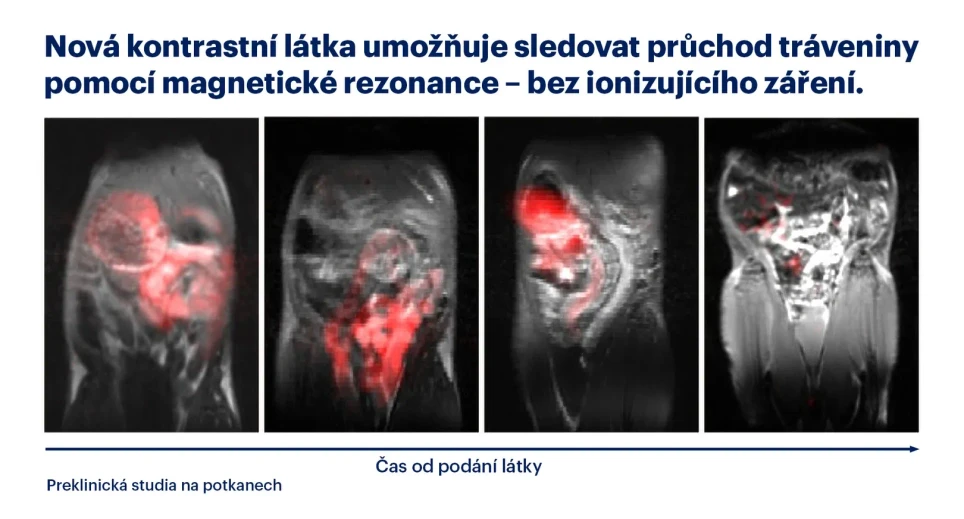
IOCB Prague: A new polymer could enable gastrointestinal transit monitoring without ionizing radiation: The passage of a polymeric contrast agent through the digestive tract of a rat over time. Its signal, detected using ¹⁹F magnetic resonance imaging (¹⁹F MRI), is shown in red.IOCB Prague: A new polymer could enable gastrointestinal transit monitoring without ionizing radiation: The passage of a polymeric contrast agent through the digestive tract of a rat over time. Its signal, detected using ¹⁹F magnetic resonance imaging (¹⁹F MRI), is shown in red.

The newly developed polymers, by contrast, are hydrophilic and water-soluble, allowing them to remain evenly mixed with the chyme and enabling researchers to track its movement through the digestive system.

Polymer chemist Kristýna Kolouchová of Ghent University in Belgium explains that developing such a tracer was not straightforward. “We needed to strike the right balance in the fluorine content of our tracer. For ¹⁹F MRI, we want the fluorine content to be as high as possible, but too much fluorine adversely affected the tracer’s properties. In the end, we found the right balance: the polymer remained highly soluble while providing a stable signal.”

Next-generation polymer headed for patent protection

The researchers tested the method in rats by administering the polymer tracer directly into their stomachs and using MRI to track its passage through the gastrointestinal tract until it was excreted. They found no evidence of systemic uptake or damage to the tissues examined.

The research is still at the preclinical stage and represents an initial proof-of-concept in an animal model. Before the method can potentially be used in clinical practice, its safety and reliability will need to be demonstrated in humans, a process that could take several years. The researchers are already working on a next generation of the polymer, which they plan to patent and develop further for practical applications. Companies have also expressed interest in the technology.

The original article

Hydrophilic Polymers Enable Gastrointestinal Transit Monitoring by Fluorine-19 Magnetic Resonance Imaging

Ondřej Groborz, Vít Herynek, Mária Hovořáková, Zuzana Pavlíková, Linda Dalecká, Klára Steklíková, Petr Matouš, Petr Páral, Margarita Tkachenko, Filip Koucký, Fatma Nalan Cetin, Ludmila Maffei Svobodová, Jiří Beneš, Kristýna Kolouchová

Adv. Healthcare Mater., 2026, e71667

https://doi.org/10.1002/adhm.71667

licenced under CC-BY 4.0
Institute of Organic Chemistry and Biochemistry of the Czech Academy of Sciences
LinkedIn Logo
 

Related articles

Scientists from IOCB Prague have improved materials for reconstructive and plastic surgery
Article | Scientific article

Scientists from IOCB Prague have improved materials for reconstructive and plastic surgery

Researchers from IOCB Prague and Ghent University have been working on improving the properties of gelatin-based materials, thereby expanding the possibilities of their use mainly in medicine.
New PET/MRI probe developed by IOCB Prague promises early discovery of covert diseases
Article | Scientific article

New PET/MRI probe developed by IOCB Prague promises early discovery of covert diseases

Researchers from IOCB Prague, in collaboration with the University of Tübingen, and the Faculty of Science, Charles University, has developed a new type of contrast agent that can be used in both MRI and PET.
A molecular trap for exotic metals promises improved diagnostics and faster drug development
Article | Scientific article

A molecular trap for exotic metals promises improved diagnostics and faster drug development

Scientists from IOCB Prague have created compounds a million times more stable than those used to treat tumors or as contrast agents for magnetic resonance imaging.
Structural sensitivity without chirality: Observation of magnetic Raman optical activity outside resonance
Article | Science and research

Structural sensitivity without chirality: Observation of magnetic Raman optical activity outside resonance

MROA enables sensitive conformational analysis of both chiral and achiral molecules, opening new possibilities for molecular studies in liquid systems.
 

Related articles

Scientists from IOCB Prague have improved materials for reconstructive and plastic surgery
Article | Scientific article

Scientists from IOCB Prague have improved materials for reconstructive and plastic surgery

Researchers from IOCB Prague and Ghent University have been working on improving the properties of gelatin-based materials, thereby expanding the possibilities of their use mainly in medicine.
New PET/MRI probe developed by IOCB Prague promises early discovery of covert diseases
Article | Scientific article

New PET/MRI probe developed by IOCB Prague promises early discovery of covert diseases

Researchers from IOCB Prague, in collaboration with the University of Tübingen, and the Faculty of Science, Charles University, has developed a new type of contrast agent that can be used in both MRI and PET.
A molecular trap for exotic metals promises improved diagnostics and faster drug development
Article | Scientific article

A molecular trap for exotic metals promises improved diagnostics and faster drug development

Scientists from IOCB Prague have created compounds a million times more stable than those used to treat tumors or as contrast agents for magnetic resonance imaging.
Structural sensitivity without chirality: Observation of magnetic Raman optical activity outside resonance
Article | Science and research

Structural sensitivity without chirality: Observation of magnetic Raman optical activity outside resonance

MROA enables sensitive conformational analysis of both chiral and achiral molecules, opening new possibilities for molecular studies in liquid systems.
 

Related articles

Scientists from IOCB Prague have improved materials for reconstructive and plastic surgery
Article | Scientific article

Scientists from IOCB Prague have improved materials for reconstructive and plastic surgery

Researchers from IOCB Prague and Ghent University have been working on improving the properties of gelatin-based materials, thereby expanding the possibilities of their use mainly in medicine.
New PET/MRI probe developed by IOCB Prague promises early discovery of covert diseases
Article | Scientific article

New PET/MRI probe developed by IOCB Prague promises early discovery of covert diseases

Researchers from IOCB Prague, in collaboration with the University of Tübingen, and the Faculty of Science, Charles University, has developed a new type of contrast agent that can be used in both MRI and PET.
A molecular trap for exotic metals promises improved diagnostics and faster drug development
Article | Scientific article

A molecular trap for exotic metals promises improved diagnostics and faster drug development

Scientists from IOCB Prague have created compounds a million times more stable than those used to treat tumors or as contrast agents for magnetic resonance imaging.
Structural sensitivity without chirality: Observation of magnetic Raman optical activity outside resonance
Article | Science and research

Structural sensitivity without chirality: Observation of magnetic Raman optical activity outside resonance

MROA enables sensitive conformational analysis of both chiral and achiral molecules, opening new possibilities for molecular studies in liquid systems.
 

Related articles

Scientists from IOCB Prague have improved materials for reconstructive and plastic surgery
Article | Scientific article

Scientists from IOCB Prague have improved materials for reconstructive and plastic surgery

Researchers from IOCB Prague and Ghent University have been working on improving the properties of gelatin-based materials, thereby expanding the possibilities of their use mainly in medicine.
New PET/MRI probe developed by IOCB Prague promises early discovery of covert diseases
Article | Scientific article

New PET/MRI probe developed by IOCB Prague promises early discovery of covert diseases

Researchers from IOCB Prague, in collaboration with the University of Tübingen, and the Faculty of Science, Charles University, has developed a new type of contrast agent that can be used in both MRI and PET.
A molecular trap for exotic metals promises improved diagnostics and faster drug development
Article | Scientific article

A molecular trap for exotic metals promises improved diagnostics and faster drug development

Scientists from IOCB Prague have created compounds a million times more stable than those used to treat tumors or as contrast agents for magnetic resonance imaging.
Structural sensitivity without chirality: Observation of magnetic Raman optical activity outside resonance
Article | Science and research

Structural sensitivity without chirality: Observation of magnetic Raman optical activity outside resonance

MROA enables sensitive conformational analysis of both chiral and achiral molecules, opening new possibilities for molecular studies in liquid systems.