We, 30.9.2026 | Original article from: LabRulezLCMS Library
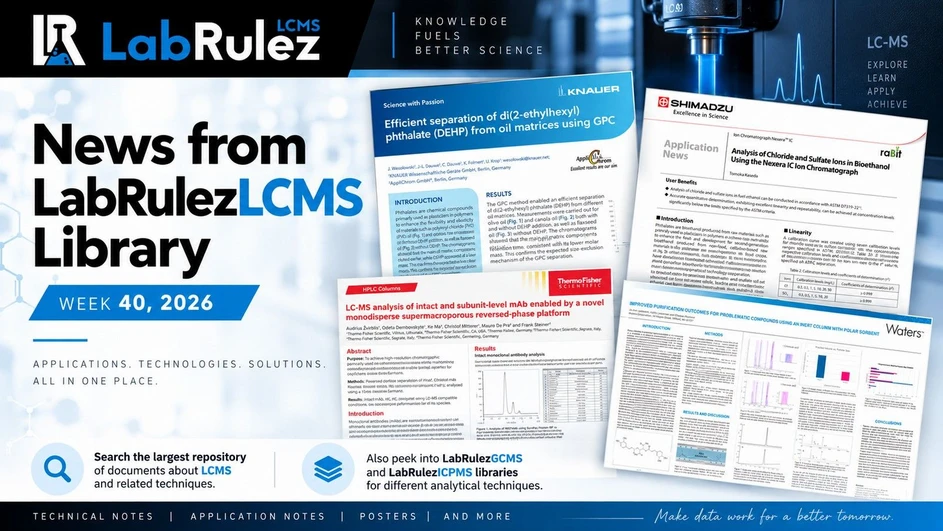
This week we bring you technical note by KNAUER, application note by Shimadzu and posters by Thermo Fisher Scientific / HPLC Symposium and Waters Corporation / AOAC!News from LabRulezLCMS Library - Week 40, 2026
LabRulez / AI: News from LabRulezLCMS Library - Week 40, 2026
Our Library never stops expanding. What are the most recent contributions to LabRulezLCMS Library in the week of 29th September 2026? Check out new documents from the field of liquid phase, especially HPLC and LC/MS techniques!
👉 SEARCH THE LARGEST REPOSITORY OF DOCUMENTS ABOUT LCMS AND RELATED TECHNIQUES
👉 Need info about different analytical techniques? Peek into LabRulezGCMS or LabRulezICPMS libraries.
This week we bring you technical note by KNAUER, application note by Shimadzu and posters by Thermo Fisher Scientific / HPLC Symposium and Waters Corporation / AOAC!
1. KNAUER: Efficient separation of di(2-ethylhexyl) phthalate (DEHP) from oil matrices using GPC
- Technical note
- Full PDF for download
Phthalates are chemical compounds primarily used as plasticizers in polymers to enhance the flexibility and elasticity of materials such as polyvinyl chloride (PVC) [1]. Since plasticizers are not covalently bound to the polymer chains, they have the potential to leach into the contacting media and contribute to contamination [2]. With the widespread and increasing use of plastic materials, the risk of phthalate release and human exposure continues to rise. As a result, and due to their potentially harmful effects on human health, phthalates have attracted growing scientific and regulatory attention in recent years [1]. Oil-rich food products can leach lipophilic phthalates from their packaging [3]. Throughout the production and packaging process, polymeric components such as tubing, containers, and caps may serve as potential sources of contamination. For the analysis of phthalates in such oil matrices, sample cleanup is an essential step. Gel permeation chromatography (GPC), based on sizeexclusion principles, is widely applied as an effective cleanup technique prior to subsequent analytical determination.
MATERIALS & METHODS
The samples were dissolved in the eluent mixture and filtered through a 0.45 µm PTFE filter prior to analysis. For both olive oil and canola oil, an additional sample spiked with DEHP was prepared and likewise filtered before analysis. Chromatographic analysis was performed using an isocratic method with an eluent composition of ethyl acetate/heptane (50:50 v/v) at a flow rate of 1.0 mL/min. Detection was carried out by UV absorbance at 254 nm. The injection volume was 8 µL using a full-loop injection mode. The column temperature was maintained at 25°C. Separation was achieved on an AppliChrom® OleoSep column (10 µm, 300 × 8 mm). The AZURA® Semi Preparative GPC System was used.
CONCLUSION
GPC sample preparation is an effective approach for separating phthalates from high-molecular-weight matrices such as edible oils. In this study, the successful separation of di(2-ethylhexyl) phthalate (DEHP) from three different oil samples was demonstrated. Based on these results, it can be assumed that other phthalates with lower molecular weights (< 390 Da) can also be effectively separated under same conditions. The KNAUER AZURA® GPC semi preparative system (Fig. 4) in combination with the AppliChrom® OleoSep GPC column provides a robust and efficient setup for sample preparation in phthalate analysis, offering rapid separation, high resolution, and minimal solvent consumption due to the short analysis time.
2. Shimadzu: Analysis of Chloride and Sulfate Ions in Bioethanol Using the Nexera IC Ion Chromatograph
- Application note
- Full PDF for download
User Benefits
- Analysis of chloride and sulfate ions in fuel ethanol can be conducted in accordance with ASTM D7319-221) .
- Accurate quantitative determination, exhibiting excellent linearity and repeatability, can be achieved at concentration levels significantly below the limits specified by the ASTM criteria.
First-generation bioethanol produced from raw materials such as corn and sugarcane has been utilized to achieve carbon neutrality. However, research and development for second-generation bioethanol produced from non-food, cellulose-based raw materials is also underway to avoid competition with food crops. In Japan, eight companies, including Toyota Motor Corporation, have formed the “Research Association of Biomass Innovation for Next Generation Automobile Fuels” (raBit) to advance research on next-generation bioethanol technologies. Shimadzu participates as a supporting member and promotes research and development through analytical technology cooperation.
It is known that the presence of chloride and sulfate ions in fuel ethanol can form engine residue, leading to reduced engine performance. ASTM D4806-252) specifies fuel ethanol quality as criterion of chloride ion must not exceed 6.7 mg/kg and that of sulfate ion must not exceed 4 mg/kg. ASTM D7319-22 includes test methods for chloride and sulfate ions in fuel ethanol using ion chromatography.
In this application, we present an example of the analysis of chloride and sulfate ions in bioethanol using the Nexera IC in accordance with ASTM D7319-22.
Conclusion
Chloride and sulfate ions in bioethanol were determined using a Nexera IC system in accordance with ASTM D7319-22. The method offers high sensitivity, linearity, and repeatability, enabling reliable quantification at concentrations well below ASTM-specified limits, thus supporting effective quality control and regulatory compliance of fuel ethanol.
3. Thermo Fisher Scientific / HPLC Symposium: LC-MS analysis of intact and subunit-level mAb enabled by a novel monodisperse supermacroporous reversed-phase platform
- Poster
- Full PDF for download
Monoclonal antibodies (mAbs) are structurally complex biotherapeutics that require multi-level analytical characterization to ensure product quality, safety, and efficacy. LC-MS analysis is routinely applied at the intact protein and subunit levels to assess molecular mass, heterogeneity, and structural integrity. Enzymatic subunit generation, such as IdeS digestion, enables targeted domain-level characterization while reducing analytical complexity compared to full peptide mapping. Achieving high-performance reversed-phase separations across intact and subunit-level workflows remains challenging, as chromatographic columns optimized for intact proteins often compromise performance of smaller subunits. Consequently, multiple columns are required to support comprehensive mAb characterization.
In this study, we evaluate a reversed-phase separation column based on a novel 2.5 μm monodisperse supermacroporous (SMP) polymeric stationary phase for unified LC-MS analysis of monoclonal antibodies under intact, reduced, and IdeSdigested conditions. The SMP resin’s uniform particle size and highly accessible pore structure enable efficient separation of both small and large analytes, including intact mAbs, reduced subunits (LC and HC), and IdeS-generated fragments such as scFc and F(ab′)₂. Using the SurePac Protein RP MDi column, baseline separation of these species was achieved within a 10- minute gradient, providing a fast, all-in-one LC-MS approach for mAb variant characterization.
Materials and methods
Instruments
Thermo Scientific Vanquish Horizon UHPLC system; Thermo Scientific Orbitrap Exploris 480 mass spectrometer with Thermo Scientific OptaMax NG ion source.
Data analysis
The UHPLC system with mass spectrometer were operated with Thermo Scientific Xcalibur 4.7 software. Full MS spectra of intact mAbs and mAb fragments were analyzed using Thermo Scientific Freestyle 1.8 and BioPharma Finder 5.4 software that utilizes the ReSpect and Xtract algorithms for molecular mass determination.
Conclusions
- A SurePac Protein RP column enabled a rapid (10 min) separation of mAb LC, HC, scFc, and F(ab′)₂ fragments, with major proteoforms identified by mass agreement.
- The SurePac Protein RP column supports comprehensive intact and subunit-level mAb characterization in a single workflow, with strong separation performance across mAb fragments.
4. Waters Corporation / AOAC: IMPROVED PURIFICATION OUTCOMES FOR PROBLEMATIC COMPOUNDS USING AN INERT COLUMN WITH POLAR SORBENT
- Poster
- Full PDF for download
Whether the goal is to obtain enough intermediate for the next step in a synthetic scheme, to polish a final product, or to create a suitable standard for compound identification, preparative liquid chromatography remains a primary technique for isolating compounds from complex mixtures. Recovering the target compound at the desired purity and yield in the least amount of time is of utmost importance.
Polar targets that do not retain, or “sticky” compounds that seemingly disappear on the column are two groups that many consider to be ’problematic’ in purification. “Sticky” compounds, also known as non-specific adsorbers (NSAs), are metal-sensitive targets what can adsorb to positively charged metal surfaces in the LC system flow path and column, making them difficult to detect and collect effectively. Although other methods, such as column pre-conditioning, can be implemented for isolating compounds known to be interactive, this option can be time-consuming and lead to sample loss and excessive solvent waste.
Although lab scale purifications in which tens to hundreds of milligrams of target compound are isolated from crude mixtures are still performed routinely, the trend toward smaller scale purification is becoming more prevalent. Laboratories are increasingly opting to isolate only a few milligrams of target compound for preliminary studies. Successful target candidates are then isolated in greater amounts to satisfy ensuing experiments. Whether the objective is to isolate a small amount of target compound for exploratory studies, or to purify greater amounts for their use as reference standards, a column which can resolve eluting impurities efficiently is required.
Echinacea is an herbaceous flowering plant in the daisy family1,2 and is one of the most important medical herbs widely used to treat the common cold and other infectious diseases.3 One of the most abundant compounds in echinacea is chicoric acid (Figure 1), a phenylpropanoid and caffeic acid derivative.4,5 In this scale-up study, chicoric acid, a suspected “sticky” target polar compound was isolated from a complex echinacea tea extract using two inert XSelect HSS T3 MaxPeak Premier OBD Columns with different particle sizes and dimensions (3.5 μm 10 x 100 mm and 5 μm 10 x 150 mm). The MaxPeak Premier OBD preparative HPLC columns are considered ’inert’ because they are enabled with Waters High Performance Surface (HPS) Technology. The chicoric acid isolated using the 3.5 μm column was of equivalent UV purity to the product isolated using the 5 μm column, with a 34% savings in run time. Smaller particle preparative isolations using columns with inert hardware are a practical option for those laboratories where reduced amounts of target are needed for projects conducted on accelerated timelines.
METHODS
- Analytical Columns and flow rate: ACQUITY Premier HSS T3 and ACQUITY UPLC HSS T3 Columns; 1.8 μm, 2.1x50 mm; 0.35 mL/min
- Prep Columns and flow rate: XSelect HSS T3 OBD Prep Column and XSelect Premier HSS T3 OBD Prep (custom) Columns, 5 μm, 10x150 mm; XSelect Premier HSS T3 OBD Prep Column, 3.5 μm, 10x100 mm; 5.4 mL/min
Instrumentation
- Analytical: ACQUITY UPLC H-Class System; Quaternary Solvent Manager, Sample Manager FTN-H, Column Manager, TUV Detector, ACQUITY QDa Detector
- Prep: Waters AutoPurification System; 2545 Binary Gradient Module, 2767 Sample Manager, System Fluidics Organizer, 2998 Photodiode Array Detector
CONCLUSIONS
- Chicoric acid was analyzed and isolated using analytical and preparative MaxPeak Premier HSS T3 Columns with inert surfaces, which increased the peak area and height for improved detection and collection.
- Chicoric acid was successfully isolated using 3.5 and 5 μm XSelect Premier HSS T3 OBD Prep Columns and fraction pool analysis showed equivalent UV purity, which suggests the viability of incorporating small particle preparative chromatography into the purification workflow.
- 3.5 μm preparative columns improve purification process efficiency and promote sustainability by reducing method run time, solvent usage, and fraction lyophilization time.
- Inert MaxPeak Premier column hardware, OBD Technology, and small particle preparative columns are well-suited for the demands of the purification laboratory when results must be generated efficiently to satisfy accelerated production timelines