We, 9.9.2026 | Original article from: International Symposium on Chromatography (ISC)
ISC 2026 opened in Prague with Short Courses, the official Opening and Award Ceremonies, three plenary lectures, and a Welcome Reception for the international chromatography community.ISC 2026 - Day 1

ISC: ISC 2026 - Day 1: Opening ceremony
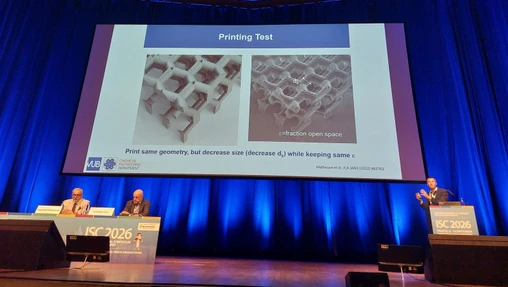
ISC 2026 officially opened in Prague on Sunday, September 6, bringing the international separation science community together at the Prague Congress Centre. The first day began with six Short Courses covering topics from analytical procedure lifecycle and mass spectral interpretation to HILIC, oligonucleotides, LC/MS data analysis, and supercritical fluids. In the afternoon, conference chairs Michal Holčapek and Lucie Nováková welcomed participants during the Opening Ceremony, followed by the J.F.K. Huber Medal Award Ceremony. The scientific program then moved into its first plenary session, spanning spintronics, single-cell proteomics and robust LC-MS, and rapid evaporative ionisation mass spectrometry. The opening day concluded with the Welcome Reception, giving participants their first opportunity to meet colleagues from around the world and begin a week of scientific exchange, new ideas, and chromatography in the heart of Prague.
Sunday, September 6th
8:30–15:45 Short Courses 3 - 8
 ISC: ISC 2026 - Day 1: Short Course SC 6 Oligonucleotides and Other Biopharmaceuticals (Koen Sandra)
16:00–16:30 Opening Ceremony
- Michal Holčapek, Czech Republic
- Lucie Nováková, Czech Republic
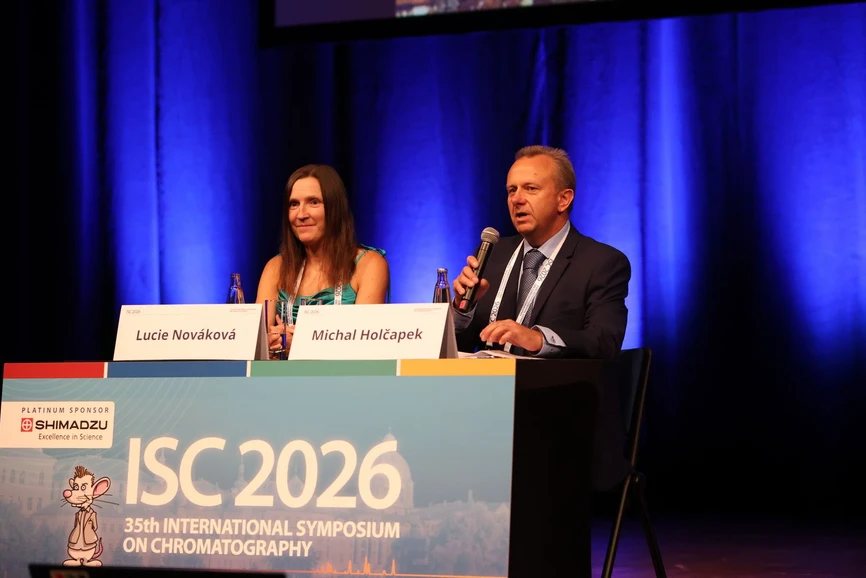 ISC: ISC 2026 - Day 1: Michal Holčapek and Lucie Nováková opened ISC 2026
16:30–17:00 Award Ceremony
- J.F.K. Huber Medal (awarded by the Austrian Society for Analytical Chemistry)
 ISC: ISC 2026 - Day 1: Davy Guillarme as a 2026 recipient of the J.F.K. Lecture Award of the Austrian Society of Analytical Chemistry
Plenary lectures
17:00 - 17:30 Spintronics: A new paradigm in digital bits
- Tomáš Jungwirth, Czech Republic
Besides the rapid developments in the big world of cloud data centers and AI, a remarkable paradigm shift is occurring on the level of the smallest “elementary particle” of information technologies – the single physical bit. For the first time in the history of microprocessor chips, semiconductor bits are being replaced by a fundamentally distinct technology. The technology is based on magnets and is called spintronics. All major developers and manufacturers of the advanced chip technologies are now implementing these new spintronic bits. Not across the entire microprocessor chip, but in some of its vital memory parts. The transition to the spintronic bits is happening because further miniaturization of semiconductor bits has become prohibitively expensive or even reached fundamental physical limits. In the talk we will introduce the distinct physical principle behind the spintronic bits, and highlight some of the recent adbances in spintronics research and development.
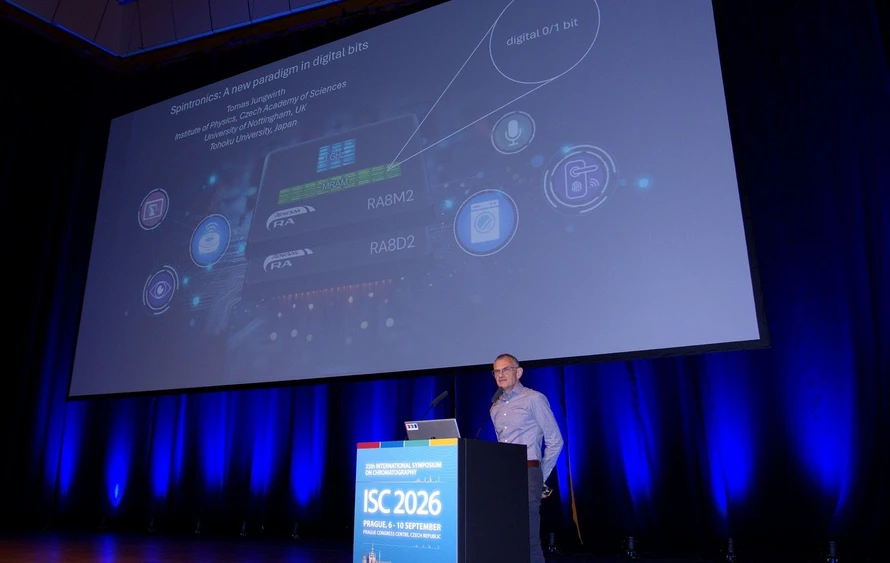 ISC: ISC 2026 - Day 1: Spintronics: A new paradigm in digital bits (Tomáš Jungwirth, Czech Republic)
17:30 - 18:00 Single cell proteomics requires robust LC-MS: Unexpected findings bring new biological understanding
- Jennifer Van Eyk, USA
Underlying precision medicine is the concept that an individual’s Omic signature (including the proteome) will provide a physician with clinically actionable diagnosis and a subsequent mechanistic therapeutic route that is appropriate for a particular person. This concept is based on the idea of pathological heterogeneity and recognizes the impact of differences in the heath state of individuals. The deployment of single cell technologies has demonstrated heterogeneity within a single cell type which impacts the degree of cellular heterogeneity within an organ. Unlike bulk proteomic approaches, which average signals across heterogeneous populations, single-cell proteomics captures the molecular diversity of cell. Today single-cell proteomics can provide high-resolution characterization of protein quantities and variability within the structural composition and signaling dynamics within individual cells which requires robust, precise and sensitive liquid chromatography and mass spectrometry (LC-MS) workflows with sufficient throughput to quantitatively analyze 1000s of single cells.
We have developed stable and precise single cell LC-MS workflow based on high-flow, dual trap with a single analytical column system that can achieve 96 samples per day. Furthermore, we have coupled this with a novel parallel sample preparation method on demand within the autosampler reducing sample lose and matching throughput with the LC-MS. Here, we have investigated the proteomic heterogeneity of cardiac muscle cells, cardiomyocytes, the specialized cells that contain the contractile proteins and which are responsible for the heart contraction and relaxation. By applying single-cell proteomics to cardiomyocytes isolated from human and mouse hearts, as well as human iPSC-derived cardiomyocytes, we uncovered previously unrecognized cellular subpopulations distinguished by differences in contractile and metabolic protein expression. As well unexpectedly, we unambiguously identified proteins traditionally considered absent in adult cardiomyocyte, such as slow skeletal troponin T, previously thought to be restricted to fetal or skeletal muscle or those proposed to be limited to non-cardiac cell types (e.g., neuronal proteins) or species (e.g., myosin heavy chain 7b). This suggests an unexpected fluidity in cardiac protein expression. Furthermore, single cell proteomics has provided critical insight into protein-level remodeling in heart failure, where the same single amino acid mutation in a contractile protein can give rise to diverse clinical phenotypes. At the single cell level, the mutant protein dosage in each cell drives a continuum of subproteomic pathological alterations. Only with precise protein quantification at the single cell level, is this understanding possible – all of which hinges on the LC-MS performance.
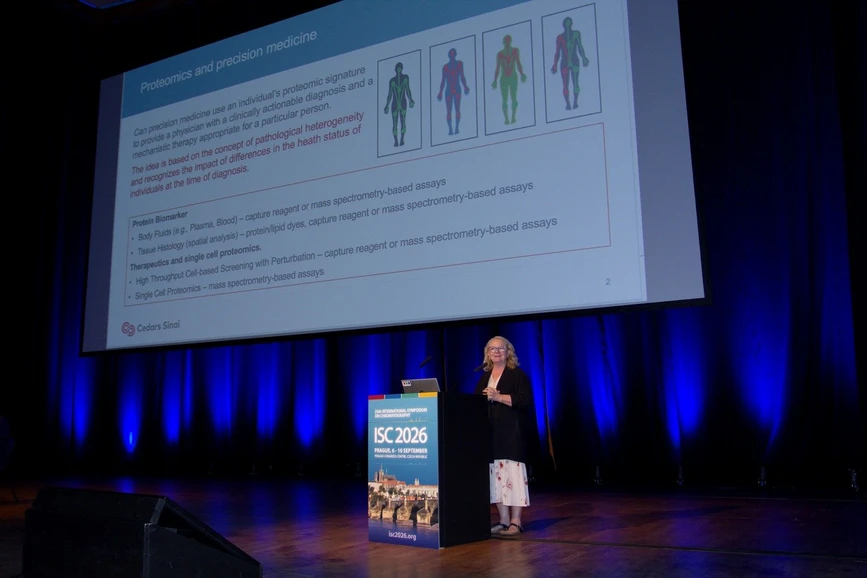 ISC: ISC 2026 - Day 1: Single cell proteomics requires robust LC-MS: Unexpected findings bring new biological understanding (Jennifer Van Eyk, USA)
18:00 - 18:30 Rapid evaporative ionisation mass spectrometry: From MSI to LC-MS
- Zoltan Takats, United Kingdom
Rapid Evaporative Ionisation Mass Spectrometry (REIMS) was originally developed for mass spectrometry-guided surgery applications, enabling the direct, real-time analysis of surgical aerosols for in-situ histological identification of tissues in cancer surgery. Coupling the technique with various surgical and non-surgical lasers led to the recognition, that the technique has comparable sensitivity to other, widely used desorption ionisation methods including DESI and MALDI. Laser Ablation REIMS using 3 μm wavelength picosecond lasers was demonstrated to provide sub-cellular resolution metabolic and lipidomic images at 2-5 μm spatial resolution, with clear visualisation of cellular nuclei. The method was subsequently used for regenerative neuroscience and cancer biology applications. The unexpectedly high sensitivity of the method (fg amounts of lipids and metabolites / pixel) encouraged us to attempt using REIMS as an LC-MS ion source. The current commercially available REIMS instrumentation utilises the so-called matrix-assited REIMS technology, involving the co-introduction of a polar solvent (water, acetonitrile or aliphatic alcohols) together with the sample aerosol. The fused droplets containing solvent and soluble components of the aerosol are introduced into the vacuum where they impact a heated (≈900 ºC) surface resulting in their 'rapid evaporation' yielding the detected ion population. In this context, the ionisation matrix was replaced by LC effluent, leading to a fundamentally new way of ionisation. The new technique termed LC-REIMS was characterised using reversed phase LC applications including lipid and metabolite profiling. The new ionisation method was found to exhibit high similarity to sonic spray and related techniques, in spite of the high temperature involved. Analytical sensitivity for complex lipids and amino acids were found to be comparable to those in ESI or APCI, albeit the relative response factors followed markedly different trends. As the technology represents an LC-MS coupling without any requirement for pressurised gas or high voltage, it has significant application potential for field instrumentation including industrial process control or security screening.
 ISC: ISC 2026 - Day 1: Rapid evaporative ionisation mass spectrometry: From MSI to LC-MS (Zoltan Takats, United Kingdom)
18:30–19:30 Welcome Reception
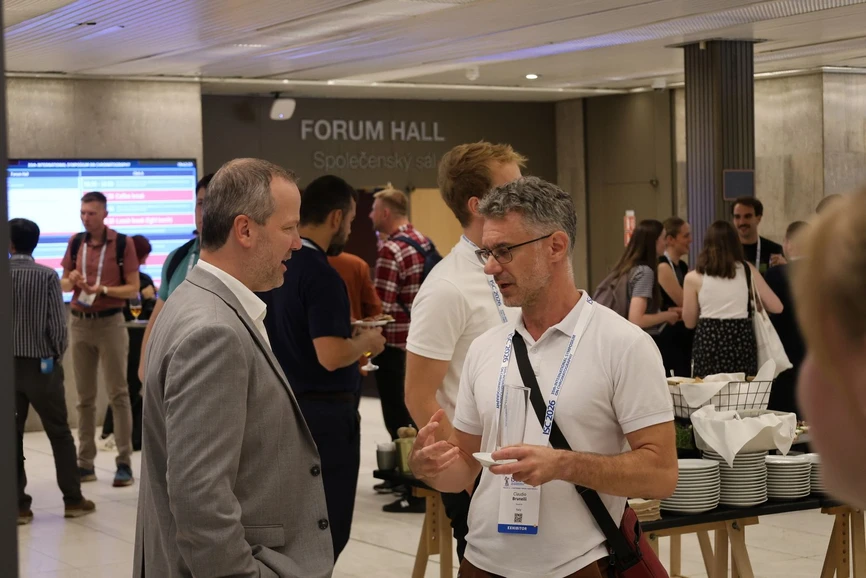 ISC: ISC 2026 - Day 1: Welcome reception
 ISC: ISC 2026 - Day 1: Welcome reception