We, 9.9.2026 | Original article from: LabRulezGCMS Library
This week we bring you application notes by Agilent Technologies and Shimadzu, presentation by MDCW / Los Alamos National Laboratory and other document by Thermo Fisher Scientific!News from LabRulezGCMS Library - Week 37, 2026
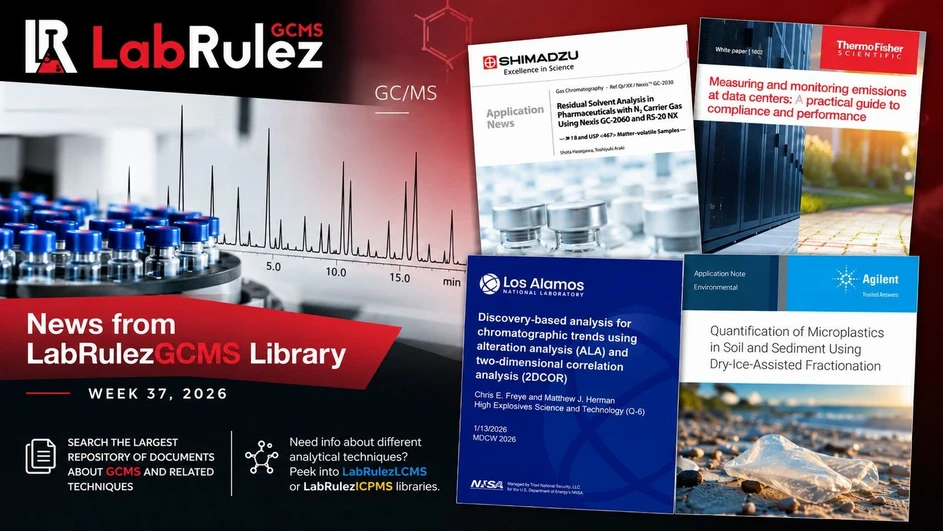
LabRulez / AI: News from LabRulezGCMS Library - Week 37, 2026
Our Library never stops expanding. What are the most recent contributions to LabRulezGCMS Library in the week of 7th September 2026? Check out new documents from the field of the gas phase, especially GC and GC/MS techniques!
👉 SEARCH THE LARGEST REPOSITORY OF DOCUMENTS ABOUT GCMS AND RELATED TECHNIQUES
👉 Need info about different analytical techniques? Peek into LabRulezLCMS or LabRulezICPMS libraries.
This week we bring you application notes by Agilent Technologies and Shimadzu, presentation by MDCW / Los Alamos National Laboratory and other document by Thermo Fisher Scientific!
1. Agilent Technologies: Quantification of Microplastics in Soil and Sediment Using Dry-Ice-Assisted Fractionation
- Application note
- Full PDF for download
Microplastics are now widely reported in terrestrial environments, including soil and sediments, raising concerns about soil health and potential human exposure pathways (for example, in agricultural regions).1,2 Microplastics can be classified by polymer type and particle characteristics (size, color, and morphology such as fragments and fibers) and may be primary (manufactured small) or secondary (formed from the breakdown of larger plastic items). In this workflow, microplastics were defined as particles ranging from 1 µm to < 1,000 µm.
Reliable and reproducible quantification remains challenging, limiting comparability between studies and complicating risk assessment and the development of defensible monitoring approaches. Challenges occur across the workflow, from sampling and extraction through to instrumental analysis and reporting, and are exacerbated by environmental heterogeneity, inconsistent reporting, and the limited availability of standard reference materials and routine quality control procedures.
Conventional soil microplastics workflows typically include drying, density separation and/or flotation, chemical digestion to remove organic matter, and filtration prior to spectroscopic identification.3–5 In this application note, we combined a fast, practical extraction workflow with consistent, automated instrumental analysis by adapting foam fractionation to soil and sediment. Several bubbling strategies (soda water, compressed air, and nitrogen) were evaluated; dry ice was selected because it produced vigorous mixing and stable foam in the presence of a surfactant, enhancing exposure of particles to the foam layer and improving isolation from the matrix.
All method validation and environmental sample analyses were performed using an Agilent 8700 LDIR chemical imaging system, providing automated particle location, polymer identification, sizing, and counting. A particle-based internal standard was integrated into the workflow as a simple, sample‑specific check on extraction and transfer performance.
Results and discussion
Environmental sample overview
The workflow was applied to environmental samples from Victoria, Australia, including three soil types (chromosol, dermosol, and hydrosol) and freshwater sediment from three locations. In all samples, the 8700 LDIR provided automated particle identification, sizing, and counting of microplastics following dry-ice-assisted fractionation and density separation. Soil concentrations ranged from 4,360 to 102,000 microplastics kg–1, with acrylonitrile butadiene styrene and polyamide the most frequently detected polymers. Sediment concentrations ranged from 41,400 to 127,000 microplastics kg–1 and were dominated by fragments in the 10 to 50 µm size range.
Conclusion
This study demonstrates the suitability of the Agilent 8700 LDIR chemical imaging system for automated, particle‑based quantification of microplastics in complex soil and sediment matrices. When combined with dry-ice-assisted foam fractionation, the 8700 LDIR provided reliable identification, sizing, and counting of microplastics across a broad size and density range with high repeatability.
The integration of a particle-based ISTD within the LDIR workflow enabled sample-specific performance assessment, addressing a key limitation in current microplastic methodologies. Application to environmental samples confirmed the robustness of the approach and highlighted the capability of the 8700 LDIR to support high‑confidence, reproducible microplastics analysis for research and routine monitoring applications.
2. MDCW / Los Alamos National Laboratory: Discovery-based analysis for chromatographic trends using alteration analysis (ALA) and two-dimensional correlation analysis (2DCOR)
- Presentation
- Full PDF for download
The presentation focuses on discovery-based analysis of complex chromatographic datasets using Alteration Analysis (ALA) and Two-Dimensional Correlation Analysis (2DCOR). The motivation is to avoid manual chromatogram comparison and labor-intensive peak-table processing, especially for GC-TOFMS and GC×GC datasets that can contain billions of data points. Instead, the authors analyze raw data directly and use statistical methods to identify only those features that show meaningful chemical changes across a series of samples.
ALA provides a quantitative way to detect how individual data points vary across a sample series. It generates three outputs: the Basic Alteration Map (BAM) for overall change, the Synchronous Alteration Map (SAM) for mainly linear changes, and the Asynchronous Alteration Map (AAM) for nonlinear behavior. Validation with simulated datasets showed that ALA can detect relatively small changes and remains effective even for severely overlapping chromatographic peaks. The presentation reports that its performance remains similar to that for isolated peaks down to a resolution of about Rs 0.3, and under suitable signal-to-noise and change conditions it can still succeed at resolutions as low as Rs 0.01.
While ALA identifies which signals are changing and the type or magnitude of that change, 2DCOR adds information about how those changes are related to one another. Synchronous correlation maps describe whether signals change together in the same or opposite direction, while asynchronous maps help establish sequential relationships between changes. Using Noda’s rule, the order in which chemical features respond to an external perturbation can be inferred. The combined ALA–2DCOR workflow therefore provides three key pieces of information: the significance of a change, the relationship between changing components, and the order in which those changes occur.
Extending these methods to GC×GC required additional processing because of chromatographic misalignment and the enormous size of two-dimensional datasets, with GC×GC-HRMS data reaching roughly 80 billion data points. The solution presented is to divide the chromatographic space into tiles, apply ALA to locate important features, then re-center tiles and use 2DCOR on the relevant regions. In a recent application to high-explosive aging, ALA detected more than 250 chemical changes, providing insight into decomposition behavior where simpler feature-selection approaches such as the F-ratio were insufficient. The authors conclude that combining ALA and 2DCOR offers a practical route for discovering and interpreting chemical trends in highly complex GC-MS and GC×GC datasets.
3. Shimadzu: Residual Solvent Analysis in Pharmaceuticals with N2 Carrier Gas Using Nexis GC-2060 and HS-20 NX
- Application note
- Full PDF for download
User benefits
- The newly designed FID delivers outstanding sensitivity, ensuring highly accurate and reliable analysis.
- Achieve full compliance with JP and USP guidelines using N2 carrier gas, which is highly affordable and readily available.
- Easily analyzes tert-butyl alcohol and Cyclopentyl methyl ether, the Class 2 solvents added in the ICH Q3C (R8) guideline.
For the analysis of residual solvents in pharmaceuticals, headspace gas chromatography (HS-GC) is widely used to target Class 1 and Class 2 solvents, in accordance with USP General Chapter <467> and JP18 (Japanese Pharmacopoeia, 18th Edition). These regulatory tests demand high sensitivity and reproducibility. The newly developed FID for the Nexis GC-2060 offers superior detection sensitivity compared to conventional models, enabling highly sensitive analysis. Additionally, due to recent helium supply shortages and rising costs, there is a growing demand for alternative analysis using nitrogen (N2) as a carrier gas.
This application note presents the analysis of Class 1 and Class 2 water-insoluble samples using the Nexis GC-2060 with N2 carrier gas, compliant with Supplement II to the Japanese Pharmacopoeia. DMSO was used as the sample solvent.
Conclusion
Using the Nexis GC-2060 with nitrogen (N2) carrier gas, we successfully achieved the analytical precision required by the Japanese Pharmacopoeia (JP18) and USP General Chapter <467>. The HS-GC method delivered excellent S/N ratios and high repeatability for the analysis of residual solvents in waterinsoluble pharmaceutical samples.
4. Thermo Fisher Scientific: Measuring and monitoring emissions at data centers: A practical guide to compliance and performance
- Other document (white paper)
- Full PDF for download
The rapid expansion of data centers, driven by artificial intelligence (AI), cloud computing, and digital infrastructure, is creating unprecedented demand for electrical power. In many regions, utility interconnection delays, transmission constraints, and the need to bring new computing capacity online quickly are driving data center developers to incorporate onsite power generation as part of their energy strategy. Natural gas-fired turbines, reciprocating engines, and other distributed generation assets are increasingly being deployed to supplement or, in some cases, serve as the primary source of power for new facilities.
As data centers evolve from purely electrical loads into powergenerating facilities, they become subject to a range of air permitting, emissions reporting, and regulatory compliance requirements. Consequently, emissions monitoring has emerged as a critical component of both regulatory compliance and responsible facility operation. Facility owners and operators must balance the need for reliable power generation with increasingly stringent environmental requirements while maintaining operational performance and uptime.
This white paper provides a practical, technically grounded overview of emissions monitoring strategies for data centers with onsite power generation. It outlines the regulatory landscape, reviews common monitoring approaches, and discusses key system design considerations to help facility owners, operators, engineers, and environmental professionals develop effective compliance strategies while supporting the continued growth of digital infrastructure.
Analyzer technology considerations for modern CEMS
Gas analyzers form the core of any continuous emissions monitoring system. These instruments rely on well-established measurement principles that are recognized by regulatory agencies worldwide. Chemiluminescence detection (CLD), as described in EPA Method 7E², is widely used for NOx measurement due to its sensitivity, selectivity, and long-term stability. Similarly, non-dispersive infrared (NDIR) technology, as described in EPA Method 10³, is commonly used for carbon monoxide (CO) monitoring. These proven measurement techniques are broadly accepted across federal, state, and local regulatory programs and provide the accuracy and reliability required for emissions compliance applications. Selecting analyzer platforms that are widely deployed and familiar to regulators, testing organizations, and CEMS integrators can further simplify implementation, helping facilities achieve a smoother commissioning process and faster path to compliance.
Within this context, modern analyzer platforms like the Thermo Scientific™ 42iQ NO-NO2-NOx Gas Analyzer and the Thermo Scientific™ 48iQ CO Gas Analyzer have been specifically designed to support continuous emissions monitoring applications. These systems deliver high sensitivity, low detection limits, and stable performance across a wide range of operating conditions. Both analyzers can also be configured with optional oxygen (O₂) measurement capability, providing a convenient and cost-effective solution for monitoring NOx , CO, and O₂. This capability is particularly valuable in direct extractive CEMS configurations, where oxygen measurements are often required for emissions correction and reporting.
Seamless integration with data acquisition and handling systems (DAHS) is another key requirement for a modern CEMS. Analyzer platforms must support reliable data communication and interoperability, enabling consistent reporting and alignment with regulatory requirements.
Selecting the appropriate analyzer technology is a critical step in CEMS design. A well-designed analyzer solution not only supports compliance, it also contributes to long-term operational efficiency, reduced lifecycle costs, and confidence in emissions data.