We, 2.9.2026 | Original article from: KNAUER
Discover how refractive index detection works in HPLC, its key advantages and limitations, and why RID remains a reliable choice for sugars, polymers, alcohols and other UV-inactive compounds.Seeing is Believing – Detection Made Easy Part 4: Refractive Index Detector

KNAUER: Seeing is Believing – Detection Made Easy Part 4: Refractive Index Detector
Refractive Index (RI) Detection in HPLC – Making Invisible Compounds Visible
When HPLC detectors are discussed, UV-Vis absorbance detection is often the first technique that comes to mind. Its popularity is easy to understand: it is sensitive, selective, and suitable for a wide range of compounds. But what happens when the analyte does not absorb ultraviolet or visible light?
This is where the Refractive Index Detector (RID) becomes particularly useful. Reliable, versatile, and often described as a “universal detector” for HPLC, RI detection can reveal compounds that remain invisible to many optical detectors. For substances such as sugars, polymers, lipids, or alcohols, it is often an important analytical option.
Let’s look at how RI detection works, where it performs best, what its main limitations are, and how to achieve stable, reproducible results.
How RI Detection Works
When light passes from one medium into another, its path changes direction, or refracts, depending on the phase velocity and angle of incidence. This phenomenon is described by Snell’s law, with the extent of refraction determined by the refractive index (RI) of the medium (Figure 1).
 KNAUER: Figure 1: Refraction of light at the interface between two media with different refractive indices, where n₁ > n₂. Since the velocity is lower in the second medium (v₂ < v₁), the angle of refraction α₂ is less than the angle of incidence α₁.
In HPLC, an RI detector monitors small changes in the refractive index of the mobile phase as compounds elute from the column. Because each substance has its own refractive index, even relatively small changes in the composition of the column effluent can generate a measurable response.
Modern RI detectors generally use a differential optical design (Figure 2). Two optical paths are continuously compared: one passes through a reference cell containing pure mobile phase, while the other passes through a sample cell containing the column effluent, i.e. mobile phase plus analyte.
A light source, commonly an LED or tungsten lamp, illuminates both cells. Changes in refractive index alter the path of the light, and a photodiode detects the resulting deviation.
When only mobile phase is present, the two optical paths are effectively identical and no significant detector response is produced. As an analyte enters the sample cell, however, the refractive index changes. The light beam is slightly deflected, creating an optical imbalance and consequently a change in light intensity.
The detector converts this change into an electrical signal, which appears as a chromatographic peak. Because the response is related to analyte concentration, RI detection can also be used for quantitative analysis.
 KNAUER: Figure 2: Schematic of a differential RI detector with dual flow cell. The sample cell carries column effluent; the reference cell contains pure mobile phase. A light beam passes through both and forms a slit image on a photodiode. Any analyte-induced change in refractive index alters the beam’s path, shifting the image on the photodiode and generating a signal peak.
For reliable measurements, the reference cell must always contain the same mobile phase as the sample cell, but without analyte. It therefore needs to be refreshed regularly with clean mobile phase, commonly using a switching valve and/or T-piece (Figure 3).
 KNAUER: Figure 3: Flow path in the AZURA® RID 2.1L during analysis (left) and flushing (right). During analysis, solvent flows from the IN port through the heat exchanger and sample cell, then continues through the T piece and flush valve to the OUT port. During flushing, the valve redirects the flow through the T piece so the solvent passes a second heat exchanger and reference cell before exiting via the OUT port.
It is important to remember that refractive index depends on both light wavelength and medium density. The wavelength is fixed by the optical design of the detector, but density—and therefore refractive index—changes with temperature, pressure, and composition.
For this reason, RI detection is particularly sensitive to changes in operating conditions. Stable measurements depend heavily on maintaining a tightly controlled analytical environment.
Why Choose RI Detection?
RI detectors become especially valuable when other detector types cannot provide a useful response. They may be less sophisticated than some modern detection technologies, but several characteristics make them indispensable for particular applications.
Broad Applicability
An RID can detect virtually any compound that produces a change in the refractive index of the mobile phase. No UV-absorbing chromophore is required.
Because almost every dissolved substance changes refractive index to some degree, RI detection is commonly regarded as a universal detection technique. Typical analytes include sugars, alcohols, lipids, fatty acids, and polymers.
Non-Destructive Detection
RI measurement does not destroy the analyte. This makes it useful in workflows where the separated compound needs to be collected or analyzed further, including preparative chromatography.
KNAUER’s AZURA® RID 2.1L for preparative applications, for example, supports flow rates up to 100 mL/min.
Simple and Reliable Operation
RI detectors are suitable for aqueous and many organic mobile phases as long as the solvent composition remains constant.
Under stable isocratic conditions, they are relatively straightforward to use, robust, and require comparatively little maintenance.
Direct Detection Without Derivatization
Analytes do not need to be derivatized or labelled before RI detection. If a compound is soluble in the mobile phase and produces a sufficient difference in refractive index, it can be detected directly.
This simplifies sample preparation and reduces additional handling steps that could introduce variability or error.
These characteristics make RI detection particularly attractive for routine applications such as lactose determination in milk or polymer purity testing.
Limitations of RI Detection
Universal detection comes with several practical compromises. RI detectors require highly stable conditions and can be considerably more sensitive to environmental and system changes than other common HPLC detectors.
High Temperature Sensitivity
Refractive index is strongly influenced by temperature. For aqueous solvents, the change in refractive index with temperature is approximately dn/dT ≈ 10⁻⁴/°C.
Even small temperature fluctuations can therefore produce baseline drift that may be larger than the analytical signal itself.
Modern RI detectors use thermostated compartments and heat exchangers to stabilize the temperature of the flow cell. This improves accuracy and reproducibility, although the heat exchangers introduce additional system volume that can contribute to peak broadening compared with UV detection.
Limited Compatibility With Gradient Elution
RI detection is essentially restricted to isocratic chromatography.
Changing the composition of the mobile phase during a gradient produces a much larger change in refractive index than the analyte itself. The resulting baseline shift can easily overwhelm chromatographic peaks.
A stable RI baseline therefore requires the sample and reference cells to contain the same mobile-phase composition throughout the analysis.
Lower Sensitivity
Compared with UV detection, RI detection is generally about one to two orders of magnitude less sensitive.
Typical detection limits are in the µg–mg/mL range, making RID less suitable for trace-level analysis or impurity profiling.
Limited Pressure Tolerance
RI flow cells can tolerate only moderate backpressure. When several detectors are connected in series, the RI detector should therefore normally be positioned last.
Longer Equilibration
RID systems require time to reach thermal and optical stability. Warm-up and equilibration can take hours before a sufficiently stable baseline is obtained.
Sensitivity to Baseline Disturbances
Because the detector responds to any change in refractive index, many factors can affect the baseline.
Temperature fluctuations, unstable flow or pressure, pump pulsation, air bubbles, inadequate solvent mixing, and impurities in the mobile phase can all lead to noise, drift, or false signals.
Clean operation and stable system conditions are therefore essential.
How to Get the Best Performance From an RI Detector
Successful RI detection can largely be summarized in one word: stability.
Small variations in temperature, flow, solvent composition, or pressure can quickly become visible in the chromatographic baseline. Careful system preparation and handling can therefore make a major difference.
Maintain a Stable Temperature
Thermal equilibration should be one of the first priorities.
Allow the detector, column, and mobile phase to equilibrate fully before beginning analysis, ideally for at least 60 minutes. A column oven can help maintain stable conditions, and the column and detector should be operated at the same temperature whenever possible.
Environmental influences such as direct sunlight, air currents, or day-to-night laboratory temperature fluctuations should also be minimized.
Use Isocratic Methods
Keep the mobile-phase composition constant throughout the run.
If the separation requires gradient elution, an RI detector is generally not the appropriate choice.
Degas the Mobile Phase and Keep the System Clean
Use well-degassed, particle-free mobile phases and make sure the LC system is properly primed.
An in-line degasser can help prevent bubble formation. Tubing, solvent reservoirs, and the entire flow path should also be kept clean because even small bubbles or contaminants can generate spikes, noise, or other baseline disturbances.
Match the Sample Solvent Carefully
Whenever possible, prepare samples directly in the mobile phase or in a solvent with very similar composition.
Large differences between the injection solvent and mobile phase can produce strong refractive-index disturbances around the void volume.
Filtering samples also helps reduce the risk of blockages and protects the detector flow cell.
Keep Flow and Pressure Stable
Maintain a constant flow rate and avoid abrupt pressure changes, excessive pump pulsation, or leaks.
A restriction capillary or back-pressure regulator positioned after the flow cell may help stabilize pressure, although these measures cannot compensate for noise caused by a poorly performing pump.
Maintenance and Practical Considerations
Flush the reference cell regularly with fresh mobile phase. The mobile phase itself should also be replaced periodically to reduce microbial growth or compositional changes caused by evaporation.
When changing solvent systems, flush the instrument with mutually miscible solvents and allow sufficient time for the new system to equilibrate fully.
Where appropriate, mobile-phase recycling or a low-flow standby mode can help reduce solvent consumption and shorten restart times between analytical sequences.
👉 Pro Tip: Keep an eye on the baseline. A stable baseline is one of the best signs that the RID has equilibrated properly. Negative peaks are not necessarily an error—they simply indicate that the analyte has a lower refractive index than the mobile phase.
The Bottom Line
With careful control of temperature, mobile-phase composition, pressure, and cleanliness, an RI detector can provide stable baselines and consistent quantitative data.
Keep the system clean, maintain constant operating conditions, and allow sufficient equilibration time, and even this demanding HPLC “diva” can deliver highly reliable results.
Typical Applications: Where RI Detection Performs Best
RI detection is particularly useful for substances that do not absorb UV light strongly and therefore cannot be detected effectively using conventional UV/VIS detectors.
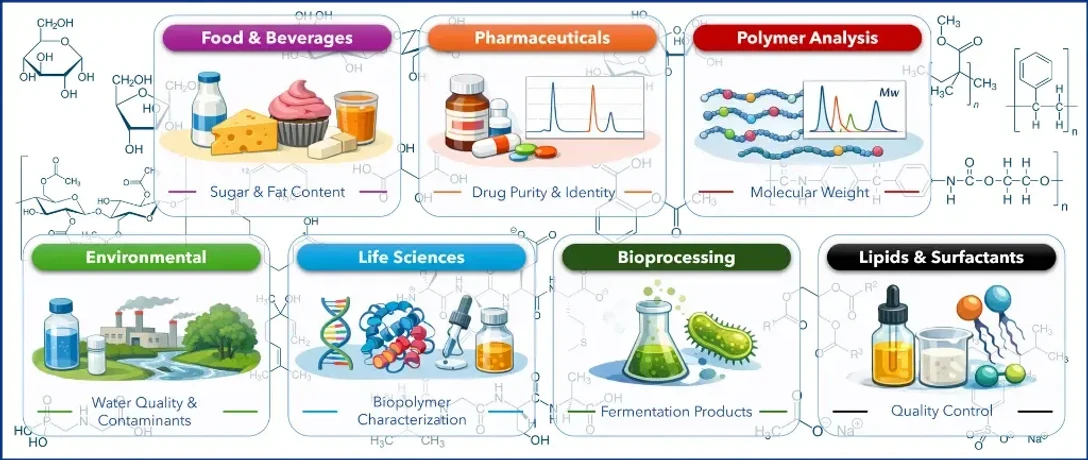 KNAUER / AI: Figure 4: Common uses of RI detection in HPLC
Typical analytes include sugars, alcohols, fatty acids, polymers, lipids, and other small organic molecules without strong chromophores.
Some common application areas include:
- Carbohydrate and sugar analysis, including determination of glucose, fructose, sucrose, or lactose in food and beverages. HPLC-RI has been used for product quality control of gummy candies, with further discussion available in this related blog post.
- KNAUER’s AZURA® RID 2.1L has also been used for the simultaneous determination of sugars and organic acids in wine, an application explored further in the article “The hidden science in your glass”.
- Polymer and macromolecule characterization in GPC/SEC applications, for example when determining molecular-weight distributions. Examples include optimization of molecular-weight determination with the KNAUER AZURA® GPC/SEC system and analysis of mucin proteins using an AZURA® SEC System.
- Bioprocessing, including monitoring fermentation products such as fructans.
- Pharmaceutical applications, for example analysis of excipients such as sugars and polyols, as well as identity and purity testing of APIs. Dextranes, which are used as carrier materials in pharmaceuticals and as thickening or moisturizing agents in cosmetics, can be characterized by SEC, as their properties depend strongly on molecular-weight distribution.
- Lipid and surfactant analysis for formulation development and quality control.
- Environmental analysis, including determination of selected organic and inorganic impurities in water samples.
Overall, RI detection works best for analytes that are soluble, stable in solution, and compatible with straightforward isocratic separation conditions.
It is not the preferred solution for trace analysis, gradient chromatography, or workflows requiring direct MS coupling. Nevertheless, it remains a practical and dependable option for compounds that are difficult or impossible to monitor using UV or fluorescence detection.
Final Thoughts: A Detector That Still Deserves Attention
As analytical laboratories adopt increasingly sophisticated detection technologies, refractive index detection can appear relatively simple. Yet for many applications, that simplicity is exactly its strength.
For analytes such as sugars, alcohols, polymers, and other compounds without strong UV absorption, RID offers a direct, reliable, and non-destructive method of detection.
Its greatest challenges are its sensitivity to temperature and its incompatibility with gradient elution. Under carefully controlled isocratic conditions, however, RI detection remains a dependable workhorse for routine HPLC and GPC/SEC applications.
Pro tip: If your analyte seems invisible to conventional optical detection, a change of perspective may be all that is needed. RI detection could make it visible.
In the next article in the “Seeing is Believing – Detection Made Easy” series, we will focus on Fluorescence Detection (FLD), a highly selective and sensitive technique for compounds that fluoresce naturally or can be derivatized to do so.
This version of the article was adapted from the original text using AI-assisted rewriting and editorial review.
Resources
- L. R. Snyder, J. J. Kirkland, J. W. Dolan, Introduction to Modern Liquid Chromatography, 3rd Edition, John Wiley & Sons, Inc., Hoboken, New Jersey, 2010.
- D. A. Skoog, F. J. Holler, S. R. Crouch, Principles of Instrumental Analysis, 7th Edition, Cengage Learning, Boston, 2018.
- R. P. W. Scott, Liquid Chromatography Detectors. In J. Chromatogr. Library, Vol. 11, Elsevier Scientific Publishing Company, Amsterdam, 1977, pp. iii-ix, 1-248.
- V. R. Meyer, Praxis der Hochleistungs-Flüssigchromatographie, 10., vollst. überarb. u. erw. Auflage, Wiley-VCH, Weinheim, 2009.
- G. Aced, H. J. Möckel, Liquidchromatographie, Apparative, theoretische und methodische Grundlagen der HPLC, VCH Verlagsgesellschaft mbH, Weinheim, 1991.
- M. W. Dong, HPLC and UHPLC for Practicing Scientists, 2nd Edition, John Wiley & Sons, Inc., Hoboken, New Jersey, 2019.