Mo, 31.8.2026 | Original article from: Anal. Chem. (2026) 98 (31): 22966–22976.
A bead-based calibration workflow enables quantitative multielement analysis of single cells by mass cytometry and supports a broad range of lanthanide tags.Quantitative Single-Cell Multielemental Analysis Using Metal-Loaded Microparticles: toward a Universal Quantification Workflow in Mass Cytometry
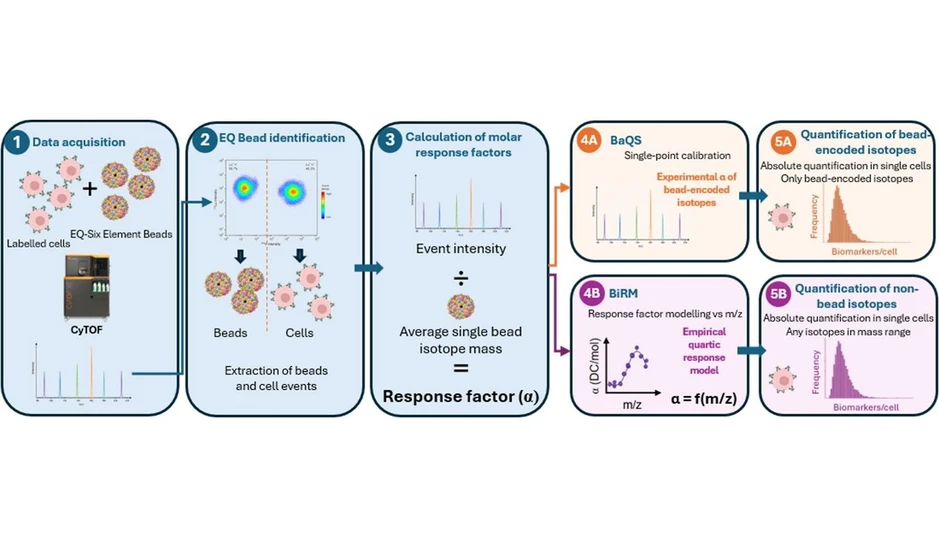
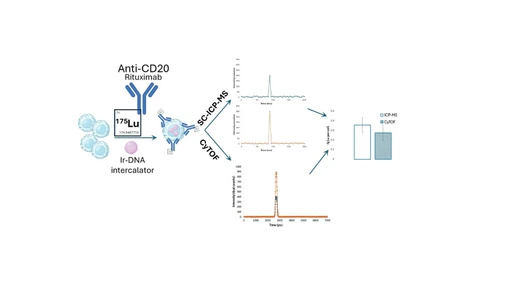
Anal. Chem. (2026) 98 (31): 22966–22976: Figure 1. Overall workflow of the proposed BaQS and BiRM strategies for quantitative single-cell elemental analysis by CyTOF and ICP–TOF–MS.
This study introduces a quantitative workflow for multielement single-cell analysis by mass cytometry using metal-loaded, multielement-barcoded polystyrene beads as calibration standards. Online mixing allows bead and cell events to be distinguished by TOF-MS, enabling elemental concentrations in labeled cells to be quantified from bead responses.
The approach was demonstrated with Lu-, Nd-, and Ir-labeled cancer cells and extended through a polynomial calibration model to elements not directly included in the beads. Agreement with external calibration highlights the method’s potential as a universal quantitative strategy for mass cytometry and single-cell ICP-TOF-MS.
The original article
Quantitative Single-Cell Multielemental Analysis Using Metal-Loaded Microparticles: toward a Universal Quantification Workflow in Mass Cytometry
Ángela de la Rosa-Díaz; Carlos López-Portugués; Mario Corte-Rodríguez*; María Montes-Bayón *
Anal. Chem. (2026) 98 (31): 22966–22976
licensed under CC-BY 4.0
Selected sections from the article follow. Formats and hyperlinks were adapted from the original.
Understanding the biochemical and functional heterogeneity of individual cells is a central challenge in modern biology, immunology, oncology, and clinical translational research. Flow cytometry, and, more recently, spectral flow cytometry, (1) have become essential tools for high-dimensional single-cell analysis. However, obtaining robust quantitative information at the single-cell level remains challenging, particularly when comparing measurements across experiments and laboratories. Quantitative approaches have been developed for fluorescence flow cytometry, typically relying on calibration beads and standardized antibody conjugates to improve interexperimental comparability. (2−4) Nevertheless, the accuracy of these methods remains influenced by fluorophore-specific properties and labeling variability, highlighting the need for alternative quantitative single-cell analytical strategies.
Mass cytometry, or cytometry by time-of-flight (CyTOF), which was introduced by the team of Bandura in 2009, has emerged as a technological breakthrough by substituting fluorophores with isotopically pure metal tags, whose signals are detected by TOF elemental mass spectrometry (MS) using an inductively coupled plasma as ion source (ICP–TOF–MS). (5) This technology has allowed to remove nearly all spectral overlaps and enabled experiments that can routinely include 40–60 parameters, including not only protein biomarkers but also DNA markers and metallodrugs or nanoparticles. (6, 7) Numerous studies have taken advantage of the highly multiplex capabilities of CyTOF to investigate immune responses, characterize tumor-infiltrating lymphocytes, or follow hematopoietic differentiation with greater resolution than was previously possible. (8−10) Indeed, the technique has become central to many multiparametric immunology pipelines by facilitating deeper functional analyses, from mapping subtle cell-cycle states (11) to profiling intracellular cytokine signatures and activation markers (12) that are often difficult to resolve by fluorescence-based approaches. (13)
Beyond its multiplexing capability, an often overlooked advantage of mass cytometry is its potential for elemental quantification. Unlike fluorescence-based approaches, ICP–MS-based detection enables direct conversion of signal intensities into elemental amounts through established calibration strategies. This principle, successfully applied for single-cell elemental analysis by ICP–MS (SC–ICP–MS), has shown to be suitable in different applications. Thus, quantification of intrinsic (14−17) or exogenous (18−20) elements, as well as protein biomarkers following metal-labeling strategies (21, 22) compare well with the bulk analyses on the same cell suspension. However, despite the efforts made to develop quantitative strategies, mass cytometry remains as a mainly qualitative strategy, where very few approaches have explored its unquestionable quantification potential. (4, 23−25)
CyTOF data quality depends critically on managing instrumental variability. Plasma fluctuations, partial clogging of the sample introduction system or injector and periodic retuning, introduce changes in sensitivity that can obscure biological differences between samples measured at different times or in different instruments. To mitigate these effects, CyTOF applies multielement calibration polymeric beads, such as EQ six-element calibration beads, that are mixed with every sample at a fixed concentration before nebulization. (26, 27) These beads, containing defined quantities of yttrium, indium, cerium, terbium, lutetium and bismuth, allow computational normalization and provide a reference signal that corrects for shifts in sensitivity over time. More recently, approaches using frozen antibody master mixes, unified acquisition templates, and sophisticated normalization algorithms have been introduced to enable reproducible multibatch studies and harmonize data sets across different research centers. (27, 28)
Since the sought beads that contain multiple elements in a wide mass range (from 89Y to 209Bi) are commercially available and show high reproducibility, they could serve as quantitative (single-point) analytical standards (once characterized accordingly). This use would increase their analytical value not only as mere drift correctors but also as calibrants that are present within the sample (matrix-matched). Such a strategy is aligned with recently proposed particle-based calibration approaches in SP/SC–ICP–MS, which exploit transient events of the same nature as the analyte to avoid transport-efficiency-related uncertainties. (29) In this way, the estimation of parameters like transport efficiencies of the ionic standards is eliminated, reducing the associated uncertainties. Moreover, since the beads are routinely added to all samples in CyTOF, any raw data file could be reprocessed at any time to extract any quantitative information without any additional measurements.
Despite their routine use for signal normalization, CyTOF calibration beads have not been systematically explored as quantitative standards for single-cell elemental analyses. Their use for quantification implies several analytical challenges, including the accurate characterization of their elemental content, the translation of bead-derived responses into cellular elemental amounts, and the extension of the calibration strategy to isotopes that are not present in the beads. Addressing these challenges is essential before calibration beads can be used as reliable quantitative reference.
An interesting additional feature of plasma-based techniques is their relatively uniform sensitivity across the entire mass range. It has been described that the observed instrumental response in most ICP–MS can be fitted to a simple equation as a function of the m/z of the isotope to be measured for the elements with similar ionization in the plasma, such as the lanthanides. (30, 31) If the transient signals of the multielemental beads are used to obtain the instrumental responses and these are empirically modeled across the monitored m/z range, a practical route toward multielemental quantification strategy is obtained. This would represent a quantification workflow for multiplex single-cell elemental analysis that repurposes multielement CyTOF calibration beads as generic standards. Such an approach seeks to address the limitations in calibration procedures and, ultimately, to enhance the quantitative applications of high-dimensional single-cell MS that can be applied not only to CyTOF-based analysis but could also be extended to any other SC–ICP–MS analysis using any other TOF mass analyzers.
Experimental Section
Instrumentation
The single-particle ICP–MS measurements were performed by using the iCAP TQ triple quadrupole ICP–MS system from Thermo Fisher Scientific (Bremen, Germany). All measurements were done using the standard configuration for sample introduction, including the Micro-Mist nebulizer at a sample flow rate of 0.4 mL min–1 and a cyclonic spray chamber. The sample introduction setup was used together with a Teledyne Cetac ASX-560 autosampler. SP-ICP-MS characterizacion of the lanthanide-loaded polystyrene beads was carried out setting a dwell time of 5 ms. Daily optimization of ICP–MS was performed to enhance signal sensitivity, ensuring that the generation of oxide ions and doubly charged species remained below 3% and 5%, respectively.
The CyTOF experiments were conducted in a CyTOF XT (Standard BioTools, San Francisco, CA, USA). This instrument is an ICP–MS that operates TOF mass analyzer with a shortened mass coverage from m/z 75 to 209. The samples are placed in a refrigerated carousel at 4 °C and injected into the CyTOF with a hydraulic autosampler that is able to handle sample introduction and system washing. The autosampler automatically adds the EQ6 calibration beads (Standard BioTools) to every sample at a 1:10 dilution. After mixing, the bead-containing sample is injected at 30 μL·min–1 through a pneumatic nebulizer and a spray chamber that is heated at 200 °C. using a constant sample flow of at 10 μL min–1. Microparticle imaging was carried out with a JEOL JEM-2100F transmission electron microscope.
Results and Discussion
BiRM: An Interpolated Model for Multielement Quantification
Taking advantage of the multielemental composition of the beads uniformly distributed along the CyTOF measuring range, their molar response factors can be estimated and plotted against the m/z of each of the isotopes contained on the beads. This is possible thanks to the high ionization efficiency achievable in the plasma for the elements of the beads that is close to 100%. In that case, previous publications demonstrated that the ICP–MS molar response can be modeled using different theoretical equations. (30, 31) Consequently, the molar responses (nresp) for all the 8 isotopes of the 6 elements contained in the beads (typically >5000 events) were calculated as in eq 3 and represented against the mass-to-charge ratio (m/z). The molar response, differently to the previously reported response factor (αi), takes into account the atomic mass of the element and isotope, the isotope abundance, and the concentration. This response was fitted empirically to polynomial functions of degree 2, 3, 4, and 5, resulting in the quartic function the one with the best correlation (r2 = 0.99) while avoiding overfitting of the data. The response factors for all the isotopes are represented in Figure 4 (every data point considered for the fitting corresponds to the average intensity obtained for a minimum of 5000 bead events and the corresponding standard deviation), together with the fitted quartic polynomial function of eq 4. This behavior showing a mass-dependent response with a slight decrease at high m/z is also consistent with published results using ICP–TOF–MS instruments. (34) The fourth-order polynomial was used as an empirical interpolation of the instrumental response within the calibrated mass range in our specific CyTOF instrument, without physical significance of the coefficients.
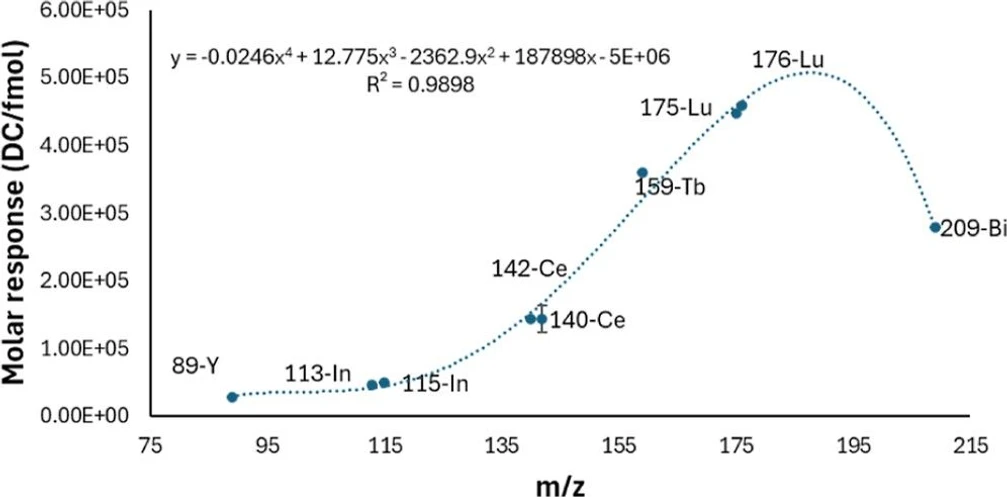 Anal. Chem. (2026) 98 (31): 22966–22976: Figure 4. Molar response factors for every isotope in the beads as a function of m/z and the quartic function model (dashed line) that fits such data obtained using CyTOF results. Standard deviation of each data point is also included (only distinguishable in the case of 140Ce).
Using the m/z of the isotope of interest and by interpolation in the curve, it is possible to estimate its molar response on each sample (matrix matched). Out of the obtained molar response and taking the integrated dual counts obtained for such isotope in the sample, inferring its mass in a single cell event is straightforward. Figure 5A shows the correlation between the predicted (using eq 4) and the experimental value (using eq 3) for the molar responses of the isotopes contained in the beads. A good correlation can be observed (R2 = 0.99), with a slope of 0.99, suggesting an excellent ability of the model to calculate the molar sensitivity of these isotopes.
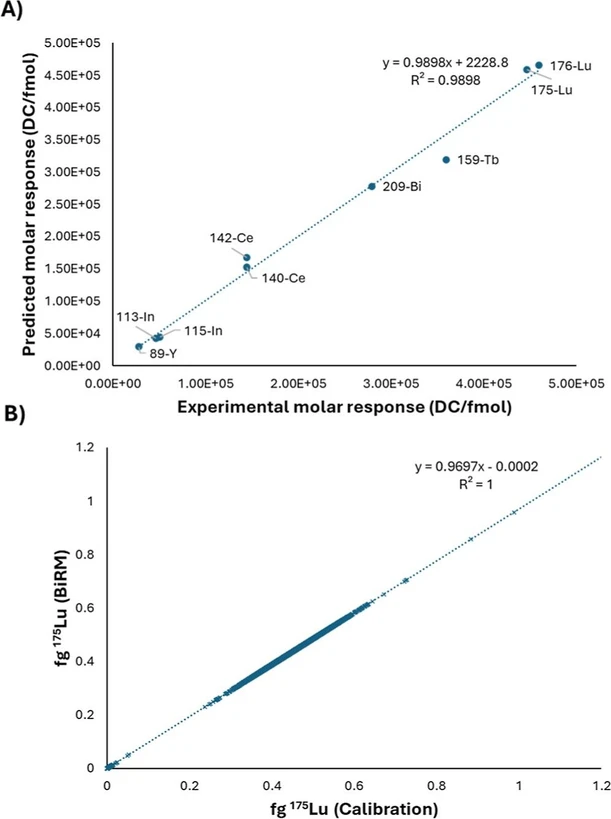 Anal. Chem. (2026) 98 (31): 22966–22976: Figure 5. (A) Plot showing the correlation between the BiRM-predicted and the experimental molar response for the multielemental beads and (B) the correlation of 8200 individual cell events obtained by BiRM versus calibration with 175Lu standards. Error bars were omitted for clarity. Experimental uncertainties associated with the molar response factors are reported in Table 2.
Although it is possible to perform the described calculations using a datasheet like from microsoft excel, Google Sheets, or LibreOffice Calc, the BiRM interpolation and quantification workflow becomes increasingly cumbersome as the number of isotopes, events and biological replicates grows. For this reason, an in-house script has been developed in R, which is provided as Supporting Information. The script, which is fully transparent and open-access, operates directly on the data matrix generated for either cell events or calibration-bead events after standard CyTOF preprocessing (see the Experimental section). By introducing the elemental information required for BiRM calculations as described in the accompanying “Readme” file, the script automatically computes the molar or mass amount of each element per cell. In addition, it generates summary statistics, diagnostic figures and histograms for rapid quality assessment. This implementation ensures reproducibility, minimizes operator-dependent variability and allows users to reprocess previously acquired data sets without any additional experimental steps. A continuously updated version of software will be made available in a public repository, where future improvements, extension and documentation will be deposited. Because the isotopes used in Figure 5A were also employed to construct the BiRM model, an additional leave-one-out validation was performed to assess its predictive capability. In each iteration, one calibration isotope was excluded from the fitting procedure and its molar response factor was subsequently predicted using a model constructed from the remaining isotopes. The predicted values were then compared with the experimentally determined molar response factors. The leave-one-out validation yielded a mean absolute relative error (MARE) of 14.3%, compared with 8.3% for the all-in model. As expected, prediction errors increased when an isotope was excluded from the model construction. However, the obtained deviations remained within a reasonable range considering the limited number of calibration points available for model fitting.
Conclusion
This study presents a practical route to quantitative mass cytometry by repurposing the multielement calibration beads that are routinely added to CyTOF samples as in-tube quantitative standards that can be extended not only to CyTOF but also to any other TOF-based ICP–MS instruments. Two complementary strategies were proposed. First, BaQS performs single-point calibration for bead-encoded isotopes to obtain the absolute mass of lanthanide per cell. Second, the BiRM makes use of the multielement bead signature to empirically model the instrumental response across the monitored m/z window, enabling the prediction of response factors for isotopes that are not present in the beads. The results indicate that both strategies provided accurate results with no statistically significant differences with the validated external standards calibration for the quantification of bead-contained and noncontained lanthanides, being BaQS and BiRM simpler, faster, more efficient, and ready to be applied to already acquired data with no additional measurements needed.