Mo, 31.8.2026 | Original article from: Anal. Chem. (2026) 98 (14): 10511–10520
A GC-MS/MS method quantifies inorganic fluoride in EOF extracts and shows that fluoride contamination can substantially overestimate organic fluorine measured by CIC.Toward Accurate Estimation of Extractable Organic Fluorine by Analysis of Fluoride Contamination in Extracts Using Gas Chromatography
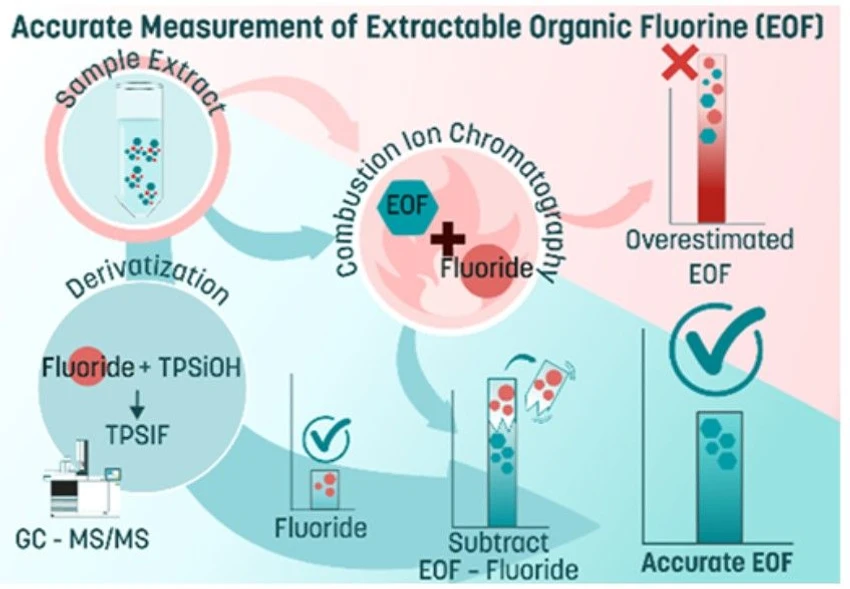
Anal. Chem. (2026) 98 (14): 10511–10520: Visual abstract
This study develops and validates a GC-MS/MS method for measuring inorganic fluoride in small aliquots of extractable organic fluorine (EOF) samples. Fluoride is derivatized to triphenylfluorosilane before analysis, providing a detection limit of 0.98 μg F⁻ L⁻¹, good precision, and accurate recoveries in reference and spiked samples.
Application to river water, AFFF-impacted soil, and fish extracts showed that inorganic fluoride accounted for 3–59% of measured EOF. The findings demonstrate that fluoride contamination can substantially overestimate organic fluorine determined by combustion ion chromatography and should therefore be quantified and subtracted for more accurate EOF analysis.
The original article
Toward Accurate Estimation of Extractable Organic Fluorine by Analysis of Fluoride Contamination in Extracts Using Gas Chromatography
Johannes Kikuchi-McIntosh; Malin Montelius; Gustav Sporre; David Bastviken; Teresia Svensson
Anal. Chem. (2026) 98 (14): 10511–10520
licensed under CC-BY 4.0
Selected sections from the article follow. Formats and hyperlinks were adapted from the original.
Per- and polyfluoroalkyl substances (PFAS) represent one of the most worrying global health- and environmental threats of today. (1) Given their widespread use (2) and environmental persistence, (3) PFAS has been suggested to constitute a new planetary boundary (4, 5) that humanity has exceeded. (6) Knowledge of human PFAS exposure first emerged during the 1960s when diverging fluorine (F) concentrations were observed in human blood plasma, and it was revealed that some of the analytical methods used only measured F–, while others measured total fluorine (TF), i.e., both inorganic and organic F. (7−11) Combination of these methodological differences allowed for estimation of the organic fluorine (OF) fraction as the difference between TF and F– (7, 8, 12, 13) (TF minus F–). Eventually, parts of the OF fraction in blood plasma were isolated, and its major constituent, the PFAS perfluorooctanesulfonic acid (PFOS), was determined by F NMR. (14) While F NMR confirmed the structure of PFOS in human blood, it was the ability to distinguish F– from OF in the blood F mass balance that led to this discovery.
Given the plethora of PFAS in use today (∼14 000 compounds (15)), it is common to analyze aliquots of PFAS extracts for extractable organic fluorine (EOF) using combustion ion chromatography (CIC) (16−21) to estimate potentially unidentified PFAS. However, organic extracts for PFAS/EOF analysis can contain inorganic fluorinated anions such as tetrafluoroborate (BF4–) and hexafluorophosphate (PF6–) that, if not accounted for by target analysis, will lead to overestimation of the OF fraction. (22) F– in extracts could also constitute a source of overestimation of the OF fraction and despite being an integral part of estimating OF in the past, (7−10) most contemporary studies neglect analysis of F– in extracts for EOF measurements. (16−21)
F removal efficiencies of 95–99.995% in extraction procedures have been reported during method development for PFAS/EOF extraction. (16, 20, 27, 33) However, as F– can be much more abundant than OF, extraction efficiencies at, e.g., 95–>99% can still result in substantial F– contamination compared to OF concentrations. Given the inherent heterogeneity of environmental samples, it is uncertain whether F– removal efficiency can be assumed to be independent and unaffected by different matrices and matrix effects. If not, residual F– might remain in sample extracts and contribute to the apparent EOF. Such uncertainties can be mitigated by quantifying F– concentrations in aliquots of extracts and subtract from analyzed F-concentrations from, e.g., CIC to yield a more accurate EOF.
Measurements of F– are typically made with IC or F– selective electrodes (FSE). (23) For IC, sample solutions are commonly injected via a peristaltic pump on the IC autosampler, and FSE’s need to be immersed in the sample solution. Consequently, these methods require large volumes of sample (several milliliters) for analysis. This is problematic considering that extract volumes for PFAS analysis rarely exceed 1–2 mL. (24−27) Furthermore, IC measurements suffer from interferences from coeluting compounds such as formate, acetate, and lactate. (28) The use of FSE’s lead to other issues as they are cross-sensitive to hydroxide ions (OH–) which necessitates the use of total ionic strength adjustment buffers (TISAB) to minimize interference from OH– and to adjust pH to shift the chemical equilibrium HF ⇌ F– toward fluoride. (23, 29) The use of TISAB buffers will further dilute the extract and fluoride, potentially below the detection limits. Standard addition methods have been used to decrease the detection limits of FSEs (30, 31) but such methods are in general tedious and time-consuming since they require repeated measurements on the same sample for accurate fluoride determinations. These issues make IC and FSE determinations problematic because many PFAS extraction procedures involve manipulating pH with acids and bases (hydrochloric acid (HCl) (27) or formic acid (HCOOH) (32) and sodium- or ammonium-hydroxide (NaOH (32, 33) or NH4OH (27, 28, 34)).
Finding other F– analysis methods that are rapid and fit-for-purpose could help mitigate potential overestimation of the EOF. Gas chromatography (GC) with various detectors has been used for F– determination and could circumvent some of the issues mentioned above. F– needs to be derivatized to a volatile form to be amenable for GC analysis. (35) For example, conversion of F– to silyl derivatives (Rx–Si–F) under highly acidic conditions has provided high sensitivity and selectivity even with small sample volumes (<1 mL). (36−38)
While GC analysis potentially addresses issues with F– measurements of EOF extracts, some aspects of the GC approach of F– analysis require improvements for broader application and utility. For example, common use of concentrated perchloric acid (HClO4) during silylation poses a significant work hazard due to its oxidative power and risk of explosions, (39, 40) and finding alternatives would be preferable. A study using triphenylsilanol (TPSiOH) to derivatize F– found that concentrated nitric acid (HNO3) produced similar derivatization efficiencies as HClO4. (38) However, HClO4 was preferred due to lower F– blank levels. This suggests that HNO3, a much weaker oxidizing agent, could be a viable alternative to HClO4 if background levels of F– could be controlled.
Derivatization time is another important aspect for efficient workflows and method utility. For silyl derivatizations, reaction times vary from 5 to 150 min depending on the derivatization agent. (36−38, 41, 42) Silylation reactions with very short reaction times require cooled conditions due to high volatility, (41) but there are more suitable options. Derivatization of TPSiOH to triphenylfluorosilane (TPSiF) can be performed at room temperature in 1 h, (36, 38) making it both fast and easy to use. Previous related studies also suggest that the derivatization time can be optimized further. (38)
To conclude, simple F– measurements in extracts could remove some uncertainties regarding EOF as analyzed with CIC, if appropriate methods were developed. Apart from fulfilling regular method validation criteria, such methods would have to be compatible with small sample volumes, complex environmental matrices, rapid in their execution, and preferably avoid reagents that pose unnecessary work safety hazards. As such, we set out to develop and optimize a rapid, easy-to-use derivatization procedure for conversion of F– to TPSiF with HNO3 and subsequent analysis by GC–MS/MS. The aim was to use sample volumes smaller than 1 mL and derivatization times under 1 h. After validation, we explored F– content in surface water-, aqueous-film-forming foam (AFFF)-impacted soil-, and fish extracts from various PFAS extraction procedures along with CIC measurements to determine EOF.
Experimental Section
Instrumentation
The GC–MS/MS system was composed of an Agilent 8890 GC connected to Agilent 7010B triple quadrupole with an Agilent 7693 Autosampler. The GC column was an HP-5 ms Ultra Inert (30 m × 250 μm × 0.25 μm, length, inner diameter, film thickness). The He carrier-gas flow was set to 1 mL min–1, and a 0.2 μL split injection (split rate 20:1) was used with an inlet temperature of 325 °C. The GC-oven program started with a 0.5 min hold time at 40 °C, followed by a 60 °C min–1 increase to 280 °C with 1.5 min hold time. Finally, the temperature was increased to 300 °C at a rate of 60 °C min–1 with a 1.7 min hold time yielding a total run time of 8.7 min with ∼4 min re-equilibration between injections.
CIC was performed using a Metrohm 930 Compact IC Flex instrument connected to the Metrohm 920 Absorber Module and Analytik Jena Combustion Module with the MMS 5000 Automatic Boat Drive autosampler. Instrument settings were combustion temperature 1050 °C, O2 gas flow of 300 mL min–1, Ar gas flow of 100 mL min–1, 0.2 mL min–1 water addition during combustion, the postcombustion time was set to 5 min, yielding a total combustion time of 9.6 min, the initial absorber solution volume was 3 mL ultrapure water, and the total absorber solution volume after combustion was ∼7.6 mL. For sample injection, ∼2.2 mL of the absorber solution was preconcentrated onto the preconcentration column (Metrosep A PCC 2 VHC 4.0) and eluted with 0.7 mL min–1 gradient elution flow with Eluent A (0.25 mM NaHCO3) and B (12 mM Na2CO3/10 mM NaOH/7.5% ethanol (v/v)) followed by analytical separation on the Metrosep A Supp 5 150/4.0. The IC calibrated range was 5–5000 μg F L–1, and the quality of the combustion step was controlled by combustion of the CRM River Water sample, a 0.5 ppm PFOS solution and IC standards.
Results and Discussion
Derivatization Optimization
The mixed effects model of the optimization factorial design showed significant interaction effects between acid-to-sample ratio and μmol of TPSiOH on derivatization efficiency (p = 0.03). Acid-to-sample ratio, TPSiOH, and derivatization time all had significant effects on derivatization efficiency on their own (p < 0.001), and the effects for all variables increased from the low to high level. Table 4 summarizes the result from the ANOVA of the mixed effects model, and an interaction plot of average derivatization efficiency over acid-to-sample ratio for the different levels of μmol TPSiOH is shown in Figure S1. (49)
 Anal. Chem. (2026) 98 (14): 10511–10520: Table 4.Results of Mixed-Effects Model ANOVA Testing Acid-to-Sample Ratio, μmol TPSiOH, Time, and Their Interaction Effects on the Derivatization Efficiency of F–
The center level (0.75 TPSiOH/1.5 acid-to-sample ratio) of the factorial design produced only derivatization efficiencies between the low and high levels and did not constitute any derivatization optima. In the initial design, even higher factor levels could have been used for the sake of finding the optimal combination of variable levels, which is why we chose to expand the acid-to-sample ratio to 3.3 and 4 for further testing. The results of all combinations of tested variables and levels are shown in Figure 2. A general trend in the derivatization efficiency was that increasing the acid-to-sample ratio reduced the necessary derivatization time to 20–40 min. Comparatively, other studies have reported necessary derivatization times of 1–3 h. (36, 38, 50)
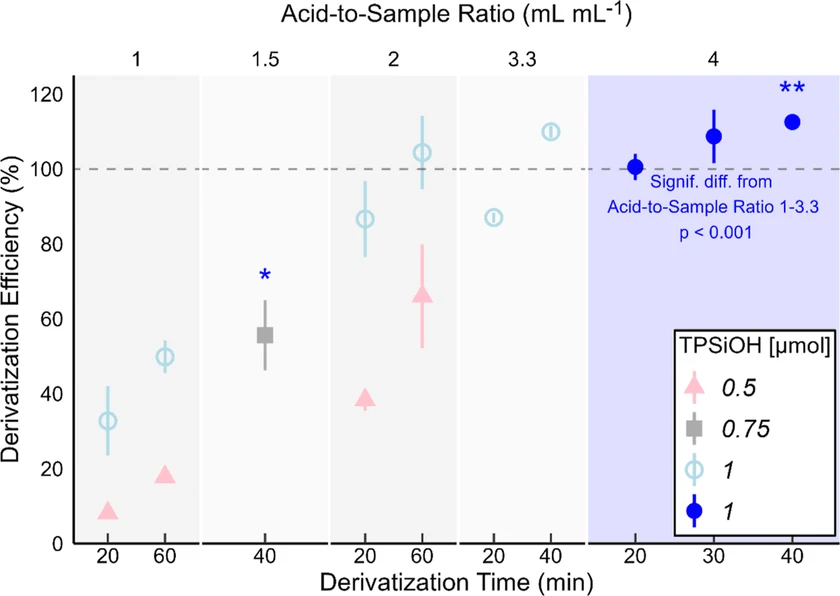 Anal. Chem. (2026) 98 (14): 10511–10520: Figure 2. All combinations of variables tested with acid-to-sample ratios 1, 1.5, 2, 3.3, and 4; derivatization times 20, 30, 40, and 60 min; and amount of TPSiOH at 0.5, 0.75, and 1 μmol. Points and error bars represent mean ± standard deviation (n = 3, *n = 6, and **n = 2).
At acid-to-sample ratio 4, all derivatization times tested gave derivatization efficiencies close to 100% or above and were significantly different from tests carried out at lower ratios (Welch’s t-test, p < 0.001). Apparent derivatization efficiencies above 100% could be caused by matrix enhancing effects (51) due to the different matrices of the derivatized sample solutions and the commercially sourced TPSiF standard solutions used for calibration. Hence, although derivatization efficiencies above 100% are not realistic, the results indicate that the efficiencies are very high and close to 100%.
Based on the results from the factorial experiment, the final optimized derivatization procedure was obtained and consisted of adding 1 mL of purified concentrated HNO3, 70 μL of 0.015 M TPSiOH, 250 μL of sample solution, and 300 μL of heptane to 1.7 mL Eppendorf tubes followed by 20–30 min vortexing. After vortexing, the tubes were centrifuged at 12 000 rpm for 10 min, and 150 μL of the heptane layer was transferred to GC analysis vials with 350 μL glass inserts and stored cold (+4 °C) until GC–MS/MS analysis.
Incorporation into Workflows
The Oasis WAX protocol (44) has been widely used for PFAS and EOF measurements to estimate unknown organofluorine compounds. (17, 19, 21, 22, 56) The results of our developed method show that F– can persist in extracts and constitute a significant portion of the measured EF. In cases where F mass balance calculations reveal large unexplained OF fractions, this method will be particularly useful to determine whether F– constitutes parts of this unknown fraction.
EOF measurements have been proposed as a screening tool in workflows for potential PFAS contamination in different sample matrices. (57, 58) The previously suggested workflow has entailed the initial extraction of fluorinated compounds from samples and subsequent EOF analysis (with CIC or continuum source molecular absorption spectrometry (16, 59) (CS-MAS)). Samples shown to contain considerable amounts of EOF would then be subjected for further target analysis of PFAS to determine the contribution of known fluorinated compounds to the fluorine mass balance of the samples. (58) Using such an approach, Aro et al. (2022) (57) successfully differentiated between individuals exposed to AFFF contamination via drinking water and individuals of a control group with no known exposure to PFAS from drinking water through analysis of blood plasma extracts. Results showed that EOF analysis alone was able to make such a distinction. In such a workflow, the method developed in this study could complement the EF/EOF analysis by also determining if and to what extent F– contributes to the determined EF/EOF. Ideally, the developed derivatization procedure and F– measurement should be made in an aliquot of the same extract that is used for EF/EOF determination. Additional analysis on the same extract will require that adequate volumes of extract are available, especially if further analytical methods are to be employed downstream in the workflow, for example, with the total oxidizable precursor assay (60−64) (TOP-assay) for the estimation of the presence of precursor compounds. Including duplicate extractions of samples, (57, 58) creating one replicate for target analysis (with isotopically labeled internal standards (IS) added during extraction) and one replicate (without added IS) for EF/EOF determination would provide enough extract for the small volumes used in the developed method and provide estimates of the potential F– contribution to EF.
Conclusions
A rapid derivatization method of F– to TPSiF was successfully developed allowing for trace level determination of F– in small aliquots (∼250 μL) of complex aqueous and solvent matrices using GC–MS/MS. In the developed method, there is no need to use perchloric acid that has previously been employed in studies utilizing TPSiOH (and other silanol-derivatives) for F– determination, (12, 36−38) making it more user-friendly. In combination with decreased derivatization time, the method allows for a high throughput of samples, rendering it applicable for routine analysis. In this study, GC–MS/MS was used for analysis, but the method is also applicable for analysis with GC–MS and other detectors such as flame ionization and electron capture detectors (36) (FID and ECD) increasing the methods applicability and versatility. A novel cleanup method for F–-contaminated concentrated HNO3 was also developed based on surface complexation of F– to −Si–F using regular silica gel, effectively reducing background F– levels to ∼1 μg F– L–1 allowing for trace level determinations. The developed method was employed for the analysis of F– in solvent extracts for PFAS and EOF analysis, clearly demonstrating that F– contributes to the apparent EOF content in extracts when analyzed by CIC.
This study highlighted the risk that past analyses may have overestimated EOF concentrations, in some cases, as much as by ∼50%. Mitigating large biases are important for accurate monitoring of environmental concentrations and for the evaluation of remediation strategies to remove PFAS in soils and waters, particularly in light of current regulatory development concerning PFAS and EOF. (65) Total sums of fluorine equivalents of targeted PFAS analysis, total organic fluorine, and EOF measurements have been discussed for establishing environmental quality standard (EQS) values in water, sediment, and biota within the EU Water Framework Directive. (65, 66) However, the risk of inclusion of inorganic fluorine species in these measurements has been highlighted as an important challenge limiting their use for establishing such threshold values. (65) Incorporating the developed method for F– determination in extracts would improve the estimation of the OF fraction by correcting for F– content. As such, we recommend that F– determinations of extracts are routinely employed to improve the accuracy of the fluorine mass balance calculations and avoid overestimation of the EOF content.