What parameters should I consider when selecting a GC column for my application?

We, 9.7.2025 | Original article from: Phenomenex
What parameters should I consider when selecting a GC column for my application?
  • Photo: Phenomenex: What parameters should I consider when selecting a GC column for my application?
  • Video: Phenomenex: Meet Zebron: Quality GC Columns By Design 

1) Polarity 

Some indication of polarity will usually be provided by the GC column manufacturer, the value provided is normally determined using Kovats retention time indices together with McReynold’s numbers. The general advice is that stationary phase polarity should closely mirror the polarity of the analytes of interest, so a non-polar phase such as a ZB-1 (rated as 5 on the polarity scale) would be a good choice for hydrocarbon analysis whilst a ZB-Wax (57 on the polarity scale) is often chosen for alcohols.

2) Selectivity 

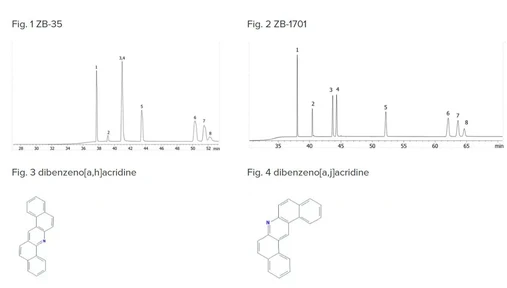
This is controlled by the different functional groups present within the polymeric stationary phase, the base of which is either polysiloxane or polyethylene glycol. Polysiloxane phases will typically have methyl groups, phenyl groups or cyanopropyl groups attached to the polysiloxane chains which allow for a variety of different interactions to occur:

  • Methyl groups: van der waals or London forces,
  • Phenyl groups: π-π interactions,
  • Cyano groups: π-π and dipole-dipole interactions.

Increasing the percentage of phenyl or cyanopropyl substituents in the stationary phase increases polarity. Polyethylene glycol (PEG)phases offer sites for dipole-dipole and hydrogen bonding interactions to take place, PEG phases are typically some of the most polar phases available.

3) Length

Increasing the length of the column increases the number of theoretical plates, which aids resolution, however increasing column length also increases the run time of any analysis conducted. A 30 m column is generally a good starting point for general method development whereas 60 m columns are typically used for the fingerprint analysis of complex mixtures. 15 m columns are generally utilised when the rapid separation of less complex mixtures is required.

4) ID

The choice of column ID impacts both column capacity (how much analyte you can inject) and efficiency. The narrower the column ID the higher the efficiency, but the lower it’s capacity. A good place to start with method development is a 0.25 mm ID column, which show a good compromise between efficiency and capacity. If you are converting a method from an old-style packed GC column to capillary GC columns then 0.53 mm ID columns are often chosen due to their higher analyte capacity.

5) Film thickness

Thin films provide the highest efficiency but have lower analyte retention. Thicker films have a higher capacity but lead to more bleed at high temperatures. If choosing to use a thin film (0.1 - 0.25 µm) with active analytes it is preferential to select a column which is highly deactivated to prevent peak tailing. Such columns generally provide lower bleed too.


Phenomenex
LinkedIn Logo
 

Related articles

Good Column Selection: Polarity vs Selectivity
Article | Academy

Good Column Selection: Polarity vs Selectivity

Understanding GC column polarity and selectivity is key to achieving optimal separations. Learn how to choose the right stationary phase for your compounds and improve chromatographic performance.
Using Phase Ratio to Reduce Run Time
Article | Academy

Using Phase Ratio to Reduce Run Time

Learn how column length, internal diameter, and film thickness work together to optimize phase ratio in GC. Discover how adjusting these parameters reduces run time while maintaining separation efficiency.
Oligos Made Easy - Part 4: HILIC
Article | Academy

Oligos Made Easy - Part 4: HILIC

Discover how HILIC-MS is transforming oligonucleotide analysis. Learn retention principles, method development steps, and practical tips for achieving high-resolution, ion-pair-free separations.
Water in GC: Safe or Risky? Here’s What You Need to Know
Article | Academy

Water in GC: Safe or Risky? Here’s What You Need to Know

Are aqueous injections in GC really a problem? Overview of chemically bonded columns, backflash behavior, PEG “wax” phases, and best practices for water in GC workflows.
 

Related articles

Good Column Selection: Polarity vs Selectivity
Article | Academy

Good Column Selection: Polarity vs Selectivity

Understanding GC column polarity and selectivity is key to achieving optimal separations. Learn how to choose the right stationary phase for your compounds and improve chromatographic performance.
Using Phase Ratio to Reduce Run Time
Article | Academy

Using Phase Ratio to Reduce Run Time

Learn how column length, internal diameter, and film thickness work together to optimize phase ratio in GC. Discover how adjusting these parameters reduces run time while maintaining separation efficiency.
Oligos Made Easy - Part 4: HILIC
Article | Academy

Oligos Made Easy - Part 4: HILIC

Discover how HILIC-MS is transforming oligonucleotide analysis. Learn retention principles, method development steps, and practical tips for achieving high-resolution, ion-pair-free separations.
Water in GC: Safe or Risky? Here’s What You Need to Know
Article | Academy

Water in GC: Safe or Risky? Here’s What You Need to Know

Are aqueous injections in GC really a problem? Overview of chemically bonded columns, backflash behavior, PEG “wax” phases, and best practices for water in GC workflows.
 

Related articles

Good Column Selection: Polarity vs Selectivity
Article | Academy

Good Column Selection: Polarity vs Selectivity

Understanding GC column polarity and selectivity is key to achieving optimal separations. Learn how to choose the right stationary phase for your compounds and improve chromatographic performance.
Using Phase Ratio to Reduce Run Time
Article | Academy

Using Phase Ratio to Reduce Run Time

Learn how column length, internal diameter, and film thickness work together to optimize phase ratio in GC. Discover how adjusting these parameters reduces run time while maintaining separation efficiency.
Oligos Made Easy - Part 4: HILIC
Article | Academy

Oligos Made Easy - Part 4: HILIC

Discover how HILIC-MS is transforming oligonucleotide analysis. Learn retention principles, method development steps, and practical tips for achieving high-resolution, ion-pair-free separations.
Water in GC: Safe or Risky? Here’s What You Need to Know
Article | Academy

Water in GC: Safe or Risky? Here’s What You Need to Know

Are aqueous injections in GC really a problem? Overview of chemically bonded columns, backflash behavior, PEG “wax” phases, and best practices for water in GC workflows.
 

Related articles

Good Column Selection: Polarity vs Selectivity
Article | Academy

Good Column Selection: Polarity vs Selectivity

Understanding GC column polarity and selectivity is key to achieving optimal separations. Learn how to choose the right stationary phase for your compounds and improve chromatographic performance.
Using Phase Ratio to Reduce Run Time
Article | Academy

Using Phase Ratio to Reduce Run Time

Learn how column length, internal diameter, and film thickness work together to optimize phase ratio in GC. Discover how adjusting these parameters reduces run time while maintaining separation efficiency.
Oligos Made Easy - Part 4: HILIC
Article | Academy

Oligos Made Easy - Part 4: HILIC

Discover how HILIC-MS is transforming oligonucleotide analysis. Learn retention principles, method development steps, and practical tips for achieving high-resolution, ion-pair-free separations.
Water in GC: Safe or Risky? Here’s What You Need to Know
Article | Academy

Water in GC: Safe or Risky? Here’s What You Need to Know

Are aqueous injections in GC really a problem? Overview of chemically bonded columns, backflash behavior, PEG “wax” phases, and best practices for water in GC workflows.