Unknown compounds analysis by HRMS, soft ionization and AI for GCxGC (Masaaki Ubukata, MDCW 2025)

We, 14.5.2025 | Original article from: The Multidimensional Chromatography (MDC) Workshop
We developed an AI-based EI mass spectral database with 120 million predicted spectra to improve unknown compound identification in GC×GC-MS beyond commercial library limits.
  • Photo: MDCW: Unknown compounds analysis by HRMS, soft ionization and AI for GCxGC (Masaaki Ubukata, MDCW 2025)
  • Video: LabRulez: Masaaki Ubukata: Unknown compounds analysis by HRMS, soft ionization and AI for GCxGC (MDCW 2025)

🎤 Presenter: Masaaki Ubukata (JEOL, Tokyo, Akishima, Japan)

💾 PDF presentation

💡 Book in your calendar: 17th Multidimensional Chromatography Workshop (MDCW) 13 - 15. January 2026

Abstract

GC-MS plays an important role in a lot of application fields and is widely used for qualitative and quantitative analysis, especially for volatile organic compounds. Most of the qualitative analysis in GC-MS is compound identification by comparison with commercially available library databases for the EI mass spectra. The EI mass spectral pattern, which is commonly used in GC-MS, is known to be highly reproducible and independent of the instrument. Therefore, a large number of EI mass spectra are available in commercial databases, and it becomes an advantage comparing with qualitative analysis in LC-MS.

However, there are still many compounds that are not registered in commercial EI mass spectral databases. For this qualitative analysis issue, we have created an AI model to predict EI mass spectra from structural formulas by machine learning.

We prepared approximately 100 million compounds structures from PubChem, 10 million TMS compounds and 5.5 million pyrolyzates compounds using in-silico. Totally, we have created a new predictive EI mass spectral database for 120 million compounds that are not registered in commercial databases.

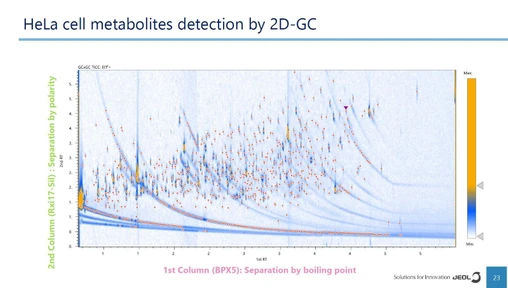
In this study, we report the details of the development for the predicted EI mass spectral database and applying to comprehensive 2-dimentional gas chromatography data.

The Multidimensional Chromatography Workshop
LinkedIn Logo
 

Related articles

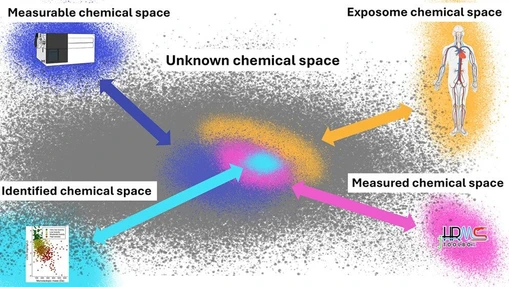
Exploring the Chemical Space of the Exposome: How Far Have We Gone?
Article | Scientific article

Exploring the Chemical Space of the Exposome: How Far Have We Gone?

In the research article published recently in the JACS Au journal, the researchers have reviewed the latest efforts in mapping the exposome chemical space and its subspaces.
For the first time, scientists have access to a comprehensive data set for identifying unknown compounds – thanks to experts at IOCB Prague
Article | Science and research

For the first time, scientists have access to a comprehensive data set for identifying unknown compounds – thanks to experts at IOCB Prague

Scientists at IOCB Prague created MSⁿLib, a vast mass spectrometry library with millions of records, enabling rapid unknown compound identification and boosting drug discovery and biomedical AI.
News from LabRulezGCMS Library - Week 10, 2026
Article | Application

News from LabRulezGCMS Library - Week 10, 2026

This week we bring you application notes by Agilent Technologies, BaySpec and Shimadzu and presentation by MDCW / JEOL.
Structural elucidation using GC×GC-TOFMS and machine learning (Masaaki Ubukata, MDCW 2026)
Presentation | Video

Structural elucidation using GC×GC-TOFMS and machine learning (Masaaki Ubukata, MDCW 2026)

Discover how AI-driven GC-MS workflows and predictive spectral libraries enable confident identification of unknown metabolites, integrating molecular-formula estimation and high-resolution GC×GC-TOFMS.
 

Related articles

Exploring the Chemical Space of the Exposome: How Far Have We Gone?
Article | Scientific article

Exploring the Chemical Space of the Exposome: How Far Have We Gone?

In the research article published recently in the JACS Au journal, the researchers have reviewed the latest efforts in mapping the exposome chemical space and its subspaces.
For the first time, scientists have access to a comprehensive data set for identifying unknown compounds – thanks to experts at IOCB Prague
Article | Science and research

For the first time, scientists have access to a comprehensive data set for identifying unknown compounds – thanks to experts at IOCB Prague

Scientists at IOCB Prague created MSⁿLib, a vast mass spectrometry library with millions of records, enabling rapid unknown compound identification and boosting drug discovery and biomedical AI.
News from LabRulezGCMS Library - Week 10, 2026
Article | Application

News from LabRulezGCMS Library - Week 10, 2026

This week we bring you application notes by Agilent Technologies, BaySpec and Shimadzu and presentation by MDCW / JEOL.
Structural elucidation using GC×GC-TOFMS and machine learning (Masaaki Ubukata, MDCW 2026)
Presentation | Video

Structural elucidation using GC×GC-TOFMS and machine learning (Masaaki Ubukata, MDCW 2026)

Discover how AI-driven GC-MS workflows and predictive spectral libraries enable confident identification of unknown metabolites, integrating molecular-formula estimation and high-resolution GC×GC-TOFMS.
 

Related articles

Exploring the Chemical Space of the Exposome: How Far Have We Gone?
Article | Scientific article

Exploring the Chemical Space of the Exposome: How Far Have We Gone?

In the research article published recently in the JACS Au journal, the researchers have reviewed the latest efforts in mapping the exposome chemical space and its subspaces.
For the first time, scientists have access to a comprehensive data set for identifying unknown compounds – thanks to experts at IOCB Prague
Article | Science and research

For the first time, scientists have access to a comprehensive data set for identifying unknown compounds – thanks to experts at IOCB Prague

Scientists at IOCB Prague created MSⁿLib, a vast mass spectrometry library with millions of records, enabling rapid unknown compound identification and boosting drug discovery and biomedical AI.
News from LabRulezGCMS Library - Week 10, 2026
Article | Application

News from LabRulezGCMS Library - Week 10, 2026

This week we bring you application notes by Agilent Technologies, BaySpec and Shimadzu and presentation by MDCW / JEOL.
Structural elucidation using GC×GC-TOFMS and machine learning (Masaaki Ubukata, MDCW 2026)
Presentation | Video

Structural elucidation using GC×GC-TOFMS and machine learning (Masaaki Ubukata, MDCW 2026)

Discover how AI-driven GC-MS workflows and predictive spectral libraries enable confident identification of unknown metabolites, integrating molecular-formula estimation and high-resolution GC×GC-TOFMS.
 

Related articles

Exploring the Chemical Space of the Exposome: How Far Have We Gone?
Article | Scientific article

Exploring the Chemical Space of the Exposome: How Far Have We Gone?

In the research article published recently in the JACS Au journal, the researchers have reviewed the latest efforts in mapping the exposome chemical space and its subspaces.
For the first time, scientists have access to a comprehensive data set for identifying unknown compounds – thanks to experts at IOCB Prague
Article | Science and research

For the first time, scientists have access to a comprehensive data set for identifying unknown compounds – thanks to experts at IOCB Prague

Scientists at IOCB Prague created MSⁿLib, a vast mass spectrometry library with millions of records, enabling rapid unknown compound identification and boosting drug discovery and biomedical AI.
News from LabRulezGCMS Library - Week 10, 2026
Article | Application

News from LabRulezGCMS Library - Week 10, 2026

This week we bring you application notes by Agilent Technologies, BaySpec and Shimadzu and presentation by MDCW / JEOL.
Structural elucidation using GC×GC-TOFMS and machine learning (Masaaki Ubukata, MDCW 2026)
Presentation | Video

Structural elucidation using GC×GC-TOFMS and machine learning (Masaaki Ubukata, MDCW 2026)

Discover how AI-driven GC-MS workflows and predictive spectral libraries enable confident identification of unknown metabolites, integrating molecular-formula estimation and high-resolution GC×GC-TOFMS.