Detecting nerve agent biomarkers in dried blood spots

Th, 24.10.2024 | Original article from: University od Amsterdam
In a paper in Forensic Chemistry, Mirjam de Bruin - Hoegée and co-workers present research on the use of dried blood spots for portable detection and laboratory verification of organophosphate poisoning.
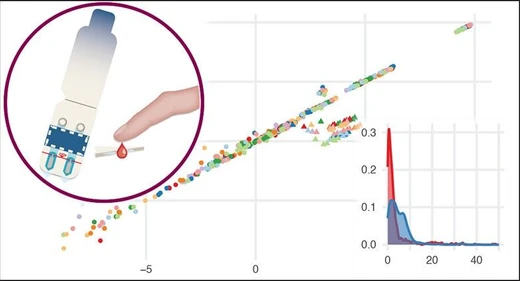
  • Photo: University od Amsterdam / HIMS / Forensic Chemistry: Detecting nerve agent biomarkers in dried blood spots
  • Video: University of Amsterdam: 3MT pitch Mirjam de Bruin-Hoegee, Revealing the origin of drugs and chemical weapons, UvA Science

In a paper in Forensic Chemistry, PhD candidate Mirjam de Bruin - Hoegée and co-workers present research on the use of dried blood spots for portable detection and laboratory verification of organophosphate poisoning. They were able to identify stable biomarkers in the dried blood and measure the cholinesterase activity using a mobile test kit months after exposure. Both LC-MS/MS and GC–MS/MS were used for unambiguous verification.

University od Amsterdam / HIMS / Forensic Chemistry: Detecting nerve agent biomarkers in dried blood spots.University od Amsterdam / HIMS / Forensic Chemistry: Detecting nerve agent biomarkers in dried blood spots.

The research establishes that the on-scene analysis of biomarkers in dried blood spots followed by laboratory verification is a promising analysis scheme to verify nerve agent exposure. Nerve agent biomarkers in dried blood spots are very stable and can be detected at least one month after application on a protein saver card and storage under ambient conditions. Furthermore, the implementation in forensic practice is relatively straightforward. The method should however be confirmed in practice with regular and dried blood spot samples from an alleged exposure victim or animal model exposure studies. Furthermore, future research should focus on the improvement of the sample preparation methods to further lower the detection limit and fully validate the quantitative method.

The research is part of the Forensic Attribution for CWA INtelliGence (FACING) project, a collaboration between the Van 't Hoff Institute for Molecular Sciences (HIMS) of the University of Amsterdam and TNO Defence, Safety & Security. The research was performed at the Netherlands Forensic Institute (NFI). Also involved were the Organisation for the Prohibition of Chemical Weapons and the CLHC Amsterdam Center for Forensic Science and Medicine. The FACING project is financed by the Dutch Ministry of Defence.

Paper abstract

The analysis of biomedical samples is important for the investigation of the alleged exposure to chemical warfare agents. The present study aims to use dried blood spots for portable detection and laboratory verification of organophosphate poisoning. After in-vitro incubation of blood with Novichok A-230, A-232 and A-234 and sarin, a volume of 25 and 50 µL was spotted on a protein saver card. Subsequently, the dried spots were extracted and analyzed by a mobile cholinesterase test kit. In addition, butyrylcholinesterase (BChE) was isolated and digested by pepsin followed by analysis with liquid chromatography tandem mass spectrometry (LC-MS/MS). The fluoride-activated samples were analyzed by gas chromatography tandem mass spectrometry (GC–MS/MS) and LC-MS/MS. It was found that the CWA induced cholinesterase inhibition was remarkably stable in dried blood spots. Even after at least one month storage under ambient conditions, the same linear reduction was visible as function of nerve agent exposure. Additionally, nonapeptide adducts were identified by LC-MS/MS one month after exposure. Also, intact Novichok nerve agents and regenerated sarin were observed by GC–MS/MS. In addition to the stability of the sample, important benefits of the proposed method include the less invasive sample collection and safer and easier shipping and storage conditions. In conclusion, this study shows the feasibility of using on-site detection and state-of-the-art laboratory analysis of dried blood spots for unambiguous verification of nerve agent exposure.

Resources
  • Mirjam de Bruin-Hoegée, Alex Fidder, Tomas van Groningen, Marcel J. van der Schans, Daan Noort, Arian C. van Asten: On-site detection and laboratory verification of the presence of nerve agent biomarkers using dried blood spots, Forensic Chemistry, Volume 35,2023, 100526, DOI: 10.1016/j.forc.2023.100526

University of Amsterdam
LinkedIn Logo
 

Related articles

Finding evidence in plants for the use of chemical weapons
Article | Scientific article

Finding evidence in plants for the use of chemical weapons

Analytical Scientists at the University of Amsterdam’s together with colleagues from TNO have demonstrated that chemical warfare agents react with plant proteins to form stable protein adducts.
How to link plastics found at a crime scene to potential suspects
Article | Scientific article

How to link plastics found at a crime scene to potential suspects

With the use of proper standards, quantitative elemental profiling with the so-called LA-ICP-MS method is a promising tool for criminal investigations.
Forensic elemental profiling of polymers
Article | Video

Forensic elemental profiling of polymers

In a paper in Forensic Chemistry, PhD candidate Mirjam de Bruin - Hoegée and co-workers present research on the forensic profiling of plastics that are often found on a crime scene.
Quantitative Assessment of a Novel Device Designed for Patient-centric Sampling of Dried Plasma Using Targeted Proteomics
Scientific article | Science and research

Quantitative Assessment of a Novel Device Designed for Patient-centric Sampling of Dried Plasma Using Targeted Proteomics

A new dried plasma microsampling device enables home sampling with high precision and stability, correlating strongly (R > 0.99) with conventional plasma in targeted proteomic analysis.
 

Related articles

Finding evidence in plants for the use of chemical weapons
Article | Scientific article

Finding evidence in plants for the use of chemical weapons

Analytical Scientists at the University of Amsterdam’s together with colleagues from TNO have demonstrated that chemical warfare agents react with plant proteins to form stable protein adducts.
How to link plastics found at a crime scene to potential suspects
Article | Scientific article

How to link plastics found at a crime scene to potential suspects

With the use of proper standards, quantitative elemental profiling with the so-called LA-ICP-MS method is a promising tool for criminal investigations.
Forensic elemental profiling of polymers
Article | Video

Forensic elemental profiling of polymers

In a paper in Forensic Chemistry, PhD candidate Mirjam de Bruin - Hoegée and co-workers present research on the forensic profiling of plastics that are often found on a crime scene.
Quantitative Assessment of a Novel Device Designed for Patient-centric Sampling of Dried Plasma Using Targeted Proteomics
Scientific article | Science and research

Quantitative Assessment of a Novel Device Designed for Patient-centric Sampling of Dried Plasma Using Targeted Proteomics

A new dried plasma microsampling device enables home sampling with high precision and stability, correlating strongly (R > 0.99) with conventional plasma in targeted proteomic analysis.
 

Related articles

Finding evidence in plants for the use of chemical weapons
Article | Scientific article

Finding evidence in plants for the use of chemical weapons

Analytical Scientists at the University of Amsterdam’s together with colleagues from TNO have demonstrated that chemical warfare agents react with plant proteins to form stable protein adducts.
How to link plastics found at a crime scene to potential suspects
Article | Scientific article

How to link plastics found at a crime scene to potential suspects

With the use of proper standards, quantitative elemental profiling with the so-called LA-ICP-MS method is a promising tool for criminal investigations.
Forensic elemental profiling of polymers
Article | Video

Forensic elemental profiling of polymers

In a paper in Forensic Chemistry, PhD candidate Mirjam de Bruin - Hoegée and co-workers present research on the forensic profiling of plastics that are often found on a crime scene.
Quantitative Assessment of a Novel Device Designed for Patient-centric Sampling of Dried Plasma Using Targeted Proteomics
Scientific article | Science and research

Quantitative Assessment of a Novel Device Designed for Patient-centric Sampling of Dried Plasma Using Targeted Proteomics

A new dried plasma microsampling device enables home sampling with high precision and stability, correlating strongly (R > 0.99) with conventional plasma in targeted proteomic analysis.
 

Related articles

Finding evidence in plants for the use of chemical weapons
Article | Scientific article

Finding evidence in plants for the use of chemical weapons

Analytical Scientists at the University of Amsterdam’s together with colleagues from TNO have demonstrated that chemical warfare agents react with plant proteins to form stable protein adducts.
How to link plastics found at a crime scene to potential suspects
Article | Scientific article

How to link plastics found at a crime scene to potential suspects

With the use of proper standards, quantitative elemental profiling with the so-called LA-ICP-MS method is a promising tool for criminal investigations.
Forensic elemental profiling of polymers
Article | Video

Forensic elemental profiling of polymers

In a paper in Forensic Chemistry, PhD candidate Mirjam de Bruin - Hoegée and co-workers present research on the forensic profiling of plastics that are often found on a crime scene.
Quantitative Assessment of a Novel Device Designed for Patient-centric Sampling of Dried Plasma Using Targeted Proteomics
Scientific article | Science and research

Quantitative Assessment of a Novel Device Designed for Patient-centric Sampling of Dried Plasma Using Targeted Proteomics

A new dried plasma microsampling device enables home sampling with high precision and stability, correlating strongly (R > 0.99) with conventional plasma in targeted proteomic analysis.