Forensic elemental profiling of polymers

Th, 17.10.2024 | Original article from: University of Amsterdam
In a paper in Forensic Chemistry, PhD candidate Mirjam de Bruin - Hoegée and co-workers present research on the forensic profiling of plastics that are often found on a crime scene.
  • Photo: University of Amsterdam / HIMS: Forensic elemental profiling of polymers
  • Video: Pittcon: Forensic Analysis: Advancements in the Analysis of Drugs and Explosives with Arian Van Asten

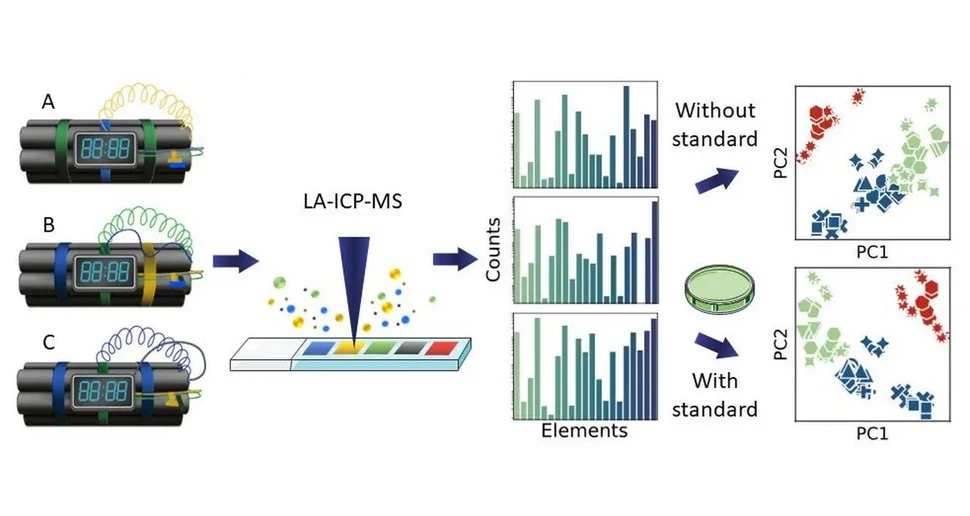
In a paper in Forensic Chemistry, PhD candidate Mirjam de Bruin - Hoegée and co-workers present research on the forensic profiling of plastics that are often found on a crime scene. They designed a standard to improve quantitative polymer analysis using LA-ICP-TOF-MS, a powerful analytical technology that enables highly sensitive elemental analysis to be performed directly on solid samples.
University of Amsterdam / HIMS: Forensic elemental profiling of polymers.University of Amsterdam / HIMS: Forensic elemental profiling of polymers.

The study shows the feasibility of using the novel standard for the quantitative analysis of chemical attribution signatures of trace elements in polymers by means of LA-ICP-TOF-MS. It significantly improves the classification and forensic comparison of polymer-based evidence.

The research is part of the Forensic Attribution for CWA INtelliGence (FACING) project, a collaboration between the Van 't Hoff Institute for Molecular Sciences (HIMS) of the University of Amsterdam and TNO Defence, Safety & Security. The research was performed at the Netherlands Forensic Institute (NFI). Also involved were the Organisation for the Prohibition of Chemical Weapons and the CLHC Amsterdam Center for Forensic Science and Medicine. The FACING project is financed by the Dutch Ministry of Defence.

Abstract of the paper

Plastic materials are often found on crime scenes in improvised explosive devices. Determining the trace-elemental composition of polymer parts may yield discrimination between samples from different sources. Although quantitative laser ablation-inductively coupled plasma-mass spectrometry (LA-ICP-MS) is well established for forensic glass analysis, the lack of sufficiently reproducible and homogeneous reference standards hampers accurate quantification of trace elements in polymers. Therefore, the present study introduces a new standard for quantitative elemental profiling of polymers. A novel approach was developed for producing polyethylene (PE), polystyrene (PS), and polyvinyl chloride (PVC) standards containing 23 elements at three concentrations. The LA-ICP-TOF-MS measurements showed excellent linear response with R2 > 0.99 for almost all elements and polymer matrices. Additionally, homogeneity was significantly improved to an average of 10% within-, and 17% between-sample variation. PVC and PE matrices presented the best homogeneity which was confirmed by line ablations. The added value of the standards was demonstrated by evaluating a set of realistic forensic polymer evidence items. The between-run variation was substantially reduced from 42% in absence of calibration to 30% when correcting with an elemental internal standard and even to 24% when applying the novel standards. In addition, its discriminating power between different classes was increased, as demonstrated by ANOVA and principal component analysis. In conclusion, this study shows the feasibility of using a novel standard for quantitative analysis of chemical attribution signatures of trace elements in polymers by LA-ICP-TOF-MS. The use of the polymer standards significantly improves classification and forensic comparison of polymer-based evidence.

Resources
  • Mirjam de Bruin-Hoegée, Jorien Schoorl, Peter Zoon, Marcel J. van der Schans, Daan Noort, Arian C. van Asten: A novel standard for forensic elemental profiling of polymers by LA-ICP-TOF-MS, Forensic Chemistry, Volume 35, 2023, 100515 DOI: 10.1016/j.forc.2023.100515

University of Amsterdam
LinkedIn Logo
 

Related articles

How to link plastics found at a crime scene to potential suspects
Article | Scientific article

How to link plastics found at a crime scene to potential suspects

With the use of proper standards, quantitative elemental profiling with the so-called LA-ICP-MS method is a promising tool for criminal investigations.
Detecting nerve agent biomarkers in dried blood spots
Scientific article | Video

Detecting nerve agent biomarkers in dried blood spots

In a paper in Forensic Chemistry, Mirjam de Bruin - Hoegée and co-workers present research on the use of dried blood spots for portable detection and laboratory verification of organophosphate poisoning.
Investigating Plastic–Metal Interactions in Aquatic Environments Using Laser Ablation ICP–MS and Chemical Markers
Scientific article | Science and research

Investigating Plastic–Metal Interactions in Aquatic Environments Using Laser Ablation ICP–MS and Chemical Markers

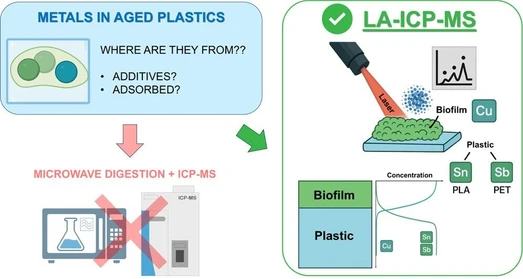
This study uses LA-ICP-MS to track metal–plastic interactions, showing biofilm-driven copper accumulation on aged plastics in aquatic systems.
A Method for the Detection of Tire Wear Microplastics in Zebrafish Guts by Laterally Resolved LA-ICP-MS-Based Elemental Fingerprinting and Chemometrics
Scientific article | Science and research

A Method for the Detection of Tire Wear Microplastics in Zebrafish Guts by Laterally Resolved LA-ICP-MS-Based Elemental Fingerprinting and Chemometrics

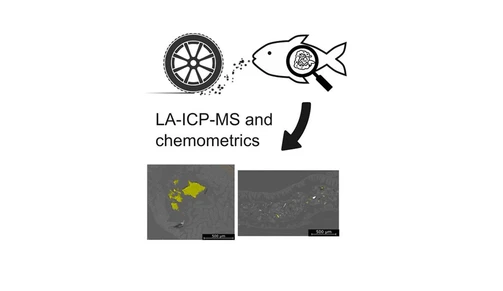
This study combines LA-ICP-MS elemental imaging and chemometrics to identify tire wear microplastics in biological tissues.
 

Related articles

How to link plastics found at a crime scene to potential suspects
Article | Scientific article

How to link plastics found at a crime scene to potential suspects

With the use of proper standards, quantitative elemental profiling with the so-called LA-ICP-MS method is a promising tool for criminal investigations.
Detecting nerve agent biomarkers in dried blood spots
Scientific article | Video

Detecting nerve agent biomarkers in dried blood spots

In a paper in Forensic Chemistry, Mirjam de Bruin - Hoegée and co-workers present research on the use of dried blood spots for portable detection and laboratory verification of organophosphate poisoning.
Investigating Plastic–Metal Interactions in Aquatic Environments Using Laser Ablation ICP–MS and Chemical Markers
Scientific article | Science and research

Investigating Plastic–Metal Interactions in Aquatic Environments Using Laser Ablation ICP–MS and Chemical Markers

This study uses LA-ICP-MS to track metal–plastic interactions, showing biofilm-driven copper accumulation on aged plastics in aquatic systems.
A Method for the Detection of Tire Wear Microplastics in Zebrafish Guts by Laterally Resolved LA-ICP-MS-Based Elemental Fingerprinting and Chemometrics
Scientific article | Science and research

A Method for the Detection of Tire Wear Microplastics in Zebrafish Guts by Laterally Resolved LA-ICP-MS-Based Elemental Fingerprinting and Chemometrics

This study combines LA-ICP-MS elemental imaging and chemometrics to identify tire wear microplastics in biological tissues.
 

Related articles

How to link plastics found at a crime scene to potential suspects
Article | Scientific article

How to link plastics found at a crime scene to potential suspects

With the use of proper standards, quantitative elemental profiling with the so-called LA-ICP-MS method is a promising tool for criminal investigations.
Detecting nerve agent biomarkers in dried blood spots
Scientific article | Video

Detecting nerve agent biomarkers in dried blood spots

In a paper in Forensic Chemistry, Mirjam de Bruin - Hoegée and co-workers present research on the use of dried blood spots for portable detection and laboratory verification of organophosphate poisoning.
Investigating Plastic–Metal Interactions in Aquatic Environments Using Laser Ablation ICP–MS and Chemical Markers
Scientific article | Science and research

Investigating Plastic–Metal Interactions in Aquatic Environments Using Laser Ablation ICP–MS and Chemical Markers

This study uses LA-ICP-MS to track metal–plastic interactions, showing biofilm-driven copper accumulation on aged plastics in aquatic systems.
A Method for the Detection of Tire Wear Microplastics in Zebrafish Guts by Laterally Resolved LA-ICP-MS-Based Elemental Fingerprinting and Chemometrics
Scientific article | Science and research

A Method for the Detection of Tire Wear Microplastics in Zebrafish Guts by Laterally Resolved LA-ICP-MS-Based Elemental Fingerprinting and Chemometrics

This study combines LA-ICP-MS elemental imaging and chemometrics to identify tire wear microplastics in biological tissues.
 

Related articles

How to link plastics found at a crime scene to potential suspects
Article | Scientific article

How to link plastics found at a crime scene to potential suspects

With the use of proper standards, quantitative elemental profiling with the so-called LA-ICP-MS method is a promising tool for criminal investigations.
Detecting nerve agent biomarkers in dried blood spots
Scientific article | Video

Detecting nerve agent biomarkers in dried blood spots

In a paper in Forensic Chemistry, Mirjam de Bruin - Hoegée and co-workers present research on the use of dried blood spots for portable detection and laboratory verification of organophosphate poisoning.
Investigating Plastic–Metal Interactions in Aquatic Environments Using Laser Ablation ICP–MS and Chemical Markers
Scientific article | Science and research

Investigating Plastic–Metal Interactions in Aquatic Environments Using Laser Ablation ICP–MS and Chemical Markers

This study uses LA-ICP-MS to track metal–plastic interactions, showing biofilm-driven copper accumulation on aged plastics in aquatic systems.
A Method for the Detection of Tire Wear Microplastics in Zebrafish Guts by Laterally Resolved LA-ICP-MS-Based Elemental Fingerprinting and Chemometrics
Scientific article | Science and research

A Method for the Detection of Tire Wear Microplastics in Zebrafish Guts by Laterally Resolved LA-ICP-MS-Based Elemental Fingerprinting and Chemometrics

This study combines LA-ICP-MS elemental imaging and chemometrics to identify tire wear microplastics in biological tissues.