Resolution Enhancement of Metabolomic J-Res NMR Spectra Using Deep Learning
Tu, 27.8.2024 | Original article from: Analytical Chemistry 2024 96 (29), 11707-11715
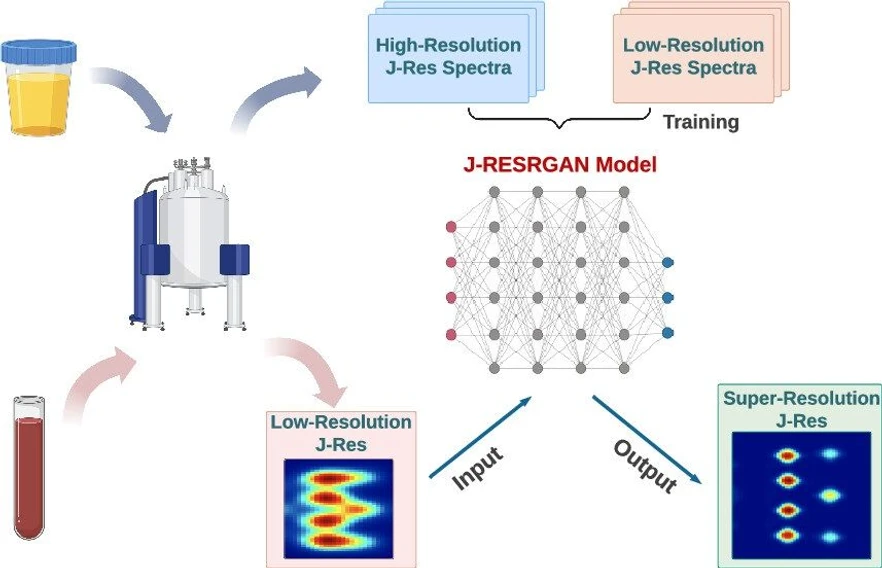
In the article published in ACS Analytical Chemistry, the researchers introduced a generative adversarial network for image super-resolution, trained to enhance metabolomic J-Resolved spectra.
<ul>
<li><strong>Photo:</strong> <em>Anal. Chem.</em> <strong>2024</strong>, <em>96</em>, 29, 11707-11715: graphical abstract.</li>
</ul>
  • Photo: Anal. Chem. 2024, 96, 29, 11707-11715: graphical abstract.

In the research article recently published in ACS Analytical Chemistry journal the researchers from the Imperial College London, UK, introduced the J-RESRGAN, an adapted and modified generative adversarial network (GAN) for image super-resolution (SR), which was trained specifically for metabolomic J-Resolved spectra to enhance peak resolution.

J-Resolved (J-Res) NMR spectroscopy is vital for metabolomics research, but it often requires a trade-off between high-resolution but time-intensive experiments and quicker low-resolution experiments prone to peak overlap. To address this, J-RESRGAN, a modified generative adversarial network (GAN), was developed to enhance the resolution of J-Res spectra using deep learning. By training the model on simulated high-resolution spectra and introducing a novel symmetric loss function, J-RESRGAN significantly improved peak resolution across a variety of sample types. The model demonstrated enhanced resolution in over 80% of peak pairs in experimental data, offering quick, accessible improvements for existing datasets. J-RESRGAN, openly accessible on GitHub, presents a promising approach for advancing precision in NMR-based metabolomics.

The original article

Resolution Enhancement of Metabolomic J-Res NMR Spectra Using Deep Learning

Yan Yan, Michael T. Judge, Toby Athersuch, Yuchen Xiang, Zhaolu Liu, Beatriz Jiménez, and Timothy M. D. Ebbels

Analytical Chemistry 2024 96 (29), 11707-11715

DOI: 10.1021/acs.analchem.4c00563

licensed under CC-BY 4.0

Abstract

J-Resolved (J-Res) nuclear magnetic resonance (NMR) spectroscopy is pivotal in NMR-based metabolomics, but practitioners face a choice between time-consuming high-resolution (HR) experiments or shorter low-resolution (LR) experiments which exhibit significant peak overlap. Deep learning neural networks have been successfully used in many fields to enhance quality of natural images, especially with regard to resolution, and therefore offer the prospect of improving two-dimensional (2D) NMR data. Here, we introduce the J-RESRGAN, an adapted and modified generative adversarial network (GAN) for image super-resolution (SR), which we trained specifically for metabolomic J-Res spectra to enhance peak resolution. A novel symmetric loss function was introduced, exploiting the inherent vertical symmetry of J-Res NMR spectra. Model training used simulated high-resolution J-Res spectra of complex mixtures, with corresponding low-resolution spectra generated via blurring and down-sampling. Evaluation of peak pair resolvability on J-RESRGAN demonstrated remarkable improvement in resolution across a variety of samples. In simulated plasma data, 100% of peak pairs exhibited enhanced resolution in super-resolution spectra compared to their low-resolution counterparts. Similarly, enhanced resolution was observed in 80.8–100% of peak pairs in experimental plasma, 85.0–96.7% in urine, 94.4–98.9% in full fat milk, and 82.6–91.7% in orange juice. J-RESRGAN is not sample type, spectrometer or field strength dependent and improvements on previously acquired data can be seen in seconds on a standard desktop computer. We believe this demonstrates the promise of deep learning methods to enhance NMR metabolomic data, and in particular, the power of J-RESRGAN to elucidate overlapping peaks, advancing precision in a wide variety of NMR-based metabolomics studies. The model, J-RESRGAN, is openly accessible for download on GitHub at https://github.com/yanyan5420/J-RESRGAN.

Anal. Chem. 2024, 96, 29, 11707-11715: Figure 6. Examples of peak pairs from experimental data. For each individual panel, the upper row displays the 2D HR, LR, and SR spectra respectively; the subsequent row depicts the 1D profiles along the red dashed line; blue─HR, red─LR, and green─SR. Plots (a, b) display two examples of peak pairs aligned along the F1 axis, demonstrating the recovery to doublets in the SR spectra from the singlets observed in LR spectra.Anal. Chem. 2024, 96, 29, 11707-11715: Figure 6. Examples of peak pairs from experimental data. For each individual panel, the upper row displays the 2D HR, LR, and SR spectra respectively; the subsequent row depicts the 1D profiles along the red dashed line; blue─HR, red─LR, and green─SR. Plots (a, b) display two examples of peak pairs aligned along the F1 axis, demonstrating the recovery to doublets in the SR spectra from the singlets observed in LR spectra.

Resources
LabRulez
LinkedIn Logo
 

Related articles

Blending Samples to Increase Accuracy and Precision of 1H NMR Urine Metabolomics
Article | Scientific article

Blending Samples to Increase Accuracy and Precision of 1H NMR Urine Metabolomics

In the article, the researchers showed that calculating 1H NMR the spectra of original samples from mixtures of urine samples using linear algebra reduces the shift problems.
17th MDCW 2026 (Day 1)
Article | Events

17th MDCW 2026 (Day 1)

Day one of MDCW 2026 showcased GC×GC and 2D-LC advances across energy, pharma, PFAS, aroma, and metabolomics, combining keynote insights, oral sessions, posters, and expert discussion.
LCMS-Net: Deep Learning for Raw High Resolution Mass Spectrometry Data Applied to Forensic Cause-of-Death Screening
Scientific article | Science and research

LCMS-Net: Deep Learning for Raw High Resolution Mass Spectrometry Data Applied to Forensic Cause-of-Death Screening

LCMS-Net is an end-to-end deep learning model for raw LC-HRMS data, improving accuracy, reducing preprocessing, and minimizing batch effects in metabolomics.
GcDUO: A Batch Processing Framework Integrating PARAFAC and PARAFAC2 for GC×GC-MS Data Analysis (Maria Llambrich, MDCW 2026)
Presentation | Video

GcDUO: A Batch Processing Framework Integrating PARAFAC and PARAFAC2 for GC×GC-MS Data Analysis (Maria Llambrich, MDCW 2026)

GC Duo simplifies GC×GC–MS data processing using PARAFAC-based algorithms, enabling feature detection, deconvolution, and accurate identification in complex datasets.
 

Related articles

Blending Samples to Increase Accuracy and Precision of 1H NMR Urine Metabolomics
Article | Scientific article

Blending Samples to Increase Accuracy and Precision of 1H NMR Urine Metabolomics

In the article, the researchers showed that calculating 1H NMR the spectra of original samples from mixtures of urine samples using linear algebra reduces the shift problems.
17th MDCW 2026 (Day 1)
Article | Events

17th MDCW 2026 (Day 1)

Day one of MDCW 2026 showcased GC×GC and 2D-LC advances across energy, pharma, PFAS, aroma, and metabolomics, combining keynote insights, oral sessions, posters, and expert discussion.
LCMS-Net: Deep Learning for Raw High Resolution Mass Spectrometry Data Applied to Forensic Cause-of-Death Screening
Scientific article | Science and research

LCMS-Net: Deep Learning for Raw High Resolution Mass Spectrometry Data Applied to Forensic Cause-of-Death Screening

LCMS-Net is an end-to-end deep learning model for raw LC-HRMS data, improving accuracy, reducing preprocessing, and minimizing batch effects in metabolomics.
GcDUO: A Batch Processing Framework Integrating PARAFAC and PARAFAC2 for GC×GC-MS Data Analysis (Maria Llambrich, MDCW 2026)
Presentation | Video

GcDUO: A Batch Processing Framework Integrating PARAFAC and PARAFAC2 for GC×GC-MS Data Analysis (Maria Llambrich, MDCW 2026)

GC Duo simplifies GC×GC–MS data processing using PARAFAC-based algorithms, enabling feature detection, deconvolution, and accurate identification in complex datasets.
 

Related articles

Blending Samples to Increase Accuracy and Precision of 1H NMR Urine Metabolomics
Article | Scientific article

Blending Samples to Increase Accuracy and Precision of 1H NMR Urine Metabolomics

In the article, the researchers showed that calculating 1H NMR the spectra of original samples from mixtures of urine samples using linear algebra reduces the shift problems.
17th MDCW 2026 (Day 1)
Article | Events

17th MDCW 2026 (Day 1)

Day one of MDCW 2026 showcased GC×GC and 2D-LC advances across energy, pharma, PFAS, aroma, and metabolomics, combining keynote insights, oral sessions, posters, and expert discussion.
LCMS-Net: Deep Learning for Raw High Resolution Mass Spectrometry Data Applied to Forensic Cause-of-Death Screening
Scientific article | Science and research

LCMS-Net: Deep Learning for Raw High Resolution Mass Spectrometry Data Applied to Forensic Cause-of-Death Screening

LCMS-Net is an end-to-end deep learning model for raw LC-HRMS data, improving accuracy, reducing preprocessing, and minimizing batch effects in metabolomics.
GcDUO: A Batch Processing Framework Integrating PARAFAC and PARAFAC2 for GC×GC-MS Data Analysis (Maria Llambrich, MDCW 2026)
Presentation | Video

GcDUO: A Batch Processing Framework Integrating PARAFAC and PARAFAC2 for GC×GC-MS Data Analysis (Maria Llambrich, MDCW 2026)

GC Duo simplifies GC×GC–MS data processing using PARAFAC-based algorithms, enabling feature detection, deconvolution, and accurate identification in complex datasets.
 

Related articles

Blending Samples to Increase Accuracy and Precision of 1H NMR Urine Metabolomics
Article | Scientific article

Blending Samples to Increase Accuracy and Precision of 1H NMR Urine Metabolomics

In the article, the researchers showed that calculating 1H NMR the spectra of original samples from mixtures of urine samples using linear algebra reduces the shift problems.
17th MDCW 2026 (Day 1)
Article | Events

17th MDCW 2026 (Day 1)

Day one of MDCW 2026 showcased GC×GC and 2D-LC advances across energy, pharma, PFAS, aroma, and metabolomics, combining keynote insights, oral sessions, posters, and expert discussion.
LCMS-Net: Deep Learning for Raw High Resolution Mass Spectrometry Data Applied to Forensic Cause-of-Death Screening
Scientific article | Science and research

LCMS-Net: Deep Learning for Raw High Resolution Mass Spectrometry Data Applied to Forensic Cause-of-Death Screening

LCMS-Net is an end-to-end deep learning model for raw LC-HRMS data, improving accuracy, reducing preprocessing, and minimizing batch effects in metabolomics.
GcDUO: A Batch Processing Framework Integrating PARAFAC and PARAFAC2 for GC×GC-MS Data Analysis (Maria Llambrich, MDCW 2026)
Presentation | Video

GcDUO: A Batch Processing Framework Integrating PARAFAC and PARAFAC2 for GC×GC-MS Data Analysis (Maria Llambrich, MDCW 2026)

GC Duo simplifies GC×GC–MS data processing using PARAFAC-based algorithms, enabling feature detection, deconvolution, and accurate identification in complex datasets.