High-sensitivity cavity ringdown polarimetry

Fr, 2.8.2024 | Original article from: University of Oxford
The novel technique can be used for high-sensitivity magnetometry and chiroptical activity measurements.
<ul>
<li><strong>Photo:</strong> University of Oxford: High-sensitivity cavity ringdown polarimetry</li>
</ul>
  • Photo: University of Oxford: High-sensitivity cavity ringdown polarimetry

Researchers from Oxford Chemistry’s Ritchie Group have developed a new variant of cavity ringdown polarimetry, described in a publication this week in The Journal of Chemical Physics. Their novel technique can be used for high-sensitivity magnetometry and chiroptical activity measurements, applicable to the development of novel Faraday rotators and the real-time characterisation of biochemical and pharmacological phenomena. The optical responses of these systems are often too small to be probed by traditional laboratory polarimeters.

The technique employs an optical cavity of bow-tie configuration addressed by a continuous-wave laser operating at 532 nm. In order to demonstrate the effectiveness of the new methodology, the team evaluated the Verdet constants of crystalline CeF₃ and fused silica, as well as optical rotations of gas- and liquid-phase samples. Their observations were complemented by state-of-the-art calculations performed by Oxford Chemistry’s Prof. David Tew using the TURBOMOLE quantum chemistry package.

Take a look at the full paper, featured now as an "Editor's Pick" in The Journal of Chemical Physics.
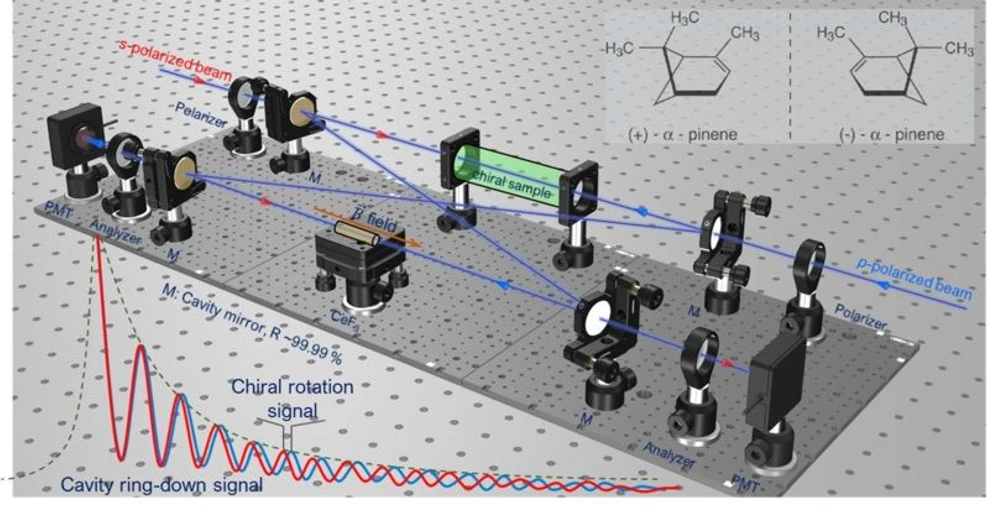
University of Oxford: Schematic diagram of the 532 nm bowtie cavity ringdown polarimeter. Further details are in the full publication.University of Oxford: Schematic diagram of the 532 nm bowtie cavity ringdown polarimeter. Further details are in the full publication.


University of Oxford
LinkedIn Logo
 

Related articles

ESAS 2022 & 17th CSSC (Speakers + Lecture/Poster deadline)
Article | Events

ESAS 2022 & 17th CSSC (Speakers + Lecture/Poster deadline)

Who will be speakers at this year's European Symposium on Analytical Spectrometry (ESAS) and the 17th Czech-Slovak Spectroscopic Conference (CSSC)?
Single-molecule light scattering using optical holography
Article | Scientific article

Single-molecule light scattering using optical holography

While all materials scatter light, the minuscule scattering from individual molecules has remained invisible to holographic techniques until now.
Customized microreactors: 3D printing has facilitated the development of polymer brushes for biosensors
Article | Science and research

Customized microreactors: 3D printing has facilitated the development of polymer brushes for biosensors

Researchers from the Czech Academy of Sciences developed a 3D-printed microfluidic reactor enabling faster, greener, and higher-quality synthesis of polymer brushes — the foundation of modern biosensors.
Plenary speakers at the 19th International Symposium on Hyphenated Techniques in Chromatography and Separation Technology (HTC-19)
Article | Events

Plenary speakers at the 19th International Symposium on Hyphenated Techniques in Chromatography and Separation Technology (HTC-19)

HTC-19 will feature leading plenary speakers including Caroline West, Emma Schymanski and Leon Barron, presenting cutting-edge advances in chromatography, MS, and non-target analysis.
 

Related articles

ESAS 2022 & 17th CSSC (Speakers + Lecture/Poster deadline)
Article | Events

ESAS 2022 & 17th CSSC (Speakers + Lecture/Poster deadline)

Who will be speakers at this year's European Symposium on Analytical Spectrometry (ESAS) and the 17th Czech-Slovak Spectroscopic Conference (CSSC)?
Single-molecule light scattering using optical holography
Article | Scientific article

Single-molecule light scattering using optical holography

While all materials scatter light, the minuscule scattering from individual molecules has remained invisible to holographic techniques until now.
Customized microreactors: 3D printing has facilitated the development of polymer brushes for biosensors
Article | Science and research

Customized microreactors: 3D printing has facilitated the development of polymer brushes for biosensors

Researchers from the Czech Academy of Sciences developed a 3D-printed microfluidic reactor enabling faster, greener, and higher-quality synthesis of polymer brushes — the foundation of modern biosensors.
Plenary speakers at the 19th International Symposium on Hyphenated Techniques in Chromatography and Separation Technology (HTC-19)
Article | Events

Plenary speakers at the 19th International Symposium on Hyphenated Techniques in Chromatography and Separation Technology (HTC-19)

HTC-19 will feature leading plenary speakers including Caroline West, Emma Schymanski and Leon Barron, presenting cutting-edge advances in chromatography, MS, and non-target analysis.
 

Related articles

ESAS 2022 & 17th CSSC (Speakers + Lecture/Poster deadline)
Article | Events

ESAS 2022 & 17th CSSC (Speakers + Lecture/Poster deadline)

Who will be speakers at this year's European Symposium on Analytical Spectrometry (ESAS) and the 17th Czech-Slovak Spectroscopic Conference (CSSC)?
Single-molecule light scattering using optical holography
Article | Scientific article

Single-molecule light scattering using optical holography

While all materials scatter light, the minuscule scattering from individual molecules has remained invisible to holographic techniques until now.
Customized microreactors: 3D printing has facilitated the development of polymer brushes for biosensors
Article | Science and research

Customized microreactors: 3D printing has facilitated the development of polymer brushes for biosensors

Researchers from the Czech Academy of Sciences developed a 3D-printed microfluidic reactor enabling faster, greener, and higher-quality synthesis of polymer brushes — the foundation of modern biosensors.
Plenary speakers at the 19th International Symposium on Hyphenated Techniques in Chromatography and Separation Technology (HTC-19)
Article | Events

Plenary speakers at the 19th International Symposium on Hyphenated Techniques in Chromatography and Separation Technology (HTC-19)

HTC-19 will feature leading plenary speakers including Caroline West, Emma Schymanski and Leon Barron, presenting cutting-edge advances in chromatography, MS, and non-target analysis.
 

Related articles

ESAS 2022 & 17th CSSC (Speakers + Lecture/Poster deadline)
Article | Events

ESAS 2022 & 17th CSSC (Speakers + Lecture/Poster deadline)

Who will be speakers at this year's European Symposium on Analytical Spectrometry (ESAS) and the 17th Czech-Slovak Spectroscopic Conference (CSSC)?
Single-molecule light scattering using optical holography
Article | Scientific article

Single-molecule light scattering using optical holography

While all materials scatter light, the minuscule scattering from individual molecules has remained invisible to holographic techniques until now.
Customized microreactors: 3D printing has facilitated the development of polymer brushes for biosensors
Article | Science and research

Customized microreactors: 3D printing has facilitated the development of polymer brushes for biosensors

Researchers from the Czech Academy of Sciences developed a 3D-printed microfluidic reactor enabling faster, greener, and higher-quality synthesis of polymer brushes — the foundation of modern biosensors.
Plenary speakers at the 19th International Symposium on Hyphenated Techniques in Chromatography and Separation Technology (HTC-19)
Article | Events

Plenary speakers at the 19th International Symposium on Hyphenated Techniques in Chromatography and Separation Technology (HTC-19)

HTC-19 will feature leading plenary speakers including Caroline West, Emma Schymanski and Leon Barron, presenting cutting-edge advances in chromatography, MS, and non-target analysis.