Single-molecule light scattering using optical holography

Th, 29.8.2024 | Original article from: University of Oxford, 13 March 2024
While all materials scatter light, the minuscule scattering from individual molecules has remained invisible to holographic techniques until now.
  • Photo: University of Oxford: Single-molecule light scattering using optical holography
  • Video: Imperial Bioeng: Department Seminar: Professor Philipp Kukura from the University of Oxford
  • Scientists from the Kukura group at Oxford Chemistry have detected ultra-weak light scattering from single protein molecules using optical holography.
  • Published today in Nature Photonics, their new approach increases the sensitivity of the technique by five orders of magnitude compared to the current state of the art.
  • This breakthrough paves the way for wider exploration of biomolecular interactions and applications in nanoscience.

University of Oxford: Single-molecule light scattering using optical holography.University of Oxford: Single-molecule light scattering using optical holography.

While all materials scatter light, the minuscule scattering from individual molecules has remained invisible to holographic techniques until now. Holographic methods – optical microscopic techniques that rely on light scattering – provide many advantages over traditional intensity measurements in terms of information content, tunability and post-processing. Previous techniques have, however, struggled to capture faint signals from individual molecules, limiting progress in label-free single-molecule studies.

Overcoming these limitations, scientists from the Kukura group at Oxford Chemistry have demonstrated detection of the ultra-weak light scattering from single proteins using optical holography. Their study, published today in Nature Photonics, introduces a transformative approach by combing dark-field scattering microscopy with a Mach-Zehnder interferometer.

Splitting light emerging from the sample and coupling it with a reference before splitting the detection into four parallel channels, researchers have increased the technique’s sensitivity by five orders of magnitude compared to the current state of the art in terms of interaction strength. This enables precise detection and measurement of single proteins.

The team’s breakthrough not only enables direct measurement of molecular polarizability and sample identity, such as particle size, material properties, or protein oligomerisation, but also paves the way for wider exploration of biomolecular interactions and applications in nanoscience more generally.

For more details on this research and its implications, refer to the article "Single-protein optical holography" published today in Nature Photonics: https://www.nature.com/articles/s41566-024-01405-2.


University of Oxford
LinkedIn Logo
 

Related articles

Detecting nanoplastics – in fractions of a second
Article | Scientific article

Detecting nanoplastics – in fractions of a second

Tiny plastic particles are an environmental problem. They can even penetrate living cells. A method has now been developed at TU Wien to detect such particles quickly and with high sensitivity.
Atomic Nucleus Excited with Laser: A Breakthrough after Decades
Article | Video

Atomic Nucleus Excited with Laser: A Breakthrough after Decades

The "thorium transition", has now been excited for the first time with lasers. This paves the way for revolutionary high precision technologies, including nuclear clocks.
Single-protein optical holography
Article | Scientific article

Single-protein optical holography

In the article published recently in Nature Photonics, the researchers reported significant improvement in sensitivity of detecting single protein molecule by methods of optical holography.
Petr Viewegh’s Microcosm and Macrocosm
Article | Scientists

Petr Viewegh’s Microcosm and Macrocosm

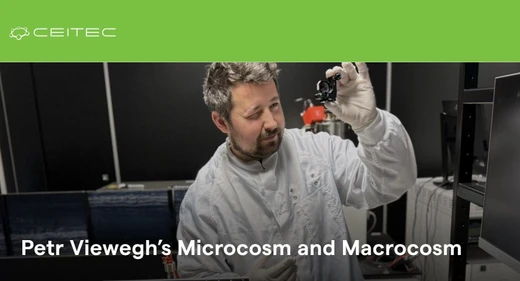
Petr Viewegh (formerly Dvořák) popularises natural sciences among the general public through his lectures, astronomy camps, and other activities.
 

Related articles

Detecting nanoplastics – in fractions of a second
Article | Scientific article

Detecting nanoplastics – in fractions of a second

Tiny plastic particles are an environmental problem. They can even penetrate living cells. A method has now been developed at TU Wien to detect such particles quickly and with high sensitivity.
Atomic Nucleus Excited with Laser: A Breakthrough after Decades
Article | Video

Atomic Nucleus Excited with Laser: A Breakthrough after Decades

The "thorium transition", has now been excited for the first time with lasers. This paves the way for revolutionary high precision technologies, including nuclear clocks.
Single-protein optical holography
Article | Scientific article

Single-protein optical holography

In the article published recently in Nature Photonics, the researchers reported significant improvement in sensitivity of detecting single protein molecule by methods of optical holography.
Petr Viewegh’s Microcosm and Macrocosm
Article | Scientists

Petr Viewegh’s Microcosm and Macrocosm

Petr Viewegh (formerly Dvořák) popularises natural sciences among the general public through his lectures, astronomy camps, and other activities.
 

Related articles

Detecting nanoplastics – in fractions of a second
Article | Scientific article

Detecting nanoplastics – in fractions of a second

Tiny plastic particles are an environmental problem. They can even penetrate living cells. A method has now been developed at TU Wien to detect such particles quickly and with high sensitivity.
Atomic Nucleus Excited with Laser: A Breakthrough after Decades
Article | Video

Atomic Nucleus Excited with Laser: A Breakthrough after Decades

The "thorium transition", has now been excited for the first time with lasers. This paves the way for revolutionary high precision technologies, including nuclear clocks.
Single-protein optical holography
Article | Scientific article

Single-protein optical holography

In the article published recently in Nature Photonics, the researchers reported significant improvement in sensitivity of detecting single protein molecule by methods of optical holography.
Petr Viewegh’s Microcosm and Macrocosm
Article | Scientists

Petr Viewegh’s Microcosm and Macrocosm

Petr Viewegh (formerly Dvořák) popularises natural sciences among the general public through his lectures, astronomy camps, and other activities.
 

Related articles

Detecting nanoplastics – in fractions of a second
Article | Scientific article

Detecting nanoplastics – in fractions of a second

Tiny plastic particles are an environmental problem. They can even penetrate living cells. A method has now been developed at TU Wien to detect such particles quickly and with high sensitivity.
Atomic Nucleus Excited with Laser: A Breakthrough after Decades
Article | Video

Atomic Nucleus Excited with Laser: A Breakthrough after Decades

The "thorium transition", has now been excited for the first time with lasers. This paves the way for revolutionary high precision technologies, including nuclear clocks.
Single-protein optical holography
Article | Scientific article

Single-protein optical holography

In the article published recently in Nature Photonics, the researchers reported significant improvement in sensitivity of detecting single protein molecule by methods of optical holography.
Petr Viewegh’s Microcosm and Macrocosm
Article | Scientists

Petr Viewegh’s Microcosm and Macrocosm

Petr Viewegh (formerly Dvořák) popularises natural sciences among the general public through his lectures, astronomy camps, and other activities.