Analysis of Heavily Glycated Proteins by HILIC and SEC-HRMS
Th, 6.6.2024 | Original article from: Chemometrics and Advanced Separations Team
CAST scientist Ziran Zhai developed a method that allows glycated proteins to be characterized for the first time at the intact protein level using advanced LC-HRMS methods.
<ul>
<li><strong>Photo:</strong> Chemometrics and Advanced Separations Team: Figure 1. BPC of non-glycated (A, C) and glycated (20 days, B and D) RNase-A acquired by HILIC-MS and SEC-MS. Deconvolution results of glycated RNase-A (20 days, E and F) obtained by HILIC-MS and SEC-MS methods.</li>
</ul>
  • Photo: Chemometrics and Advanced Separations Team: Figure 1. BPC of non-glycated (A, C) and glycated (20 days, B and D) RNase-A acquired by HILIC-MS and SEC-MS. Deconvolution results of glycated RNase-A (20 days, E and F) obtained by HILIC-MS and SEC-MS methods.

The CAST scientist Ziran Zhai recently published a manuscript in which he investigated the usefulness of two novel CAST methods, namely low-flow HILIC [1] and SEC-HRMS [2], to characterize extensively glycated proteins from the intact level. Zhai focuses on four critical aspects: i) using denaturing HILIC-MS to separate glycoconjugates (including, in some cases, the separation of isomers), ii) using native SEC-MS to study the aggregates formed during glycation, iii) identifying the advanced glycation end-products (AGEs), and iv) monitor the dynamic changes of AGEs.

Advanced glycation end products (AGEs) are a family of compounds of diverse chemical nature that are the products of nonenzymatic reactions between reducing sugars (here glucose) and, in the case of our study, proteins. Sugars can attach at different positions in a protein following a Maillard reaction, distributing over several amino acids and in many different chemical species. Previous studies focused on digesting glycated proteins to identify the AGEs and glycoconjugates from the peptide level. However, these strategies make it difficult to monitor the co-occurrence of multiple glycation events and, therefore, cannot monitor the evolution of the glycation process.

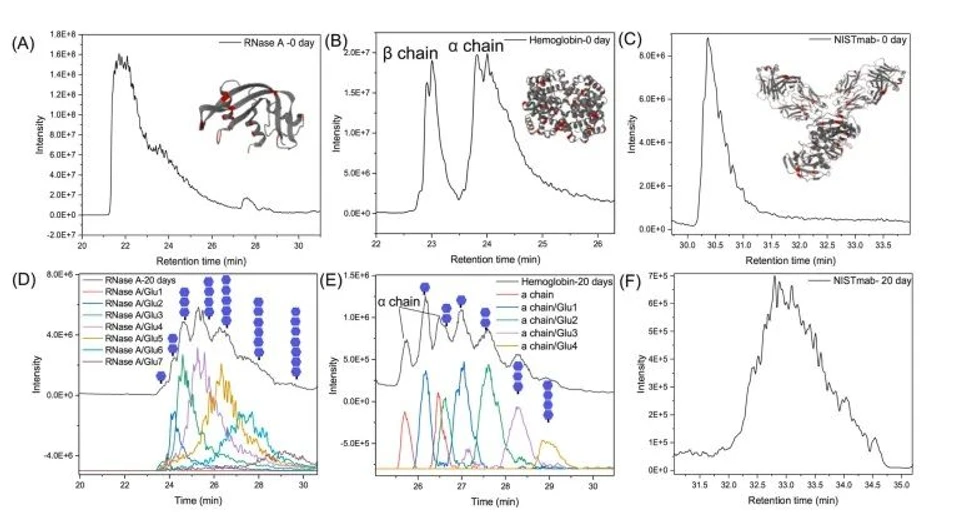
In this study, three model proteins (RNase-A, hemoglobin, and NISTmab) were exposed to conditions that favored extensive glycation and the formation of AGEs. As shown, with HILIC-MS, the glycated forms of the proteins could be resolved based on the number of reducing monosaccharides, and the SEC-MS method under non-denaturing conditions provided insights into glycated aggregates (Figure 1). More than 25 different types of species were observed in both methods, among which 19 of these species have not been previously reported. By tracing the progress of glycation, the dynamic changes of the specific AGEs could be monitored over time.

CAST: Figure 1. BPC of non-glycated (A, C) and glycated (20 days, B and D) RNase-A acquired by HILIC-MS and SEC-MS..jpgCAST: Figure 1. BPC of non-glycated (A, C) and glycated (20 days, B and D) RNase-A acquired by HILIC-MS and SEC-MS..jpg

The study is part of the FFF (From Form to Function) project of Zhai, Astefanei, Corthals, and Gargano and was funded by the Chinese Scholarship Council (CSC) and was recently published in Analytica Chimica Acta and can be accessed freely at the link below.


Chemometrics and Advanced Separations Team (CAST)
LinkedIn Logo
 

Related articles

Conference CEEPC/IPM/CMSC 2022 (Day 1)
Article | Events

Conference CEEPC/IPM/CMSC 2022 (Day 1)

On the first day of 2022 joint conference on mass spectrometry and proteomics we saw 16 expert lectures, poster discussions and the presentation of the Josef Chmelík award.
Nanoflow IEC-HRMS to study complex proteoform mixtures
Article | Scientific article

Nanoflow IEC-HRMS to study complex proteoform mixtures

CAST scientist Ziran Zhai developed a nanoflow IEC-HRMS method that allows for native MS analysis.
Ion exchange chromatography of biotherapeutics: Fundamental principles and advanced approaches
Scientific article | Science and research

Ion exchange chromatography of biotherapeutics: Fundamental principles and advanced approaches

This review outlines IEX fundamentals and explores advanced strategies—like pH gradients, ultra-short columns, and coupling with MS—for characterizing complex biotherapeutics.
Monitoring mAb Manufacturing the Easy Way with Switchable 2D‑LC-UV-MS
Article | Science and research

Monitoring mAb Manufacturing the Easy Way with Switchable 2D‑LC-UV-MS

How can mAb manufacturing monitoring be simplified? Switchable 2D-LC-UV-MS workflows enable near real-time tracking of critical quality attributes and faster process decisions.
 

Related articles

Conference CEEPC/IPM/CMSC 2022 (Day 1)
Article | Events

Conference CEEPC/IPM/CMSC 2022 (Day 1)

On the first day of 2022 joint conference on mass spectrometry and proteomics we saw 16 expert lectures, poster discussions and the presentation of the Josef Chmelík award.
Nanoflow IEC-HRMS to study complex proteoform mixtures
Article | Scientific article

Nanoflow IEC-HRMS to study complex proteoform mixtures

CAST scientist Ziran Zhai developed a nanoflow IEC-HRMS method that allows for native MS analysis.
Ion exchange chromatography of biotherapeutics: Fundamental principles and advanced approaches
Scientific article | Science and research

Ion exchange chromatography of biotherapeutics: Fundamental principles and advanced approaches

This review outlines IEX fundamentals and explores advanced strategies—like pH gradients, ultra-short columns, and coupling with MS—for characterizing complex biotherapeutics.
Monitoring mAb Manufacturing the Easy Way with Switchable 2D‑LC-UV-MS
Article | Science and research

Monitoring mAb Manufacturing the Easy Way with Switchable 2D‑LC-UV-MS

How can mAb manufacturing monitoring be simplified? Switchable 2D-LC-UV-MS workflows enable near real-time tracking of critical quality attributes and faster process decisions.
 

Related articles

Conference CEEPC/IPM/CMSC 2022 (Day 1)
Article | Events

Conference CEEPC/IPM/CMSC 2022 (Day 1)

On the first day of 2022 joint conference on mass spectrometry and proteomics we saw 16 expert lectures, poster discussions and the presentation of the Josef Chmelík award.
Nanoflow IEC-HRMS to study complex proteoform mixtures
Article | Scientific article

Nanoflow IEC-HRMS to study complex proteoform mixtures

CAST scientist Ziran Zhai developed a nanoflow IEC-HRMS method that allows for native MS analysis.
Ion exchange chromatography of biotherapeutics: Fundamental principles and advanced approaches
Scientific article | Science and research

Ion exchange chromatography of biotherapeutics: Fundamental principles and advanced approaches

This review outlines IEX fundamentals and explores advanced strategies—like pH gradients, ultra-short columns, and coupling with MS—for characterizing complex biotherapeutics.
Monitoring mAb Manufacturing the Easy Way with Switchable 2D‑LC-UV-MS
Article | Science and research

Monitoring mAb Manufacturing the Easy Way with Switchable 2D‑LC-UV-MS

How can mAb manufacturing monitoring be simplified? Switchable 2D-LC-UV-MS workflows enable near real-time tracking of critical quality attributes and faster process decisions.
 

Related articles

Conference CEEPC/IPM/CMSC 2022 (Day 1)
Article | Events

Conference CEEPC/IPM/CMSC 2022 (Day 1)

On the first day of 2022 joint conference on mass spectrometry and proteomics we saw 16 expert lectures, poster discussions and the presentation of the Josef Chmelík award.
Nanoflow IEC-HRMS to study complex proteoform mixtures
Article | Scientific article

Nanoflow IEC-HRMS to study complex proteoform mixtures

CAST scientist Ziran Zhai developed a nanoflow IEC-HRMS method that allows for native MS analysis.
Ion exchange chromatography of biotherapeutics: Fundamental principles and advanced approaches
Scientific article | Science and research

Ion exchange chromatography of biotherapeutics: Fundamental principles and advanced approaches

This review outlines IEX fundamentals and explores advanced strategies—like pH gradients, ultra-short columns, and coupling with MS—for characterizing complex biotherapeutics.
Monitoring mAb Manufacturing the Easy Way with Switchable 2D‑LC-UV-MS
Article | Science and research

Monitoring mAb Manufacturing the Easy Way with Switchable 2D‑LC-UV-MS

How can mAb manufacturing monitoring be simplified? Switchable 2D-LC-UV-MS workflows enable near real-time tracking of critical quality attributes and faster process decisions.