Nanoflow IEC-HRMS to study complex proteoform mixtures
Mo, 17.6.2024 | Original article from: Chemometrics and Advanced Separations Team
CAST scientist Ziran Zhai developed a nanoflow IEC-HRMS method that allows for native MS analysis.
<ul>
<li><strong>Photo:</strong> Chemometrics and Advanced Separations Team: Nanoflow IEC-HRMS to study complex proteoform mixtures</li>
</ul>
  • Photo: Chemometrics and Advanced Separations Team: Nanoflow IEC-HRMS to study complex proteoform mixtures

The CAST scientist Ziran Zhai published a manuscript investigating a novel method of using nanoflow strong cation exchange – native mass spectrometry to characterize non-denaturing complex proteoforms mixtures from the intact level. Zhai focuses on three critical aspects: i) extending the MW that can be observed by top-down proteomics, ii) increasing the MS sensitivity to create conditions of detecting low-abundant proteins, and iii) apply mild desolvation conditions to maintain the native structures of proteins and complexes.

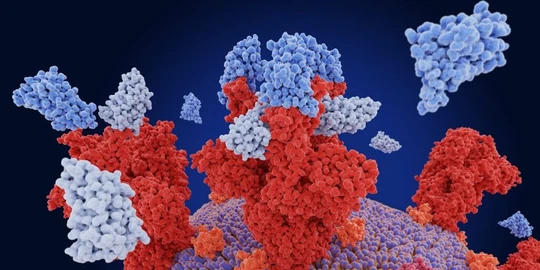
Proteoforms, which are protein products arising from homologous genes due to sequence variations, alternative splicing, and post-translational modifications, play a crucial role in a wide range of critical functions. However, the standard approach to characterize proteins, known as bottom-up proteomics, faces limitations. This approach cannot directly identify proteoforms as the presence of proteins is inferred from peptides. While top-down proteomics and intact protein mass spectrometry offer solutions to these limitations, the most common top-down methods employ denaturing LC-MS approaches, which unfold proteins and lead to the loss of non-covalent protein complexes.

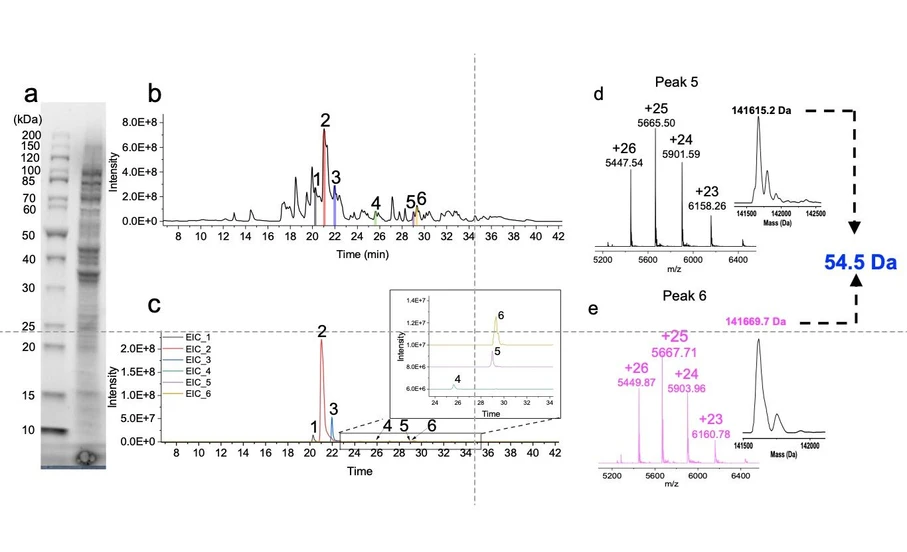
In this work, we directly coupled nanoflow (250 or 500 nL min¯¹) strong cation exchange chromatography (SCX) to nano-electrospray-ionization (nESI) under native MS (nMS) conditions. Proteins were separated on packed capillary SCX columns and eluted according to their pI values by a salt-mediated pH gradient method. The low flow promoted desolvation/ionization efficiency allowing for sensitive detection of low-abundant proteins and complexes. We successfully applied our method to analyze an E. coli cell lysate and observed hundreds of proteins with masses up to 150 kDa. We believe that the proposed nanoSCX-nMS is a promising approach for characterizing proteoforms and provides a universal strategy to overcome detection limitations in native top-down proteomics.

Chemometrics and Advanced Separations Team: screenshot from the publication.Chemometrics and Advanced Separations Team: screenshot from the publication.

The study is part of the FFF (From Form to Function) project of Zhai, Astefanei, Corthals, and Gargano and was funded by the Chinese Scholarship Council (CSC) and was recently published in Analytica Chimica Acta and can be accessed freely at the link below.


Chemometrics and Advanced Separations Team (CAST)
LinkedIn Logo
 

Related articles

Novel MS hyphenated separation methods for complex mixtures of peptides and proteins
Article | Video

Novel MS hyphenated separation methods for complex mixtures of peptides and proteins

Two recently published articles describing the use of advanced separation methods to study complex mixtures of peptides and proteins.
Imaging Large Multiprotein Complexes Using Native Nano DESI Mass Spectrometry
Article | Science and research

Imaging Large Multiprotein Complexes Using Native Nano DESI Mass Spectrometry

Prof. Helen Cooper from the University of Birmingham shared new insights into imaging large multiprotein complexes using native nano-DESI mass spectrometry.
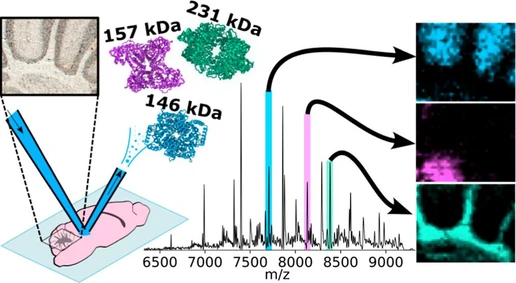
Imaging of Protein Assemblies up to 231 kDa in Tissues with Nano-DESI Mass Spectrometry
Scientific article | Science and research

Imaging of Protein Assemblies up to 231 kDa in Tissues with Nano-DESI Mass Spectrometry

This study extends nano-DESI mass spectrometry imaging to intact protein assemblies up to 231 kDa, enabling direct identification of large complexes in tissue.
News from LabRulezLCMS Library - Week 21, 2026
Article | Application

News from LabRulezLCMS Library - Week 21, 2026

This week we bring you application notes by Agilent Technologies, Metrohm and Shimadzu, technical note by Thermo Fisher Scientific and poster by Waters Corporation!
 

Related articles

Novel MS hyphenated separation methods for complex mixtures of peptides and proteins
Article | Video

Novel MS hyphenated separation methods for complex mixtures of peptides and proteins

Two recently published articles describing the use of advanced separation methods to study complex mixtures of peptides and proteins.
Imaging Large Multiprotein Complexes Using Native Nano DESI Mass Spectrometry
Article | Science and research

Imaging Large Multiprotein Complexes Using Native Nano DESI Mass Spectrometry

Prof. Helen Cooper from the University of Birmingham shared new insights into imaging large multiprotein complexes using native nano-DESI mass spectrometry.
Imaging of Protein Assemblies up to 231 kDa in Tissues with Nano-DESI Mass Spectrometry
Scientific article | Science and research

Imaging of Protein Assemblies up to 231 kDa in Tissues with Nano-DESI Mass Spectrometry

This study extends nano-DESI mass spectrometry imaging to intact protein assemblies up to 231 kDa, enabling direct identification of large complexes in tissue.
News from LabRulezLCMS Library - Week 21, 2026
Article | Application

News from LabRulezLCMS Library - Week 21, 2026

This week we bring you application notes by Agilent Technologies, Metrohm and Shimadzu, technical note by Thermo Fisher Scientific and poster by Waters Corporation!
 

Related articles

Novel MS hyphenated separation methods for complex mixtures of peptides and proteins
Article | Video

Novel MS hyphenated separation methods for complex mixtures of peptides and proteins

Two recently published articles describing the use of advanced separation methods to study complex mixtures of peptides and proteins.
Imaging Large Multiprotein Complexes Using Native Nano DESI Mass Spectrometry
Article | Science and research

Imaging Large Multiprotein Complexes Using Native Nano DESI Mass Spectrometry

Prof. Helen Cooper from the University of Birmingham shared new insights into imaging large multiprotein complexes using native nano-DESI mass spectrometry.
Imaging of Protein Assemblies up to 231 kDa in Tissues with Nano-DESI Mass Spectrometry
Scientific article | Science and research

Imaging of Protein Assemblies up to 231 kDa in Tissues with Nano-DESI Mass Spectrometry

This study extends nano-DESI mass spectrometry imaging to intact protein assemblies up to 231 kDa, enabling direct identification of large complexes in tissue.
News from LabRulezLCMS Library - Week 21, 2026
Article | Application

News from LabRulezLCMS Library - Week 21, 2026

This week we bring you application notes by Agilent Technologies, Metrohm and Shimadzu, technical note by Thermo Fisher Scientific and poster by Waters Corporation!
 

Related articles

Novel MS hyphenated separation methods for complex mixtures of peptides and proteins
Article | Video

Novel MS hyphenated separation methods for complex mixtures of peptides and proteins

Two recently published articles describing the use of advanced separation methods to study complex mixtures of peptides and proteins.
Imaging Large Multiprotein Complexes Using Native Nano DESI Mass Spectrometry
Article | Science and research

Imaging Large Multiprotein Complexes Using Native Nano DESI Mass Spectrometry

Prof. Helen Cooper from the University of Birmingham shared new insights into imaging large multiprotein complexes using native nano-DESI mass spectrometry.
Imaging of Protein Assemblies up to 231 kDa in Tissues with Nano-DESI Mass Spectrometry
Scientific article | Science and research

Imaging of Protein Assemblies up to 231 kDa in Tissues with Nano-DESI Mass Spectrometry

This study extends nano-DESI mass spectrometry imaging to intact protein assemblies up to 231 kDa, enabling direct identification of large complexes in tissue.
News from LabRulezLCMS Library - Week 21, 2026
Article | Application

News from LabRulezLCMS Library - Week 21, 2026

This week we bring you application notes by Agilent Technologies, Metrohm and Shimadzu, technical note by Thermo Fisher Scientific and poster by Waters Corporation!