Non-destructive identification of prehistoric adhesives by HS-GC×GC-TOFMS (Anika Lokker, MDCW 2023)

Th, 18.1.2024 | Original article from: The Multidimensional Chromatography (MDC) Workshop
Identification of prehistoric adhesives on stone tools is valuable as it might reveal something about tool use and human behaviour.
  • Photo: Non-destructive identification of prehistoric adhesives by HS-GC×GC-TOFMS (Anika Lokker, MDCW 2023)
  • Video: LabRulez: Anika Lokker: Non-destructive identification of prehistoric adhesives by HS-GC×GC-TOFMS (MDCW 2023)
  • 🎤 Presenter: Anika Lokker¹, Pierre-Hugues Stefanuto², Ronè Oberholtzer², Dries Cnuts², Veerle Rots², Jean-François Focant² (¹University of liège, liège, Belgium. ²University of liège, Liège, Belgium)

Abstract

Identification of prehistoric adhesives on stone tools is valuable as it might reveal something about tool use and human behaviour. Currently, prehistoric glues are chemically analysed by gas chromatography coupled to mass spectrometer (GC-MS) which requires extraction and derivatization of the residues¹.

This is a major drawback as it is destructive for the glue and often, the required amount is not present. Moreover, the adhesives cover a wide range of materials (e.g., resin,animal glue, gum). Therefore, sensitive, universal, and non-destructive identification methods are needed. Headspace solid phase micro-extraction (HS-SPME) in combination with GC-MS and with comprehensive GC-time-of-flight mass spectrometer (HS-SPME-GCxGC-TOFMS) has been proposed²´³.

HS-SPME requires no extraction and derivatization, it is therefore a good opportunity for the chemical identification of prehistoric glues. Moreover, GCxGC-TOFMS has more peak capacity and is more sensitive than GC-MS³. But sensitivity remains a problem, therefore we investigated a different headspace method; dynamic headspace (DHS) coupled to GCxGC-TOFMS.

The DHS method is optimized and validated via design of experiment on pine resin and hide glue. Subsequently, the method is tested on several different adhesives and compared to SPME-GCxGC-TOFMS.

(1.) D. Cnuts, K. A. Perrault, P. H. Stefanuto, L. M. Dubois, J. F. Focant, and V. Rots, Archaeometry, 2018, 60, 1361.
(2.) M. Regert, V. Alexandre, N. Thomas, and A. Lattuati-Derieux, J. Chromatogr. A, 2006, 1101, 245.
(3.) K. A. Perrault, P. H. Stefanuto, L. Dubois, D. Cnuts, V. Rots, and J. F. Focant, Separations, 2016, 3, 8.

The Multidimensional Chromatography Workshop
LinkedIn Logo
 

Related articles

Lipid profiling of boar tainted and untainted pig plasma using GC×GC-TOFMS (Kinjal Bhatt, MDCW 2023)
Presentation | Video

Lipid profiling of boar tainted and untainted pig plasma using GC×GC-TOFMS (Kinjal Bhatt, MDCW 2023)

The aim of work was to understand the difference between boar-tainted (BT) pigs and untainted (UT) pigs based on the fatty acid profiling of pig serum using (GC×GC-TOFMS).
Chromatographic fingerprint by combining headspace, SPME, and GC×GC (Steven Mascrez, MDCW 2023)
Presentation | Video

Chromatographic fingerprint by combining headspace, SPME, and GC×GC (Steven Mascrez, MDCW 2023)

We present the combination of Vac-SPME and MC-SPME into Vac-MC-SPME, along with the enhanced separation capability provided by GC×GC and advanced tile-based data handling.
Sensory-classified roasted arabica coffee with GC×GC-TOFMS and chemometrics (Caitlin Cain, MDCW 2024)
Presentation | Video

Sensory-classified roasted arabica coffee with GC×GC-TOFMS and chemometrics (Caitlin Cain, MDCW 2024)

This work develops a volatile fingerprint of potato taste defect (PTD) in roasted arabica coffee using HS-SPME-GC×GC-TOFMS and chemometrics.
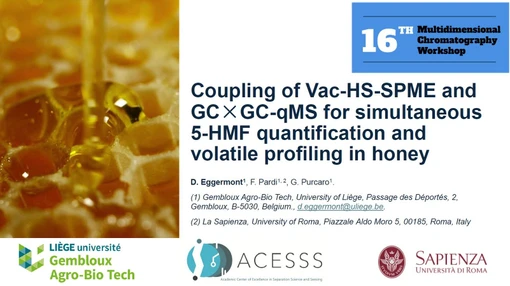
Vac-HS-SPME & GC×GC-qMS for 5-HMF quant. & volatile profiling in honey (Damien Eggermont, MDCW 2025)
Presentation | Video

Vac-HS-SPME & GC×GC-qMS for 5-HMF quant. & volatile profiling in honey (Damien Eggermont, MDCW 2025)

Vac-HS-SPME/GC×GC-qMS enables sensitive 5-HMF quantification and volatile profiling in honey, offering higher yield, better green metrics, and broader analytical capabilities.
 

Related articles

Lipid profiling of boar tainted and untainted pig plasma using GC×GC-TOFMS (Kinjal Bhatt, MDCW 2023)
Presentation | Video

Lipid profiling of boar tainted and untainted pig plasma using GC×GC-TOFMS (Kinjal Bhatt, MDCW 2023)

The aim of work was to understand the difference between boar-tainted (BT) pigs and untainted (UT) pigs based on the fatty acid profiling of pig serum using (GC×GC-TOFMS).
Chromatographic fingerprint by combining headspace, SPME, and GC×GC (Steven Mascrez, MDCW 2023)
Presentation | Video

Chromatographic fingerprint by combining headspace, SPME, and GC×GC (Steven Mascrez, MDCW 2023)

We present the combination of Vac-SPME and MC-SPME into Vac-MC-SPME, along with the enhanced separation capability provided by GC×GC and advanced tile-based data handling.
Sensory-classified roasted arabica coffee with GC×GC-TOFMS and chemometrics (Caitlin Cain, MDCW 2024)
Presentation | Video

Sensory-classified roasted arabica coffee with GC×GC-TOFMS and chemometrics (Caitlin Cain, MDCW 2024)

This work develops a volatile fingerprint of potato taste defect (PTD) in roasted arabica coffee using HS-SPME-GC×GC-TOFMS and chemometrics.
Vac-HS-SPME & GC×GC-qMS for 5-HMF quant. & volatile profiling in honey (Damien Eggermont, MDCW 2025)
Presentation | Video

Vac-HS-SPME & GC×GC-qMS for 5-HMF quant. & volatile profiling in honey (Damien Eggermont, MDCW 2025)

Vac-HS-SPME/GC×GC-qMS enables sensitive 5-HMF quantification and volatile profiling in honey, offering higher yield, better green metrics, and broader analytical capabilities.
 

Related articles

Lipid profiling of boar tainted and untainted pig plasma using GC×GC-TOFMS (Kinjal Bhatt, MDCW 2023)
Presentation | Video

Lipid profiling of boar tainted and untainted pig plasma using GC×GC-TOFMS (Kinjal Bhatt, MDCW 2023)

The aim of work was to understand the difference between boar-tainted (BT) pigs and untainted (UT) pigs based on the fatty acid profiling of pig serum using (GC×GC-TOFMS).
Chromatographic fingerprint by combining headspace, SPME, and GC×GC (Steven Mascrez, MDCW 2023)
Presentation | Video

Chromatographic fingerprint by combining headspace, SPME, and GC×GC (Steven Mascrez, MDCW 2023)

We present the combination of Vac-SPME and MC-SPME into Vac-MC-SPME, along with the enhanced separation capability provided by GC×GC and advanced tile-based data handling.
Sensory-classified roasted arabica coffee with GC×GC-TOFMS and chemometrics (Caitlin Cain, MDCW 2024)
Presentation | Video

Sensory-classified roasted arabica coffee with GC×GC-TOFMS and chemometrics (Caitlin Cain, MDCW 2024)

This work develops a volatile fingerprint of potato taste defect (PTD) in roasted arabica coffee using HS-SPME-GC×GC-TOFMS and chemometrics.
Vac-HS-SPME & GC×GC-qMS for 5-HMF quant. & volatile profiling in honey (Damien Eggermont, MDCW 2025)
Presentation | Video

Vac-HS-SPME & GC×GC-qMS for 5-HMF quant. & volatile profiling in honey (Damien Eggermont, MDCW 2025)

Vac-HS-SPME/GC×GC-qMS enables sensitive 5-HMF quantification and volatile profiling in honey, offering higher yield, better green metrics, and broader analytical capabilities.
 

Related articles

Lipid profiling of boar tainted and untainted pig plasma using GC×GC-TOFMS (Kinjal Bhatt, MDCW 2023)
Presentation | Video

Lipid profiling of boar tainted and untainted pig plasma using GC×GC-TOFMS (Kinjal Bhatt, MDCW 2023)

The aim of work was to understand the difference between boar-tainted (BT) pigs and untainted (UT) pigs based on the fatty acid profiling of pig serum using (GC×GC-TOFMS).
Chromatographic fingerprint by combining headspace, SPME, and GC×GC (Steven Mascrez, MDCW 2023)
Presentation | Video

Chromatographic fingerprint by combining headspace, SPME, and GC×GC (Steven Mascrez, MDCW 2023)

We present the combination of Vac-SPME and MC-SPME into Vac-MC-SPME, along with the enhanced separation capability provided by GC×GC and advanced tile-based data handling.
Sensory-classified roasted arabica coffee with GC×GC-TOFMS and chemometrics (Caitlin Cain, MDCW 2024)
Presentation | Video

Sensory-classified roasted arabica coffee with GC×GC-TOFMS and chemometrics (Caitlin Cain, MDCW 2024)

This work develops a volatile fingerprint of potato taste defect (PTD) in roasted arabica coffee using HS-SPME-GC×GC-TOFMS and chemometrics.
Vac-HS-SPME & GC×GC-qMS for 5-HMF quant. & volatile profiling in honey (Damien Eggermont, MDCW 2025)
Presentation | Video

Vac-HS-SPME & GC×GC-qMS for 5-HMF quant. & volatile profiling in honey (Damien Eggermont, MDCW 2025)

Vac-HS-SPME/GC×GC-qMS enables sensitive 5-HMF quantification and volatile profiling in honey, offering higher yield, better green metrics, and broader analytical capabilities.