Fr, 13.11.2026 15:30 CET
Ensure beer consistency and clarity with Thermo Scientific! Combine industrial filtration and UV-Vis methods to accurately measure IBU, color, and VDKs.Go to the webinar
Great beer starts with consistency. From fermentation through to the finished product, brewers rely on robust process monitoring and quality control strategies to ensure every batch meets expectations for taste, appearance, and stability.
Filtration and analytical testing play essential roles throughout the brewing workflow, helping breweries remove unwanted particulates, improve clarity, monitor product quality, and minimise the risk of contamination. As production demands increase, having reliable methods to assess critical quality parameters becomes increasingly important.
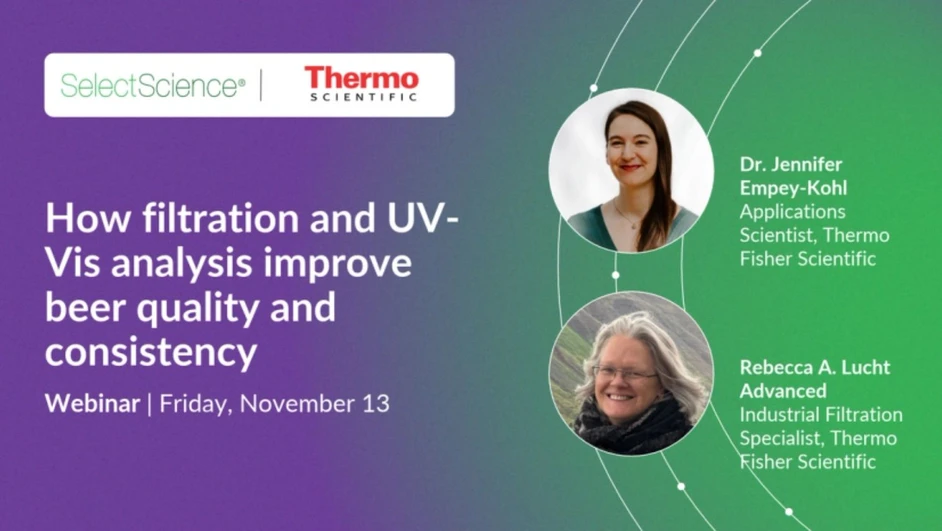
In this SelectScience® webinar, Dr. Jennifer Empey-Kohl, Applications Scientist and Rebecca Lucht, Advanced Industrial Filtration Specialist at Thermo Fisher Scientific, will demonstrate how filtration technologies and UV-Visible (UV-Vis) spectrophotometry can support quality assurance across the brewing process.
Discover how brewers use these techniques to assess key quality parameters, including bitterness (International Bitterness Units, IBU), beer colour, and vicinal diketones (VDKs), while improving product clarity, reducing contamination risks, and supporting consistent beer quality from fermentation through to the finished product.
If you attend the live webinar, you will automatically receive a certificate of attendance, including a learning outcomes summary, for continuing education purposes.
If you view the on-demand webinar, you can request a certificate of attendance by emailing [email protected].
This event is perfect for:
Join the webinar to get answers to these questions:
Presenter: Dr. Jennifer Empey-Kohl (Applications Scientist, Thermo Fisher Scientific)
Dr. Jennifer Empey-Kohl has been with Thermo Fisher Scientific as an Applications Scientist for 5 years where she supports the cuvette-based UV-Visible instruments. Prior to this position, she received her PhD in Chemistry from The Ohio State University where she used various spectroscopic techniques to study colloidal nanoparticles.
Presenter: Rebecca A. Lucht (Advanced Industrial Filtration Specialist, Thermo Fisher Scientific)
Rebecca A. Lucht has been with Thermo Fisher Scientific Filtration and Separation Business for over 25 years. She is currently the Advanced Industrial Filtration Specialist for the Food & Beverage market in Solventum Purification and Filtration Division. Her depth in filtration knowledge is derived from her 24 years of experience in R&D, product development, and now customer application support.
Moderator: Olivia Long (Editorial Team, SelectScience)
Olivia Long is a science editor specializing in pharmaceutical and applied science. She has a BSc in Pharmacology, and an MSc in Neuroscience, where she investigated neuro‑oncology drug‑resistance pathways using patient‑derived cell models. Her laboratory experience spans R&D hygiene testing, controlled‑environment sample production, and protocol development, giving her a broad understanding of analytical workflows and the scientific principles underpinning quality control in food and beverage sectors.