Tu, 3.11.2026 17:00 CET
Join the USP and Waters webinar on antibody-drug conjugate (ADC) analysis. Discover reference standards and inline mass deconvolution in Empower CDS.Go to the webinar
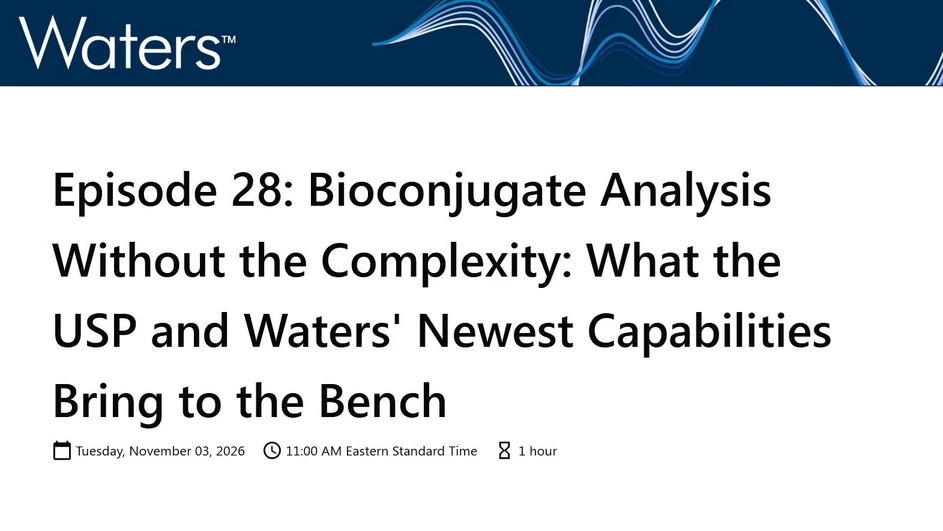
Antibody-drug conjugates are transforming cancer treatment, but their complexity creates real analytical challenges. The linker and payload introduce quality attributes that demand reliable standards and accessible workflows.
In this webinar, experts from USP and Waters explore how fit-for-purpose reference materials and simplified mass detection can work together to make ADC characterization more confident, consistent, and routine, from method development through QC.
The session concludes with a panel discussion, moderated by Samuel Seal, exploring how reference standards and accessible mass detection work together to support bioconjugate analysis across QC, method development, and routine characterization.
This webinar is designed for analytical scientists, QC analysts, method development specialists, and laboratory managers working with antibody-drug conjugates and other bioconjugates in biopharmaceutical development, manufacturing, and quality control.
It will be especially valuable for teams looking to strengthen ADC characterization with reliable reference materials, and for labs that want to bring LC-MS analysis into routine workflows without relying on specialist high-resolution MS expertise. Regulatory and quality professionals interested in emerging standards for complex modalities will also benefit.
Speaker: Rakesh Aithal, Ph.D. (Team Lead, Senior Scientist I, Pipeline Development, Global Biologics, United States Pharmacopeia)
Rakesh Aithal is currently working as a Team Lead, Senior Scientist I in the Pipeline Development Team of Global Biologics at USP. In this role, he works closely with scientific experts and stakeholders to develop physical and documentary standards used to support development and quality assessment of biopharmaceuticals with a major focus on protein therapeutics including monoclonal antibodies and antibody conjugates.
He did his Ph.D. in Biomolecular Chemistry from Masaryk University and worked as a post-doctoral researcher in Cancer Research Center Marseille on the mechanistic understanding of meiotic recombination before transitioning into the biopharmaceutical industry.
He has extensive expertise in a range of analytical methods for protein characterization and molecular biology techniques; and has published several research articles in peer reviewed journals. His expertise includes analytical method development, qualification, and validation along with comparative analytical similarity assessments to support biosimilar development.
Speaker: Henry Foddy (Senior Scientist, Waters Corporation)
Henry is a Senior Scientist in the Pharma Quan team at Waters, working to develop LC-MS and LC-MS/MS applications to support DMPK, regulated bioanalysis, nitrosamine testing and pharmaceutical impurity profiling.
He has over 5 years of experience with Waters, working previously in a food and environmental role support regulatory testing of Pesticides, PFAS, and Pyrrolizidine Alkaloids.
Prior to joining Waters, Henry obtained an MSc in Neuroscience from King’s College London.
Moderated by: Samuel Seal (Biopharma Market Development Manager, Waters Corporation)
Samuel Seal is a market development manager specializing in the biologics space. He loves LC and MS – especially on how this technology provides benefit and value.
Sam joined Waters in January of 2014 as a Sales Technical Support Specialist in the Irvine office/lab. As a TSS he performed demonstrations on various instruments, provided training for customers, often presented on technical information at varying events, and assisted with troubleshooting from Colorado to Los Angeles.
He previously worked at Pyxant Labs in Colorado Springs, CO where he gained extensive experience developing and validating methods for small/large molecules in bioanalytical assays, agricultural commodities, registration of pesticides, and worker exposure studies. He also has experience in column chromatography, sample extraction, sample clean-up, reporting and data management. Sam has hands on experience with running and maintaining various manufacturers' LC/MS/MS systems. Prior to Pyxant, Sam was a Laboratory Instructor at the University of Colorado at Colorado Springs where he earned his Bachelor of Arts in Biology and Bachelor of Arts in Chemistry.