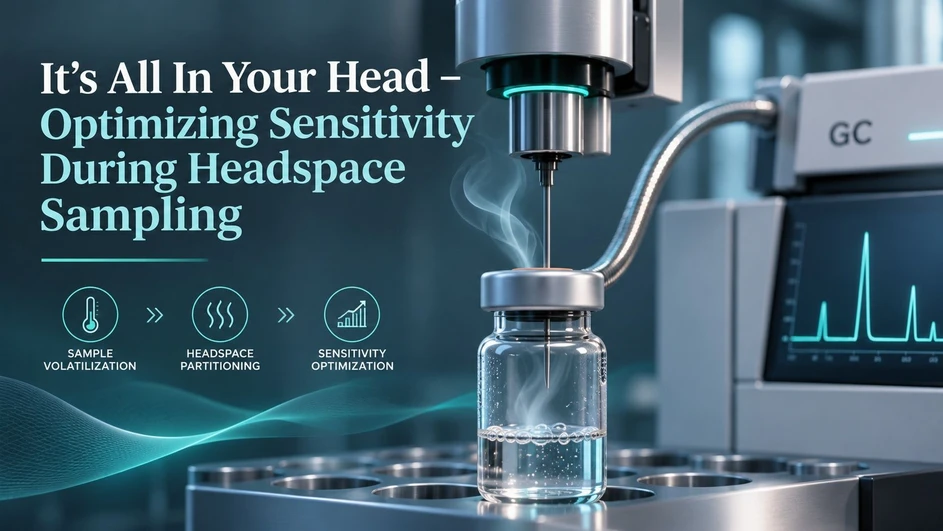
It’s All In Your Head – Optimizing Sensitivity During Headspace Sampling
Th, 26.11.2026 | Original article from: Phenomenex
Explore how solvent selection, headspace sampler temperature settings, and sample additives can improve analyte partitioning into the gas phase and enhance HS-GC sensitivity.
<p><span><strong>LabRulez/AI:</strong></span> It’s All In Your Head – Optimizing Sensitivity During Headspace Sampling</p>

LabRulez/AI: It’s All In Your Head – Optimizing Sensitivity During Headspace Sampling

Headspace sampling during GC analysis is an effective tool with which to evaluate the volatile analytes within an otherwise non-volatile sample. There are many means by which to optimize the volatility of targeted analytes to improve sensitivity during headspace-GC methods. The primary concerns are the choice of sample diluent and the temperature settings for the headspace sampler. Beyond that, we can consider additives with which to encourage analyte volatility.
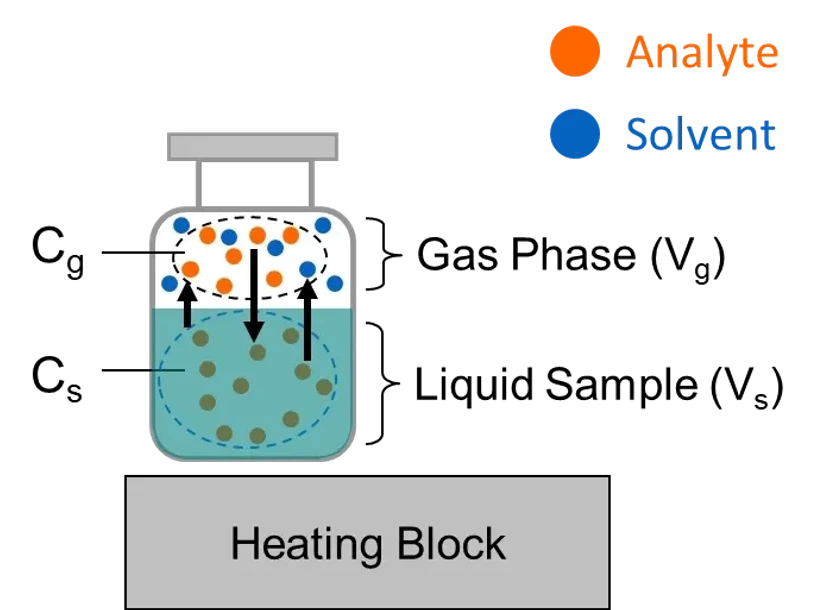
Phenomenex: It’s All In Your Head – Optimizing Sensitivity During Headspace SamplingPhenomenex: It’s All In Your Head – Optimizing Sensitivity During Headspace Sampling

Sample Diluent and Detector Considerations

  • A low-boiling diluent during a residual solvent analysis would overwhelm the headspace volume within the vial and occlude the sensitivity of the GC method towards the analytes.
  • The diluent during a Residual Solvent Analysis should ideally feature a higher boiling point than the targeted analytes. Examples would be DMF, DMSO, or DMI. This will allow the sample to be warmed to a high enough temperature to volatilize the residual solvents of interest. The diluent itself will generate a small peak and will not tail into any analyte peaks. DMSO is a common diluent and is often warmed to 100 °C for 30 min prior to sample injection.
  • If water must be used as a diluent during headspace analysis, limit the vial temperature to 80 – 90 °C and consider a long equilibration time at this temperature, such as 30 – 45 min.
  • The transfer line and sample loop should be warm enough to ensure the volatility of the analytes as they travel towards the injection port of the GC instrument. Temperatures often range 125 – 175 °C, depending on the analytes.

Sample Additives

  • Salts may be added to analytes that are dissolved in water. The water will expend effort to dissolve the salt at the expense of maintaining solubility of any organic substances, allowing them to volatilize more readily. A kosmotropic salt, such as ammonium sulfate, would be ideal to “salt out” targeted analytes, but sodium chloride is also common.
  • Water may be added to samples that are dissolved in a water-miscible organic solvent, such as DMF or DMSO. As with the example above, the targeted analytes will volatilize more readily.
  • Beyond these considerations, be sure to use the proper size for your vial, such that the sample diluent only occupies only a quarter or half of the total volume within the vial. This will avoid contaminating the sampling needle and will provide the space for ample volatilization of the analytes.

Phenomenex
LinkedIn Logo
 

Related articles

News from LabRulezGCMS Library - Week 16, 2025
Article | Application

News from LabRulezGCMS Library - Week 16, 2025

This week we bring you application notes by Agilent Technologies, Shimadzu and poster by University of Copenhagen / MDCW!
Sample Preparation Mastery: Expert Insights on Evaporation Techniques for Chromatography
Interview | Video

Sample Preparation Mastery: Expert Insights on Evaporation Techniques for Chromatography

Discover how rotary, centrifugal and freeze-drying techniques compare in modern sample prep. In this expert interview, Wade explains trade-offs in cost, throughput, analyte integrity and automation.
Static headspace enantioselective comprehensive two-dimensional gas chromatography–time-of-flight mass spectrometry in food analysis: a proof-of-principle study
Scientific article | Science and research

Static headspace enantioselective comprehensive two-dimensional gas chromatography–time-of-flight mass spectrometry in food analysis: a proof-of-principle study

This proof-of-principle study applies static headspace enantioselective GC×GC–TOFMS for solvent-free volatile profiling and chiral analysis in citrus essential oils.
News from LabRulezGCMS Library - Week 27, 2026
Article | Poster

News from LabRulezGCMS Library - Week 27, 2026

This week we bring you application note by Agilent Technologies, presentation by MDCW / William & Mary and posters by Shimadzu and Thermo Fisher Scientific / ASMS!