Tu, 20.10.2026 | Original article from: Thermo Fisher Scientific / Zoe Julian
PFAS analysis now combines targeted quantitation with non-targeted discovery. Chromeleon CDS and Compound Discoverer help reveal known and emerging PFAS and move findings into structured follow-up.PFAS Analysis Beyond the Target List: Connecting Quantitation and Discovery in a Single Workflow

Thermo Fisher Scientific: PFAS Analysis Beyond the Target List: Connecting Quantitation and Discovery in a Single Workflow
Per- and polyfluoroalkyl substances (PFAS) analysis is no longer defined by a fixed list of known compounds.
As regulatory frameworks evolve and scientific understanding deepens, laboratories are being asked to go beyond routine testing. In addition to quantifying known PFAS, they must also investigate unknown, unexpected, and emerging compounds that fall outside predefined target lists.
Thermo Fisher Scientific: PFAS Analysis Beyond the Target List: Connecting Quantitation and Discovery in a Single Workflow
This shift introduces a fundamental analytical challenge.
Targeted quantitation provides robust and validated concentration data for known PFAS. However, by design, it only answers questions about compounds already included in the method. In contrast, non-targeted analysis, using high-resolution accurate-mass (HRAM) data, enables scientists to explore the broader chemical landscape, revealing additional PFAS that were not included in a targeted quantitation method.
For PFAS, where thousands of structurally related compounds and transformation products may be present, neither approach alone provides a complete picture.
The real challenge lies in connecting these workflows. Discovery findings must be translated into actionable results that can be reviewed, followed up, and reported within a controlled analytical framework.
In a previous blog post, we introduced how Thermo Scientific Compound Discoverer software and Thermo Scientific Chromeleon Chromatography Data System (CDS) connect discovery and routine workflows. Here, we explore what that connection looks like in practice using PFAS analysis as an example.
Why PFAS requires more than one analytical question
PFAS represent a large and diverse class of compounds, with some estimates exceeding 40,000 individual substances. Regulatory methods typically focus on a limited subset, yet environmental and biological samples often contain many more PFAS, including precursors and transformation products.
This creates two essential and complementary analytical questions:
How much of these known PFAS are present?
and
What other PFAS-related compounds might be present?
A complete workflow needs to support both questions.
Starting with targeted quantitation
For known PFAS, targeted quantitation remains the backbone of routine analysis.
Chromeleon CDS provides a controlled environment for data acquisition, processing, calibration, and reporting. In a PFAS workflow, this supports routine quantitation of predefined targets using laboratory-specific method and review criteria.
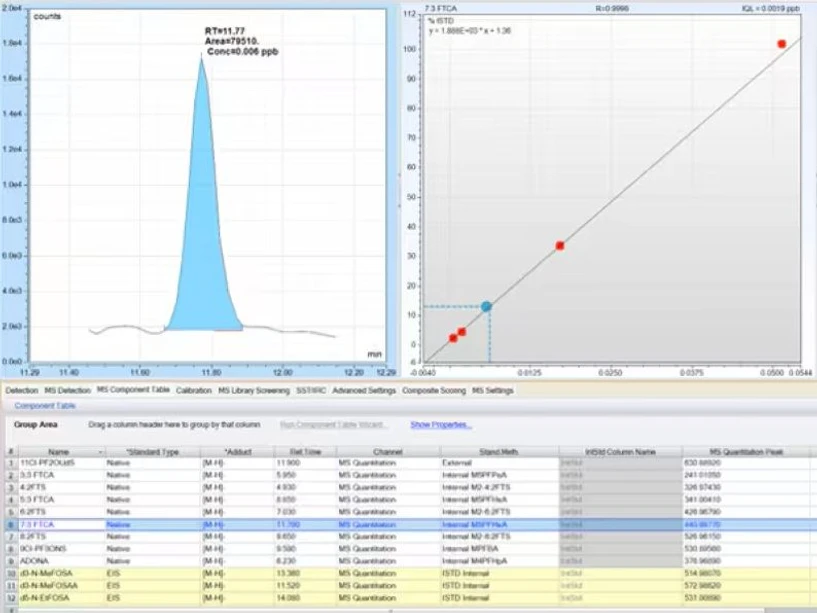 Thermo Fisher Scientific: PFAS Analysis Beyond the Target List: Connecting Quantitation and Discovery in a Single Workflow: Figure 1. Targeted quantitation of known PFAS in Chromeleon CDS. This example is from the analysis of PFAS using a Thermo Scientific Orbitrap Exploris 240. Here we are showing the calibration curve (right) and extracted ion chromatogram (left) of 7:3 FTCA at 6 ng/L. The bottom half shows the processing method that contains many target PFAS and isotopically-labelled internal standards.
This targeted workflow is essential, but it is only part of the story. A sample may contain PFAS-related compounds not included in the original method.
Looking beyond known PFAS
Once HRAM data have been acquired, the same dataset can be explored beyond the target list using Compound Discoverer software. This enables comprehensive analysis of complex datasets, including:
- Detection and alignment of unknown features
- Statistical comparison across samples and blanks
- Spectral library searching and database annotation
- Evaluation of isotope patterns, fragmentation, and homologous series
For PFAS, this is particularly valuable. The software can leverage characteristic properties such as negative mass defect, CF₂-based homologous series, and diagnostic fragment ions to prioritize PFAS-related candidates and assign confidence to putative identifications.
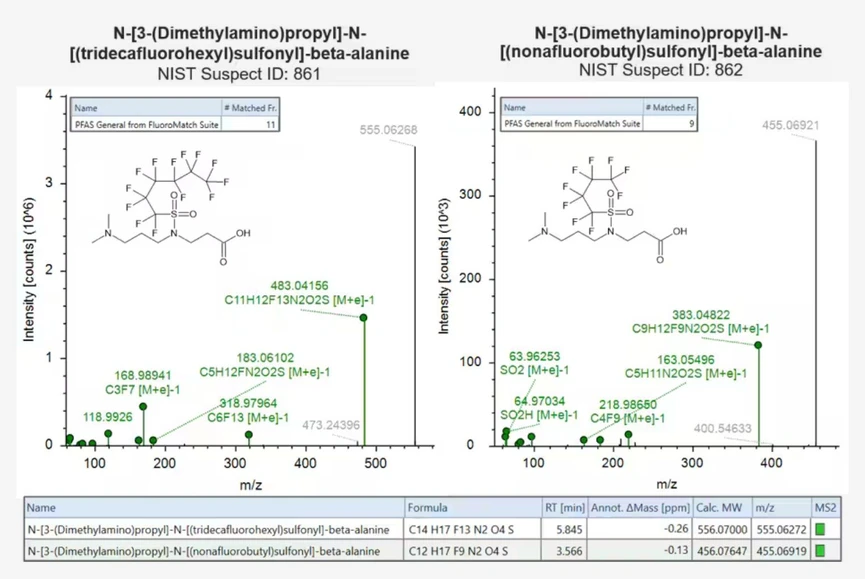 Thermo Fisher Scientific: PFAS Analysis Beyond the Target List: Connecting Quantitation and Discovery in a Single Workflow: Figure 2. Discovery of additional PFAS-related components in Compound Discoverer software. Here we show an example of using PFAS fragment libraries, one of many PFAS-specific resources available within Compound Discoverer software, to annotate fragments within acquired MS2 spectra of two unknown compounds and then identify them as PFAS that were outside the targeted quantitation method.
The goal of discovery is not simply to generate more data. It is to reduce complexity and identify the most relevant candidates for further investigation with a defined level of confidence.
From discovery to follow-up
One of the most important questions in non-targeted analysis is what happens after candidate identification.
Discovery workflows can identify interesting candidates, but those candidates need to move into a practical follow-up process. Scientists may want to monitor them across additional samples, estimate relative or semi-quantitative abundance, trend their presence over time, or include them in a reviewable report.
This is where the connection between Compound Discoverer software and Chromeleon CDS becomes especially valuable.
After PFAS candidates have been prioritized in Compound Discoverer software, selected components can be transferred back into Chromeleon CDS and incorporated into the Chromeleon processing methods for follow-up analysis. This allows scientists to evaluate these compounds within the same controlled environment used for targeted quantitation.
For PFAS analysis, this may support semi-quantitative follow-up for compounds where authentic standards are not yet available. While fully quantitative results require appropriate standards and validated methods, semi-quantitative workflows can provide useful estimates or relative comparisons to help prioritize further investigation.
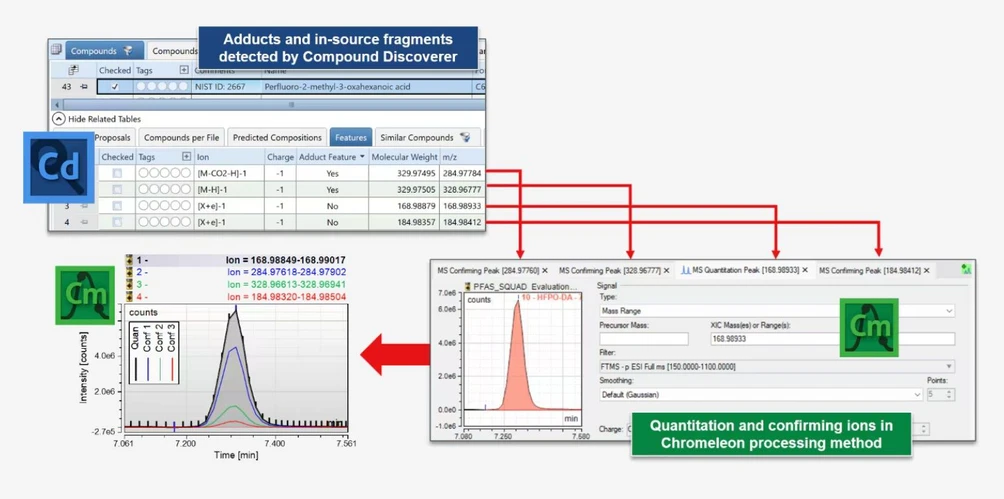 Thermo Fisher Scientific: PFAS Analysis Beyond the Target List: Connecting Quantitation and Discovery in a Single Workflow: Figure 3. Prioritized PFAS candidates brought back into Chromeleon CDS for follow-up. Prioritized PFAS candidates from Compound Discoverer software can be brought back into Chromeleon CDS for follow-up review, semi-quantitative evaluation, and controlled reporting.
This is the key workflow advantage: discovery does not stop at identification. It can feed directly into a practical analytical process.
Why this matters
PFAS analysis increasingly requires laboratories to balance routine testing with exploratory investigation.
A connected workflow between Chromeleon CDS and Compound Discoverer software supports this by:
- Combining targeted quantitation and non-targeted discovery to characterize samples more completely
- Reducing manual data transfer and workflow fragmentation
- Enabling discovery results to be reviewed and reported within a controlled CDS environment
- Supporting investigation of emerging PFAS investigations without immediate method redevelopment
- Bridging research-driven insights with routine analytical workflows
This reflects a broader shift in analytical science, where the value lies not only in generating data, but in connecting workflows and turning data into actionable information.
Moving PFAS analysis forward
PFAS analysis is evolving from a fixed target list toward a more comprehensive understanding of complex chemical mixtures.
Laboratories must quantify known compounds while remaining prepared to identify and evaluate what lies beyond them.
By connecting Compound Discoverer software with Chromeleon CDS, laboratories can move seamlessly from targeted quantitation to discovery and into structured follow-up. The result is a more complete view of PFAS contamination and a more efficient path from data to insight.
Learn more
Explore how Compound Discoverer software and Chromeleon CDS can help connect targeted quantitation and non-targeted discovery workflows for PFAS analysis.
Visit us on LinkedIn: #PFAS #Chromeleon #CompoundDiscoverer #Environmental